Global Home Gym Equipment Market Poised for Growth as Smart Technology and Regional Expansion Take Center Stage
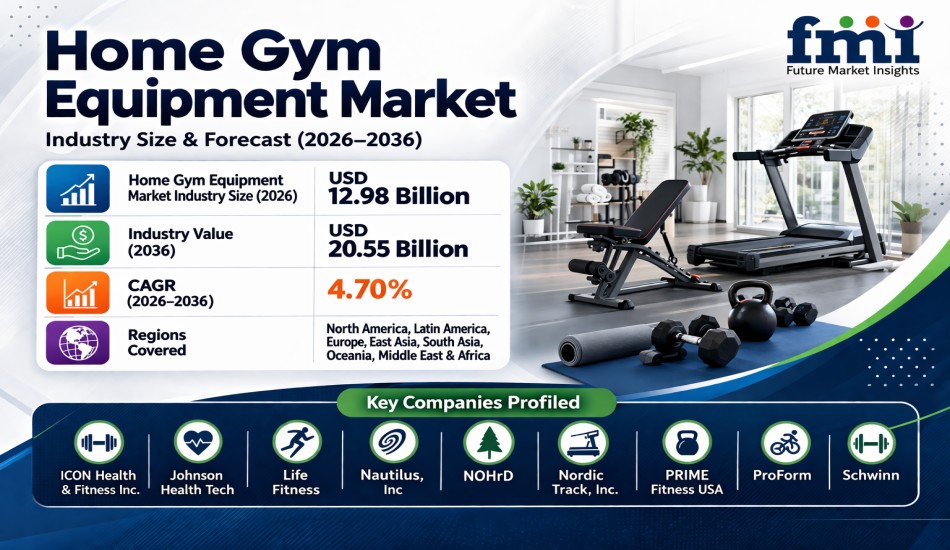
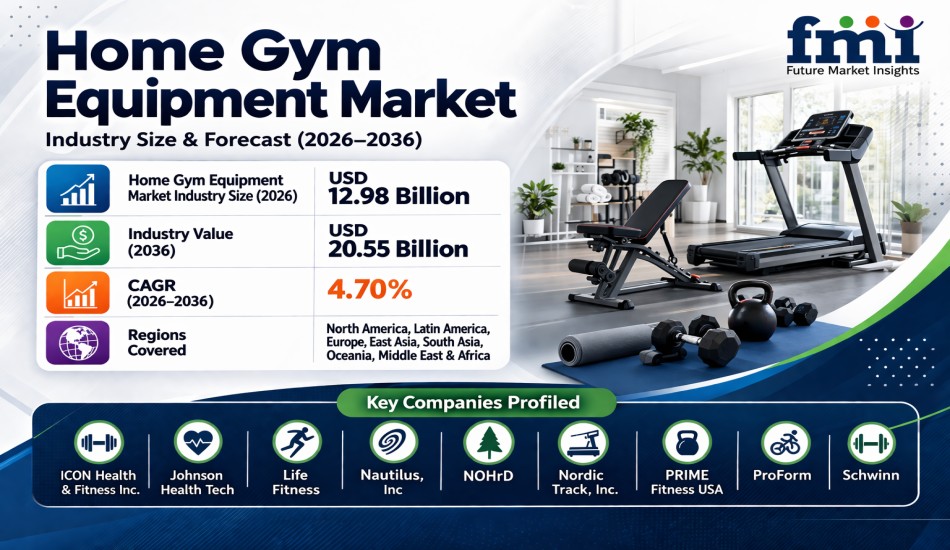
NEWARK, DE / ACCESS Newswire / April 8, 2026 / The global home gym equipment market, as analyzed by Future Market Insights (FMI), was valued at USD 12.40 billion in 2025 and is projected to reach USD 12.98 billion in 2026. The market is expected to expand steadily to USD 20.55 billion by 2036, registering a CAGR of 4.70% over the forecast period. According to FMI, the total incremental opportunity between 2026 and 2036 is estimated at USD 7.57 billion, driven by growing consumer preference for flexible, home-based workouts, increased adoption of smart connected equipment, and evolving global supply chain dynamics.
Get Access of Report Sample: https://www.futuremarketinsights.com/reports/sample/rep-gb-23532
Market Snapshot
Global Market Size (2025): USD 12.40 Billion
Estimated Market Size (2026): USD 12.98 Billion
Projected Market Value (2036): USD 20.55 Billion
Compound Annual Growth Rate (CAGR): 4.70%
Incremental Opportunity (2026-2036): USD 7.57 Billion
Leading Segments: Cardiovascular training equipment (volume and revenue share), smart connected fitness equipment
Geographic Growth Leaders: China, India, Germany, France, United Kingdom, United States, Brazil
Key Demand Drivers
Shift to Home-Based Fitness: Consumers are increasingly seeking flexible workout schedules that eliminate commuting to gyms.
Smart Connected Equipment: Devices with integrated screens, subscription-based streaming classes, and real-time performance tracking are driving higher average selling prices and recurring revenue models.
Space-Efficient Solutions: Compact, multifunctional equipment designed for urban apartments is boosting adoption.
Rising Health Awareness: The post-pandemic lifestyle change toward wellness and preventive health is sustaining demand globally.
Segment Analysis
By Equipment Type
Cardiovascular Training Equipment (treadmills, stationary bikes, ellipticals, rowers) leads with a 63% revenue share in 2026, driven by broad appeal, smaller space requirements, and integration with smart technology.
Strength Training Equipment includes free weights, cable machines, and multi-gyms, showing steady growth but limited by space constraints.
By Category
Smart Equipment dominates with 54% market share in 2026, fueled by personalized virtual training, wearable integration, and app connectivity.
Conventional Equipment faces price pressure and margin compression as the market shifts toward connected solutions.
By Price Range
Medium-tier equipment holds 46% revenue share, balancing affordability, advanced features, and space efficiency.
High/Premium and Low-tier segments cater to specialized or budget-conscious buyers, respectively.
By Distribution Channel
Online Channels are increasingly important in urban regions with e-commerce penetration.
Offline Channels remain vital for experiential trials of smart equipment and premium machines.
Regional Outlook
China
6.3%
Rapid urbanization, rising middle-class adoption, and domestic smart equipment production drive growth.
India
5.9%
Increasing urban fitness awareness and online distribution channels boost adoption.
Germany
5.4%
Established home fitness culture and premium equipment preference sustain growth.
France
4.9%
Connected equipment adoption and wellness trends support steady growth.
UK
4.5%
Digital fitness platforms and self-care trends drive home gym purchases.
USA
4.0%
Largest value market with high smart equipment penetration and subscription model adoption.
Brazil
3.5%
Expanding fitness participation fuels moderate growth.
Supply Chain Dynamics
Manufacturers: ICON Health & Fitness Inc., Johnson Health Tech, Life Fitness, Nautilus, Inc., Technogym, PELOTON, Tonal Systems.
Suppliers: Component suppliers provide electronics (screens, sensors), mechanical parts (treadmill belts, resistance mechanisms), and software integrations.
Distribution: Products are supplied to retailers, e-commerce platforms, and direct-to-consumer channels. Smart equipment often integrates with third-party content providers for subscription-based virtual classes.
Pricing Trends
Premium smart equipment commands higher ASP due to software integration and connected services.
Medium-tier equipment dominates volume, balancing affordability and feature richness.
Conventional equipment faces price deflation as commoditization increases.
Competitive Landscape
Key players differentiate via product innovation, smart connectivity, and subscription-based ecosystems:
ICON Health & Fitness Inc. – NordicTrack, ProForm, FreeMotion (interactive cardio and strength machines).
PELOTON – Connected bikes with live and on-demand classes.
Technogym – High-end home and commercial fitness equipment.
Tonal Systems – Digital strength training with AI-enabled resistance.
Johnson Health Tech – BowFlex and Horizon Fitness treadmills and strength systems.
Barriers to Entry: High production costs, strong brand loyalty, technology integration requirements, and partnerships with content providers.
Key Trends, Risks, and Opportunities
Trends:
Growth of virtual training platforms and app-integrated devices.
Compact and multifunctional designs catering to urban consumers.
Expansion of subscription-based revenue models.
Risks:
High initial costs and residential space limitations.
Margin pressure on conventional equipment without smart features.
Investment Opportunities:
Development of connected fitness ecosystems with subscription services.
Expansion of online retail and experiential offline showrooms.
Partnerships with content providers for equipment-agnostic virtual fitness programs.
Analyst Commentary
Principal Consultant, FMI:
The market is bifurcating between conventional equipment facing price deflation and smart connected platforms commanding premium pricing. Manufacturers without integrated fitness software risk margin compression as traditional equipment becomes commoditized. Strategic investment in subscription-enabled smart devices is essential for long-term growth.
Future Outlook
The home gym equipment market is expected to sustain steady double-digit growth in Asia and moderate growth in developed markets through 2036. Smart connectivity, health-conscious consumer behavior, and space-efficient solutions will continue to define competitive success. The market presents significant investment opportunities in connected fitness platforms, digital content partnerships, and urban-focused product design.
For an in-depth analysis of evolving formulation trends and to access the complete strategic outlook for the Home Gym Equipment Market through 2036, visit the official report page at: https://www.futuremarketinsights.com/reports/home-gym-equipment-market
Browse More Consumer Product Industry Reports:
About Future Market Insights (FMI)
Future Market Insights (FMI) is a leading provider of market intelligence and consulting services, serving clients in over 150 countries. Headquartered in Delaware, USA, with a global delivery center in India and offices in the UK and UAE, FMI delivers actionable insights to businesses across industries including automotive, technology, consumer products, manufacturing, energy, and chemicals.
An ESOMAR-certified research organization, FMI provides custom and syndicated market reports and consulting services, supporting both Fortune 1,000 companies and SMEs. Its team of 300+ experienced analysts ensures credible, data-driven insights to help clients navigate global markets and identify growth opportunities.
For Press & Corporate Inquiries
Rahul Singh
AVP – Marketing and Growth Strategy
Future Market Insights, Inc.
+91 8600020075
For Sales – sales@futuremarketinsights.com
For Media – Rahul.singh@futuremarketinsights.com
For web – https://www.futuremarketinsights.com/
SOURCE: Future Market Insights, Inc.
View the original press release on ACCESS Newswire