“Hearst Magazines and Yahoo may earn commission or revenue on some items through these links.”
LATE LAST YEAR a PR company pitched me a wellness product that, quoting from their press release, “offer[ed] a rich, velvety on-the-go energy boost, crafted from 100% Hawaiian-grown Kona coffee beans, velvety cacao, and Guarana.”
So, candy. With guarana.
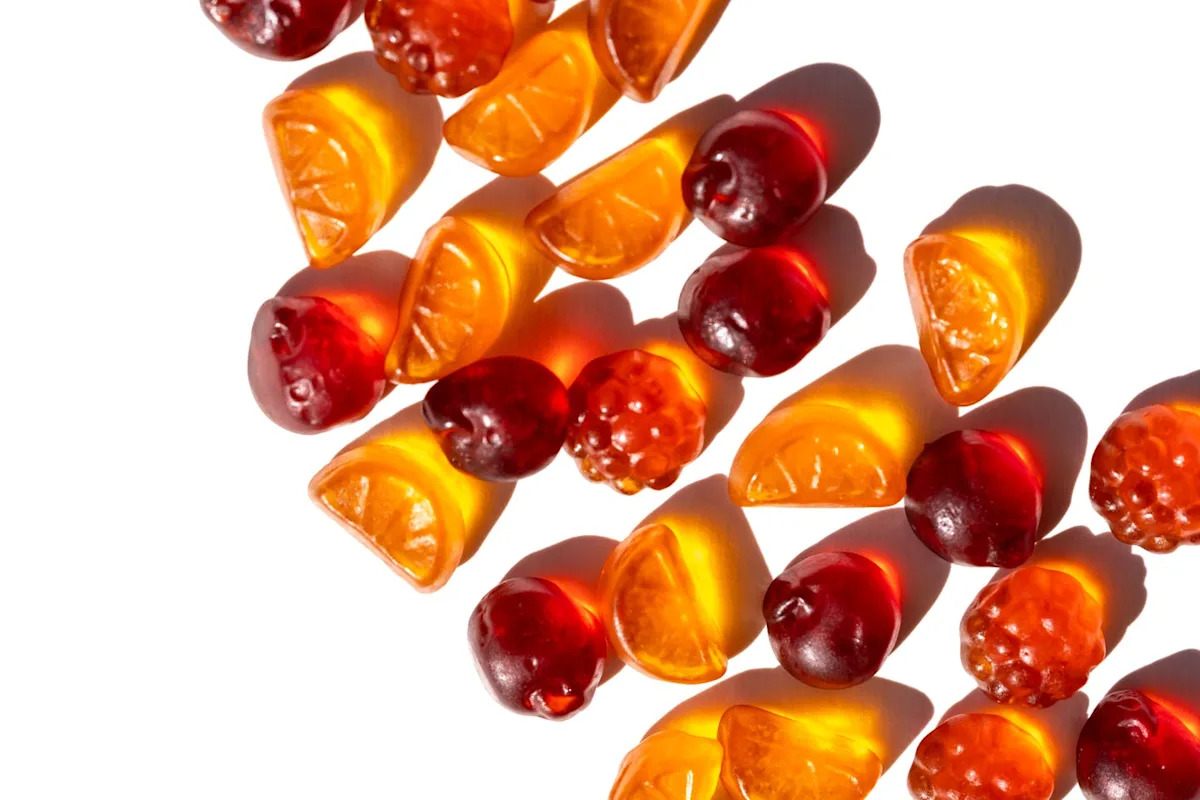
Melatonin-laced gummy bears, collagen-loaded chewables, reishi-mushroom-infused chocolates—there’s a slew of this stuff on the market. So much so that industry types are calling this booming sweets-meet-supplements category “candyceuticals.” Entire companies, like Funtrition (!) are developing product lines around the concept that gummies taste as amazing as they make you feel and pills are for boring old grandparents.
As you’re probably guessing, there’s a ton of money to be made in this space. A recent ADM summary titled (no lie) “Science-backed gummy goodness” rounded up data on what it called the “burgeoning gummy supplement market.” By 2028, this market is projected to reach $48.5 billion, outpacing capsules and tablets.
If you wanted to credit (or blame) anyone, you could pin this rise on certain generations. “Millennials and Gen Z are at the forefront of this gummy revolution, with 30% and 38%, respectively, favoring gummies over traditional formats,” the ADM summary stated. (By “traditional formats” they mean pills for Centrum Silver crowd.)
Then there’s the really interesting part: “Millennials and Gen Z not only display the strongest affinity for gummy supplements but also exhibit the most polarizing aversion to tablet formats.”
A polarizing aversion to tablet formats!
Millennials and Gen Z, technically, are adults. So why are they eating their multivitamins—not to mention their creatine, B-12, beetroot, and even their greens—like they were kids?
We know that COVID launched a modern supplement boom that we’re still in the middle of. And we also know that supplement companies are all fighting for their share of the cash pile with splashy Wonkaesque marketing (guarana-infused, chocolate-covered coffee beans). But, still, there are other larger cultural factors at work.
The real kicker to this whole candyceuticals phenomenon is that some dietitians believe these products might actually be more candy than true supplement.
So, Why Is Every Supplement Now a Gummy?
There are plenty of underlying factors, says Emily Contois, PhD, who studies popular culture and nutrition at The University of Tulsa.
The first is that in terms of the candy category, gummies are gaining ground on traditional chocolate. Gen Z is eating up gummy candies (ahem, Nerds Gummy Clusters) because they’re seen as cheaper than chocolate, lower in guilt, and tailor-made for social media in all their bright-hued squishiness.
But there’s also a nostalgic factor for Millennials, Contois says. “With (at least elder) millennials, gummies (more broadly) run a bit deeper because most of the big fruit gummy snacks/treats (fruit snacks, Gushers, fruit roll ups, Fruit by the Foot, etc.) were developed for our childhoods, coming to market in the 1980s and 1990s.” Why swallow a forgettable capsule when you can recreate the joy of your youth via gummy form?
There’s also a track record of success for gummies outside the candy world. After California kickstarted the legalization of weed roughly 20 years ago, THC/CBD gummies provided an alternative to smoking or vaping weed. Plus, “as concerns about sleep have become quite commonplace, too, I feel like everyone is talking about taking their melatonin gummy before bed,” Contois says.
And then there’s a health halo around gummies that feels almost counter-intuitive. “Gummies might feel to some consumers like food and a ‘healthy’ treat, while pills/tablets feel more straightforwardly like medicine,” says Contois. “Depending upon the consumer, they might feel inclined to avoid a medical view of supplements, but be open to one that’s about wellness or recreation or performance.”
That perception may also extend to less mainstream supplements, such as creatine, which long held the reputation of being a hush-hush, steroid-adjacent bodybuilding substance. Now, you don’t even need to visit a supplement store to pick up a tub of creatine. You can buy pack of creatine-infused gummies online and have them shipped directly to your door. It’s better health, delivered with less hassle, and packaged as a “treat.” Or at least that’s how gummy supplements are being marketed.
But the big question is whether these supplements actually deliver on that “better health” claim.
Are Gummy Supplements Healthier Than Other Supplements?
Well, right now, probably not.
“Gummy supplements are often made with sugar, which pills most often aren’t,” says Abby Langer, RD, a Men’s Health Nutrition Advisor and author Good Food, Bad Diet. Now, it’s not a ton of added sugar, but consider some creatine gummies, which contain 1 gram of sugar per chew—but you need to take five chews to reach the minimum effective dosage. That’s 5 grams of added sugar daily—35 grams of added sugar per week—that wasn’t there before. Again, not a huge deal. But sort of a medium deal.
Then there are the issues that gummies can also be less potent, contain less of their active ingredients, and they can be missing certain nutrients that don’t work in gummy form, such as iron, says Langer. Gummies are typically more expensive than tablets, too. Future iterations might solve for these issues (and there are sugar-free gummies on the market), but right now those polarizing tablet formats seem to have the nutritional edge.
“If you absolutely can’t swallow pills, then gummy supplements can be better than nothing,” Langer says. “However, it’s important that you compare the gummy form of a supplement to the traditional pill format in order to see if you’re getting similar nutrients in similar amounts. Don’t just grab gummy supplements off the shelf and assume that they’re equal to the pill format. A lot of them are junk, marketed with claims to convince us that we need them.”
At least Nerds Gummy Clusters aren’t promising to be something they’re not?
You Might Also Like