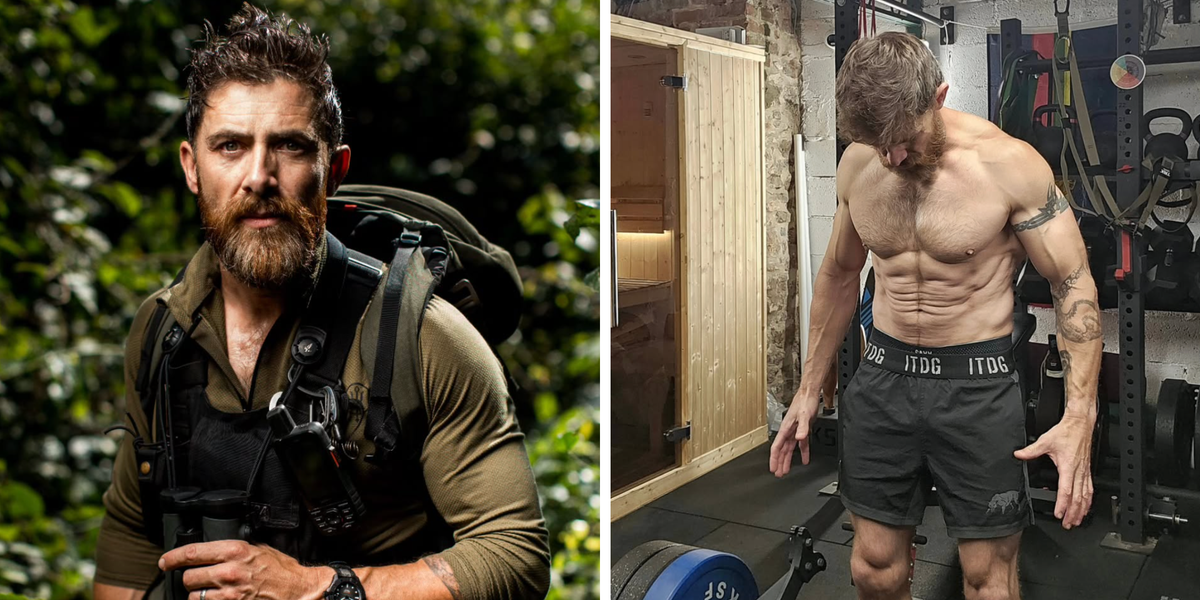
Former Royal Marines Commando turned world-record-holding adventurer and TV survival expert Aldo Kane has built a career operating where most people would barely function. From summiting Mount Everest to completing a team, 500km ultra marathon across the Arctic Circle in Sweden, his job demands resilience. But his nutrition? Surprisingly simple.
We caught up with Kane off the back of his latest expedition, a world-record breaking high-altitude marathon in Chile.
How do you train to stay expedition-ready?
I’m 48. I’ve been training five days a week since I was about 15. I train in the gym four times a week lifting weights. On the fifth day I’ll do full bodyweight circuits – press-ups, pull-ups, burpees, all the stuff I grew up doing in the Marines. I run twice a week – In my head I need to be able to run 10 miles at the drop of a hat. I got two weeks notice for the marathon in Chile at just under 7,000 metres and didn’t do any specific training. I just went out and cracked it. I’ll also do one or two static bike sessions a week. One will be 40 minutes steady. The other will be something like the Norwegian 4×4 protocol for VO2 max. If I’m preparing for something specific like Everest or freediving, I’ll do breath-hold work to deal with increased CO2 or reduced oxygen. Before Everest, I increased the amount of load on my legs and did a lot of weighted walks – what the Americans call rucking. For me training is about resilience – being able to deal with injury, bad kit or not having perfect conditions.
What does your day-to-day nutrition look like when you’re at home?
When I’m away, I don’t have any control over what I eat, when I eat and how much I get. So when I’m at home I enjoy a simple schedule. I don’t follow any protocols other than just eating whole foods. I eat three times a day. I have breakfast every morning with the kids around 6am. It’s usually porridge with a little bit of protein in there or scrambled eggs on toast. Lunch, if I’m running around on the hoof, will be sandwiches. Then dinner is when the whole family sits down and eats together. It’s simple, cooked food – a different meal every night. With the kids we rely quite heavily on pasta because it’s easy to prepare. But we make sure we get enough protein – we eat a lot of red meat, chicken and venison. I’ve never counted my calories, but I know my base metabolic rate is around 1,650 calories. So if I’m eating over 2,000 calories a day, I know I need to be doing some graft to keep [energy balance] neutral.
How different does your diet become when you’re out in the field?
When I’m working, it really depends on the job. It could be a big wall climb, diving, jungle, altitude. Sometimes I can go a whole day without eating. I need to be able to function and operate on no food for a day because that’s just part of it when you’re busy. I’m not somebody who needs exact amounts of food every couple of hours. I’ve done three weeks without food before, which is a lot longer than most people think you can survive on. When I went head-to-head with Ed Stafford, I did seven or eight days without food and didn’t actually lose that much weight in the process. I’ve just come back from Chile where I broke the world record for the highest marathon. We did 15 hours climbing to the top of the volcano and then about 12 hours running and moving for the marathon. I only ate probably two Cliff bars in over 24 hours. I can get stuff done without all any special nutrition. That’s me as a person. My body needs to be resilient enough to deal with hardship. That’s kind of where I thrive.
What did you have for dinner last night?
Chicken curry, salad and naan bread. Homemade.
What supplements do you use?
I use a non-flavoured whey protein. It’s organic whey with nothing in it. I take a high-strength EPA and DHA, so cod liver oil, vitamin D, and I’ve been taking NMN [Nicotinamide Mononucleotide: a compound purported to increase energy levels and support longevity] for the last two years. I know I don’t get enough vitamin D and I know my omega levels were low, so I supplement that.
Have you ever experimented with supplements that weren’t worth it?
About a year ago I was using something for my hair [finasteride]. I think it was more of a medicine than a supplement. It kept my hair thick, but it was affecting how I was feeling because it was acting as a hormone blocker. I wasn’t my normal self, so I stopped. I didn’t need it.
Dream expedition partner?
[Sir Ernest] Shackleton
What’s one luxury item you’d take if you were stranded on a desert island?
Soap. Nobody likes crotch-rot.
What’s the one food you’d love to smuggle for a meal in an inhospitable environment?
Steak
Related Stories
With almost 18 years in the health and fitness space as a personal trainer, nutritionist, breath coach and writer, Andrew has spent nearly half of his life exploring how to help people improve their bodies and minds.
As our fitness editor he prides himself on keeping Men’s Health at the forefront of reliable, relatable and credible fitness information, whether that’s through writing and testing thousands of workouts each year, taking deep dives into the science behind muscle building and fat loss or exploring the psychology of performance and recovery.
Whilst constantly updating his knowledge base with seminars and courses, Andrew is a lover of the practical as much as the theory and regularly puts his training to the test tackling everything from Crossfit and strongman competitions, to ultra marathons, to multiple 24 hour workout stints and (extremely unofficial) world record attempts.
You can find Andrew on Instagram at @theandrew.tracey, or simply hold up a sign for ‘free pizza’ and wait for him to appear.