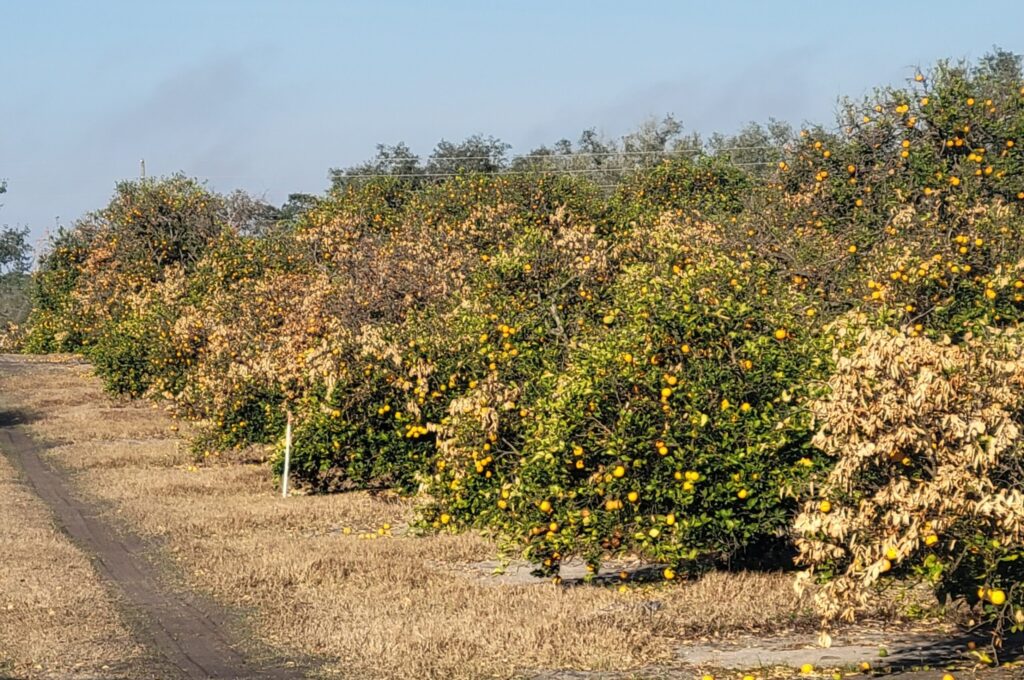

As Florida’s citrus industry continues to adapt to ongoing challenges like HLB, researchers are taking a renewed look at how trees are fed. The goal is no longer just maximizing inputs, but optimizing them.
Integrated nutrient management is emerging as a key strategy for improving both sustainability and production. Rather than relying solely on traditional fertilization methods, growers are trying approaches that combine split fertilizer applications, soil amendments, and more precise nutrient blends tailored to citrus needs.
UF/IFAS is helping guide that shift. One ongoing study is evaluating controlled-release fertilizer programs designed to deliver a steady supply of nutrients over time. Early results show that these programs can perform just as well as standard fertilizer practices when it comes to fruit yield and juice quality, even at lower nitrogen application rates.
That finding is reinforced by another multiyear study examining nitrogen and phosphorus rates across 14 sites statewide. After several years, researchers have not observed significant differences in yield or juice quality across a wide range of application rates. In some cases, phosphorus levels in leaves were even found to be excessive, suggesting that growers may be able to scale back applications without sacrificing production.
Beyond fertilizer rates, attention is also turning to how nutrients move and behave in Florida’s soils. Studies show that most nutrients remain concentrated in the top six inches, where the majority of citrus roots are located. However, there is also evidence that some nutrients can leach deeper, highlighting the importance of efficient application strategies.
One of the more innovative approaches gaining traction is the use of orange peel powder as a soil amendment. This byproduct of citrus processing provides a wide range of nutrients while also improving soil structure and water retention. Over time, it can enhance nutrient cycling and even contribute to increased yields and tree growth.
Taken together, these findings point toward a future where citrus nutrition is more precise, efficient, and sustainable, helping growers maintain productivity while reducing waste and environmental impact.