A patient with three different autoimmune diseases has entered complete remission after undergoing an experimental treatment that effectively reset her immune system.
The 47-year-old woman in Germany previously required daily blood transfusions to manage her conditions, two of which affected her blood cells.
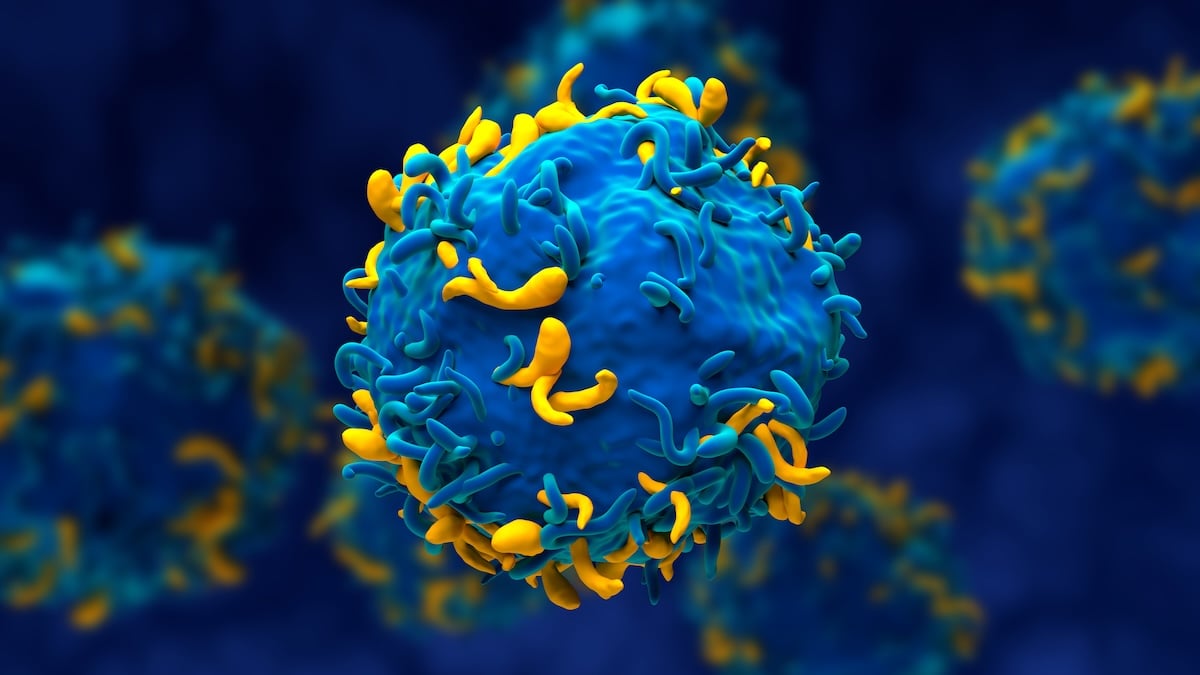
She was given Chimeric Antigen Receptor (CAR-) T cell therapy, which involves extracting a sample of immune cells, ‘supercharging’ them against a specific target, and returning them to the body.
Within weeks of treatment, the patient’s symptoms improved, and she no longer requires blood transfusions, even almost a year after the therapy.
“The treatment was extremely efficient in getting rid of all three autoimmune conditions at once,” says Fabian Müller, hematologist at the University Hospital of Erlangen in Germany.
“After being sick for more than a decade, the patient is now in treatment-free remission and able to return to an almost normal life. This therapy significantly improved her quality of life.”
The patient’s primary condition was autoimmune hemolytic anemia (AIHA), a rare disease that occurs when the immune system begins to attack the red blood cells.
She was later also diagnosed with two related autoimmune diseases. The first was antiphospholipid antibody syndrome (APLAS), in which immune cells mistakenly attack tissues, leading to blood clots. The second was immune thrombocytopenia (ITP), where immune cells attack platelets, the small cell fragments that prevent excessive bleeding.
This trio of conditions meant the patient needed blood transfusions every day, and had to regularly take blood-thinning medication to prevent clots. Over the years she had undergone nine different types of treatments to try to improve her health and quality of life, but none had worked for very long.
In the new study, the patient received CAR-T cell therapy, which is increasingly showing promise in treating a variety of cancers. Rather than using chemicals or radiation to kill off cancerous cells, this treatment uses the body’s own immune system, teaching it to hunt down a specific target more effectively.
The team behind the work had also previously tuned CAR-T cell therapy to fight other autoimmune diseases, including more than five lupus patients who all went into remission.
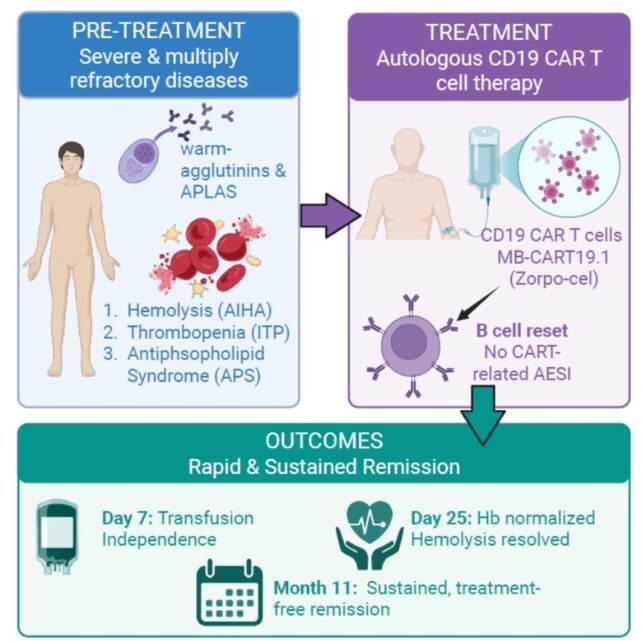 The patient’s disease and treatment course. (Korte et al., Med, 2026)
In this case, the patient’s problems all seemed to stem from B cells, which produce antibodies as part of an adaptive immune response. Her B cells, however, had gone haywire and were instructing the rest of her immune system to attack healthy red blood cells, platelets, and other tissues.
So, the researchers isolated her T cells and engineered them to attack a protein called CD19, which is found on the surface of B cells. They were then infused back into the patient’s bloodstream, where they could get to work killing off her rogue B cells.
And sure enough, her health began to improve almost immediately after just a single infusion of CAR-T cells. Seven days after the treatment, she no longer needed blood transfusions.
“After discharge at day 10, the patient experienced a rapid and remarkable increase in physical strength and has been able to carry out normal everyday activity,” the researchers write in a paper describing the trial.
By day 25, biomarkers indicated that she had entered complete remission. Her hemoglobin levels returned to normal after being greatly depleted – this protein is found on red blood cells, so its increase indicated that those cells were no longer being destroyed.
Her platelet counts stabilized, and antibodies that trigger blood clots also fell and eventually became undetectable.
“After more than 10 years of illness, the patient’s blood counts normalized within just a few weeks. The speed and depth of the response was remarkable,” says Müller.

After 322 days, the patient’s B cells began to return, but, importantly, almost all of them were ‘naive,’ meaning they didn’t retain immune memory and therefore weren’t attacking healthy cells.
Around that same time, the patient was able to stop taking the drugs to prevent blood clots, without any signs of new clots forming. No other negative side effects of the treatment were noted.
Some of her biomarkers remain slightly elevated compared with those of healthy patients, but these could be lingering effects of her many prior treatments, the team says.
Related: Scientists Cut Amyloid Plaques by 50% in Mice With Engineered Cells
While a single case study can’t confirm that the therapy will work for every patient, the results are very promising. The scientists note that further controlled clinical trials are needed.
“We believe that using CAR-T therapy earlier for patients with severe autoimmune disease could help prevent complications from years of ineffective treatments,” Müller says. “If we can intervene sooner, we may be able to stop the disease process, avoid organ damage, and give patients their lives back.”
The research was published in the journal Med.