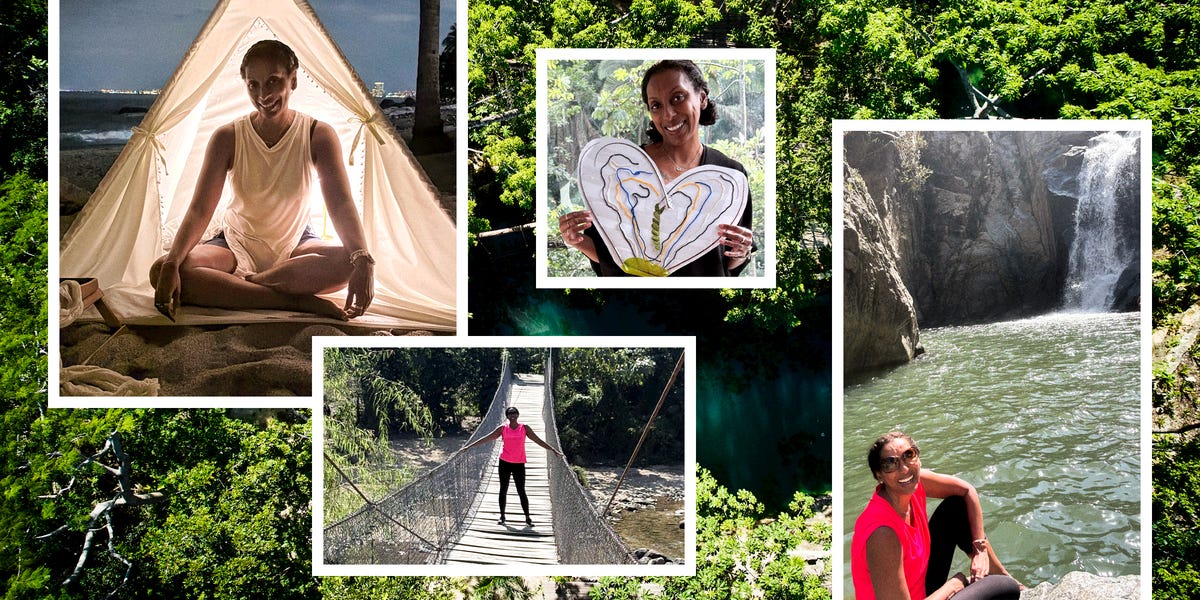
A woman carries me, cradled like a baby, around a small infinity pool as sunrays filtering through a canopy of trees above dance across my closed eyelids. Moments ago, before I surrendered to Miriam’s toned arms—and this surreal experience of Aqua Chi—she asked me to declare an intention and take a series of deep breaths while she turned her face to the sky and began to channel spirits? Energy? The ancestors? I have no idea. I also have no idea if spiritual intentions operate like birthday wishes, meaning I should keep the one I make to myself so I don’t risk it not coming to be. Not wanting to take any chances, I whispered it under my breath, a fragile secret of the heart, before I lay back and let the tears slide from my cheeks and flow seamlessly into the warm water.
In the months before I found myself in a stranger’s arms 2,300 miles from home, I had spilled enough tears to fill an Olympic-size pool. My relationship with my partner, a man I loved with my whole heart (is there any other way?) and told the world I wanted to marry in this very outlet, unraveled. Turns out, the life I was excited to continue to build with him after four years in a long-distance relationship wasn’t a vision he shared. As I listened to him explain, anguished, all the ways and reasons he questioned his readiness to live together or get married in the near future, or possibly ever, he might as well have been slowly peeling my skin off with a paring knife—the pain felt that visceral, a shocking, agonizing wound that left me exposed and raw to the world.
Actually, it was more like salt spread on an already gaping wound. I had lost my beloved father exactly a year (almost to the day) before that conversation. Since then, I’d existed in a disoriented state, utterly bewildered by how I was supposed to carry on—to publish the novel I’d dedicated to him, to buy groceries, to laugh at an Instagram reel—without the person who’d been my bedrock since my first breath. In the turbulent rapids of that grief, my partner had been a source of steadfast support, and anticipating our happy future kept me afloat. And then, just like that, he was gone, too. Very much alive, but as gone as the dead. These back-to-back losses were like trying to do intense physical therapy on a broken ankle only to be kneecapped just as you’re finally starting to walk again. Which is to say, completely emotionally hobbling.
Would middle age amount to constantly bracing for endless losses—love, parents, friends, estrogen, democracy, the climate?
In books and movies, heartbreaks, existential crises, and dramatic ruptures have always seemed exciting or almost romantic to me—looking at you and your groove, Stella. But in reality, the emotional upheaval of being partially orphaned and newly single in the last year of my 40s sparked not possibility but an almost paralyzing sense of dread.
Would middle age amount to constantly bracing for endless losses—love, parents, friends, estrogen, democracy, the climate? What terrified me more than all that was the prospect of losing something even more precious: myself.
My preternaturally upbeat nature, my steadfast positivity, my resolute good cheer, the core traits that made me, me, suddenly seemed to be preciously fragile and slipping out of reach. The fear of that—and desperation—drove me to Google at 2 a.m. one frigid December night when I typed in a frantic search along the lines of “grief + escape + retreat + sun+ transformation + help.” A 30-day wellness retreat in Mexico popped up. Its tagline read as both an order and a promise: “Reclaim Your Life.” I also took it as an invitation. Three weeks later, I was on a plane.
I don’t know quite what I expected from the vague descriptions on the retreat’s website, which featured serene-looking women in flowing dresses, but I pictured yoga, meditating, perhaps a beach bonfire where I ceremonially burned my regrets or negativity. I suspected there would be trust falls and sharing. “Name a time you’ve overcome a challenge.” Clearly, I’ve gone to too many leadership trainings. But Transform is centered around a form of Gestalt group psychotherapy, which is also—and notably, for the back pain that shortly sets in—done entirely on a hard wooden floor.
Clad in identical drab olive green uniforms that call to mind “commune wear,” three therapists in their 30s greet us the first morning with a warning that the “program” will be “intense” and then present us with a schedule that involves 8 to 10 hours of activities and workshops a day, seven days a week. I look around at the four other participants sitting on the floor of this villa tucked high on a lush hill overlooking a slice of the Pacific in the distance. We’re all women, ranging in age from 32 to 66, and have come from different corners of the U.S. and Canada. We all have different issues (some more serious than I expected), but our apprehensive eye contact reveals we have one thing in common. We’re all silently wondering: What have we gotten ourselves into?
This feeling intensifies over the coming days as we submit to “therapeutic” exercises which only seem to escalate in their…unconventionality. For example, I am directed to have long conversations (out loud) with my inner child; I pantomime holding her hand while walking back and forth across the room as if we’re on a “stroll in the park.” I stare into another participant’s eyes for 10 unbroken minutes. I attend a faux children’s birthday party thrown by the therapists, where I play “dress up” (picture fairy wings and a rainbow fringe pom-pom headband) and engage in a surprisingly rousing game of Duck, Duck, Goose. At another point, I am to act out being one animal, then another, then another until finally, I settle on “tortoise” just so I can collapse on the floor. One day, I create a mask from a table of art supplies that looks like a Michaels arts and crafts store threw up on it—sequins, feathers, construction paper, pipe cleaners, and more glitter than you’d find in a stadium after a Taylor Swift concert. My creation ends up being as hideously awkward as the workshop that follows, where I am forced to wear it while I earnestly explain to the group how “hiding behind the mask I put on for the world” doesn’t serve me.
I could swear I hear him laughing at what grief has driven me to do.
I participate in all of this as gamely as I can, even while mocking the absurdities in text dispatches to my friends back home (“Made a butterfly out of string today!”) and even as I remain skeptical that any of it—including the trust falls we do actually do—will have any effect whatsoever on my poor broken heart.
As someone who considers bacon a food group, I’m also wary of the vegan menu. Meal after meal, I apply all the therapeutic visualization techniques we’ve been practicing to mentally transform plates of cauliflower “steak” and slices of roasted pumpkin into steaming hot wings and juicy sliders until I give up and take to devouring the contraband gouda I smuggled in. Cracker crumbs in my lap, I stare at the crooked poles and nonfunctional appliances of the dorm-like (and mold-infested) “villa” I share with three of the women—and sink into disillusionment. Not only are the “luxury” accommodations falling short, but so is the promise of “transformation.” I came all this way for revelations! The best I can say is that I’m distracted. That’s not nothing, but I still have a wild-hearted desperation that something will penetrate my cynical shell and help heal my tattered spirit.
And then it happens. Almost two weeks in, I am in that sunlit pool, in Miriam’s arms. She’s promised me that Aqua Chi would be magical, and to my surprise—and relief—it is. I’m finally able to feel a calm that’s eluded me for weeks, months, maybe even years. More incredibly than that…I feel my father, his presence: a sense of connection that’s felt just out of reach since his death. He is here with me in a way that I can’t explain or understand, but he must have heard the intention I whispered into the wind. I could swear I hear him laughing at what grief has driven me to do, this whole surreal experience, comically exasperated at my veganism, half-hearted as it may be.
The next week, I have another unexpected breakthrough in sound therapy. Ruben, the therapist leading the session, has long golden curls that would inspire Fabio himself to ask for hair tips, eyes a color that would make the Caribbean jealous, and the mystical disposition of someone who regularly goes on vision quests. So if anyone could bring me to tears playing folk instruments made from animal hides…
In our one-on-one the next day, I tell Ruben what a meaningful experience it was and lament how rare it is for me to be able to surrender to and believe in things I can’t see or touch: God, an afterlife, even, until yesterday, my own capacity to feel my dad. But there’s something else, too, that underlies my skittishness.
“The one thing I truly and wholeheartedly did believe in was love, the connection I had with my partner,” I tell Ruben, my eyes glassy. In the deepest reaches of my soul, I trusted we’d be together forever. “So, how can I have faith in anything or anyone again, now that I no longer have faith in my own intuition?” I ask, more a plea than a question.
This retreat isn’t the point or the endgame; it’s the portal to begin thinking about how I can tap into something bigger, bigger even than grief, than heartbreak.
Ruben looks at me with some mix of compassion and bemusement. “Intuition is man-made, self-made; what you’re seeking to trust in is something bigger. Something that by its nature can’t be right or wrong, but just is.”
He reminds me that this retreat isn’t the point or the endgame; it’s the portal to begin thinking about how I can tap into something bigger, bigger even than grief, than heartbreak. “This is an invitation, Christine, to take your spirituality seriously.” I love that phrasing, like I am being summoned to a party of spirits and stardust and sprites. He tells me that I will be grateful for all this pain one day, and how it will shape me. “When, exactly? A month? A year?” I ask, the desperate tinge back in my voice.
Ruben doesn’t have an answer, just a patient, knowing smile.
I think of something a yoga teacher said days before, cheerily, matter-of-factly. “Everything is as it is.” Such a simple statement, but then again, so is “I love you,” and look what it can do. The sentiment captures a certain fundamental truth about the state of things at any given moment, good or bad. Whatever has happened has happened—we can’t bend the present (or the past or the future) to our will. And we can’t bend people to it, either. There’s a certain freedom in accepting that; there’s also, I’m starting to understand, no alternative. I have to accept that I can’t bring my dad back, but that doesn’t mean he’s gone from my life. I have to accept that my ex and his love are gone from my life, but that doesn’t mean it never was or never mattered. I have to accept that I’ve had these shattering losses and I still have to go on. Which is also a simple statement, and yet, as I sit on the plane to return to New York, it, too, pierces me.
We push back from the gate and I take out the pale blue journal we were given back on day one, which feels like 150 years ago. I laugh at a note I scrawled across one of the lined pages: “I can’t do this anymore!” I came close to leaving many times, but I’m glad I stuck it out. The month was chock-full of metaphors (see: that butterfly art) and here was yet another one.
My initial guilt that this experience was a ridiculous privilege at best or a waste of time at worst has given way to a blooming gratitude. I respect this month of self-reflection as the gift of time and space it was. Stripped of routines and the vices we all use to escape ourselves (drinking, overworking, zoning out on TV, buying stuff, endlessly doomscrolling), I had to face myself and my pain. How often do we do that? Take real stock of how we’re living, how we’re dealing with our challenges, how we’re making choices about who to love and where to work and why? It’s infinitely easier to coast along and opt for complacency over intention, especially if you’re happy enough. For better or worse, it often takes a crisis to force us to do the meaningful work of wrestling with ourselves, one of the lessons we necessarily have to learn the hard way. I should know.
As the plane banks sharply above the sun-dappled waves of Banderas Bay, lifting higher and higher, my heart skips and stutters. Not because of a fear of flying, but because the angle against the sun allows me to glimpse my reflection in the oval window, framed by the barest wisps of clouds beyond. I catch myself smiling. Faintly, at first, and then bigger, with a sense of recognition. There she is. I went all the way to Mexico to find her, and she’s right here, tanned, covered in bug bites, and on a journey home, in so many senses of the word.
And my god, she wants a cheeseburger.
Member Exclusive: Discover Oprah’s Insider Community Villages


Christine Pride is a writer, editor and long-time publishing veteran where she held editorial posts at various Big Five imprints and published many bestselling and critically acclaimed novels and memoirs over her twenty-year career. She is also the author of three novels: two with Jo Piazza: We Are Not Like Them (a Good Morning America Book Club Pick) and You Were Always Mine, as well as her solo debut, All The Men I’ve Loved Again which was an instant USA Today bestseller. In addition to writing, she does select editorial work, proposal/content development, and teaching and coaching.