Cell Culture Supplements Market
The cell culture supplements market is on track to experience significant growth over the coming years as advancements in biotechnology and regenerative medicine continue to accelerate. With increasing demand for high-quality, controlled inputs to support cell and gene therapies, this sector is poised to expand rapidly. Here is an overview of the market’s valuation, key players, emerging trends, and segmentation that define its landscape.
Forecast for the Cell Culture Supplements Market Size by 2030
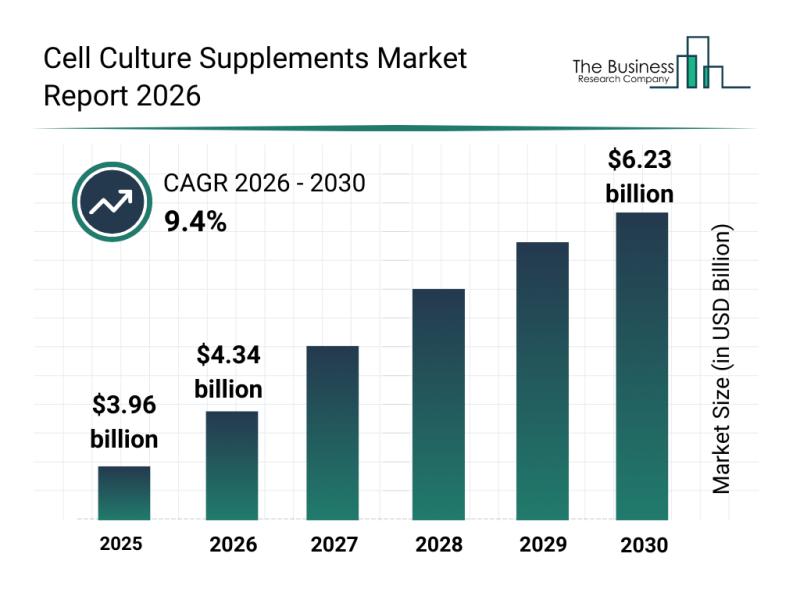
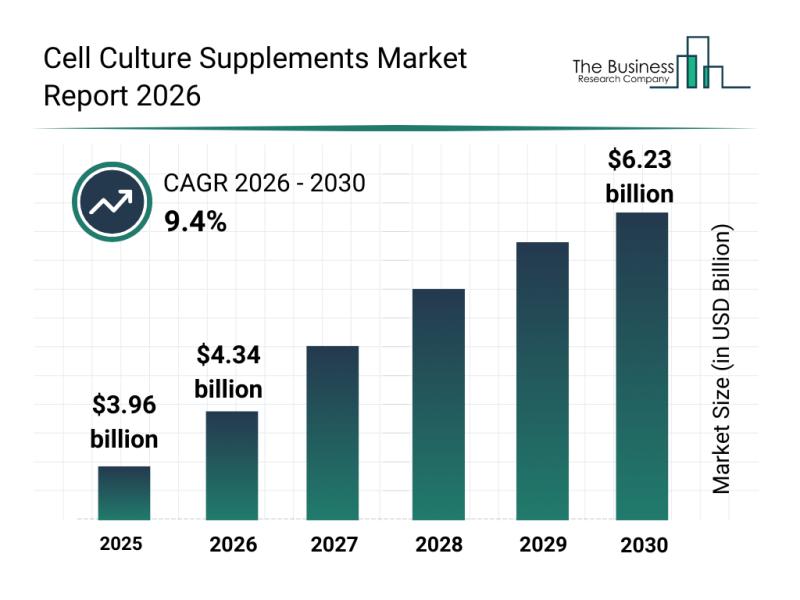
The cell culture supplements market is projected to reach a valuation of $6.23 billion by 2030, growing at a compound annual growth rate (CAGR) of 9.4%. This anticipated growth is fueled by multiple factors, including intensified development of cell and gene therapies, a stronger emphasis on scalable biologics manufacturing, expanding research in regenerative medicine, and an increasing need for xeno-free culture systems. Additionally, stricter regulatory requirements for quality-controlled cell culture inputs contribute to this upward trajectory. Trends shaping the market include broader adoption of serum-free and chemically defined supplements, heightened demand for high-purity growth factors, increasing preference for animal-origin-free products, expansion in customized media formulations, and a focus on ensuring batch-to-batch consistency.
Download a free sample of the cell culture supplements market report:
https://www.thebusinessresearchcompany.com/report/global-cell-culture-supplements-market-report?utm_source=OpenPR&utm_medium=Paid&utm_campaign=Apr_PR
Key Drivers Behind the Expansion of the Cell Culture Supplements Market
The growing development of cell and gene therapies is a primary driver propelling the cell culture supplements market forward. As these therapies become more widespread, there is a heightened demand for specialized supplements that meet rigorous quality standards to ensure efficacy and safety.
At the same time, the regenerative medicine field is expanding swiftly, leading to increased research activities that require advanced cell culture supplements. The demand for xeno-free culture systems – which exclude animal-derived components – is also rising, driven by both regulatory pressures and ethical considerations. This shift supports the need for standardized, high-performance supplements that facilitate consistent and scalable bioprocessing.
The cell culture supplements market is on track to experience significant growth over the coming years as advancements in biotechnology and regenerative medicine continue to accelerate. With increasing demand for high-quality, controlled inputs to support cell and gene therapies, this sector is poised to expand rapidly. Here is an overview of the market’s valuation, key players, emerging trends, and segmentation that define its landscape.
Forecast for the Cell Culture Supplements Market Size by 2030
The cell culture supplements market is projected to reach a valuation of $6.23 billion by 2030, growing at a compound annual growth rate (CAGR) of 9.4%. This anticipated growth is fueled by multiple factors, including intensified development of cell and gene therapies, a stronger emphasis on scalable biologics manufacturing, expanding research in regenerative medicine, and an increasing need for xeno-free culture systems. Additionally, stricter regulatory requirements for quality-controlled cell culture inputs contribute to this upward trajectory. Trends shaping the market include broader adoption of serum-free and chemically defined supplements, heightened demand for high-purity growth factors, increasing preference for animal-origin-free products, expansion in customized media formulations, and a focus on ensuring batch-to-batch consistency.
Download a free sample of the cell culture supplements market report:
https://www.thebusinessresearchcompany.com/report/global-cell-culture-supplements-market-report?utm_source=EINPresswire&utm_medium=Paid&utm_campaign=Apr_PR
Key Drivers Behind the Expansion of the Cell Culture Supplements Market
The growing development of cell and gene therapies is a primary driver propelling the cell culture supplements market forward. As these therapies become more widespread, there is a heightened demand for specialized supplements that meet rigorous quality standards to ensure efficacy and safety.
At the same time, the regenerative medicine field is expanding swiftly, leading to increased research activities that require advanced cell culture supplements. The demand for xeno-free culture systems – which exclude animal-derived components – is also rising, driven by both regulatory pressures and ethical considerations. This shift supports the need for standardized, high-performance supplements that facilitate consistent and scalable bioprocessing.
Leading Companies Making an Impact in the Cell Culture Supplements Market
Several prominent players dominate the cell culture supplements industry, including Thermo Fisher Scientific Inc., Danaher Corporation, Merck KGaA, Becton, dic*kinson and Company, GE HealthCare, Corning Incorporated, Lonza Group AG, Sartorius AG, Bio-Techne Corporation, Repligen Corporation, Takara Bio Inc., HiMedia Laboratories, PromoCell GmbH, RoosterBio Inc., Capricorn Scientific GmbH, Genexis Biotech Pvt Ltd., PromoKine GmbH, BioProcess Technologies Ltd., Jin Kairui Biotechnology Co. Ltd., FUJIFILM Irvine Scientific, and Athena Enzyme Systems.
Notably, in May 2025, Germany’s PL BioScience partnered with South Korea’s DewCell Biotherapeutics to develop fully animal-free, high-performance cell culture supplements. This collaboration focuses on producing scalable, synthetic human platelet lysate media, aiming to meet regulatory demands for standardized, ethical solutions in cell therapy and biopharmaceutical production.
Emerging Trends Shaping the Cell Culture Supplements Market
Innovations in serum-free and chemically defined supplements are gaining momentum, reflecting industry efforts to improve product purity and reduce variability. These advancements help manufacturers meet stringent quality control requirements and support more predictable results during cell culture processes.
In parallel, there is an increasing push toward animal-origin-free supplements that respond to ethical concerns and regulatory expectations. Customized media formulations tailored to specific applications are also expanding, offering more precise solutions to meet the diverse needs of biopharmaceutical production and regenerative medicine research.
How the Cell Culture Supplements Market is Organized by Product and Application
This market is segmented into several key categories:
1) By Product Type: Growth Factors and Cytokines, Amino Acids, Vitamins, Hormones, Attachment Factors, and Other Product Types
2) By Source: Animal-Based, Human-Based, Synthetic, and Plant-Based
3) By Application: Biopharmaceutical Production, Tissue Engineering and Regenerative Medicine, Diagnostics, Drug Development, and Other Applications
4) By End-User: Pharmaceutical and Biotechnology Companies, Academic and Research Institutes, and Other End-Users
Further detailing the product types, subsegments include specific growth factors and cytokines such as Epidermal Growth Factor (EGF), Fibroblast Growth Factor (FGF), Vascular Endothelial Growth Factor (VEGF), Transforming Growth Factor Beta (TGF-β), and Interleukins (ILs). Amino acids cover L-Glutamine, L-Arginine, L-Lysine, L-Leucine, and L-Methionine. Vitamins include Vitamin A (Retinol), Vitamin B Complex, Vitamin C (Ascorbic Acid), Vitamin D, Vitamin E (Tocopherol), and Vitamin K. Hormones in this segment comprise Insulin, Cortisol, Estrogen, Progesterone, and Thyroid Hormones. Attachment factors include Fibronectin, Laminin, Collagen, and Vitronectin, while other product types cover Trace Elements, Lipids, Nucleotides, and Antioxidants.
Reach out to us:
The Business Research Company: https://www.thebusinessresearchcompany.com/,
Americas +1 310-496-7795,
Europe +44 7882 955267,
Asia & Others +44 7882 955267 & +91 8897263534,
Email us at info@tbrc.info.
Follow Us On:
LinkedIn: https://in.linkedin.com/company/the-business-research-company,
Twitter: https://twitter.com/tbrc_info,
YouTube: https://www.youtube.com/channel/UC24_fI0rV8cR5DxlCpgmyFQ
Learn More About The Business Research Company
With over 17500+ reports from 27 industries covering 60+ geographies, The Business Research Company has built a reputation for offering comprehensive, data-rich research and insights. Armed with 1,500,000 datasets, the optimistic contribution of in-depth secondary research, and unique insights from industry leaders, you can get the information you need to stay ahead.Our flagship product, the Global Market Model (GMM), is a premier market intelligence platform delivering comprehensive and updated forecasts to support informed decision-making.
This release was published on openPR.