#19,113
Just over two years ago, in ECCMID 2024 Study: Mpox (monkeypox) Antibodies Wane Within A Year of Vaccination, we looked at a study by researchers from Erasmus MC in Rotterdam that found:
. . . recipients of the 2-Dose JYNNEOS/ IMVANEX/ IMVAMUNE mpox vaccine who did not receive a childhood smallpox vaccination (discontinued in the 1970s) experienced substantial drops in their immune response after 12 months.
Another presentation, released at roughly the same time from Sweden (see Immune response to MPXV wanes rapidly after intradermal vaccination with MVA-BN (Jynneos)) found an even quicker loss (> 28 days) of detectable neutralizing antibodies after the second vaccination, writing:
Our findings corroborate previous data showing that intradermal MVA-BN vaccination results in neutralizing antibodies only in a proportion of vaccinees, and that a significant decline occurs already during the first months post-vaccination. Immunity after MPXV infection mounts a higher and more robust neutralizing response. In conclusion, the findings merits the study of booster doses.
Which was followed roughly 6 months later by an EID Journal Dispatch: Mpox Epidemiology and Vaccine Effectiveness, England, 2023, which found that nearly half of new community acquired mpox cases in 2023 were among vaccinated individuals. They note:
Nearly half of outbreak case-patients in 2023 were vaccinated, and there were more cases among those who had received 2 doses of MVA-BN vaccine than among those who had received 1 dose.
This unexpected result, they suspected, may have had more to do with the risk behavior of some who may feel `protected’ by two-doses of the vaccine, than the vaccine itself.
To be fair, it was never expected that the JYNNEOS vaccine would be 100% effective against Mpox, or that it would convey life-long immunity. The authors also revealed `. . . that no vaccinated persons had been hospitalized for mpox in 2023, indicating that the MVA-BN vaccine probably protects against severe disease requiring hospitalization.’
Since then we’ve revisited this story several times, including Preprint: The Two-dose MVA-BN Mpox Vaccine Induces a Nondurable and Low Avidity MPXV-specific Antibody Response and Preprint: A three-dose MVA-BN Mpox Vaccination Series Improves the Quality of Anti-monkeypox Virus Immunity.
During this time we’ve also seen the emergence of new Mpox clades, including clade 1b and a new recombinant clade. While not currently deemed a PHEIC (Public Health Emergency of International Concern) by the WHO, these pox viruses continue to make inroads around the globe.
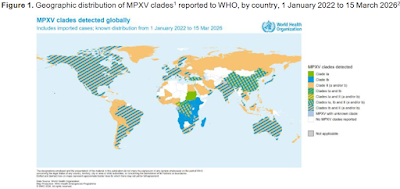
All of which brings us to a new Eurosurveillance research study, published yesterday, which finds additional evidence of declining protection over time from both Mpox Infection, and the MVA-BN (Jynneos) vaccine.
This is quite a lengthy and detailed report, so I’ve just provided the link, summary, and concluding remarks below. I’ll have more after the break.
Waning humoral immunity following monkeypox virus infection and vaccination, Canada, 2020 to 2023
Jérémie Prévost1 , Sarah J Medina1 , Ana Citlali Márquez2,3 , Kristina Dimitrova1 , Tahereh Valadbeigy2 , Gabrielle Angelo P Cortez2 , Mruthula Narayan2 , William C Carson4 , Michael B Townsend4 , Agatha N Jassem2,3 , David Safronetz1,5Key public health message
What did you want to address in this study and why?
Monkeypox virus (MPXV) is an emerging pathogen responsible for the mpox disease, which has spread to over 100 countries in 2022, causing more than 130,000 infections It has been suggested that MPXV (re)infections that occur after vaccination or previous MPXV infections have to do with immunity decreasing over time. We therefore wanted to investigate the durability of immune response to MPXV infection and vaccination.
What have we learnt from this study?
We developed specific and sensitive assays to track immunity to MPXV infection and vaccination. We showed that individuals infected with MPXV display a strong initial antibody response within the first 2 months after infection, but those antibodies decrease over the following 5 months. A similar decline occurred after mpox vaccination, where the antibodies reached low to undetectable levels after 30 months.
What are the implications of your findings for public health?
Decreasing immunity in both MPXV-infected and vaccinated populations suggests that vaccine booster doses may be necessary to maintain antibody levels and protection, in order to reduce the possibility of MPXV reinfections or vaccine breakthrough infections. Future studies need to assess immunity and long-term protection in individuals receiving booster doses of the MVA-BN vaccine compared with the standard two-dose regimen.
(SNIP)
Conclusion
This study provides a characterisation of the magnitude and durability of MPXV-specific humoral immunity following natural infection and MVA-BN vaccination. Our findings show that both infection- and vaccine-induced antibodies decline over time.
This raises important considerations for long-term vaccine protection, the potential need for booster immunisations, and the risk of reinfection. Moreover, the development and validation of highly specific MPXV serological assays using discriminating antigens offer valuable tools for future serosurveillance studies.
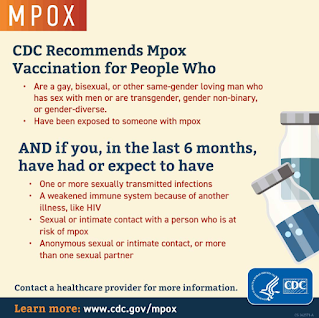
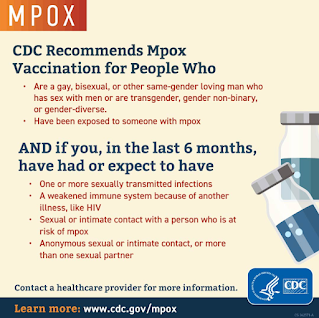
Complicating matters is the fact that the global supply of the JYNNEOS (MVA-BN) vaccine remains limited. Thus far, public health entities like the CDC, WHO, ECDC, etc. have not endorsed booster shots (with a few exceptions).
The following screenshot (4/10/26) from the CDC website illustrates the CDC’s current position.
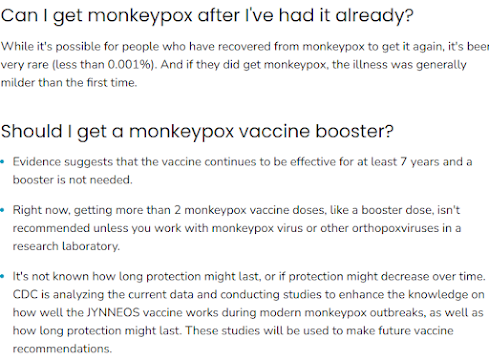
While it would appear that there is some distance between the CDC’s position, and these recent studies, the CDC states they are continuing to analyze the data.
Since the eradication of smallpox in the 1970s, there has been a growing belief that poxviruses are a thing of the past; a near-forgotten relic of the 20th century.
The emergence and international spread of 2 new Mpox clades (Ib & IIb) since 2020 – and a new recombinant recently reported in Asia – serve to reinforce that warning.
And while Mpox is currently at the top of our watch-list, some of the other emerging poxviruses we’ve looked at in recent years include:Alaska Health Department Announces A Fatal Alaskapox InfectionA Newly Discovered Poxvirus Detected In Reindeer in Sweden & Norway
EID Journal: Novel Poxvirus in Proliferative Lesions of Wild Rodents in East-Central Texas, USA