

As Santa Barbara City College builds a new Life Fitness Center (LFC) under Measure P, the facility will remain limited to students enrolled in physical education courses. This policy reflects the space’s purpose as an academic center rather than a public gym.
City College’s LFC operates as an instructional facility linked directly to coursework, unlike universities that do offer recreational centers funded by student fees. Students must enroll in one-unit or half-unit physical education classes to gain access.
“The Life Fitness is an educational facility,” said Diego Ramirez, director of the Life Fitness Center. “It’s designed as a lab that is part of a course, not a general fitness center.”
The LFC is structured around instruction, requiring students to complete participation hours, 36 hours for one-unit courses and 18 hours for half-unit courses along with assessments.
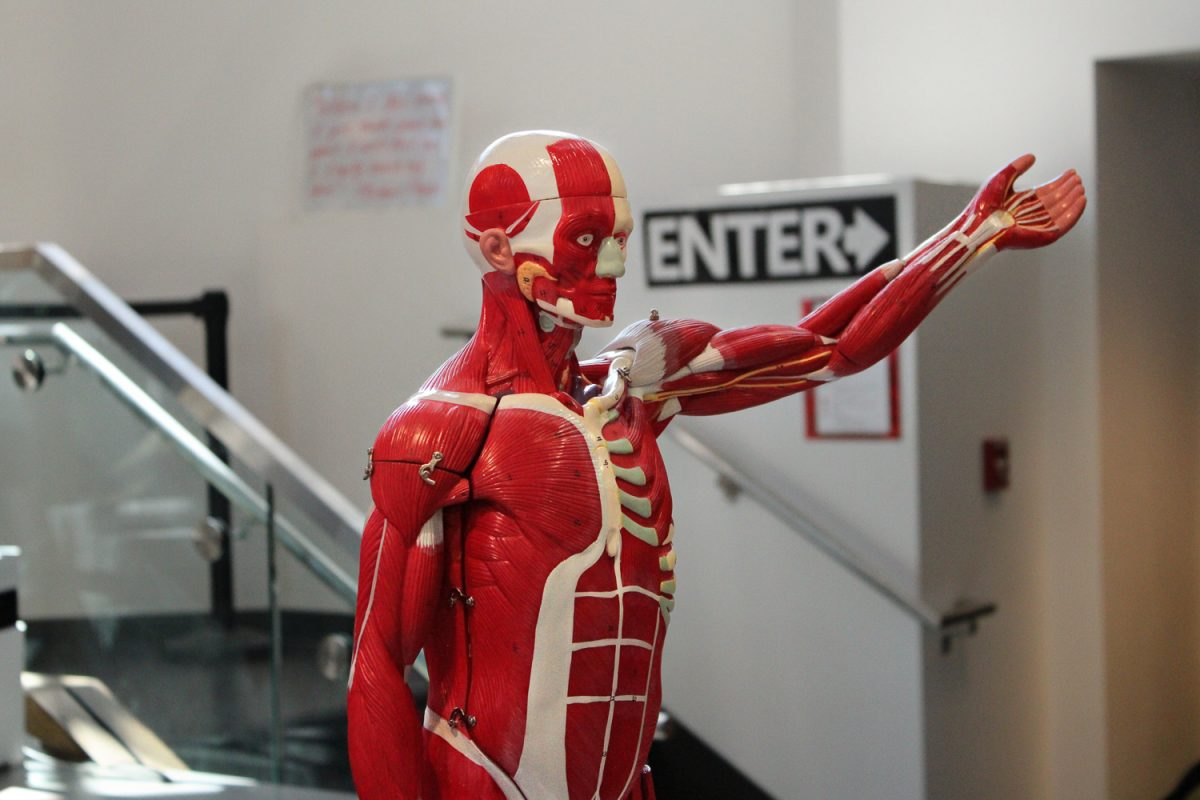
A human anatomy model stands on display inside the Life Fitness Center on Tuesday, April 8 at City College in Santa Barbara Calif. The model reflects the focus of the physical education courses linked to kinesiology.
Ramirez said access is tied to enrollment because the facility is funded through academic courses rather than general student fees. At community colleges, students do not pay fees that support recreation centers.
Kathy O’Connor, chair of the Physical Education Department, said the structure is necessary to maintain the program.
“That’s how we actually support that center,” O’Connor said. “With student enrollment, you get funding from the state, and that’s what pays for the faculty, staff and equipment.”
Safety is another reason behind the policy. Kinesiology-trained faculty members supervise students and provide guidance on how to use equipment and perform exercises correctly to reduce the risk of injury.
“Fitness centers can be very dangerous,” O’Connor said. “People don’t know how to use the equipment, and they can get hurt.”
Students who want access to the LFC can enroll in courses such as general fitness, strength training or circuit training, which require a minimum of 18-36 hours in the LFC each semester.
These courses are designed to help students build long-term physical health and understanding of exercise. Faculty describe the goal is to develop habits that students can apply beyond the classroom. Although some students may be frustrated with the lack of open access, the faculty say the way the coursework is built helps to add value. Students receive instruction, guidance, and access to fitness assessments that would otherwise cost significantly more at other gyms.
“It’s a great deal for students,” O’Connor said. “They have access to the facility any time it’s open, along with instruction and support.”
The new facility will improve accessibility, but the core structure is unlikely to change. Once finished, the project will provide a modern and conveniently located space for students while continuing to support the class focus of the program.
Story continues below advertisement