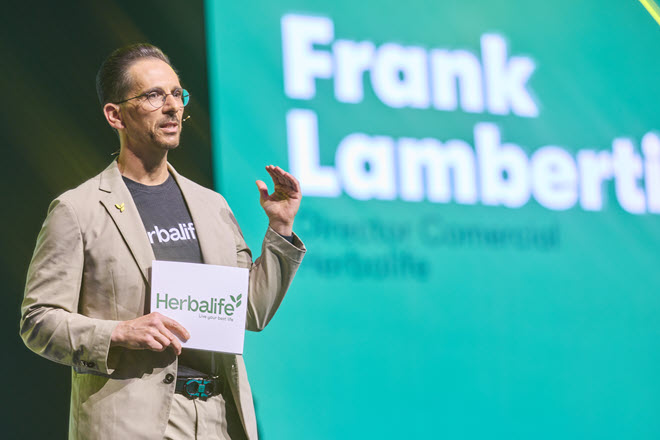
When Frank Lamberti joined Herbalife in 2005, the health and wellness company was focused on helping customers lose weight through nutritional products. Soon after that, Herbalife repositioned itself around sports nutrition, adding a new line of protein shakes and revamping branding and communications.
Today, the company is shapeshifting again, with a new emphasis on personalized health and wellness. As Herbalife’s chief commercial officer, Lamberti plays a pivotal role in that effort.
“We’ve always measured what people do, whether with a tape measure and a scale in the early days, or more recently, with BMI,” says Lamberti, who oversees sales, marketing, and corporate communications, among other functions. “How we’re doing it is evolving to the next level—with blood testing and biomarkers to develop more individualized offerings.”
Overall, the health and wellness industry is at an inflection point, says Russell McLean, a principal with Deloitte Consulting LLP who leads the direct-selling subsector. “Consumers increasingly expect brands to understand their individual needs, not simply demographics,” he says. “The companies that thrive will likely be those that marry data-driven personalization with trusted human relationships.”
Lamberti and his team are spearheading multiple initiatives that set the stage for Herbalife’s next evolution, including a new digital app and personally formulated products. He’s also working with Herbalife’s community of independent distributors, who bring the company’s offerings directly to consumers, to convey the brand’s new focus.
“When we put all of these components together, I see this powerhouse opportunity ahead—and that’s what keeps me motivated here after 21 years,” says Lamberti, who stepped into his current role in 2024 after serving as Herbalife’s chief operating officer. He has also held roles in financial planning and investor relations, regional management, operations, and executive strategy at Herbalife.
In a recent interview, Lamberti discussed personalized nutrition, digital transformation, and supply chain innovation, among other topics.
What priorities are top of mind currently? How are you and your team advancing the next evolution of Herbalife?
Lamberti: We see where health and wellness is headed—and personalization is a big part of that. We are working on a beta version of our new app, which will give distributors and customers a personalized health score, track daily activities, and allow distributors to nudge app users to act—for example, to drink more water or take more steps. Eventually, customers will be able to administer their own blood tests, which will be surfaced in the app. The personalized data will allow us to create individual plans that help customers achieve whatever goal they want. We’re also launching a new range of nutritional products in the healthy lifespan category and partnering with our operations team to revamp our brand packaging.
The direct-selling industry has evolved over the past several years. What are the biggest disruptive forces, and how do they influence Herbalife’s business now?
When I started out, direct sales involved more face-to-face interactions. Over time, we’ve had to provide education and training to our distributors on digital marketing. Consumer expectations of more tailored interactions have also changed the game. When our distributors combine those two trends with personalized digital experiences, they can offer an even better value proposition. We’ve also seen social media change how our distributors reach customers, allowing them to quickly grow a following. Yet there’s still a need for one-to-one human connection, which remains an important part of our model.
The company’s audience includes both distributors and consumers. What have you learned about effectively engaging both groups?
Distributors come to Herbalife to run a business. Consumers come because they want to achieve a goal—for example, to lose weight. Often, the best distributors started out as customers who accomplished their desired result. The overlap is a shared passion around goal setting, though of course there are differences in what each audience is looking for. Customers tend to seek information that will help them improve themselves. Distributors want that, too, but they also need to be able to teach others how to accomplish their goals, run a sales team, and recruit people into the business.
Herbalife operates in more than 90 markets around the world. How do you balance global consistency with local flexibility?
Our distributors do it best. We provide an infrastructure of sales materials and products that they make local. In the U.S., for example, weight loss and sports nutrition are popular, while in India, we have a range of Ayurvedic products. We also give our distributors a lot of flexibility around how they go to market in their local communities. In some cases, that could be through a nutrition club, a physical location where customers can come in, buy a shake or other products, and take a wellness assessment. In the U.S., nutrition clubs tend to be more commercial, whereas they’re more communal and less formal in Asia and Mexico. We try to harness the best of what’s local while maintaining a professional standard of quality. When we see that one distributor has gained a lot of success—often through strong recruiting and sustainable sales growth—we’ll work with them to obtain best practices and showcase their success story to other distributors.
As Herbalife scales personalization and commercialization initiatives worldwide, what challenges are you facing?
Our distributors have been personalizing nutrition for years by curating products, but advancing to one-to-one formulations requires a different approach. One of the challenges we’re seeing is that the regulations in our category weren’t developed for personalized nutrition, so we’re working to help advance those regulations. We’re also rethinking our supply chain, which was designed to mass-produce canisters with enough powder for 30 days. Many of our products are manufactured in an 800,000-square-foot facility in North Carolina, with enormous hoppers that pour ingredients into canisters. Going forward, we’ll be using a machine that dispenses specific formulations via multiple small hoppers, then shakes those ingredients together to create a homogenous powder.
What is your overall leadership philosophy, and how does your cross-functional background shape your approach?
I’ve been lucky to hold a wide range of roles in this company. Those experiences have given me perspective on sales, marketing, growth, and innovation—while understanding the need to be financially responsible. To gain buy-in from finance, it’s important to demonstrate ROI. Sometimes, that comes in the short term, but it can also be long-term. For example, strong brands tend to be associated with higher stock prices. As a leader, my objective is to build high-performing teams by hiring good people, generating strategy together, and then driving toward execution. Often, the best approach is to stay out of the team’s way. If you hire good people who understand the strategy, they’ll employ the best innovations.
—by Jennifer D. Fisher, writer, Executive Perspectives in The Wall Street Journal, Deloitte Services LP