
In a natural product whodunit, researchers hunt down the true source of antiviral action hiding in a plant-derived sample of isoquercitrin. The new family of antivirals they find, dicitriosides, boasts nanomolar potency against some highly transmissible viruses (J. Nat. Prod. 2026, DOI: 10.1021/acs.jnatprod.6c00077).
Isoquercitrin is a common plant flavonol and a wellness supplement shown to have many medicinal effects, such as fighting inflammation and cancer. Yet isoquercitrin samples come from many different plants and are never just that one molecule, according to Guido Pauli, a natural products expert at the Pharmacognosy Institute at the University of Illinois Chicago.
Because other plant-derived molecules lurk in these substances, a given sample of isoquercitrin can have significantly different properties than another. “There are as many different ‘isoquercitrins’ as there are biological effects,” Pauli says.
In 2022, Majambu Mbikay, a biochemist at Montreal Clinical Research Institute, contacted Pauli about a sample of 90% purity isoquercitrin that inhibited Ebola, Zika, and SARS-CoV-2 viruses in cell-based experiments. Yet Mbikay’s lab found that a separate, 98% pure isoquercitrin sample had, surprisingly, shown no antiviral action. This disparity led them to believe that something besides the isoquercitrin was fending off the viruses.
Pauli and Mbikay’s labs passed samples of the 90% mixture back and forth over the next two and a half years, using tailored separation techniques and quantitative bioactivity tracking to carefully home in on the trace antiviral source. Pauli’s lab first knocked isoquercitrin out of the sample entirely using counter-current chromatography. His team then built a 7 m long Sephadex column to separate out everything else.
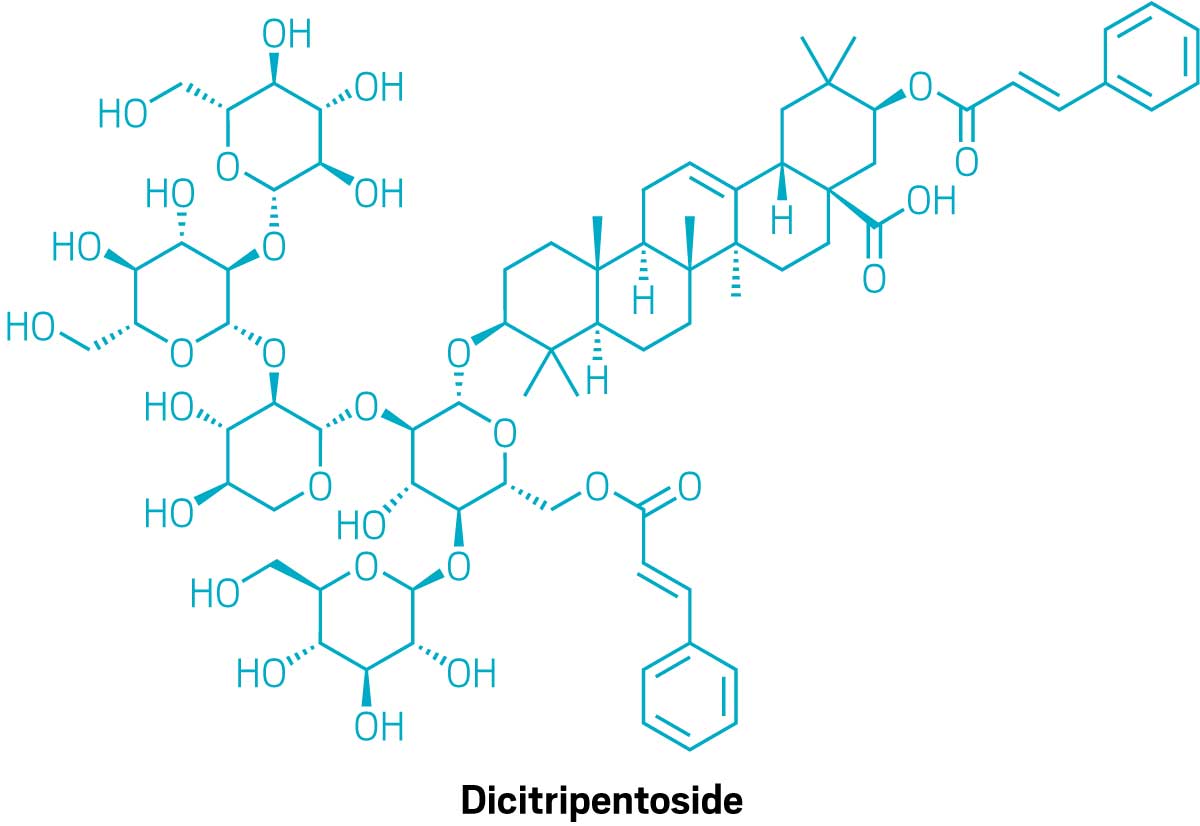
The line structure of dicitripentoside with a branched chain of five sugars coming off its left side and two cinnamate chains hanging off the molecule.
Dicitripentoside is part of a newly discovered family of antiviral compounds called dicitriosides. The molecule has potent antiviral activity in laboratory cell tests.
Mbikay’s lab found the antiviral action concentrated in less than 1% of the original sample. It turned out that the antiviral actors were a new family of molecules found at very low concentrations in the less pure isoquercitrin substance. The researchers dubbed them dicitriosides: triterpenoids bearing two cinnamates and a branched sugar chain.
In cells infected with SARS-CoV-2, the dicitriosides showed antiviral potency about 25 times as high as the original 90% pure substance. The compounds’ potency at such low concentrations makes them promising drug candidates against Ebola and SARS-CoV-2, the researchers say.
The teams are now tracking down which plants make these rare compounds and figuring out the essential antiviral parts of the dicitriosides’ complex structure. They also say their study is an example of the importance of minor components in natural products. “Everybody looks at the elephant in the room,” Pauli says. “We’re looking at the mouse in the room.”
Chemical & Engineering News
ISSN 0009-2347
Copyright ©
2026 American Chemical Society