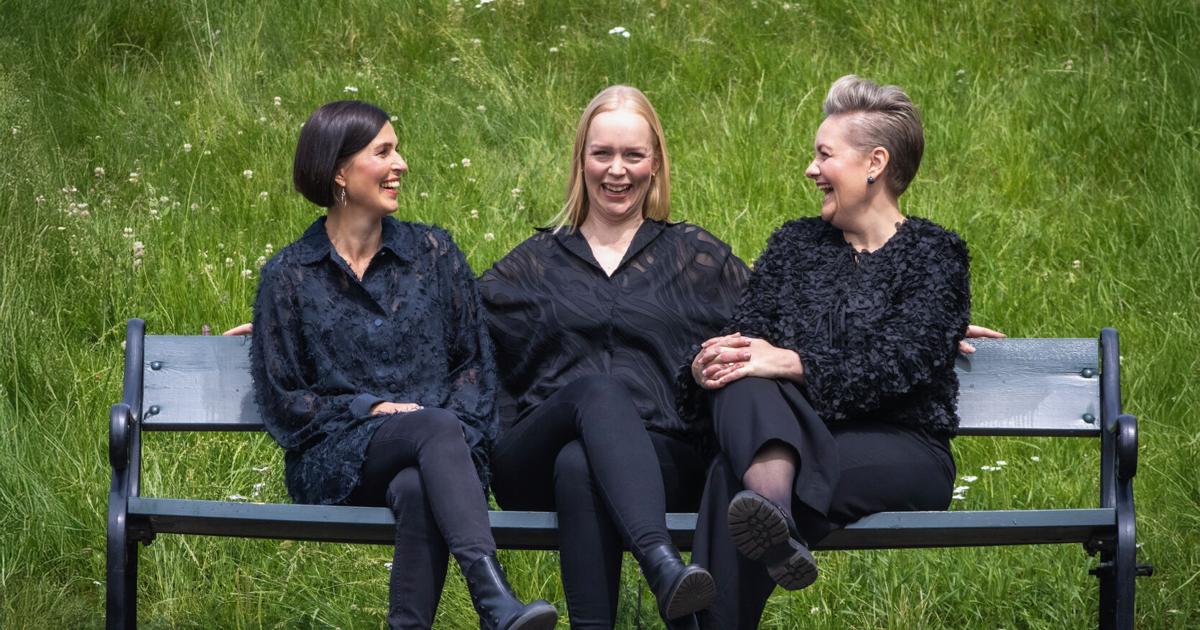
This week I read program notes that described the performances of the artists I was hearing as representing “a unique coming together of past and present, places and cultures, spanning hundreds of years and thousands of miles.” The singers in question create concerts combining three types of music: scores from medieval Europe, folk songs (typically Nordic), and contemporary music (often composed specifically for the group).
The ensemble is Trio Mediaeval, and while the three kinds of music don’t readily suggest any obvious connection, the fact that these three women are scrupulous in their selections means that for all the unlikelihood of the combination, this ensemble delivers in a way it’s hard to imagine any other group could. These singers have pioneered a unique niche and have been stunning audiences for nearly 30 years.
Trio Mediaeval, founded in Oslo in 1997, is made up of Anna Maria Friman, Ditte Marie Braein and Jorunn Lovise Husan. Founding member Linn Andrea Fuglseth sometimes sings with them but will retire at the end of this year and did not appear for this concert. They have been this year’s Don Michael Randel ensemble in residence at the University of Chicago, and last Sunday’s concert at the Logan Center was their final performance in that role.
Their concert opened with a Sarum chant from medieval England. Most of the concert was unaccompanied singing, but for this and a few other works, the women employed melody chimes, tubes that make a gentle, soothing humming sound when moved through the air. The beguiling sound seems to me to be the musical equivalent of a glow. It added a lovely dimension to the music.
There were three works by Sungji Hong (b. 1973), starting with the “Kyrie” from her “Missa Lumen de Lumine.” It used the same text as the previous medieval chant and was infused with striking close harmonies. An added measure of excitement came from the fact that Hong was in the audience to hear the trio deliver her mesmerizing music, which they did with impeccable artistry.
There were a handful of traditional Swedish hymns collected from Estonia, which was under Swedish rule for four centuries. “Pris vare Gud” featured amazing unisons from the three singers. Both “Abba, hjärtanes Fader god,” arranged by Anna Maria Friman, and “Nu rinder solen opp,” arranged by Linn Andrea Fuglseth, gave you a sense of the strength of devotional music that has survived for centuries in northern Europe.
“Krist er oppstanden,” a traditional Norwegian medieval hymn, was vibrant and engaging, while a chant by Leone Power (ca. 1370–1445), “Ave regina celorum,” was given a luminous finish and was ornamented with the chimes. “Regali ex progenie” by Fonteyns, from the early 15th century, had a charming stillness to it, which was remarkably calming.
Marianne Reidarsdatter Eriksen’s “Sol lucet,” composed in 2022, was one of the most memorable works, with the composer creating a dialogue among shepherds that effectively communicated connection at a distance. The short text is timeless: “The sun shines for everybody. Is it not the best thing that nature has made common property?” The women moved away from each other to more effectively create the sense of distance between shepherds and at one point even turned their backs to the audience for a still greater sense of physical separation.
David Lang (b. 1957), famous for being one of the founders of Bang on a Can, was represented in this concert by his “Alleluia/Amen” from 2002. Only those two words were used, and the trio drew out the gentle and quiet music, creating a sense of fragility.
After the intermission, the ensemble began the second half with more from composer Sungji Hong’s “Missa Lumen de Lumine,” this time the “Sanctus.” The singers gave the music a celebratory sense combined with heartfelt devotion. “Nesciens mater” by Thomas Bittering was from the 15th century and was hypnotic.
“Nu rinder solen opp,” a traditional hymn from Ørsta, Norway, had rich harmonic texture and intriguing dissonances.
The last work on the program was again by Sungji Hong, this time from her 2024 work “Missa Ichthys.” The “Agnus Dei” from this mass was luminous and a fitting way to close the published part of the concert.
Then there was a three-in-one encore. They concatenated three traditional lullabies from Norway and Sweden into a single piece. The three constituent parts — “Tru Soli Måtte Skine,” “Vyssa Lulla lite bån,” and “Sov Min Søte Sulli”— gave each member of the trio a chance to have a final and impressive solo run. It was a satisfying way to end a performance that was truly spectacular.