A small pilot trial suggests a beetroot-based nitrate supplement can shift nitric oxide and redox pathways in amateur triathletes, but whether those biochemical changes translate into better endurance or recovery remains unproven.
Study: Effect of Beetroot Nitrate Supplementation on Nitric Oxide Pathways and Oxy-Inflammatory Biomarkers in Amateur Triathletes: A Randomized Cross-Over Pilot Study. Image Credit: StockImageFactory.com / Shutterstock
A recent Italian study published in the journal Nutrients explores a novel beetroot-based multi-ingredient nitrate supplement in amateur triathletes. After one week, supplementation markedly increased key biomarkers linked to nitric oxide (NO) production and redox activity, without evidence of lipid oxidative damage. Importantly, the supplement was well-tolerated, with no adverse effects reported.
These early findings highlight its potential to influence physiological pathways that may be relevant to endurance performance, but the study did not directly measure performance, stamina, or recovery outcomes. However, larger controlled trials are needed to confirm functional benefits.
Nitric Oxide, Exercise, and Nitrate Background
Nitric oxide plays a central role in vascular regulation, metabolism, and skeletal muscle function, supporting blood flow, mitochondrial efficiency, and endurance performance. It also interacts closely with oxidative stress and inflammatory pathways, and imbalances in these pathways can contribute to fatigue and tissue damage during exercise.
Dietary nitrate sources such as beetroot have shown potential to increase nitric oxide availability and improve exercise-related outcomes. However, current evidence remains limited and heterogeneous, with considerable variation in study design, dosing strategies, and participant characteristics. Importantly, only a small number of studies have concurrently examined nitric oxide metabolism alongside redox balance and inflammatory markers, leaving significant mechanistic gaps in trained athletic populations.
Beetroot Supplement Cross-Over Study Design
In this randomized, open-label, crossover study, researchers examined the acute and short-term impact of a beetroot-based nitrate supplement in amateur male triathletes.
The team enrolled healthy individuals aged 30–59 years, all of whom trained for ≥300 minutes per week and maintained a stable diet and activity throughout the study. They excluded individuals with smoking habits, high alcohol or caffeine intake, underlying medical conditions, recent infections, or supplement use to minimize confounding factors.
The protocol included two seven-day phases, supplement and control, with a 15-day interval between phases. The investigators randomized the participants in a 1:1 ratio into two sequences, so each participant served as their own control. They adjusted the supplement dose by body weight: 10 g (≤80 kg), 20 g (80–90 kg), or 30 g (>90 kg), dissolved in water, and instructed participants to consume it daily at a fixed time. The team monitored adherence through daily logs and returned product checks. The formulation also contained ingredients besides beetroot-derived nitrate, including L-citrulline, L-arginine, carbohydrate, and N-acetylcysteine.
The researchers collected blood and urine samples on days 1, 7, 22, and 28 to assess NO metabolites, oxidative stress markers, and inflammatory cytokines. They used standardized laboratory techniques, including enzyme-linked immunosorbent assays (ELISA) and electron paramagnetic resonance spectroscopy (EPR), to quantify biomarkers. Urinary analyses included lipid peroxidation and creatinine levels.
The investigators scheduled visits at similar times and conducted the study during a non-competitive training period. Additional evaluations included body composition, echocardiography, and questionnaires such as the International Physical Activity Questionnaire (IPAQ) and a dietary survey on nitrate intake. The team assessed gastrointestinal tolerability using the Gastrointestinal Symptom Rating Scale (GSRS) and continuously monitored activity with wearable devices.
Nitric Oxide and Redox Biomarker Findings
Ten individuals (mean age, 48 years; body mass index (BMI), 24 kg/m²) completed the study. Participants showed a typical endurance profile with low body fat and high fat-free mass. Physical activity remained stable across the 28 days, with non-significant differences between study phases or sequences. However, there was some variability between self-reported and device-based measures.
After one week of supplementation, researchers observed significant elevations in key biomarkers. These included NO metabolites (NOx, 155%), peroxynitrite (60%), inducible nitric oxide synthase (iNOS, 56%), 3-nitrotyrosine (3-NT, approximately 9.0%), interleukin-6 (IL-6 cytokine, 73%), and reactive oxygen species (ROS, 413%). Acute intake also rapidly elevated iNOS and peroxynitrite levels, indicating prompt activation of nitric oxide pathways. These elevations persisted for 7 days, suggesting sustained NO generation, although the study did not test whether this translated into improved exercise efficiency or performance. Importantly, lipid peroxidation markers remained stable, indicating no overt oxidative damage despite increased redox activity.
The observed rise in ROS, peroxynitrite, and cytokines may reflect, as the authors interpret, a coordinated redox and immune response rather than harmful inflammation. In trained individuals, such transient increases are often linked to adaptive signaling processes that support vascular function, mitochondrial efficiency, and metabolic regulation. The stabilization of oxidative markers over time further suggests a shift toward controlled redox homeostasis. The supplement was well tolerated, with no adverse events reported. One participant reported mild loose stools, but the investigators did not classify this as an adverse effect because it had occurred previously.
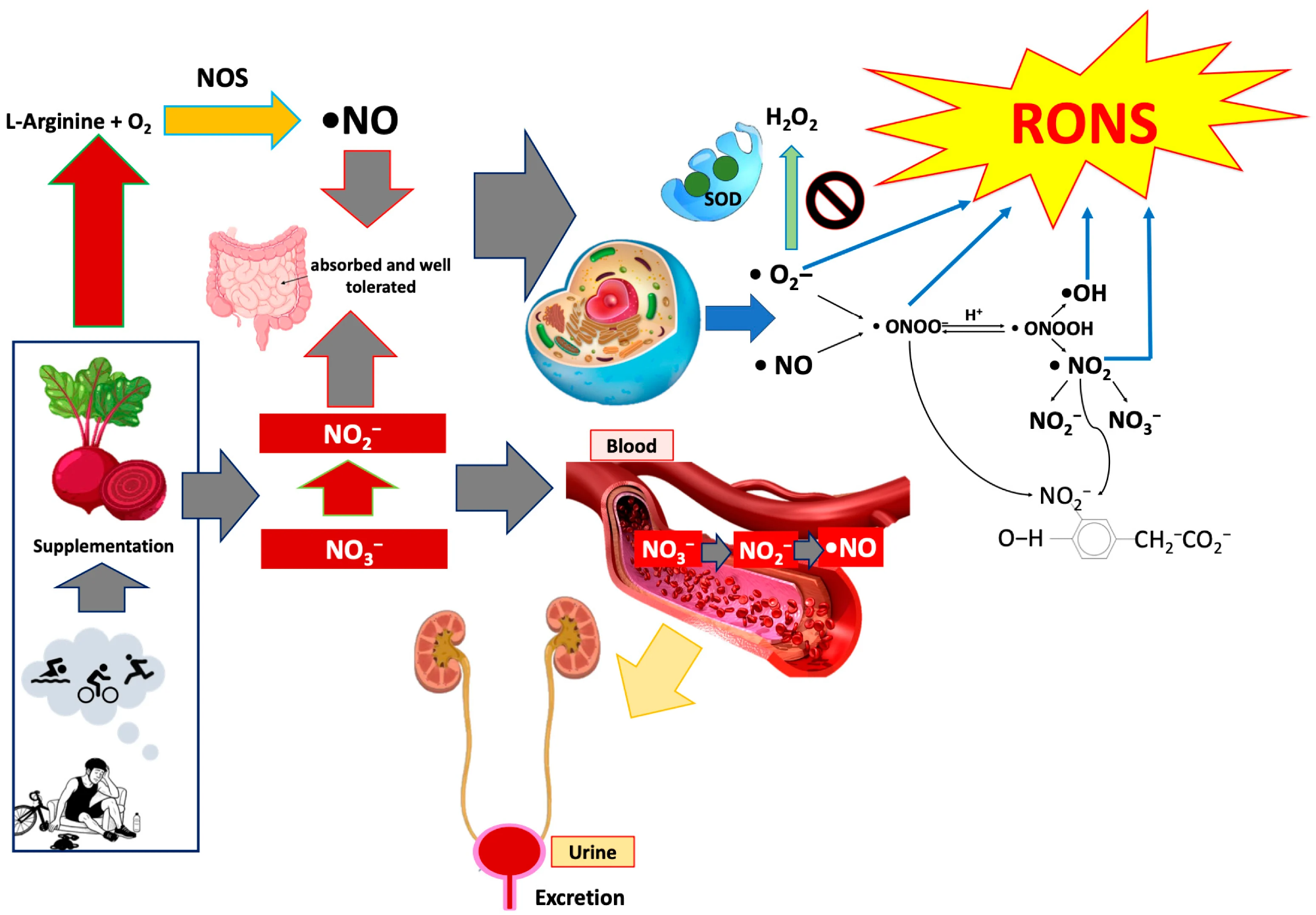
Schematic diagram of the mechanisms underlying beetroot-based nitrate supplementation (B-bNs) and its effects on nitric oxide metabolism, redox balance, and inflammation in endurance athletes. Dietary nitrate (NO3−) is absorbed and reduced to nitrite (NO2−) and nitric oxide (NO), increasing systemic NO bioavailability in blood and urine. Enhanced NO signaling is associated with increased nitric oxide synthase (NOS) activity and downstream formation of reactive nitrogen species, including peroxynitrite and 3-nitrotyrosine. Although reactive oxygen species production rises, antioxidant defenses (e.g., SOD activity) and lipid peroxidation markers remain unchanged, indicating preserved redox balance. Mild increases in IL-6 reflect physiological adaptation rather than pathological inflammation, supporting the safety and efficacy of B-bNs in modulating NO-related pathways without inducing oxidative damage. •NO, nitric oxide; H2O2, hydrogen peroxide; NOS, nitric oxide synthase; NO2−, nitrite; NO3−, nitrate; NO2, nitrogen dioxide; NO2−/NO3−, nitrite/nitrate pool; ONOO−, peroxynitrite; ONOOH, peroxynitrous acid; O2−, superoxide anion; •OH, hydroxyl radical; RONS, reactive oxygen and nitrogen species; SOD, superoxide dismutase.
Beetroot Supplement Implications for Endurance Training
The findings suggest that this beetroot-based supplement may support nitric oxide-related signaling while maintaining oxidative balance in endurance-trained individuals. The observed increases in NO metabolites and redox-active species appear to reflect controlled, adaptive responses according to the authors, but the study did not establish whether these biochemical changes improve athletic performance or recovery. Although these biochemical changes point toward potential benefits for performance and recovery, that possibility remains unproven in this trial.
Future research should prioritize larger placebo-controlled trials with consistent dietary and training conditions, longer follow-up periods, and the inclusion of women and younger athletes to improve generalizability. Combining molecular, physiological, and functional measures will be essential to clarify the real-world impact of nitrate supplementation and its role in optimizing endurance training and recovery. The study’s small sample size, male-only cohort, open-label design, and absence of direct performance outcomes should be considered when interpreting the findings.
Journal reference:
Mrakic-Sposta, S. et al. (2026). Effect of Beetroot Nitrate Supplementation on Nitric Oxide Pathways and Oxy-Inflammatory Biomarkers in Amateur Triathletes: A Randomized Cross-Over Pilot Study. Nutrients, 18(8). DOI: 10.3390/nu18081215, https://www.mdpi.com/2072-6643/18/8/1215