Senior Jivika Gulrajani recalls comparing two photos with her sister — one of actress Lindsay Lohan from before her alleged plastic surgeries, and one from after. Her sister was attempting to explain the difference between third and fourth wave feminism, and they had gotten into a heated argument about celebrities getting cosmetic surgery. While her sister criticized celebrities who denied getting procedures done, Gulrajani disagreed on the basis of validating women’s choices, though she’s since come around to her sister’s perspective.
“I didn’t understand why,” Gulrajani said. “I thought she was putting down women, and I thought it was inherently anti-feminist to do something like that. I remember her telling me, ‘You’re too young to understand now, but you understand later that they say they do this for themselves, but doing it for yourself is inherently doing it for someone else because they’ve internalized someone else’s opinion of them.’ I understand that now, because there’s different ways to describe that. It’s like they’ve internalized a different gaze.”
Plastic surgery encompasses many procedures, including craniofacial, hand surgery, microsurgery and more. Cosmetic surgery — a small subsection of plastic surgery that focuses on aesthetic reconstruction and contouring — is a rapidly growing industry, valued at $53 billion in 2025 and projected to grow to $61 billion by 2026. Cosmetic surgery surged in popularity during the third wave of feminism from the 1990s to the 2010s, framed as an empowering choice for women, who make up 90% of cosmetic surgery patients.
Math teacher Katie Collins recalls how she also used to be strongly opposed to cosmetic surgery, finding it vain and pointless, especially considering the health risks associated with silicone implants. However, after she spent her 40th birthday in the hospital, her perspective on aesthetics began to change. Collins remembers her experience with MVHS alum ‘25 Nathan Chiang doing her makeup and how she started to see the value in some cosmetic procedures. However, she still maintains that she would never go under the knife for elective cosmetic surgery.
“I’ve gotten older and sicker, and I literally watched myself go from what I thought was looking pretty young or my age to aging rapidly,” Collins said. “Knowing my physical health was declining, it was really hard to watch how I could see that in my face. Last year, I went and got Botox, and it was this weird, funny moment where I felt like a hypocrite. And it was just a little bit, but between the dehydration and the profound hypotension in my body and the CSF and all this crap, I could see the little difference. People say, ‘Look good, feel good.’ There is something to that. My problems are not going to go away because my wrinkles are less on my face, but I’m able to look in the mirror and not associate every line with, well, this was one pulmonary embolism.”
Reconstructive and cosmetic surgeon as well as co-founder of the Bay Area’s Duet Plastic Surgery Jennifer Weintraub centers her practice on restoring women’s self-confidence after pregnancy. Weintraub attended Albert Einstein College of Medicine, where she specialized in a field that allowed her to express creativity, leading her to match into a six-year residency at Stanford University and pursue plastic surgery as a career. She says her favorite part of the job is seeing how patients become more comfortable in their bodies after an operation, such as young women who get breast reduction surgery.
“You can take a person who hides in a sweatshirt and won’t join a team and who won’t go on a class trip and take that person and open up a lot of doors for them, and make them stop thinking about this thing that’s holding them back,” Weintraub said. “So I think the pro is that, in the right context, when done on the right patient in the right way, it really helps people feel good about themselves. There’s really nothing better than to just have someone be able to actualize their lives in a way that they want.”
However, there are situations where Weintraub refuses to operate, particularly when she feels a specific procedure wouldn’t suit the patient or the intention behind getting a procedure comes from seeking external validation rather than internal motivation. To prevent this, she counsels every patient on the risks and asks questions regarding their objectives. Earlier in her career, Weintraub found it difficult to turn patients down, but over time found it important to discern what her patients wanted out of the procedure.
“It’s not really the physical part that they’re complaining about,” Weintraub said. “That’s the problem. I try to validate someone for how they feel because they really do feel that way, but I have to say no, because the worst thing you can do in that situation is to actually operate. Their problems will not get better because their relationship has nothing to do with the size of their nose or whatever they’re complaining about. They’re mad at you — really mad at you — for about 10 minutes, but it’s better than them being mad at you for the rest of their lives.”
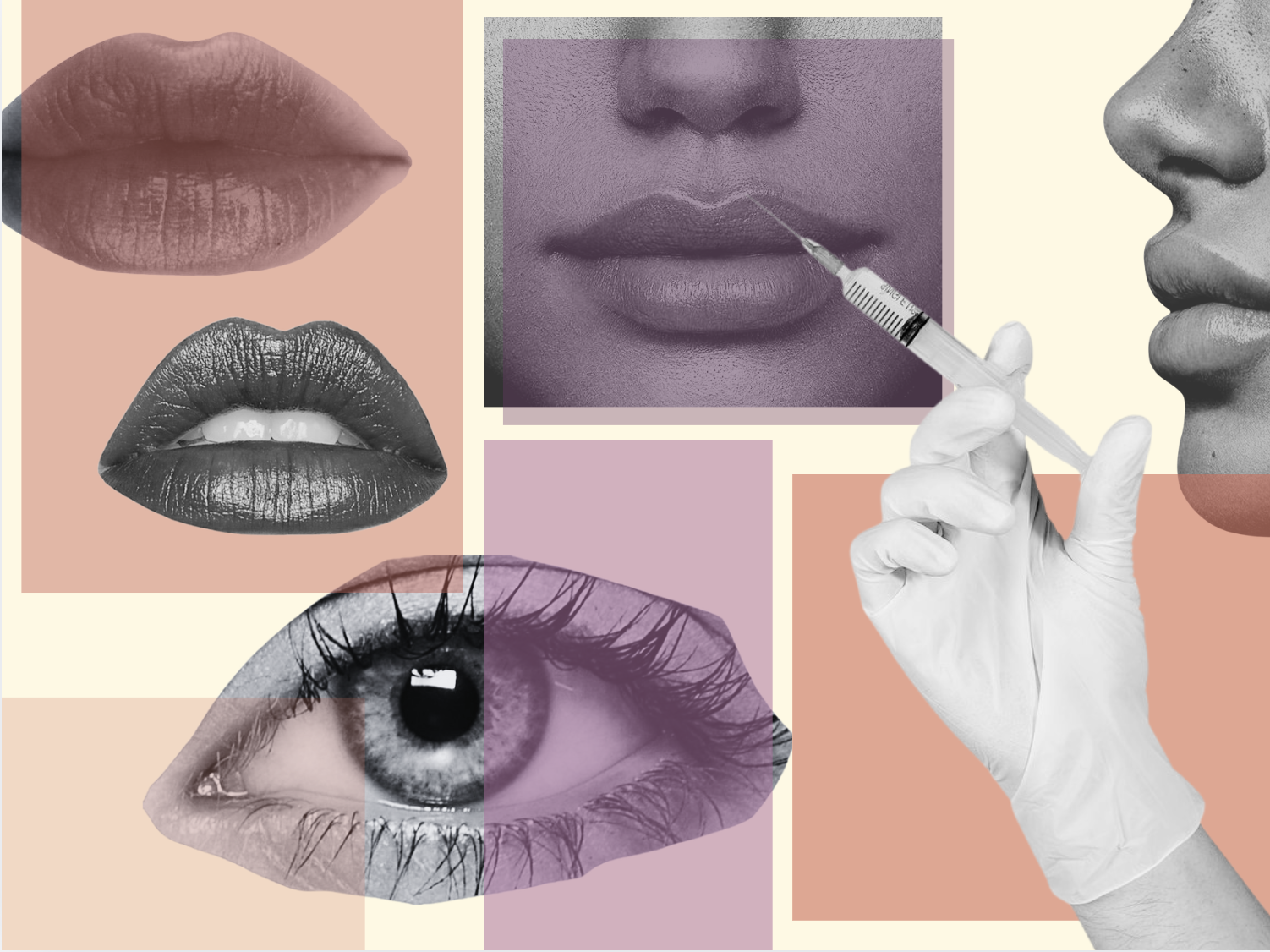
 Illustration | Radhika Dharmapurikar
Weintraub attributes these insecurities some patients experience to an idealized portrayal of women’s bodies on social media, something Collins also notices. Studies have found a direct correlation between the amount of time spent on social media and increased desire to get cosmetic procedures. Collins worries the oversimplification of self-improvement, like specific workouts or diets, takes away from individual people’s experiences, adding that some people’s health conditions might add complications social media fails to account for.
Gulrajani sees a heightened desire to undergo cosmetic surgery stemming from social media as well, specifically noticing people’s inclination to change their features to align with eurocentric beauty standards. Though Gulrajani has idly considered getting procedures like a nose job before, she worries about the message it might send to her peers about their ethnic features. Specifically, she describes how South Asian people tend to have mesorrhine nose structures, illustrating that if a South Asian person were to get rhinoplasty surgery to alter their nose shape to be slimmer, the implication is that the typical Eurocentric nose shape is more desirable.
“To make the choice to get plastic surgery is to say that I am so fed up with how I look, and I am so fed up with this feature of mine that I want to go as far to change it permanently for the rest of my life,’’ Gulrajani said. “To do something like that means that you internalized judgment and hatred of that feature to the point where you took action on it. If you get plastic surgery and claim to think, ‘Oh, all bodies are beautiful, all people are beautiful’ — if you really think that, why did you act that out yourself? It’s hypocritical.”
However, though Gulrajani notes the stigma around women getting cosmetic surgery — particularly in the context of the “clean girl” trend, which emphasizes a clean, effortless look — she says that the shame around being perceived as “ugly” ultimately outweighs the shame of pursuing cosmetic surgery in the first place.
“It’s not all women’s fault — a lot of it is the fault of the male gaze, which is perpetuated by men,” Gulrajani said. “But I think women have more agency than we think, and we have more choice than we think in terms of pandering to that. Because the more we choose to do things like this and label it as empowerment, the more we influence others to do the same, and also the more we normalize it.”
 Illustration | Radhika Dharmapurikar
Weintraub also sees this conflict between accepting people as they are and performing cosmetic surgery, especially with the role she plays as a surgeon. She worries that the industry can inadvertently perpetuate unrealistic beauty standards, but concludes that to be a surgeon is to recognize the discomfort and does her best to ensure her patients are there for the right reasons.
“I feel so mixed about it, because we’re doing these good surgeries, and people want to see it,” Weintraub said. “We’re helping a lot of people. A lot of people feel really good, but at the same time, what message are we sending? That your ‘before’ was wrong and your ‘after’ is right? There is nothing wrong with a lot of these ‘befores.’ It’s just normal human variation. It’s hard to be a plastic surgeon and say that your ‘before’ is normal, because then you won’t be doing surgery. So it’s complex that we have to live in that discomfort.”
Even so, Weintraub acknowledges the reality of beauty standards, which people internalize from a young age. She notes that different cultures have different perceptions of cosmetic surgery. While some cultures talk about cosmetic procedures openly or even as an expectation, Weintraub has noticed that people in the Bay Area prefer to go “under the radar,” especially professional women. Despite these often superficial standards, Weintraub says, successful cosmetic procedures still help people integrate into society.
“We grew up in a culture that tells us that our worth comes from our looks, and it’s wrong,” Weintraub said. “It’s totally wrong, but it is the messaging from birth. I struggle with that, too, because I feel like we should change that messaging — who on earth cares if your breasts are small or big? How on earth does that affect your worth or your value in this society? But the problem is that that is the messaging, and you can’t really get away from it. So, we try to help women feel good about themselves.”