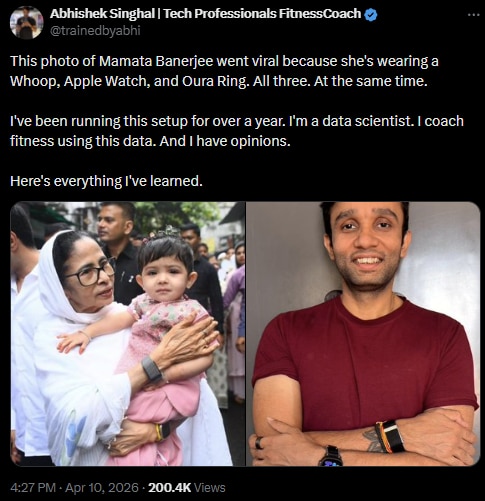
A photo of West Bengal Chief Minister Mamata Banerjee turned heads on social media after eagle-eyed users noticed something unusual, as she appeared to be wearing not one, but three fitness tracking devices at the same time.
The conversation was brought up on X by tech and fitness coach Abhishek Singhal, who pointed out, “This photo of Mamata Banerjee went viral because she’s wearing a Whoop, Apple Watch, and Oura Ring. All three. At the same time.”
Sharing his own experience, he added, “I’ve been running this setup for over a year. I’m a data scientist. I coach fitness using this data. And I have opinions. Here’s everything I’ve learnt,” turning it into a broader discussion around wearable tech and health tracking.
The image showed Banerjee holding a child while dressed in her signature white saree, which received attention not just for the moment itself, but for the subtle detail of multiple wearables on her wrist and hand.
Take a look at the post here:
Now, in a detailed thread, Singhal explained how he personally used the same setup and why, arguing that each device excelled in a specific area rather than overlapping.
Apple Watch
APPLE WATCH ULTRA 3: The Workout Companion
Been using Ultra since it launched 3 years ago. Currently on Ultra 3.
I don’t wear it 24/7 like the other two. I put it on for workouts (especially badminton, where I want heart rate zones and session tracking) and when I’m going out. pic.twitter.com/FTvlzX2kwG— Abhishek Singhal | Tech Professionals FitnessCoach (@trainedbyabhi) April 10, 2026
Starting with the Apple Watch, he explained how it excelled in workouts, tracking heart rate zones, calories, VO2 max, and GPS, but “for deep health tracking like sleep and recovery? It doesn’t come close to Oura or Whoop and that’s fine. That’s not its job.”
Speaking for himself, Singhal said that he doesn’t wear the Apple Watch all the time like the other two. “I put it on for workouts (especially badminton, where I want heart rate zones and session tracking) and when I’m going out,” he said.
Oura Ring
OURA RING 4: The Sleep Machine
Bought the Stealth model in December 2024. Haven’t taken it off since.
It tracks sleep stages (light, deep, REM), HRV overnight, resting heart rate, body temperature deviation, blood oxygen, sleep latency, and gives you a daily Readiness Score. pic.twitter.com/4i6ql1u9G7— Abhishek Singhal | Tech Professionals FitnessCoach (@trainedbyabhi) April 10, 2026
On the other hand, the Oura Ring dives deep into metrics like sleep stages (REM, deep, light), HRV, resting heart rate, body temperature, and even provides a daily readiness score. He specifically highlighted its Resilience Metric, which tracked how the body balanced stress and recovery over a 14-day period, focusing on trends rather than single nights.
He added that Oura’s finger-based sensor system, including an 18-path sensor array, allowed for more accurate readings, backed by studies comparing it to medical-grade sleep tracking.
Whoop
WHOOP: The Training Coach
Bought it in July 2025. On my wrist 24/7 since.
Whoop does one thing better than any other device: the Strain-Recovery loop.
Every morning you wake up to a Recovery Score (0-100%). Green (67-100%): go hard. Yellow (34-66%): moderate. Red (0-33%): pic.twitter.com/Cr1WWdwdwh— Abhishek Singhal | Tech Professionals FitnessCoach (@trainedbyabhi) April 10, 2026
For Whoop, he emphasised its strain-recovery loop as a game-changer. “Every morning you wake up to a Recovery Score (0-100%) The data decides, not the ego,” he wrote, explaining how it helped tailor workouts based on actual physical readiness rather than guesswork. He also praised its Sleep Coach, which calculated how much sleep a person actually needed based on strain, sleep debt, and patterns. This is the device that has been on Singhal’s wrist 24/7.
In another thread, Singhal also explained how he used all three fitness trackers in his daily training sessions, mentioning that when a client’s fat loss stalled, most coaches would simply cut more calories. He, on the other hand, resorted to checking their data first.
When HRV trended down for a week, he believed that recovery was compromised. Instead, he would reduce training volume instead of cutting food.
If a client was sleeping below 6.5 hours for 5+ days, that’s where he was able to track that the plateau was hiding. With that information, he was able to change his client’s diet and exercise plan, ensuring they didn’t overtrain without knowing it.
Now, if you are thinking whether you should buy all three, Abhishek Singhal has a clear answer: probably not.
He suggested beginners stick to basics like tracking steps, diet, and sleep, while serious users should choose just one device based on their priority – sleep, training, or all-round use.
Only those deeply invested in data-driven fitness may benefit from multiple devices – but even then, fundamentals like protein intake, steps, and sleep matter more than any gadget.
– Ends
Published By:
Yashna Talwar
Published On:
Apr 14, 2026 10:15 IST