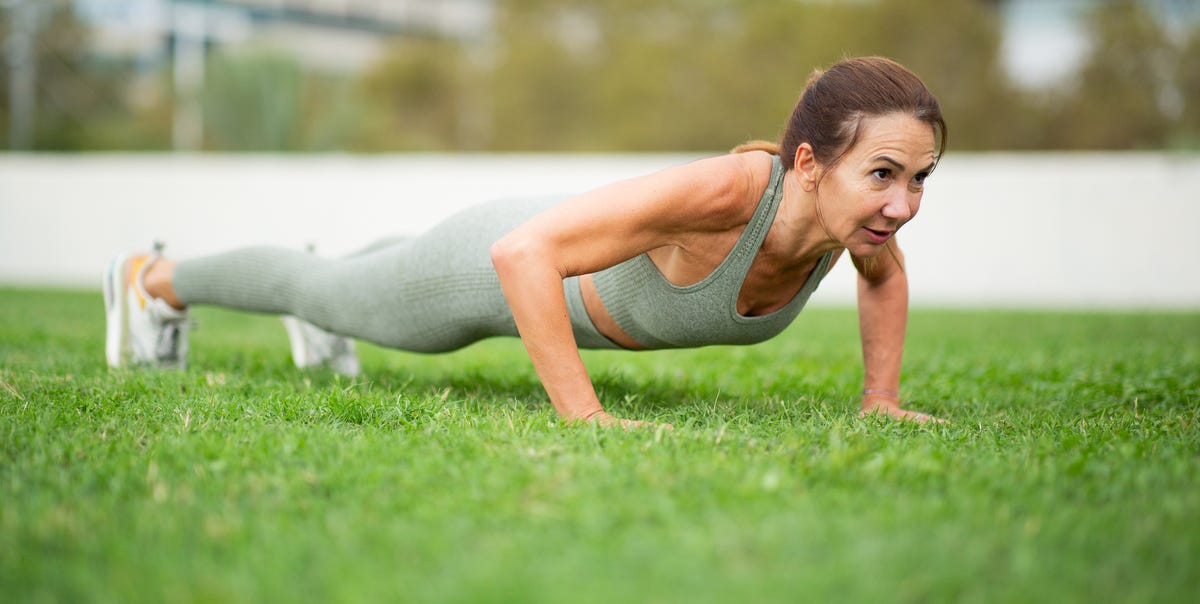
A new push-up ‘hack’ for women is trending on social media, where instead of pointing your fingers forward, you turn them outwards to around 90º, facing away from your body. With some videos getting nearly 680k likes, we break down how it can help you and if it’s a suitable technique to try.
How to do the push-up hack – and how it can help
The hack supposedly works because women have a larger carry angle – the natural outward bend at your elbow when your arm hangs relaxed at your sides – than men, to accommodate pelvic width and structure, says Daniel Booth, PT, strength and conditioning coach, performance psychologist and the co-founder of MyoLab Performance Concierge. In women, the angle is around 15º, whereas in men, it’s roughly 10º.
‘That means in a standard push-up, women are often working against their natural joint alignment, creating inefficiency and unnecessary strain at the elbow and shoulder before a single rep is even completed,’ he continues.
‘Rotating your hands outward brings your forearms more in line with that natural carry angle, so the force travelling through your joints during the push phase is better aligned with the bone structure beneath it,’ he explains. ‘This means less compensation, cleaner movement and – for a lot of women – a position that finally just clicks.’
Who should try the push-up hack
If you’ve always found push-ups uncomfortable at your wrist, elbow, or front of the shoulder without a clear reason why, your carry angle could be the culprit, continues Booth.
‘This tweak is particularly worth trying if your elbows tend to drift into an awkward middle-ground during reps – not quite flaring, not quite tucked – as your adjusted hand position can naturally resolve that,’ he explains. That creates a more anatomically honest starting point and a more stable base to push from.
When to use the push-up hack
This modification really earns its place when the goal is reducing joint stress without reducing load – and that’s a meaningful distinction, clarifies Booth.
‘For women returning from a minor shoulder or elbow injury, or who are managing conditions like lateral tennis elbow, the adjusted alignment allows continued training without aggravating your tissues under repair,’ he says.
The position shift is equally useful if you have limited wrist mobility or tighter forearm flexors, where your standard hand position demands a range that simply isn’t available yet.
‘In those cases, forcing the standard grip isn’t building better push-ups — it’s building compensation patterns. The rotation offers a way to train the movement honestly, within the mechanics you have,’ he explains.
Why the push-up hack may not be effective
If you don’t experience discomfort at your wrist, elbow or shoulder, have limited wrist mobility or aren’t injured in any of these areas, you don’t necessarily need the tweak.
‘There’s no strong evidence that women need a fundamentally different push-up technique,’ says London celebrity trainer and PT Aimee Victoria Long. ‘The main reason women often find push-ups harder is simply that, on average, they have less upper-body muscle mass relative to body weight than men, which makes the movement more challenging,’ she explains.
‘Rotating your hands excessively – particularly towards a 90-degree angle – isn’t generally recommended for most people, as it can place unnecessary strain on your wrists, hands and shoulders,’ she continues.
‘Excessive hand rotation can also reduce joint stability, so it’s usually better viewed as an individual variation rather than an optimal default technique,’ she adds. While small adjustments can be helpful, that should make the push-up feel stable and well-supported.
If you’re struggling to do push-ups, in many cases, concentrating on achieving better overall body alignment, controlled elbow tracking, and full range of motion will deliver greater benefit.
To build to a full rep, trainers usually recommend regressions such as incline or knee push-ups, which can help to increase strength while still requiring your upper body to lift less of your body weight, says Long.
Having a strong core is about far more than sporting a six-pack. Build functional mid-section strength – while also improving your power, posture, coordination and balance – with WH COLLECTIVE coach Izy George’s 4-week core challenge. Download the Women’s Health UK app to access the full training plan today.
 Related Stories