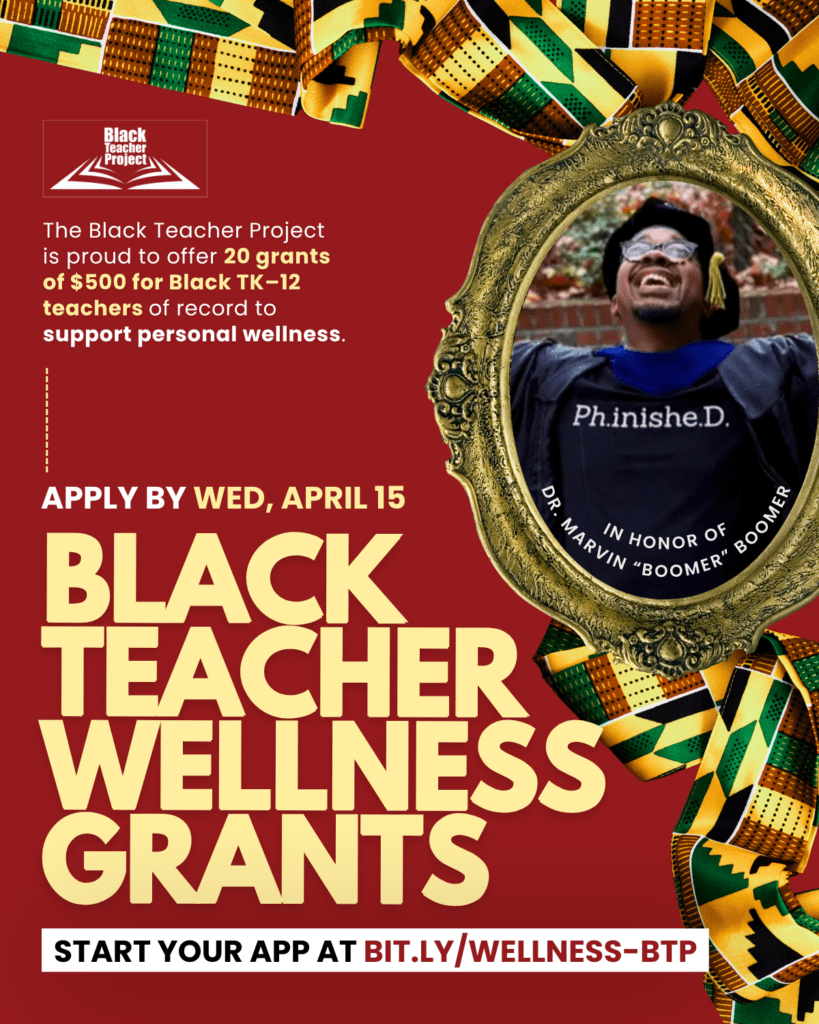
The Black Teacher Project (BTP) Wellness Grant represents a targeted effort to address one of the most overlooked dimensions of education systems globally: the wellbeing of Black educators.
In 2026, the initiative continues its mission to support Black teachers in sustaining their health, identity, and professional longevity while working within educational environments that are often structurally inequitable.
This grant cycle is not simply a financial award. It is positioned as part of a broader movement to reimagine schools as spaces where both students and educators can thrive. The program provides twenty $500 wellness grants to eligible Black teachers of record working in TK–12 classrooms. Its purpose is to support personal wellness and healing outside the classroom, recognizing that teacher wellbeing is foundational to educational transformation.
The initiative is administered by the Black Teacher Project in partnership with the National Equity Project. It is explicitly designed for teachers who identify as Black, African American, or part of the African Diaspora and who are currently serving as classroom teachers of record. The eligibility requirements are intentionally focused, reflecting the program’s commitment to centering the lived experiences of Black educators in the United States.
At its core, the Black Teacher Project is grounded in the belief that Black teachers play a critical role in dismantling inequitable education systems. Research consistently shows that students who have at least one Black teacher experience improved academic outcomes, stronger social-emotional development, and increased engagement in learning. Despite this evidence, Black educators continue to face disproportionate challenges within the education system, including racialized expectations, limited access to culturally responsive professional development, microaggressions, and systemic burnout.
The Wellness Grant directly responds to these conditions by prioritizing restoration, healing, and sustainability. It acknowledges that the work of teaching—particularly for Black educators—cannot be separated from the broader social and institutional environments in which it takes place.
The 2026 grant cycle is dedicated to the memory of Dr. Marvin Boomer, an Oakland-based educator whose legacy continues to influence education equity work. Known widely as “Boomer,” Dr. Boomer was recognized for his relational approach to teaching and leadership. He built trust-based relationships with students and colleagues, emphasizing collective uplift rather than individual recognition. His work reflected a belief that educational transformation is rooted in community connection and shared responsibility.
His legacy informs the philosophy behind the Wellness Grant. The program emphasizes that teacher wellbeing is not a personal luxury but a structural necessity. Without adequate support systems for educators, particularly those working within racially inequitable environments, efforts toward school reform and student success remain incomplete.
The grant provides direct financial support intended to help teachers access wellness resources. This may include mental health services, restorative practices, physical wellness activities, or other forms of personal care that contribute to emotional and psychological wellbeing. Importantly, the funding is not intended for student-facing projects but for teacher-centered healing and restoration outside the classroom environment.
The application process is structured through a Google Forms system and requires applicants to provide personal, professional, and demographic information. This includes confirmation of eligibility as a Black educator, current teaching role, school affiliation, and years of experience. Applicants must also confirm they have not received a prior BTP Wellness Grant in recent cycles, as the opportunity is reserved for new recipients.
The timeline for the 2026 cycle follows a structured review and selection process. Applications open on March 27 and close on April 15. A review period takes place from April 16 to April 27, followed by internal award communications between April 28 and May 1. Public announcement of awardees is scheduled for May 7. This timeline reflects the organization’s effort to balance accessibility with a structured evaluation process.
There are also important administrative considerations for applicants. Because the grant is administered within the United States, recipients must be able to receive payment domestically. Additionally, any funding exceeding $600 within a calendar year may be subject to IRS reporting requirements, with recipients receiving a 1099 tax form. These conditions highlight the formal financial structures involved in even small-scale education equity grants.
Beyond the financial component, the Black Teacher Project Wellness Grant reflects a broader philosophical commitment to educational justice. It challenges the assumption that teacher resilience alone is sufficient to sustain educational systems under strain. Instead, it argues that systems themselves must be restructured to support the wellbeing of educators who have historically been marginalized within them.
This framing is particularly significant in the context of ongoing discussions about teacher retention, burnout, and equity in education. Across many school systems, Black teachers are underrepresented in leadership roles while simultaneously overrepresented in disciplinary and pastoral expectations. This imbalance contributes to emotional labor that is often unrecognized and uncompensated.
By centering wellness, the grant reframes teacher support as a prerequisite for educational transformation rather than an optional benefit. It recognizes that sustained impact in education requires not only professional development and policy reform but also intentional investment in the human beings who carry out daily instructional work.
The Black Teacher Project situates this initiative within a larger vision of liberation-oriented education. This vision emphasizes collective wellbeing, shared leadership, and the dismantling of oppressive structures within schooling systems. It also highlights the importance of cultural identity and lived experience as central to effective teaching practice.
In this context, the Wellness Grant becomes more than a funding mechanism. It becomes a symbolic and practical intervention that acknowledges the value of Black educators’ labor, identity, and wellbeing. It affirms that supporting teachers holistically is essential to achieving long-term educational equity.
As education systems continue to confront issues of inequality, burnout, and workforce instability, initiatives like the Black Teacher Project Wellness Grant offer a model for how targeted, identity-conscious funding can contribute to systemic change.
By investing directly in the wellbeing of Black educators, the program reinforces a broader commitment to educational environments where both teachers and students can thrive.
For more opportunities such as these please follow us on Facebook, Instagram, WhatsApp, Twitter, LinkedIn and WPChannel
Disclaimer: Global South Opportunities (GSO) is not the organization that is offering this opportunity. For any inquiries, please contact the official organization directly. Please do not send your applications & CVs to GSO, as we are unable to process them. Due to the high volume of emails, we receive daily, we may not be able to respond to all inquiries. Thank you for your understanding.
Related