
Breadcrumb Trail Links
May even prompt food producers to ‘improve the nutrient profile’ of their products
Published Apr 14, 2026 • Last updated 2 minutes ago • 4 minute read
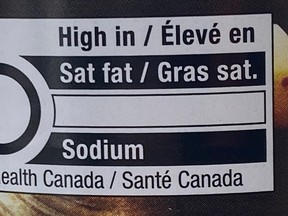 The front-of-package nutrition symbol on this can of clam chowder warns of high saturated fats and high sodium levels. Photo by Jeffrey Ougler /The Sault StarArticle content
You likely knew that beloved bowl of clam chowder was chalk-full of sodium. And, as for those crispy potato chips that seem to go hand-in-hand with TV binge watching …
Advertisement 2
This advertisement has not loaded yet, but your article continues below.
Article content
If anyone requires a reminder of a favourite food’s darker side, a relatively new black-and-white symbol on many packaged edible items is geared to do just that. Or, perhaps, even impart an unknown nutrition detail.
Article content
Recommended Videos
Article content
The bottom line is many consumers already understand that heavily processed foods tend to contain higher amounts of added sodium or sugar. And front-of-package nutrition symbols merely afford added “evidence-based” ammunition to make wise choices, says an Algoma Public Health dietitian.
“I think this gives consumers one more tools in their toolbox to make informed choices,” Lindsay Fera told The Sault Star in a recent interview.
“I think that they will (take heed) … certainly those who are looking to make an informed choice, it’s going to help them do that.”
The Government of Canada is requiring a front-of-package nutrition symbol on prepackaged foods that are high in saturated fat, sugars or sodium. Health officials say regularly consuming high amounts of those nutrients can increase the risk of stroke, obesity, heart disease, Type 2 diabetes, high blood pressure and some cancers.
Advertisement 3
This advertisement has not loaded yet, but your article continues below.
Article content
The symbol features a magnifying glass and clearly indicates whether a product is high in saturated fat, sugars, sodium or a combination of the three. It also includes the words “Health Canada / Sante Canada,” signaling that it is government mandated.
According to Health Canada, the label is intended to help shoppers make quicker, more informed choices and to support health professionals when teaching about nutrition.
LAW OF THE LAND
The symbol is mandatory on prepackaged foods that meet or exceed set thresholds for the targeted nutrients, though several categories are exempt. These include fruits and vegetables without added fat, sugar or salt, plain milk and yogurt, raw single-ingredient meats and poultry, very small packages and certain products used primarily as seasonings, such as butter, sugar, salt and honey.
Labels don’t necessary have to be a downer, Fera said. Employing moderation and common sense is always good food for thought.
Advertisement 4
This advertisement has not loaded yet, but your article continues below.
Article content
“All foods can fit in that healthy eating pattern, and all foods provide energy and nutrients,” Fera said. “But we do know that some foods are more dense in nutrients that support optimal health outcomes. And the front-of-package label is another tool to help consumers make informed decisions.”
The food industry was given until Jan. 1 to make this change. However, some front-of-package nutrition symbols may have appeared earlier. Or later.
“We have to keep in mind, too, that like some canned items have a long shelf life,” Fera said. “So, I’m not sure if we just haven’t gone through all the stock, but I’ve certainly been seeing more and more of it lately.”
QUALITY VERSUS QUANTITY
Few will argue the Canada Food Guide is out to lead consumers astray. But healthy foods, these days, do cost more than grub chalk-full of empty carbs, and the playing field is not equal when it comes to having the economic wherewithal to purchase what pundits pitch as most healthy and nutritious.
Advertisement 5
This advertisement has not loaded yet, but your article continues below.
Article content
So, will the one-quarter of regional households Algoma Public Health recently pegged in a report as stomaching food insecurity give a hoot about labels when the goal might be to merely put food on the table?
“Nutrition is one of many factors that people may consider when purchasing food, but price and budget is definitely another significant factor,” Fera said.
From 2023-2024, the prevalence of household food insecurity in Algoma was 25.6 per cent, or about one in four households, Monitoring Food Affordability in Algoma: 2025 Nutritious Food Basket found. The provincial rate for the same period was 24.8 per cent.
Household food insecurity refers to inadequate or insecure access to food due to financial constraints. Food insecurity, income and housing, are “critical” social determinants of health that significantly impact health outcomes across the lifespan, the report said.
In fact, children and adults living in food insecure households are more likely to suffer from a range of physical and mental health challenges, leading to greater demand on health-care services, higher rates of hospitalization and elevated risk of premature death.
Advertisement 6
This advertisement has not loaded yet, but your article continues below.
Article content
WHAT IF THERE ARE FEW CHOICES?
And what if you have little say in what you eat, as a good chunk of your meals come from a food bank – a sad and growing trend in Sault Ste. Marie and area.
St. Vincent Place’s assistant executive director Sara McCleary said the findings around food insecurity “fully align” with what is being seen at the downtown Sault Ste. Marie food bank. Since the beginning of January, food bank demand has grown by 85 per cent compared to the same period last year; 491 families in 2025 compared to 908 this year.
“Of particular note is that many of these clients have never accessed our food bank before,” McCleary told The Sault Star earlier, adding the service has seen 56 per cent more “new” clients compared to last year.
St. Vincent Place is also seeing an increase in the number of individuals or families whose primary source of income is employment, but as has always been the case, those on ODSP and OW make up the large majority of those in need of help; 41 per cent and 31 per cent of clients respectively.
Advertisement 7
This advertisement has not loaded yet, but your article continues below.
Article content
“Food insecurity is an unfortunate reality that far too many local families are now facing, and I suspect that the challenging times are only beginning,” McCleary said.
APH says labels are mandatory for all package foods, which will include some lower-cost items such as frozen and canned products.
The policy is not limited to name brand items, said Fera, adding that, for example, labels may help someone choose canned beans, which are lower in sodium.
“A potential positive outcome of this is that it could motivate food companies to improve the nutrient profile of their products, which would benefit the entire population,” she added.
Article content
Share this article in your social network