
This article is sponsored by Needed. Thank you for supporting the brands that support Motherly and mamas.
Julie Sawaya was a trained nutritionist. She shopped at the farmer’s market. She was intentional about everything she put in her body. And when she pricked her finger for an at-home nutrient test during business school at Stanford, she was sure the results would confirm what she already knew: she was doing everything right. Instead, almost every single nutrient on the panel came back in the red zone.
That shock—shared by her co-founder and fellow nutritionist, Ryan—became the seed of Needed, a perinatal nutrition company built on a simple but startling premise: 97 percent of pregnant women take a prenatal vitamin, and yet 95 percent are still nutritionally depleted. The problem, Sawaya and her team discovered, isn’t that women aren’t trying. It’s that the standard most prenatal vitamins are designed around dates back to 1941 and is based largely on research conducted on men.
In this episode of the Motherly Podcast, Sawaya sits down with Liz Tenety to talk about what optimal nutrition actually looks like during pregnancy and postpartum, why depletion has been normalized for mothers in this country, and what it’s been like to build a company—and a family of three—at the same time.
Meet the expert
Julie Sawaya is the co-founder of Needed, a science-backed perinatal nutrition company that provides high-quality vitamins and supplements designed to address the significant nutritional gaps women face before, during, and after pregnancy. A Stanford MBA and trained nutritionist, Sawaya co-founded Needed alongside Ryan Woodbury after discovering that despite their expertise, both were massively nutritionally depleted—a finding that mirrored what clinical research shows for the vast majority of women. Needed is now recommended by more than 15,000 women’s health practitioners. Sawaya is a mother of three who had four pregnancies while building the company.
Liz Tenety: What surprised you about motherhood?
Julie Sawaya: Probably the most honest answer is just how much I love it. I knew that I wanted kids, but I didn’t realize how much I would enjoy being a mother. The day to day of being a working mom is challenging, but it’s by far the best thing that’s ever happened to me—three times over. Prior to pregnancy, I wasn’t sure I was going to enjoy being pregnant. But the actual physical act of being pregnant, I enjoyed a lot more than I expected. It just felt magical in a way that I couldn’t have understood before becoming pregnant.
Liz Tenety: What was becoming a mother like for you?
Julie Sawaya: I’m a trained nutritionist, as is my co-founder, Ryan. We actually started working on Needed prior to becoming pregnant ourselves, so I came into my pregnancy experience knowing a lot about how I wanted to prepare. My first daughter was born in 2020—she was a COVID baby. I grew up in a medical family, so I started out planning a hospital birth, but when hospital policies changed around birthing support, I ended up changing my birth plan around 28 weeks and worked with a home birth midwife. It was a really smooth, beautiful birth experience, but totally unexpected.I’ve been pregnant a total of four times. I had a loss in between my first and second daughters—a missed miscarriage at 11 weeks. The experience of going through a loss and then subsequent pregnancies in the care of a midwife with an amazing backup OB was really profound. It’s really the standard of care in other countries that have phenomenally improved birth outcomes versus the U.S.: midwifery as the standard for low-risk pregnancies, done in complement with a higher-risk OB when you need it.
Liz Tenety: What was the aha moment that led you to found Needed?
Julie Sawaya: Ryan and I were next-door neighbors in business school at Stanford. In 2016, at-home nutrient testing was becoming accessible, and we did it thinking it was going to confirm we knew our stuff. We’re the super nerds shopping at the farmer’s market, being really intentional. What we found was exactly the opposite—we were both massively nutritionally depleted. In my case, almost every single nutrient was in the red zone.We ended up diving into the problems of women’s nutritional depletion, and we found it’s a relatively silent but ubiquitous epidemic. Upwards of 95 percent of women are nutritionally depleted across many stages of health. And if you zero in on pregnancy, that deficiency persists despite 97 percent of pregnant women taking a prenatal vitamin.
“97 percent of pregnant women take a prenatal vitamin, and yet 95 percent are nutritionally depleted.”
Liz Tenety: So what’s broken? What about prenatal nutrition is failing women?
Julie Sawaya: What it takes to nourish a woman is orders of magnitude different from what’s in a standard prenatal vitamin. Most prenatal vitamins in the U.S. are designed around a nutritional standard that came out of 1941, established under the conditions of wartime scarcity. The paradigm of RDAs—recommended daily allowances—is basically the minimal amount of nutrition needed to avoid disease. Those RDAs are 85 years old, and 83 percent of the research studies that underpin the pregnancy and breastfeeding RDAs don’t include pregnant and breastfeeding women. Most of the research is done on men, and then it’s estimated what women need from that. So it’s a bare minimum paradigm, not an optimal one.
Liz Tenety: Why has nutrition been so underemphasized within pregnancy care?
Julie Sawaya: First, the system of medicine really doesn’t emphasize nutrition. Most doctors receive less than four hours of nutritional training in four years of medical school, and they typically aren’t referring out to registered dietitians. Most women just don’t have access to someone who can go deep on nutritional recommendations.Second, most OBs in the U.S. have average appointment times of 12 minutes. Nutrition often isn’t a focus unless there’s a diagnosis like gestational diabetes. In my own first pregnancy, the question was, are you taking a prenatal? I said yes. And that was it—no follow-up about which one, what’s in it, what else I’m eating. Just check the box. From the thousands of consumer interviews we’ve done at Needed, the most common answer when patients ask which prenatal to take is: take anything, they’re all the same.
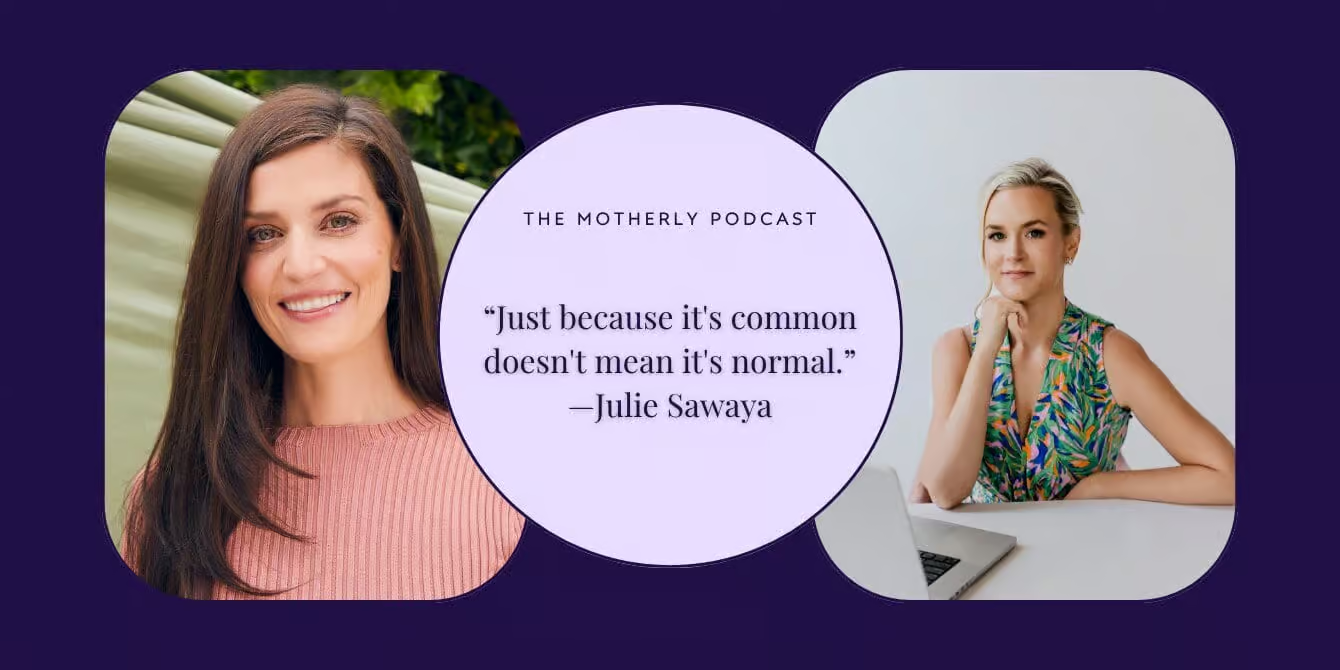
“Just because it’s common doesn’t mean it’s normal.”
Liz Tenety: Why does the nutrient environment preconception, during pregnancy, and postpartum matter to the woman, to the baby, and to society?
Julie Sawaya: Nutrition is proven to change outcomes. Pregnancy-related conditions like gestational diabetes, hypertension, and preterm birth all have a proven nutritional link. Beyond birth, there’s strong research showing that choline consumed in utero has cognitive benefits for the child three to five years out.But an area we’re really passionate about is women’s own wellbeing. Our bodies are really good at prioritizing the baby’s needs during pregnancy, so the difference between optimal and minimalistic nutrition is felt most by mom. In the case of omega-3 and folate, the body literally pulls from the maternal brain to give to the baby. Pregnancy, fertility, postpartum is the most nutritionally demanding time of a woman’s life. And the time period between stopping breastfeeding and the onset of perimenopause—the second most nutritionally demanding time—it’s not that long. It’s this kind of forgotten time period.
Liz Tenety: How is Needed different?
Julie Sawaya: We started with the question of what is optimal—not what can fit into a certain number of pills, not what would hit the right price point or profit margin. A lot of products on the market are simply white-labeled: a manufacturer stocks a standard prenatal, you change the branding, tweak a nutrient or two, and you can launch in a couple of months. Needed spent three and a half years in deep product R&D.Our eight-capsule prenatal multivitamin pro is practitioner-grade, optimizing 26 vitamins and minerals—it’s 12 times more nutrition than the average of the leading prenatals. Our three-capsule prenatal is eight times more. But we’re not about “more is more” all the time—we actually dose lower than many peers in folate, because more is not always better. We take a systems approach: every product is designed to be safe to take alongside the others, from our egg quality support through cycle support and perimenopause.
Liz Tenety: Why do you think we live in a world that has normalized women being depleted?
Julie Sawaya: It has been normalized to feel exhausted, to self-sacrifice for the family, to make everything work at work, and to not feel great. At the same time, women are under so much societal pressure to bounce back right away. Many women in the U.S. have no paid leave and are expected to return to work at two weeks postpartum. It’s going to take a major cultural shift.The products are necessary, but they’re insufficient on their own. What it takes is first making women aware of the signs of depletion—normalizing that this is a thing that’s happening and there is a different way. We never set out to create a supplements brand. We very much hope there’s a future state where products like Needed are not needed. But women who are undernourished can show up so much more fully in all the ways that matter—at home, at work—if we’re not starting from a place of nutritional deficiency.
“The body literally pulls from the maternal brain to give to the baby.”
Liz Tenety: You had three children and four pregnancies while building this company. How do you combat depletion in your own life?
Julie Sawaya: I keep my vitamins literally on my desk because if I don’t, I’ll forget to take them. My kids are actually pretty good at reminding me now. Even with all the information I know, it’s still hard to build a habit. The reason I try to be intentional is because I know I feel better—my stress response is different.Outside of nutrition, I try to get outside daily or at least move my body. I try to not doom-scroll late at night. And I’m very protective of my weekend time with my kids. The mission at Needed is in and of itself anti-depletion for me, but I still need boundaries. It’s hard to be a founder. It’s hard to be a working mother. And I know from family and friends where motherhood is their number one job—that is also really, really hard.
Liz Tenety: If you had a magic wand and could change one thing about how we support mothers in this country, what would it be?
Julie Sawaya: Centering the importance of mothers in our society and heroing women for the role they play every single day. It sounds cheesy, but literally every day should be Mother’s Day. Moms are the foundation of our society, and in an environment with declining birth rates, we need to figure out how we fundamentally shift what we prioritize as a country and emphasize mothers and children as the most important thing there is.
Liz Tenety: At Motherly, we believe that motherhood brings out our superpowers. What do you see as yours?
Julie Sawaya: Showing up and making people feel seen and supported in a group setting. Being a mom of three, I’m often parenting not individually but in a group, finding a way to be there for everyone individually and for the group overall. That feels resonant at Needed too, as our team has grown.Back to your earliest question—I really thought becoming a mother would change my ability to work in a negative way. If anything, it’s done the opposite. It’s allowed me to be so much more efficient, clear in my priorities, clear in my communications. I wish I had known that in my twenties—to not be afraid of it, to embrace it.
This interview has been edited and condensed for clarity. Listen to the full conversation on the Motherly Podcast.