
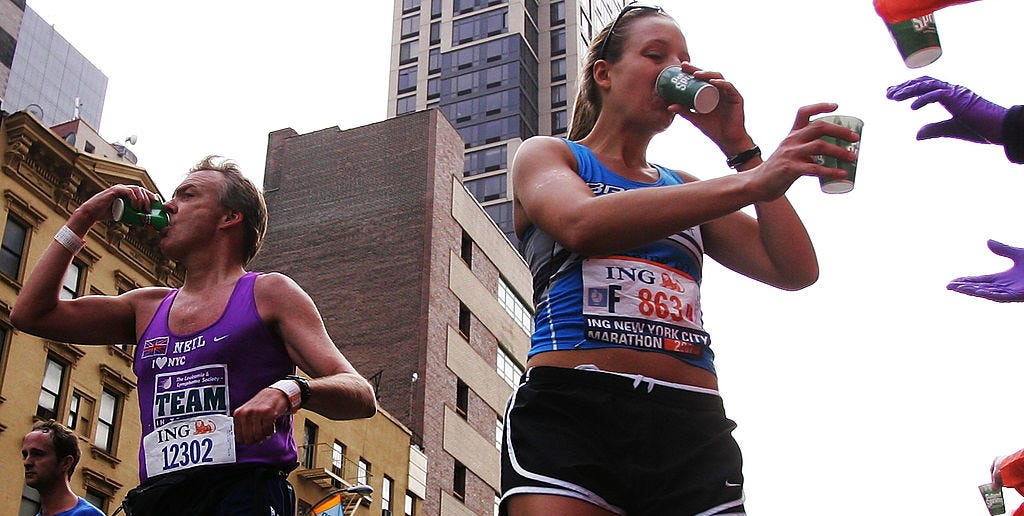
We’re a week out from the London Marathon, which means up and down the country, nervous marathon runners are eagerly discussing everything from their race day shoes to which flavour gels they’re cramming into the waistband of their shorts. And while some runners won’t give a second thought to their race day hairstyle (French braids or ponytail?!), one topic sure to be on everyone’s lips – no matter how fast or slow they plan to complete those 26.2 miles – is the weather.
Last April, temperatures hit 22.2°C in London – and while it wasn’t quite a record for the hottest marathon day (that was back in 2018 when it got to 24.2°C in the capital) – it did force runners to think about their hydration strategy.
So if you’re reading this (especially if you’re running next weekend), and you’re thinking what on earth is a hydration strategy, buckle in – staying properly hydrated during a marathon can be the difference between a great race and a truly awful one.
‘If you wait until you feel thirsty or low on energy, you’re already playing catch-up,’ says Olympic marathon runner Rose Harvey – showing that elite runners don’t leave hydration up to chance, so neither should you.
The most common hydration mistakes 1. Following a generic hydration plan
The most common mistake, says Dr Sam Shepherd, RNutr, Head of Sports Science at Precision Fuel & Hydration, is ‘following a rigid, one-size-fits-all drinking schedule rather than listening to your body and understanding your individual needs. Many runners are told to “drink X amount per hour” without any consideration of how much they actually sweat – and sweat rates can vary by up to 15 times between seemingly similar athletes.’
This is why elite runners take a much more personalised approach. Harvey, for example, bases her hydration on sweat testing, which showed she loses around 1000mg of sodium per litre of sweat – something she then actively replaces during races.
Hydration is not a fixed science, adds Dr Shepherd. ‘Your sweat rate, your sodium concentration, the temperature, the humidity, your pace; all of these change the equation. A personalised approach accounts for that in a way a generic plan simply can’t.’
2. Relying on just water
‘Water alone doesn’t replace what’s lost in sweat,’ says Dr Shepherd. ‘Over time, this can cause your sodium levels to drop, impairing performance and, in serious cases, contributing to hyponatremia.’
Harvey says she adds electrolytes to her carb drinks to match her sweat needs. She also adjusts her hydration strategy depending on the conditions. In hotter weather, when sweat losses are higher, she relies more heavily on drinks rather than gels – helping her take on both fluid and electrolytes at the same time.
‘The key is taking fluid in small, regular amounts rather than large amounts at once, which can cause stomach issues,’ she explains.
Related Story3. Starting too late
Another common mistake runners make is leaving their fuelling and hydration until they feel they need it – by which point it’s often too late to recover.
‘Some runners under-drink and arrive at the finish line significantly dehydrated’, says Dr Shepherd.
That’s why elite runners build their strategy around starting early. Rose Harvey, for example, begins hydrating well before the race starts. ‘The night before the race I’ll have a carb drink with slightly stronger electrolytes (usually PH 1500) to preload on salts and top up glycogen stores’. She also sips on a carb and electrolyte drink on race morning.
‘During the race, I take 30g of carbohydrate every 5km, which works out at roughly every 17 minutes. I use a mix of gels and carb drinks depending on the conditions – if it’s warmer, I’ll rely more on drinks, whereas if it’s cooler, I prefer gels.’
Related Story4. Overhydrating
On the other end of the spectrum, you can end up diluting your body’s sodium levels if you drink too much water. ‘When you drink more fluid than your body can absorb or excrete, particularly plain water, you dilute the sodium concentration in your blood,’ explains Dr Shepherd.
‘Sodium is critical for maintaining fluid balance, nerve function, and muscle contraction. When blood sodium drops below normal levels, you develop a condition called hyponatremia.’
The cruel irony, he says, is that the symptoms of overhydration can closely mimic those of dehydration – nausea, bloating, confusion – so ‘well-meaning runners sometimes respond by drinking even more water, making the situation worse’.
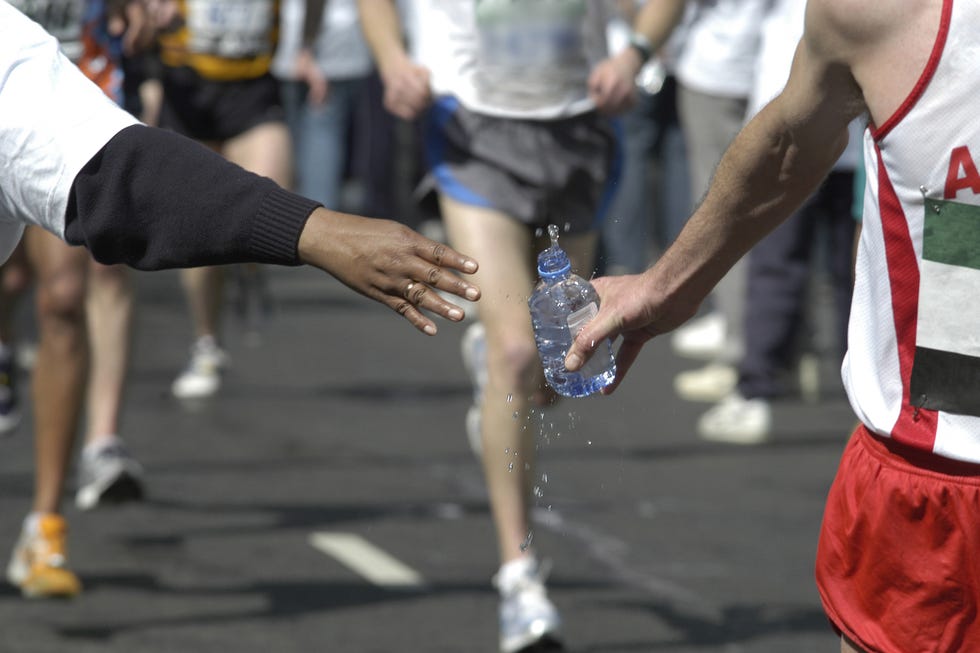 grahamheywood//Getty Images
Everyone loses a different amount of sodium in their sweat and, if you don’t replace that right, you risk hydration-related issues like cramps, dehydration and hyponatremia
So, what does a ‘perfectly hydrated’ marathon actually look like?
A well-hydrated marathon is one where you’ve done the preparation before race day, not just during it, says Dr Shepherd. ‘That means arriving at the start line already in a good hydration state, not dehydrated from the journey or over-hydrated from nervous over-drinking the night before.’
During the race, the goal isn’t to replace every drop of sweat lost, he explains. ‘Some degree of body weight reduction (up to around 2-3%) is normal and doesn’t necessarily hurt performance. What matters is replacing enough fluid and sodium to keep your body functioning well.’
Related Story
In practice, this means drinking to thirst (rather than to a strict schedule) and using electrolyte drinks rather than water alone for anything longer than about 60-75 minutes.
‘You’d finish the race feeling like you’ve performed well, without the tell-tale signs of either camp: no headache, nausea or cramping from under-hydration; no bloating, low sodium symptoms or heavy legs from over-drinking,’ he adds.
How to figure out your sweat rate: Weigh yourself (without clothes) before and after a run of known duration, accounting for any fluid you drank during it. Every kilogram of weight lost equates to approximately one litre of sweat. Do this across a few different sessions and conditions, and you’ll start to build a reliable picture of how much you lose per hour.
The bottom line
Ultimately, hydration isn’t about drinking more (more fluid is not always better) – it’s about drinking smarter. And as both the science and the elites show, the runners who get it right aren’t guessing on race day – they’re executing a plan they’ve already tested, and replacing sodium alongside fluids.
Harvey’s top tip for race day? ‘Have an electrolyte drink the night before and on race morning, and stay on top of fluids early in the race. If you’re able to carry salt tablets during the race, that can also help replace the sodium you’re losing through sweat.’
Related Stories