
Emily Peacock’s Babycakes begins where a joke begins — with timing, pressure, and a face kept almost straight — yet the show never settles for the quick pleasure of a punch line. At Seven Sisters, Peacock builds a small theater of tender hazards: a loose tooth, a cigarette, baby’s breath, a child’s blister, a lock of hair, a burning marshmallow, a tray of dead butterflies, a cake under duress, a body kneeling in the grass as if prayer had wandered into the wrong century and decided to stay. The props arrive dressed in pastel and velvet, in confectionary pinks and aquariums of turquoise, in the colors of birthday frosting, hospital mints, nursery walls, and low-budget glamour. They look soft enough to trust. Then Peacock lets the trust wobble. She tests the limits of sanity — sanity understood less as clarity than as a hopelessly bourgeois allegiance to the tepid, the normie, the lukewarm.
That wobble gives the exhibition its pulse. Babycakes moves through sweetness the way someone might move through a room full of family heirlooms while drunkenly carrying a lit cigarette — carefully, irreverently, and stumbly with affection and a slight desire to see what burns first. Peacock understands that sentiment usually collapses under very little force. A middle finger sinks into icing. Ahhh. Wind-up teeth clamp down on cigarettes. Swoon. An ashtray holds both butts and butterflies, as though the remains of a bad evening and the remains of a brief life had found each other by aesthetic instinct. The work courts prettiness, then leans on it until prettiness gives up some truth.
 An installation view of Emily Peacock’s “Babycakes” at Seven Sisters
The title helps. Babycakes arrives petting, teasing, faintly unhinged — the kind of phrase suburban femininity already tried to flatten into a “Live, Laugh, Love” cliché; the sort of word that enters a room already wearing perfume and quotation marks. Peacock likes language that arrives overhandled by culture. The press release invokes Edward Ruscha, and that feels right, though not because Peacock borrows his cool so much as because she shares his appetite for phrases that wobble between deadpan, affection, throwaway, and threat. Her titles do real work. Pretty, Witty, Shitty could pass for a self-diagnosis, a dating profile, a review of the whole emotional economy; it also names the show’s tonal system with rude efficiency. Peacock never divides beauty from pettiness, humor from grief, care from damage. She lets them share a bed and figure out the terms later.
 Emily Peacock, “The One I didn’t lie to,” 2025, archival inkjet print, 26 10/16 x 38 3/4 inches
What makes the exhibition stick, though, lies less in the titles than in Peacock’s feel for staging. The photographs and sculptural photo-objects never pretend toward spontaneity. These scenes know their angles, their textures, their color temperatures. Baby’s breath recurs like a florist’s version of a sigh. Satin puddles across tabletops and backdrops in folds so lush they take on a synthetic glamour, as though softness itself had entered the studio as a prop. Bottles line up like green-blue ghosts in The One I Didn’t Lie to, each one holding a little cloud of white bloom. The title turns the arrangement from still life into confession. Suddenly those vessels hold less water than memory. The bottles begin to read as stand-ins for people kept in a lineup of fragile honesty, each one empty, each one transparent, each one carrying just enough decoration to look cared for. Peacock has a gift for that tiny turn in the screw: the object stays itself while also becoming emotionally inconvenient.
 Emily Peacock, “Baby Tooth,” 2025, archival inkjet print, 9 3/4 x 12 3/4 inches
A similar doubleness sharpens the smaller, seemingly quieter works. Baby Tooth could have come from any family archive — the obligatory close-up of a child’s mouth in transition, developmental loss reframed as milestone. Yet in this company the image sheds nostalgia’s usual blur. The gap in the gums looks adorable, of course, and also faintly brutal. Childhood enters Peacock’s work not as innocence preserved but as a sequence of tender extractions. Teeth fall out. Skin blisters, then hardens. A child’s hand in about ready to pop carries a raised bubble on the fingertip that reads at once as wound, effort, and tiny prophecy. The title makes the blister comic, but the photograph holds its little ache with real seriousness. So much of family life works exactly like this: pain translated into anecdote, damage softened into a story you tell with a laugh so the room can keep breathing.
The bird photographs push that logic further and deepen the show’s emotional weather. Mordecai, with its tiny fledgling poised in Peacock’s tattooed palm against a black field, feels almost indecent in its vulnerability. The chick’s yellow beak opens upward with the absolute trust of need. No irony can entirely protect that image, though Peacock still keeps a dry edge in the title. Elsewhere, Feeding Frenzy turns the sky into a scene of appetite and aerial impatience, gulls caught midswoop like scraps of white paper animated by hunger. Taken together, the two works give the show a vertical axis: open mouth below, circling mouths above; helpless dependence on one end, opportunistic scrambling on the other. Peacock’s world never separates nurture from appetite for very long. Care arrives hungry. Hunger arrives theatrical.
 An installation view of Emily Peacock’s “Babycakes” at Seven Sisters
That tension between care and performance runs through the body-based works, where the exhibition grows stranger and harder. In the only son of a photographer, a tiny snail traverses the broad curve of a bare back. The title opens the image into a field of inheritance, favoritism, authorship, maternal gaze, and sly absurdity. A snail on skin ought to feel whimsical; instead it feels uncannily precise. Time slows. Touch almost vanishes into weightlessness. The body becomes landscape, pedestal, and condition of looking all at once. Peacock often works this way — taking a setup that might easily drift into gimmick, then holding it still, long enough for mortality to enter from the side.
She pulls off an even riskier maneuver in Notes on Impulse Control, one of the show’s anchors. The image presents Peacock on all fours in the grass at night, pink clothes pooled around her legs, a single candle rising absurdly and vulnerably from behind, the frame bordered below by a row of melted candles like a chapel after a nervous breakdown. It would be easy to read the work as transgression packaged for effect, but Peacock’s intelligence lies in how she refuses clean routes into scandal or confession. The picture carries humiliation, comedy, erotic theater, devotional residue, self-parody, and real exposure in the same breath. That tonal compression gives the piece its force. The title promises discipline; the image offers ritualized leakage. It knows exactly how ridiculous it looks. It also knows ridicule cannot fully account for what a body does with its loneliness, its need for attention, its urge to turn desire into a ceremony just to watch the ceremony fail with style.
Like Notes on Impulse Control, Proof of Affection pushes the photograph into objecthood, though here the assemblage logic hardens more explicitly. A framed image of marked skin sits above a row of chattering teeth, turning the work into a small architecture of evidence, repetition, and display. Affection leaves impressions, the piece says, but impression never guarantees comfort. The work literalizes what many of the photographs already imply: love marks the body; repetition turns marking into habit; habit acquires a mechanical grin. The chattering teeth matter because they drag the whole thing toward toy logic, toward vaudeville, toward the comedy of compulsion. One can laugh at them. One can also recognize the joke’s cold center. Teeth chatter whether anyone listens or not.
 An installation view of Emily Peacock’s “Babycakes” at Seven Sisters
That understanding of compulsion animates some of the most biting still lifes in the exhibition. Loosie places baby’s breath in a magenta bottle pierced by a cigarette, turning the vase into both body and habit, ornament and damage. I Run My Mouth Off stacks wind-up dentures, each one gripping a cigarette against a pink backdrop so sweet it almost curdles. The image looks instantly funny, then a little sad, then strangely exact about social performance — about chatter as reflex, vice as accessory, self-sabotage wound up and set loose to clack across the room. Pretty, Witty, Shitty, with its ashtray of cigarette butts and dead butterflies perched on pink satin, offers the show in miniature: elegance sharing space with residue, decoration keeping company with waste, the whole arrangement hovering between an afterparty and a wake. Peacock trusts the ashtray more than a lesser artist would. She knows it already contains a full moral drama: appetite, pause, crush, discard, repeat.
The floral and relic-like pieces extend that drama into another register — one closer to shrine, keepsake, and private altar. The Delicate places pink underwear in a wreath of baby’s breath with enough compositional devotion to make the object feel cherished, mocked, and mourned at once. The Tress frames a lock of hair within the same floral logic, turning bodily remainder into emblem. The Honorable, with its foil-covered sword laid across turquoise satin and flowers, lets a child’s idea of valor slide into pageantry and loss. These works could easily have tipped into the merely precious. Peacock saves them through tonal interference. She never allows reverence the final word. Every shrine in Babycakes carries a trace of drag, craft-store glamour, or adolescent over-investment. That trace keeps the work alive. Memory, after all, rarely arrives in noble form. More often it comes wearing cheap satin and insisting on its own importance.
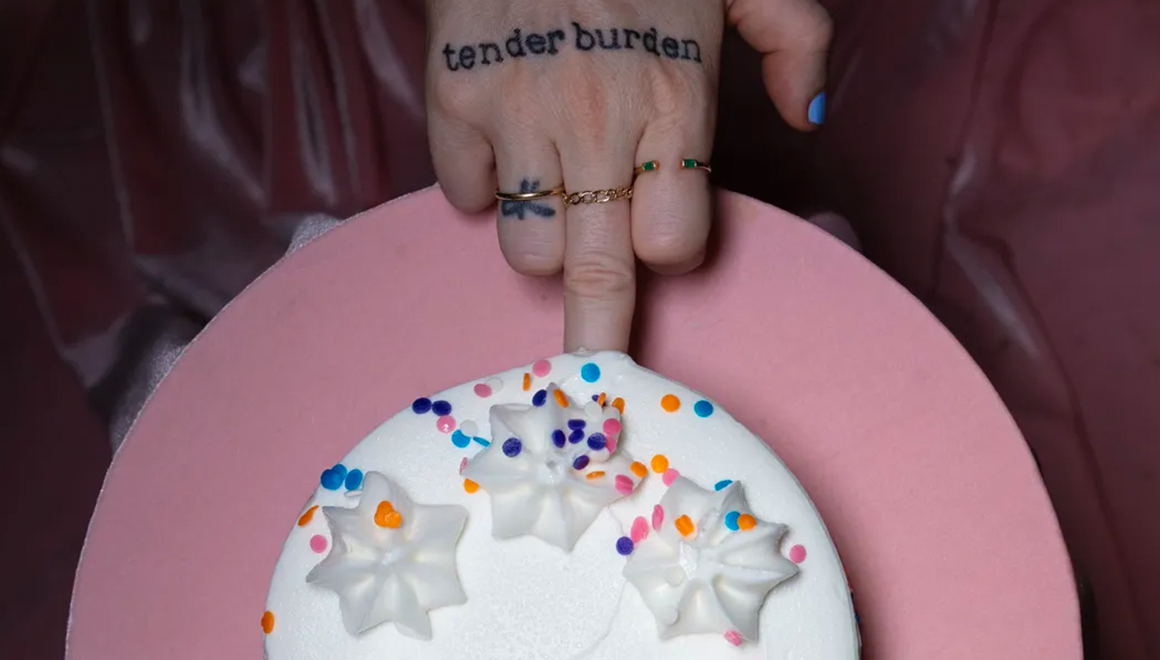
 Emily Peacock, “Tender Burden,” 2025, archival inkjet print, 18 3/4 x 12 3/4 inches
One of the show’s most incisive gestures arrives in Tender Burden, where a tattooed hand presses a finger straight into the immaculate white top of a cake. The phrase on the hand does half the work; the fingertip does the rest. Few images here summarize Peacock’s intelligence so cleanly. Celebration and resentment meet in one touch. The cake looks festive, almost prim. The hand interrupts that whole regime of niceness with a pressure that feels both childish and philosophical. To care for someone, the work hints, often means developing fantasies of vandalism alongside acts of service. Burden rarely arrives without tenderness; tenderness rarely arrives free of annoyance, appetite, or fatigue. Peacock neither condemns nor excuses the gesture. She simply stages it with exquisite clarity.
The show’s power finally rests in how lightly Peacock carries material that could have grown heavy in clumsier hands. She never pleads for pathos. She never mistakes disclosure for depth. Her comedy keeps the work ventilated; her grief keeps the comedy from becoming cute. Even the softer images — the bottles, the flowers, the bird, the child’s blister — carry an aftertaste of attrition. Even the harsher ones keep a strange courtesy toward beauty. Peacock seems interested in that narrow strip where adornment and damage begin to resemble one another, where the domestic tableau starts admitting evidence, where care leaves a mark that looks uncomfortably close to appetite.
By the end, Babycakes reads less like a suite of images than like a manual for surviving sentiment without surrendering to it. Peacock knows that tenderness in adult life rarely appears in pure form. It arrives mixed with nicotine, sarcasm, embarrassment, ritual, bodily comedy, maternal dread, decorative instinct, and the occasional wish to ruin the cake before anyone asks you to cut it nicely. That mixture gives the show its emotional accuracy. Peacock does not mock sweetness from a superior distance; she handles it, bruises it a little, watches what leaks out, then sets the whole arrangement under flattering light. The result feels sly, yes, but also unusually bold. Not bold in the loud sense. Bold in the quieter one — the kind that lets beauty stay in the room after the joke lands, and lets the joke stay in the room after beauty has started to hurt.
Emily Peacock: Babycakes is on view through May 16, 2026, at Seven Sisters gallery in Houston.