
Breadcrumb Trail Links
WellnessTravelTravel CanadaTravel Guide
Demand for hydrotherapy is fuelling a wave of spa-driven travel with new facilities opening up across the country
Published Apr 16, 2026 • Last updated 2 days ago • 6 minute read
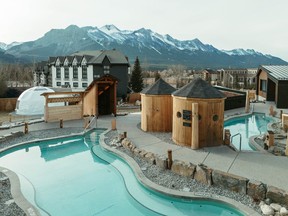 At Everwild Canmore’s Nordic spa, pools and sauna structures unfold across an open-air site beneath the Rocky Mountains. Photo by Geoff McLeanArticle content
Reviews and recommendations are unbiased and products are independently selected. Postmedia may earn an affiliate commission from purchases made through links on this page.
For Breanne Salmon, the ritual began in her early 20s while living in Asia. “Spa culture there is very normalized and seen as a regular way to reset and recharge rather than a luxury reserved for special occasions,” she says.
Advertisement 2
This advertisement has not loaded yet, but your article continues below.
Article content
When the Hamilton, Ont.-based founder of children’s preloved clothing subscription Second Nature moved home, the habit came with her. Now, thermal spas are the starting point for many of her trip plans, from bachelorette weekends across southern Ontario and Quebec to quiet getaways with her partner. She says she finds that once a spa is on the itinerary, it has a way of becoming the part of the trip that everyone remembers most.
Article content
Article content
“It brings a different rhythm to travel. Sightseeing can be busy and fast-paced, but a few hours at a spa slows everything down,” she says. “I think of it as an anchor in the trip. It gives you a moment to ground yourself before jumping back into the hustle and bustle of travelling.”
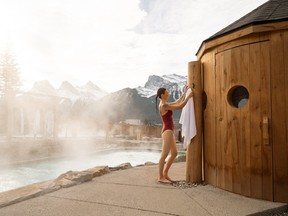 At Everwild Nordic Spa in Canmore, guests move between outdoor pools and sauna structures set against the Rocky Mountains. Photo by DEVON ROGERS /TRAVEL ALBERTA
Salmon is far from alone. Thermal spas are facilities centred on bathing in heated mineral or spring water, typically paired with contrast therapies like cold plunges and steam. In Canada, spa culture is already a significant part of the travel economy. The country’s spa sector generated about US$2.65 billion in revenue in 2024, up from US$2.22 billion in 2019, according to the Global Wellness Institute.
Advertisement 3
This advertisement has not loaded yet, but your article continues below.
Article content
The thermal/mineral springs category remains smaller, but globally it is gaining momentum. The sector generated US$71.7 billion in 2024 across more than 31,000 establishments in 130 countries, with revenues projected to grow at 10 per cent annually through 2029. That momentum is beginning to show up in Canada, as Nordic-style and hydrotherapy-focused facilities expand the country’s spa landscape.
“The whole wellness industry has just exploded and continues to explode. Thermal spas are part of this much bigger movement,” says Marion Joppe, a distinguished professor emerita in hospitality and tourism management at the University of Guelph.
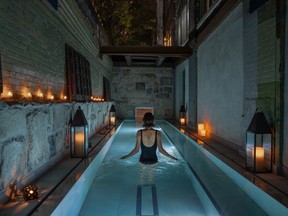 At AIRE Ancient Baths Toronto, candlelit pools and near-silence offer a deliberately slow, immersive escape from the pace of the city. Photo by AIRE ANCIENT BATHS
Joppe traces part of the surge to demographics, particularly an aging population increasingly focused on longevity. The rest, she says, comes down to exposure: Canadians have encountered thermal culture abroad and come home wanting more.
“As people travel, they experience them in Europe or even in places like Japan. This is finally making its way into the Canadian industry,” she says. “It’s really growing here because we’re way behind on those trends compared to other countries.”
Advertisement 4
This advertisement has not loaded yet, but your article continues below.
Article content
New thermal spas in Canada
In New Brunswick, Usva by-the-Sea at The Algonquin Resort in St. Andrews will bring Scandinavian-style thermal bathing to the Atlantic coast when it opens this spring.
In Saskatchewan, the $52-million Dakota Dunes Thermal Spa, set to open in late 2026, will be both the first thermal spa in the province and the first in Canada rooted in Indigenous culture and design.
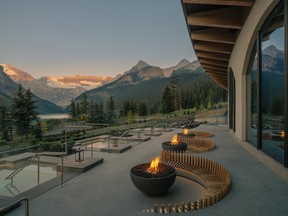 Resort-based thermal experiences, like Basin Glacial Waters at Lake Louise, are helping redefine luxury hotel stays across Canada. Photo by CHRIS AMAT /FAIRMONT CHATEAU LAKE LOUISE
In Ontario, Therme Canada has long-term plans for a large-scale waterpark and wellness complex at Ontario Place. And in Alberta, Everwild Canmore’s Nordic spa, developed by Basecamp Resorts, opened in November 2025.
“One of the biggest changes we’ve seen is that Nordic spas are no longer just a niche wellness activity,” says Geoff McLean, chief commercial officer and co-founder, Basecamp Resorts. “We’re seeing everyone from international tourists and weekend travellers to locals coming for a day trip. The appeal has become much more universal.”
Three more Everwild locations are in development. Everwild Fernie, a 70-room spa hotel in the Elk Valley, is set to open in fall 2027, followed by Everwild Banff, a rooftop thermal circuit in the heart of downtown Banff that guides guests from cavelike interiors to open-air mountain views, by early 2028. The company’s future flagship, Everwild Harmony, will be a lakeside resort just west of Calgary with an 80,500-square-foot Nordic spa facility that is expected to become the largest in Western Canada when it opens in early 2028.
Advertisement 5
This advertisement has not loaded yet, but your article continues below.
Article content
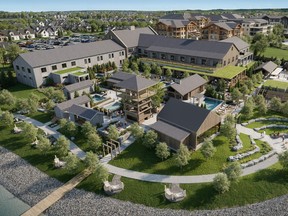 A rendering of Everwild Harmony, a lakeside development that will become one of Western Canada’s largest Nordic spa facilities. Photo by EVERWILD
At Fairmont Chateau Lake Louise, Basin Glacial Waters opened in September 2025 to considerable buzz, offering glacier-fed thermal pools to overnight guests. Tracy Lowe, the hotel’s general manager, has watched it shift the nature of the guest experience.
“Since the debut of Basin Glacial Waters, we’ve seen guests engage more deeply with the overall resort experience,” she says. “Many are extending their stays or intentionally building time into their visit to explore our ‘Well–being Your Way’ approach, reflecting a growing interest in immersive, holistic spa and wellness experiences rather than treating them simply as an add-on.”
Lowe frames Basin’s opening as both a response to demand and a competitive necessity, saying that thermal wellness experiences have become essential to how luxury properties stand apart in an increasingly crowded market.
In Toronto, AIRE Ancient Baths occupies a restored 1912 heritage building, its series of baths lit by candlelight in near-silence. Andrea Trillo, AIRE’s global marketing director, says the city has proven to be a receptive market. “In a fast-paced city like this, there is a clear desire for places where people can slow down and reconnect, and the response to AIRE has reflected that,” she says.
Advertisement 6
This advertisement has not loaded yet, but your article continues below.
Article content
The brand has also benefited from existing familiarity — many Toronto guests first encountered AIRE in New York, Chicago, London, or Barcelona — and arrive already converted.
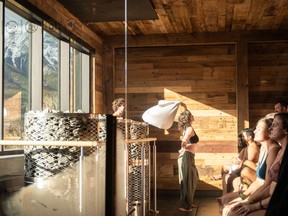 At Everwild Canmore’s Nordic spa, guests gather for a sauna session framed by mountain views. Photo by GEOFF MCLEAN /EVERWILDWhat are the health benefits?
Thermal bathing’s surge in popularity is not just about slowing down. Health benefits are increasingly part of the draw. Dr. Stephen Cheung, an exercise and environmental physiologist at Brock University who studies heat stress and thermoregulation, says the evidence for heat therapy’s cardiovascular benefits is substantial.
When the body is immersed in heat, blood flow increases to the skin and vessels as the body tries to dissipate temperature. “That rhythmic flow really improves long-term health and the plasticity of your blood vessels,” he says.
He also points to strong evidence linking regular heat therapy to long-term brain health, including a reduced risk of stroke and neurodegenerative diseases such as Alzheimer’s and dementia.
Advertisement 7
This advertisement has not loaded yet, but your article continues below.
Article content
On cold plunges, Cheung is less convinced. “I would sum up the health benefits as really uncertain right now for cold plunges,” he says.
He acknowledges that the jolt of a cold plunge has genuine psychological value, even if the physical evidence remains thin. “It’s like having a very strong cup of coffee,” he says.
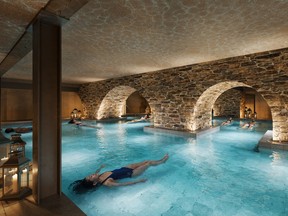 At Everwild Harmony, a thermal spa development west of Calgary set to open in early 2028, large-scale bathing circuits will be structured around cycles of heat, cold and rest. Photo by EVERWILD
His most important caveat, however, is about frequency. “The other thing to keep in mind is if you just go and do this once, it’s not a magic bullet,” he says. “We’re talking about doing this fairly regularly and by fairly regularly, I mean at least once a week, if not more, in order to see benefits. It’s one of those things you need to keep up just like exercise.”
Both AIRE and Everwild are careful not to lean too heavily on clinical language. “We begin with the experience itself,” says Trillo. “While the science helps explain the benefits, what resonates most strongly is the feeling people leave with.”
Beyond the hard health data, Joppe anchors the boom in something simpler. “People, for centuries, have used this stuff. They can’t all be wrong,” she says. “Mother Nature has looked after us forever, much more gently, much more regularly.”
The thermal spa culture that Canadians have been discovering abroad for years is finally taking root at home. With so many projects in the pipeline, the industry is only just warming up.
Read More

I went to Canada’s ‘best day spa’ and learned how to do winter right

Here’s where Canadians are travelling this summer
Article content
Share this article in your social network