
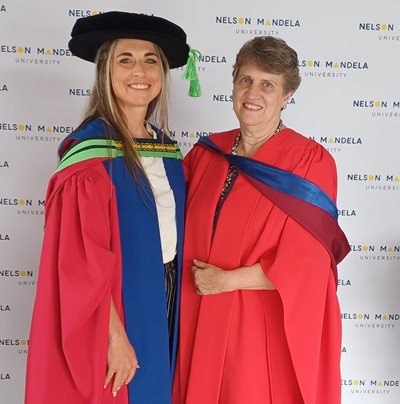
-Copy.jpeg) Dr Madeleine Nienaber and her supervisor Professor Annelie Gresse
Dr Madeleine Nienaber and her supervisor Professor Annelie Gresse
“Despite global efforts to achieve Zero Hunger, food insecurity remains widespread in South Africa, especially in low-income communities where poverty, unemployment and shocks, such as the COVID-19 pandemic, increase vulnerability”, says Dr Madeleine Nienaber.
These are among the conclusions of Dr Nienaber’s doctoral research, the first PhD in Food, Nutrition and Wellness, based in the Nelson Mandela University’s Department of Human Nutrition and Dietetics.
Her supervisor was Professor Annelie Gresse, who started this Department at Mandela University.
As co-supervisor, Emeritus Professor Rosa du Randt, also provided also valuable inputs into the research process, as well as the international co-supervisor, Dr Christin Lang from the University of Basel, Switserland, who ensured a global perspective.
Existing measurement tools often fail to capture the multidimensional nature and context of food insecurity. Dr Nienaber’s research recommends surveillance and implementing targeted, context-specific, locally relevant interventions as being essential to improve food security and resilience to socioeconomic shocks.
Her research developed a multidimensional household food security index, adapted to low-resource South African households, integrating dietary diversity, hunger experience and nutritional status into a combined measurement framework.
The study included a household questionnaire and assessed five- to 13-year-old children in four public primary schools as part of an international study on the influence of exercise and nutrition on academic progress.
This research also contributes to original knowledge by providing a practical food security measurement and offers an adaptable tool, suitable for clinical, community and policy application.
The study confirmed that dietary diversity declined sharply, and hunger increased, especially during the COVID-19 pandemic. Households affected by pandemic-related disruptions experienced greater declines in dietary diversity and higher hunger levels.
“My hope for future research is to build on my PhD by advancing the application of the Household Food Security Index (HFSI) as a practical tool to improve how food insecurity is identified and addressed in vulnerable communities in South Africa, says Dr Nienaber.
Government departments, such as the Departments of Health and Social Development, can use the tool to better target nutrition and social support programmes. In clinics and schools, the HFSI can also help practitioners identify at-risk households early and guide interventions that address both hunger and poor dietary quality, she says.
It can also be integrated into community and digital health systems to monitor food security trends and support timely, evidence-based decision-making.
“My dream job is to become a professor, leading impactful research focused on the prevention of non-communicable diseases in vulnerable communities, while also mentoring the next generation of researchers and practitioners in health and wellness, says Dr Nienaber, who is 31 years old.
She is currently working on disseminating her research by writing articles for publication and presenting at conferences. She wants to expand her research into accessible, real-world solutions that influence public health policy and practice in South Africa.
“I also aspire to publish in influential journals, collaborate internationally, and ultimately work towards achieving prestigious national recognition, such as the NRF A-rating, which recognises leading researchers with sustained international impact”, Dr Nienaber says.