
image:
DOI: 10.59717/j.xinn-nutri.2026.100009
Credit: Zhang J., Geng T., Wang Y., et al. (2026). Challenges, advances and future directions in nutritional epidemiology. The Innovation Nutrition 1:100009. https://doi.org/10.59717/j.xinn-nutri.2026.100009
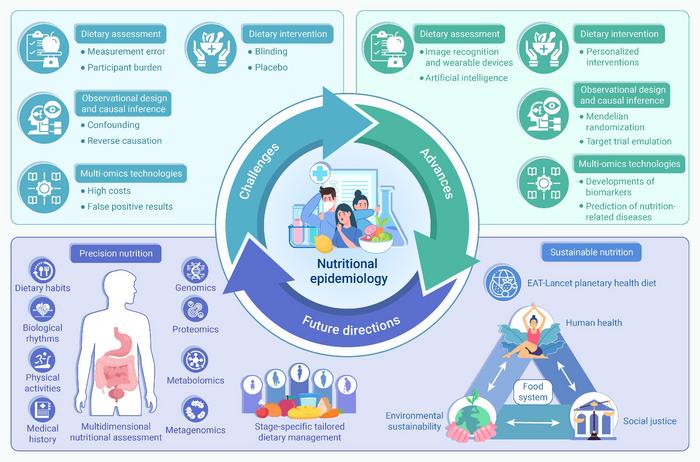
While nutritional science has historically shaped major public health policies—such as the fortification of foods with folic acid to prevent birth defects and the global effort to eliminate trans fatty acids—the field has long struggled with inaccuracies in how people report what they eat. In a new review published in The Innovation Nutrition, a research team led by Professor An Pan from Huazhong University of Science and Technology argues that the integration of multi-omics and artificial intelligence (AI) is finally breaking these traditional bottlenecks.
Nutritional epidemiology is the study of how diet affects disease at the population level. For decades, researchers relied on subjective tools like food frequency questionnaires and 24-hour recalls, which are often prone to memory bias and misreporting.
“The field is evolving from traditional observational approaches toward more rigorous, systematic, and mechanistically informed research paradigms,” says Professor An Pan, the corresponding author and Dean of the School of Public Health, Tongji Medical College. “Multi-omics technologies allow us to discover objective biomarkers in blood or urine, while AI and image recognition are making dietary monitoring more efficient and user-friendly.”
The review details how new methodologies are strengthening “causal inference”—the ability to prove that a specific food actually causes a health outcome, rather than just being associated with it. By using tools like Mendelian randomization (using genetic variants as proxies for dietary intake) and “target trial emulation” (designing observational studies to mimic clinical trials), researchers can now provide higher-quality evidence for dietary guidelines.
Looking forward, the authors identify two transformative pillars for the future of the discipline:
1. Precision Nutrition: This approach moves away from “one-size-fits-all” advice. By integrating an individual’s genetic background, metabolic profile, and gut microbiota with wearable sensor data, researchers can provide personalized dietary recommendations. The review even highlights “digital twin” technology, which creates virtual replicas of individuals to simulate the long-term effects of a diet before a person even starts it.
2. Sustainable Nutrition: Recognizing that food production accounts for nearly 30% of global greenhouse gas emissions, the review emphasizes the need for diets that are healthy for both people and the planet. The researchers advocate for adapting global frameworks, such as the EAT-Lancet planetary health diet, to local contexts to address unique challenges like the dual burden of malnutrition in rapidly urbanizing regions like China.
“Our mission is to leverage technological innovation to address the complex diet-health-environment nexus,” Professor Pan adds. “This will be essential for promoting population well-being and planetary health on a broad scale.”
Method of Research
Literature review
Subject of Research
People
Article Title
Challenges, advances and future directions in nutritional epidemiology
Article Publication Date
13-Apr-2026
Disclaimer: AAAS and EurekAlert! are not responsible for the accuracy of news releases posted to EurekAlert! by contributing institutions or for the use of any information through the EurekAlert system.