

Dr. Robert Easter traces 75 years of history showing how the corn-soy diet reshaped pig diets and disrupted traditional feeding models
 21 April 2026

7 minute read
At the 2026 ASAS Midwest Section meeting, Dr. Robert Easter, Professor Emeritus of swine nutrition and President Emeritus, University of Illinois, spoke at the U.S. Soy-sponsored Swine Application Symposium, offering a historical perspective on one of the most important developments in modern pig production: the corn-soybean meal diet. What today is considered a foundational feeding strategy was not always obvious or even accepted.
Instead, as Easter explained, its development reflects decades of scientific discovery, industry disruption and practical problem-solving that reshaped how pigs are fed and how the swine industry operates.
“It’s a pleasure to be here today, and I want to assure you that I was not present at the beginning of the history of the corn soy, but early in my career I did have the privilege of knowing some of those who had been engaged in that history,” Easter said. “The history is a lot more complex than you might imagine. It involves about 75 years of work.”
Soybeans: An uncertain beginning
Soybeans were not always central to livestock feeding. In fact, when they first arrived in the United States in the 18th century, they were little more than an agricultural curiosity.
“Soybeans are not native to North America. They’re native to northeastern China. They’ve been cultivated for at least 2,000 years as an ingredient in human diets in that part of the world,” Easter explained. “They arrived in this country in 1764, and the reality is no one really knew what to do with them.”
By the late 1800s and early 1900s, soybeans had made their way into the Midwest, where farmers began experimenting with them primarily as forage crops. Early feeding practices often involved grazing pigs directly on soybean plants, supplementing more traditional feed ingredients like corn.
Even with limited scientific understanding, farmers recognized one key attribute: soybeans were rich in protein.
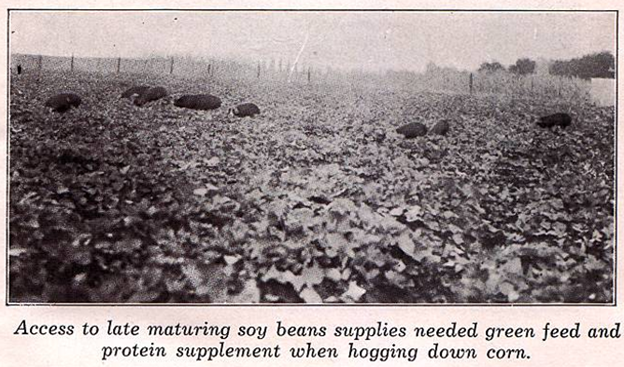 Photo courtesy of The Mortgage Lifer – Published by Hog Breeder, Inc. 1936
“Nutrition as a science was very rudimentary at the time, but they did appreciate that protein was helpful to animals,” Easter said.
Early researchers and extension specialists began to take notice of soybeans. William Henry was a pioneering scientist and researcher and the first Dean of the College of Agriculture at the University of Wisconsin-Madison. In 1910, Henry famously wrote that no other plant held as much promise for agriculture, particularly animal husbandry – a statement that would prove prophetic decades later.
Science catches up
The slow adoption of soybeans in pig diets was not due to lack of interest, but rather a lack of scientific understanding. At the turn of the 20th century, the fundamentals of animal nutrition were still being uncovered.
“We didn’t know very much about nutrition in 1900,” Easter noted. “We knew that we needed protein and things like salt were typically considered. We also knew if we fed ashes to pigs, they seemed to do a little better because there were minerals included, but it wasn’t until 1952-1953 that the corn-soy diet, as we know it, began to be recommended.”
One of the earliest breakthroughs came from researchers Thomas Burr Osborne and Lafayette B. Mendel, who evaluated protein quality using nitrogen retention studies in the 1910s at the Connecticut Agricultural Experimental Station. Their work demonstrated that soy protein was highly effective in supporting growth – an important step toward recognizing its value in animal diets.
“They compared the nitrogen retention with an array of legumes and plant materials, and soybeans were better than anything else they tested. In addition, they found that if you heated soybeans, it was even better,” he explained. “This was the first indication, for example, of a trypsin inhibitor in soybeans that needed to be destroyed and other inhibitors of protein digestion. Remember, they didn’t know what the essential amino acids for various species were. Threonine had not even been discovered.”
However, even as scientists began identifying essential amino acids and understanding protein quality, practical feeding results in pigs did not immediately match expectations. This disconnect delayed widespread adoption of soybean meal in swine diets.
World War II and the start of soybean processing
While scientific advances were crucial, external forces also played a major role in accelerating the use of soybeans.
World War II created unprecedented demand for high-energy foods, particularly fats and oils for human consumption. Traditional sources like lard, tallow and butter were in short supply, prompting interest in alternative oils.
“The German military was making cooking oil from soybeans that provided extra calories in the diets for their soldiers,” Easter noted. “One of the priorities after the end of WWII was to figure out what they’d actually been doing, which was discovered quickly. As a result, the industry evolved around producing soybean oil for human consumption.”
The U.S. rapidly adopted soybean oil processing technologies, creating a new market for soybeans for human consumption. As oil production increased, soybean meal became widely available as a byproduct, offering a cost-effective, high-protein feed ingredient.
This shift dramatically increased the availability of soybean meal and set the stage for its widespread use in livestock diets.
The missing piece: vitamin B12
Early feeding trials showed that pigs fed plant-based diets, including soybean meal, did not perform as well as those receiving animal protein sources like meat and bonemeal or fishmeal. Researchers struggled to identify why.
Likewise, in the 1920s the human disease condition, pernicious anemia, had been shown to be improved by consumption of meat and liver.
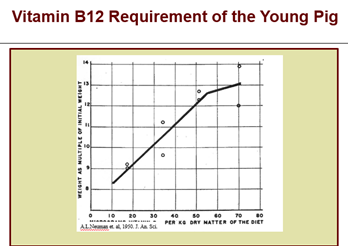
“In 1947, the unidentified factor was recognized as vitamin B12. A year later, Merck commercialized the production of vitamin B12, and suddenly, you have a vitamin that we didn’t know much about,” Easter explained.
Once researchers understood that pigs require vitamin B12, and that it was naturally supplied in animal proteins but absent in plant-based diets – the solution became clear. Supplementing B12 allowed plant-based diets to match the performance of traditional rations.
This discovery removed a critical barrier to the adoption of corn-soy diets and marked a turning point in swine nutrition.
The shift to corn-soy diets required breaking tradition
Despite growing evidence supporting soybean meal, the feed industry was slow to abandon established feeding practices.
For decades, standard pig diets included a combination of corn, plant proteins and animal-derived protein sources. Feed companies built their business models around selling concentrated supplements that farmers mixed with grain.
But by the early 1950s, research from institutions like the University of Illinois and Iowa State University demonstrated that pigs could perform just as well on a simplified diet – provided they were properly balanced.
The late Dick Carlisle, long-time swine extension specialist at the University of Illinois, was interviewed in the 1990s regarding the corn-soy diet and made this comment, “When Gene Becker, a young researcher at the University of Illinois, had enough research to convince himself that a corn-soy diet would work, he wrote a circular with a new ration suggestion, and we anticipated that there would be resistance from the feed industry because we were changing their model,”
The response from producers was immediate and practical.
“You mean to say that I can get by if I just feed corn, soybean meal, minerals and vitamins, and antibiotics?” one farmer asked after an extension meeting.
That simple question captured the significance of the shift. The corn-soy diet offered a streamlined, cost-effective alternative to more complex feeding systems.
A simple swine diet with impact
By 1953, corn-soy diets were officially recommended, and adoption spread quickly.
Typical formulations included corn, soybean meal, minerals and vitamin premixes and is an approach that remains largely intact today. But the impact of this transition extended far beyond nutrition.
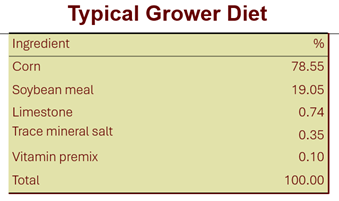
The ability to produce complete diets on farm disrupted the feed industry’s reliance on manufactured supplements. At the same time, it enabled greater efficiency and specialization within pig production systems.
“There were some consequences,” Easter said. “Simple on-farm feed manufacturing disrupted the business model built around supplements and facilitated the increased farm specialization with larger farrow-to-finish operations.”
Perhaps most notably, the corn-soy diet contributed to the shift from pasture-based systems to indoor production. With consistent, balanced feed readily available, producers could move pigs into controlled environments and scale up their operations.
Continued evolution in swine nutrition
While the corn-soy diet became the industry standard, Easter emphasized that the story of soybean meal in swine nutrition is far from finished.
Advances in amino acid nutrition, ingredient processing and feed formulation continue to refine how soybean meal is used.
Key developments include:
Improved understanding of amino acid requirements and digestibilityUse of synthetic amino acids to optimize dietsInclusion of grain processing byproducts Ongoing research into the energy value and bioactive compounds in soybeans
These innovations have allowed nutritionists to fine-tune diets for efficiency, cost and performance while maintaining soybean meal as a core ingredient.
What’s next?
Easter concluded by emphasizing that the evolution of swine nutrition mirrors the evolution of science itself, and that future discoveries will continue to shape how soybeans are used.
“The story began around 1900, and it continues today,” he said.
Looking forward, he sees new opportunities emerging from ongoing research into soybean composition and functionality.
“I don’t know what comes next, but I’m convinced that nutrition scientists will continue to look for and find bioactive molecules and other things that we can consider as being additional values that our pigs are getting from this ingredient,” Easter said.
Brought to you by U.S. Soy. Fully funded by the Soy Checkoff.