
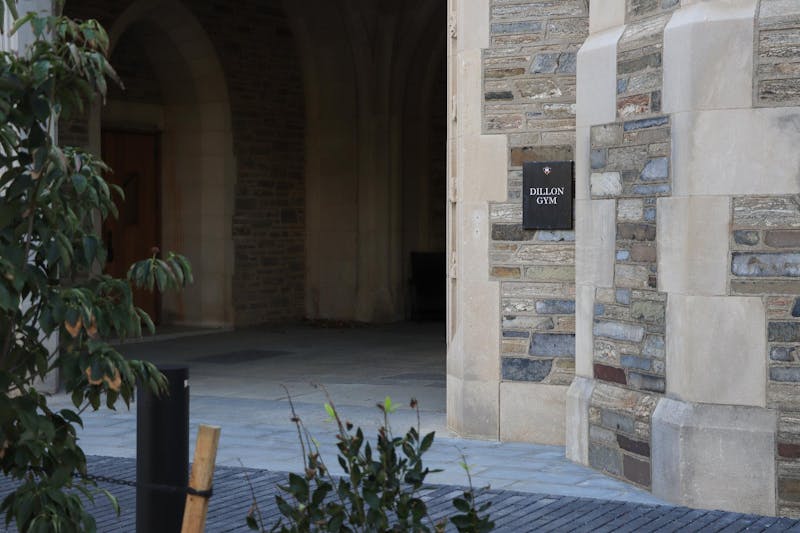
As a regular at Dillon Gym’s group fitness classes, I was intrigued to hear about other fitness studios right next to campus. This left me wondering: how do the Dillon Gym classes, taught by students and free for students, compare to classes run by established businesses? And more importantly, are the business’ classes worth the price?
I reviewed three studios in town: Gratitude Yoga, ALIGN Method Studio, and Pure Barre. I took classes that were as similar as possible to those offered at Dillon in order to best compare them.
Vinyasa Yoga at Gratitude Yoga
The first class I tried was the “Gentle Vinyasa Yoga” class at Gratitude Yoga studio, which costs $15 for the general public and $10 for students. The studio’s classroom is a long, narrow room with a large window overlooking Nassau Hall and framed with several plants. Even though I was ten minutes early, there were already people set up on mats beginning to warm up. The instructor quickly came over to introduce herself, and kindly grabbed me a mat. Immediately, it was clear the instructor had strong relationships with her clients, greeting some of them with kisses on the cheek. Before I knew it, the small room was filled with about 18 people, all our mats side by side.
The hour of class was spent holding various stretches and poses, with one brief yet intense portion of core exercises. She encouraged us to focus on gratitude in our lives, all set to calm, classical music. The instructor spent about half the time demonstrating, with the other half spent circling the room correcting form. The shape of the studio, however, sometimes made it difficult to see her demonstration at the front of the room.
I was pleasantly taken aback when she praised me by name, despite our brief introduction. It was clear that she genuinely wanted each of us to have an enjoyable workout experience. The instructor’s close bonds with her clients, the small studio, and being in close proximity to other yoga-goers all contributed to the intimate atmosphere.
Vinyasa Yoga at Dillon Gym
To compare, I took a Vinyasa yoga class at Dillon. The Dillon studio was much larger than Gratitude‘s, but only had 10 attendees. I was surprised at how similar the class structure was: both followed a similar order of exercises, had us focus on our breathing, and ended the class lying down with our eyes closed. In both classes, I became very acquainted with the Downward Dog to Chaturanga to Cobra sequence.

Support nonprofit student journalism. Donate to the ‘Prince.’ Donate now »
The Dillon Gym class had more of an emphasis on strength, while Gratitude Yoga’s class focused on stretching and holding poses. I was unable to complete some of the difficult moves, and some left my entire body shaking. By comparison, Gratitude’s class was much more relaxed.
At Dillon, the instructor demoed the entire time and did not walk around. Though it meant that I couldn’t get individual feedback on technique, being able to turn your brain off and simply copy her movements so early in the morning was nice. Both Vinyasa classes left me feeling rejuvenated, and they were both a great start to my day. Overall, I felt I had more of a workout at the Dillon Gym class, while the camaraderie at the Gratitude Yoga class created a more personal experience.
Reformer Pilates at Align Pilates
The next off-campus studio I tried was Align Pilates. They specialize in reformer Pilates, which involves a reformer machine — a platform attached to springs and straps often used for resistance-based and Pilates exercises. The machine allows one to target specific muscles and is lower impact. The machines make this class the most expensive class I tried, ringing in at $45.
The Align Pilates lobby was much more professional than the Gratitude one, decked out with a full coffee station, a selection of merchandise for purchase, and lockers. I walked into the classroom and immediately saw the reformer machines lined up in a slightly intimidating fashion. The instructor briefly explained how the spring system worked and told us about the various equipment: a wooden box, ball, and mat. However, she did not introduce herself or make an effort to get to know me.
Each section of the class started with a typical mat Pilates exercise and then progressed to using the machine, a ramp-up that made using the machine feel more accessible. The instructor didn’t do any demos, except for one exercise; instead, she explained the moves and corrected our form. Since there were only seven of us in the class, she was able to help us each individually. This was super helpful, especially with the more foreign exercises.

Get the best of the ‘Prince’ delivered to your doorstep or inbox. Subscribe now »
Overall, the machines added a novel experience to my daily workout, which made the class fly by. However, there was more transition time between exercises to set up the different equipment, and it would take several classes to become comfortable with the reformer technique. This made the workout a lot less intense. Also, it was harder to incorporate what I learned from class into my own gym routine; I would have to continue booking this class to make it a regular workout.
Pilates at Dillon Gym
To compare, I took Dillon Gym’s regularly scheduled Pilates class at 4:45 p.m. on a Thursday. I often frequent this extremely popular class and was accompanied by about 50 other participants. While there are no reformer machines in Dillon, the class still offers a full-body workout rooted in the Pilates principles, and uses similar auxiliary equipment as Align Pilates.
The pop music was more upbeat, and the instructor demoed the exercises for the majority of the class. With fewer breaks between sections, the 45-minute class feels quicker, but also harder. While I regretted signing up for the class during lunge pulses that caused my entire body to shake, I left and immediately signed up for the following week.
Overall, this class felt more like a lecture, while the class at Align Pilates was more akin to a precept. At Align Pilates, we were able to ask the instructor for clarification on technique, and she could more easily watch our form. While I do think it’s worth it to try a reformer Pilates class to experience an alternative workout style, I feel Dillon offers a free equivalent or even more challenging option, even without the reformer machines.
Pure Barre
Pure Barre was the first fitness studio I had heard of in town. I know several other students who frequent it, so I was excited to see what it was like. The class was $35, but they also offer unlimited class memberships for $209 per month. Walking into the studio, which is situated right next to the cafe Maman, there were cubbies for personal storage and a small area to purchase merchandise. I went with a friend who is a regular, and she was instantly greeted by the friendly staff, introducing me to them.
We grabbed our equipment, found a spot, and started stretching. Within the first five minutes, the instructor announced a 90-second plank that made me nervous about the difficulty in the rest of the class. Exercises went straight from one to the next, maximizing class time and making it feel very efficient, which also made it the hardest class I tried.
The class had 18 people, and the average age was much younger than the other two off-campus classes I tried. The instructor would demo the move to start, and then circle the studio correcting form. Additionally, each participant was at a spot at the barre on the perimeter of the room, creating a circle around the instructor. This made it easier to see the instructor and gave the class a more communal feel. Furthermore, the instructor remembered my name and would call out to each student specifically.
Support nonprofit student journalism. Donate to the ‘Prince.’ Donate now »
Pure Barre is a chain fitness studio, unlike Gratitude Yoga and Align Pilates. While this probably meant a greater degree of consistency across locations and instructors, it also limits the instructor’s personalization for the class. The instructor told me that Pure Barre gives them playlists to choose from that are curated to the timing of the class. At the other studios, the instructor made their own playlists. While I didn’t mind the Pure Barre playlist, letting instructors make their own playlists would have been a nice way to add flair to the class.
Barre at Dillon
For my final comparison, I took Dillon’s barre class. It was at 7:30 a.m., so there were only two attendees, including me. Although it was a barre class, we didn’t use an actual barre. Instead, the class featured pilates-esque exercises with fewer motions and more repetitions. It also made the class less intense, since most of the exercises just used bodyweight, as opposed to the resistance band used at Pure Barre. At both Dillon and Pure Barre, we used light weights for the arm portion.
Get the best of the ‘Prince’ delivered to your doorstep or inbox. Subscribe now »
The instructor demoed the entire time, but would call out general corrections from what she could see in the mirror. The music also involved more pop songs, with the playlist curated by the instructor. I enjoyed both classes, but the one at Dillon felt more like recovery or stretching, while I felt more energized from the solid workout that I received from the class at Pure Barre.
⸻
Prior to writing this article, I was already a fan of several Dillon Gym fitness classes, so I didn’t think paying for a town class would be worth it. And while I’m not rushing to sign up for another class in town, I can definitely see the appeal in going off campus for a workout.
Gratitude Yoga offered a much more intimate setting, with an instructor and community who seemed to all really know each other. Align Pilates was a fun and unique twist to an everyday workout, while the class at Pure Barre was an intense and efficient workout. In contrast, the classes at Dillon were less personable, as the instructors don’t get to know the participants as much. The student instructors also tend to perform the workout the entire time, rather than correcting form. However, the classes are still intense and feel very professional, leading me to attend them week after week.
While there’s value in trying other studios to experience new workouts and learn new exercises to integrate into your own routine, routinely paying for off-campus studios doesn’t seem worth it to me.
Larkin Macosko is a member of the Class of 2028 and a contributing writer for The Prospect. She can be reached at lm4788[at]princeton.edu.
Please send any corrections to corrections[at]dailyprincetonian.com.