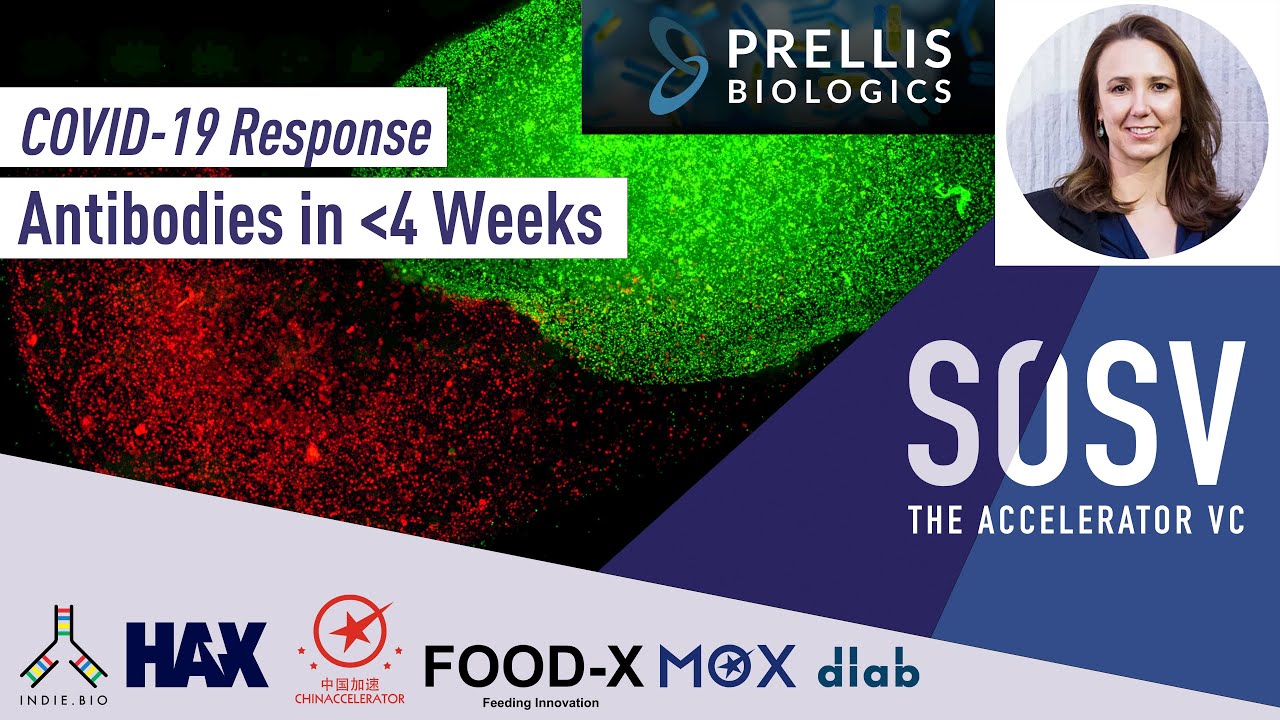
Prellis Biologics is making human anti-SARS-CoV2 antibodies for use against COVID-19 using bioprinted, human mini lymph nodes. In 2017, the printed lymph nodes produced human antibodies for passive immunity against Zika virus. Now, Prellis is doing the same for the coronavirus.
The mini lymph node system produces antibodies in a little over a month. The lymph nodes develop from immune cells within a week, and the antibodies produced from these lymph nodes are ready for screening after another month. Six weeks after the process begins, the antibodies are sequenced for scale-up and additional trials, which can begin in as few as 10 weeks. This faster turnaround time represents a more rapid method to generate antibodies that have potential for protection against COVID-19.
Transcript:
00:00 I’m Julie Wolf of IndieBio and I’m speaking with Melanie Matheu, PhD, of Prellis Biologics today about how her system allows the generation of human monoclonal antibodies outside of the human body.
00:16 What we do is we take immune cells from a blood draw. We typically use a healthy donor’s blood. We isolate the immune cells, and then we grow them up to be antibody producing cells. We really recreate the human lymph node outside of the body. And that allows us to challenge it as you would if you got a vaccine to induce those cells to produce good antibodies against that viral pathogen.
00:40 In addressing COVID-19 and the SARS CoV2 virus, what are you using in order to stimulate those immune cells?
00:47 Our little company is registered with the CDC and so we are receiving heat inactivated viruses, which is virus that is no longer infectious but it retains all the viral surface proteins that you might want to make an antibody against. And so that’s one of our strategies. We’ll also be looking at the two different spike proteins from the COVID 19. And we’ll be challenging the lymphnodes with those as well to get as many possible shots on goal. What we’ve done is we’ve really externalized the human immune response in a way that we can capitalize on adaptive immunity before patients come down with something like this and we can use that therapeutically after a patient’s been infected and you can use it as a prevention mode as well. So this is a project we actually started in the lab right now and we believe that we’ll have our first antibody hits in about four weeks.
01:37 So this is almost as fast as if someone got a vaccination. So we can really start to outpace things like viral replication. You’re generating these lymph nodes basically from the cell up, but in a 3D structure. Can you talk about how it is that you do this and why this makes Prellis unique in its antibody generation capabilities? We are a tissue-engineering company and I spent 15 years of my academic career imaging the scaffolds and structures of lymph nodes and how cells respond to them. And so we took a lot of that research knowhow and knowledge from my academic background and combined it with some of the literature out there to recreate scaffolds that mimic the human lymph node. And this is really important because the way that antibodies evolve – it requires a physical distancing from some other types of cells, although they kind of talk to each other.
02:28 And so having a three dimensional scaffold and structure there is actually pretty important for generating good antibodies. With our initial studies using Zika virus, we found several different antibodies and different wells that had good binding affinity to the virus. So we expect that we are actually recreating a good human-like lymph node response and so that we should have a variety of antibodies out of this. Once you have a binding antibody and it’s very specific to the virus of interest, we could absolutely use these in detection assays as well. And once we find mutations that other antibodies that have been developed are missing and the virus persists, our system is incredibly advantageous for that because we can very rapidly go after those mutations in vitro without having to collect serum from infected patients or do any other antibody evolution process than what we already do, that just takes a couple of weeks. And how much longer until Prellis Biologics and your team has some anti SARS CoV2 antibodies ready? That’s going to be about six weeks. Six weeks. Are you prepared to scale up? Should those be successful neutralizing antibodies? Yes. We’re actually discussing this with different GMP contractors at the moment, so we should actually be prepared to scale-up quite quickly once we have a neutralizing antibody in hand.