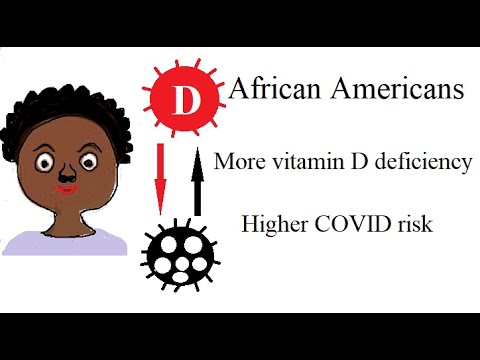
Black Americans are 3 times more likely than white Americans to get covid-19 infection.
Black Americans are twice as likely to die from the coronavirus.
So far, there is no consensus in views of reasons for high rates of coronavirus cases among Black Americans.
Several studies found vitamin D deficiency may raise risk of getting COVID-19.
A new study found that over 80% of COVID-19 patients have vitamin D deficiency.
Jose L. Hernandez et al. Vitamin D status in hospitalized patients with SARS-CoV-2 infection, The Journal of Clinical Endocrinology & Metabolism, 2020
Black Americans are at high risk of vitamin D deficiency. So they face high risks from COVID-19.
An estimated 40% of American adults may be vitamin D deficient.
Up to 76% of black Americans may be vitamin D deficient.
Stephen W. Farrell et al. Cardiorespiratory fitness, different measures of adiposity, and serum vitamin D levels in African-American adults, Journal of Investigative Medicine, 67(7), 2019
A strong immune response is the first line of defense against COVID-19 infection.
Vitamin D can modulate the immune system.
Immune cells are capable of synthesizing and responding to vitamin D.
Cynthia Aranow, Vitamin D and the immune system, J. Imvestig. Med. 59(6):881-886, 2011
Vitamin D is a unique nutrient in that the body can synthase its own vitamin D with the help of sunlight.
To make vitamin D, the body converts a chemical in our skin cells into an inactive form of vitamin D.
When we are exposed to sunlight, this inactive form transfers into an active one.
Skin colors regulate the sunlight level into the skin cells because vitamin D levels determined the skin color.
During the long-ranging human exodus from Africa, vitamin D levels in the body drive the evolution of human skin color.
Evolution has given us shades of skin color from black to white, optimally adapted from humans according to where they live on Earth.
Evolution has brilliantly arranged that light skin, in regions lacking sun, absorbs more UV for the production of vitamin D than dark skin.
As a result, humans living near the equator developed darker skin tones, while those in northern climates developed lighter hues.
There is a clear geographical pattern between skin color and distance from the equator.
Dark-skinned people need 6 times more sun than white-skinned people to get enough Vitamin D.
Thus, dark skin people in North America often do not get enough sunlight for healthy levels of vitamin D.
Nina G. Jablonski, Living color: the biological and social meaning of skin color, University of California Press, 2014.
A study found that sunlight and skin type are drivers of vitamin D deficiency at UK latitudes.
The white-skinned people of the UK are able to meet their vitamin D needs with short, daily lunchtime exposures to sunlight.
The brown-skinned people of the UK need more sunlight exposure to make the same amount of vitamin D in the skin as white Caucasians.
Ann R. Webb et al. Color counts: sunlight and skin type as drivers of vitamin D deficiency at UK latitudes, Nutrients, 10:457, 2018
Given the relationship between vitamin D and sunlight, it is easy to understand black Americans are more likely to get COVID-19.
3 ways to avoid a vitamin D deficiency:
1. Sun exposure: A common recommendation is about 20 minutes for sun several times a week.
2. Good food choices: Consuming vitamin D rich foods like fish, milk, eggs and mushrooms.
3. Vitamin D supplements: Check your vitamin D levels with your doctor. Follow your doctor’s advice.