




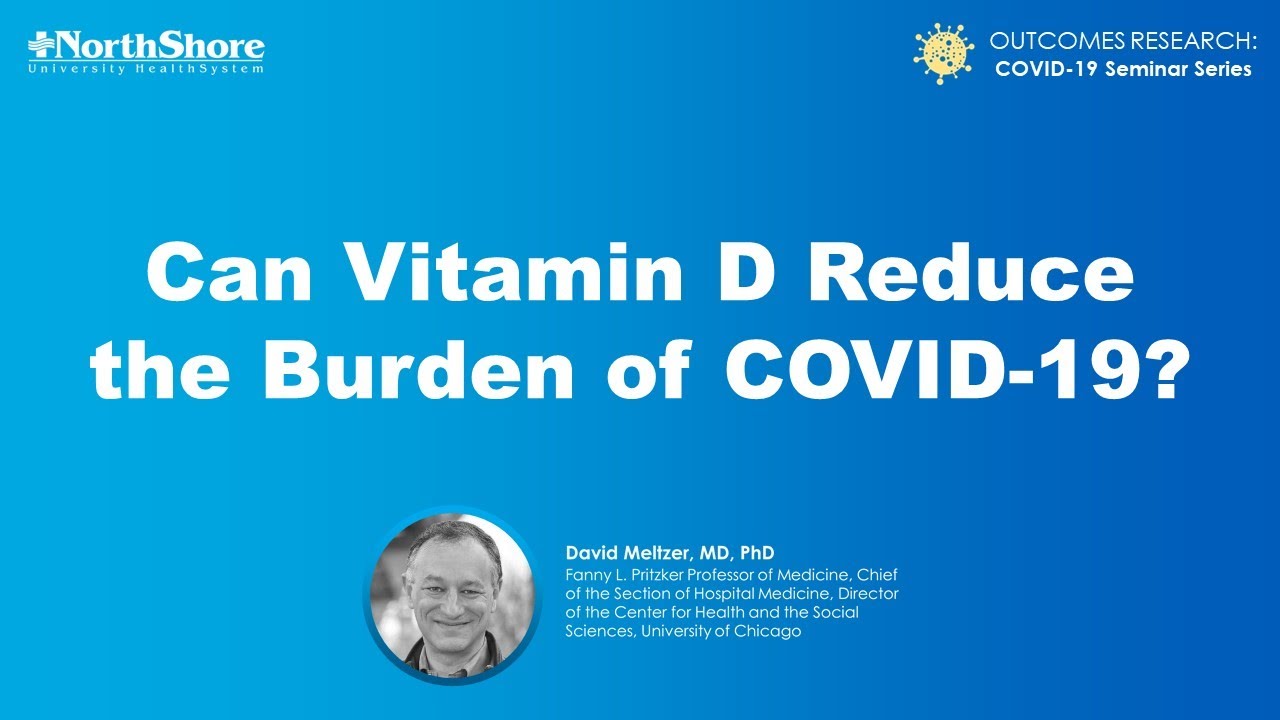
Outcomes Research COVID-19 Research Seminar on April 20th 2021
good afternoon and welcome to the north shore outcomes research seminar and the eighth of our covid19 research series today we’re delighted to have dr david meltzer who will be joining us to present his research on covet 19 and vitamin d we will also be joined by an expert panel including dr raphael lee from the university of chicago dr stuart sprague from north shore university health system and dr claire hastie from the university of glasgow the outcomes first want to start off by giving a special thanks to the first responders and everyone working on the front lines during the pandemic i’d like to thank our director of outcomes research dr bernie bernard ebukman program directors for the outcomes research network the north shore leadership and everyone who’s contributed today to this seminar and to all of you participants for joining us today to those of you who are new to the outcomes research network the orn was developed in late 2018 and it was developed with some key academic leadership structure providing support in order to catalyze research across north shore and across our partners within the ctsa the institute for translational medicine academic communities and the goals of the outcomes research network are to enable community access to care that is effective efficient and equitable to enrich the practice of medicine and to support our strategic clinical quality and operational decision making the objectives of the seminar series are to promote the flourishing and networking of principal investigators to disseminate our research and resources to investigators across institutions and disciplines and to promote a true culture of collaboration and team science we really want people to connect to generate new ideas and come together around exciting projects and we want to bridge researchers to their peer community communities across chicagoland and beyond and ultimately delivering outcomes research that demonstrates improved patient population health outcomes for our for our communities next slide oh and i’d like to most importantly introduce my partner in this process rachel burlington who is facilitating the seminar rachel will be working with me to go over some of the technical aspects of the zoom process and i will hand it over to rachel thank you dr david and hello everybody in today’s webinar all attendees will be muted with the exception of our panelists and speakers however there will be some opportunity for interaction if you have any questions or comments at any point during the presentation or the incubator hub discussion please submit your communication by using the chat function as noted by the blue arrow on the screen if you are on a computer you can access this icon by hovering your mouse over the bottom of your screen your zoom screen please give special attention to the audience of your message before you submit it as you can see on the image to the right you can choose to message either the panelists and speakers this will include myself or you can choose to message everyone on the webinar feel free to leave your questions and comments at any point during the presentation if you are experiencing any technical difficulties please let me know by messaging all panelists and i will assist you the best i can i’m going to hand it back over to dr david and he will go over our agenda for the day thank you very much rachel and uh as rachel said please don’t feel like you need to wait to the end of the the lecture to put submit your comments or questions um we will collect those and make sure that we feed them to the panel and to to the speaker throughout so we’ll start off uh presently with this introduction um often takes less than 10 minutes but we then are going to move on to the main attraction the presentation by dr meltzer and that will run until 3 40. after that there’ll be time for questions and answers which we’ll draw from the the chat so please do remember to submit your questions along the way and and definitely during this period and then following that we’ll have our incubator hub expert panel discussion with our three expert panelists and dr meltzer and we really encourage you to submit your comments um we’re going to discuss how this research relates to health equity to policy to clinical implementation and dissemination as well as translational science so we really want to have a rich discussion and have as many people participate as possible and then we’ll have a fall a conclusion of closing remarks based on on today’s seminar okay next slide very good so i’d like to start off by introducing professor david meltzer dr meltzer is a um the chief of section of the section of hospital medicine in the fannie el pritzker professor of medicine as well as director of the center for health and social sciences at the university of chicago dr meltzer is also a health economist and has had a impressive repertoire of research including clinical trials to developing comprehensive care models and a whole range of of work and today he’s going to be discussing his research on covid19 and vitamin d so should we so dr meltzer please um take it away great thanks so much sean and rachel thanks for your help in setting all this up as well so um as sean and i’m really thrilled everyone has been able to join and thanks also to all the the wonderful panelists um oh and uh start my video there we go um so anyway thank you all for joining so i’m gonna be talking today about about whether vitamin d can reduce the burden of of covid19 um go to the next slide please um so let me begin by telling you a little bit about how i got started on this so my my day job as sean mentioned was running the section of hospital medicine at the university of chicago and um i was i was at home you know getting emails and trying to help manage things from there and watching the covet patients come in to the hospital and i got this email that i’ve sort of copied the headline of here and it had the the header vitamin d and respiratory issues and i thought to myself oh you know covid’s a respiratory issue um i better open this email so i opened it and uh the first sentence was can vitamin d prevent viral respiratory tract infections i thought that was interesting and i clicked ahead into the email and rachel go on to the next slide and um what i found it was referring to was a meta-analysis done by adrian martino in the uk about at that point it was two years earlier and published in the bmj and it was a individual or person-level meta-analysis of randomized trials of vitamin d supplementation and there was a sub analysis within this that looked in particular at daily vitamin d supplementation um and um and and in particular whether the supplementation affected the rate of viral respiratory tract infection and what they found was um you know a substantial um reduction overall about a 20 reduction in um acute respiratory tract infections and i thought wow that’s interesting and i dug a little deeper and found that um in those who were severely vitamin d deficient with them blood levels of less than 10 nanograms per liter it’s actually a 70 reduction um so an odds ratio of 0.3 and in fact even with people with somewhat higher levels um about a 25 reduction i thought wow you know those are those are big numbers and here we are in march of 20 you know 19 or i guess uh 20 um 2020 rather with uh you know no real treatments for covert or ways to prevent it i thought wow this is this is interesting so i called some of my epidemiologist friends and said head what do you think of these studies and as epidemiologists do they told me you know some of the limitations but they all said you know but this is interesting so i i sort of kept going and trying to try to learn more so let me go on to the the next slide so um it was kind of my my my reasoning you know you know could vitamin d and covet really matter well you know i i knew that um covered 19 obviously at that point was caused by a coronavirus and the coronaviruses are common causes of lower respiratory tract infections in adults they’re about seven percent of lower respiratory tract infections in general and about 20 percent of of viral lower respiratory tract infections so it seemed plausible that this martino study was pointing towards you know something that could potentially reflect effects on coronaviruses i also knew that vitamin d deficiency was common um almost half of u.s adults are vitamin deficiency and more than 80 percent of non-whites and um you know obviously being in chicago and on the south side that is indeed um you know our our major population in many ways um and then finally i was aware already even in this early stage of some of the emerging epidemiologic associations with both covid19 and their similarity to the associations with vitamin d deficiency so for example um african americans hispanics are both groups where we are more likely to have vitamin d deficiency also more likely to have covet older adults more likely to have vitamin d deficiency more likely to get covet nursing home residents and with it you know lack of of sun exposure which all come to a scale again more likely obese individuals also more likely to be vitamin d deficient more likely to get coveted moreover when was coveted arising it was arising in the winter it was arising in dark places at that point um you know seattle if you’ll remember was the first big outbreak in the u.s a city that’s known for you know unending rain and lack of sun and then there was an outbreak on the east coast originally among a group of orthodox jews who you know one thinks about being in temple and covering up skin and you know i can only imagine that vitamin d deficiency is common given the importance of sunlight in producing vitamin d so the epidemiologic associations were were really um really intriguing as well um and you know so i started to read a little more and on the next slide um is a slide um sort of getting at coronaviruses and thinking about some of the the seasonality of this and indeed as you look this is the sort of common viral respiratory tract in infections this was a study from paris and what you can see is not all of these are you can’t quite see the print is a little small but basically like if you look at influenza that’s the spike every winter in influenza which we’re all familiar with and not all of them have spikes every winter you can see rsv does um pretty clearly and then down in the bottom right you can see coronavirus a highly seasonal um sort of incidence so the fact that we were there um in the in the the winter seeing the spike and coronavirus really was um um you know very you know suggestive to me as well um the next slide sort of continues this a little more this is data from the us this is data just for coronaviruses and you can see that um there’s a seasonal spike the top panel is testing for um for um viral causes of um of um respiratory tract infections you can see there’s some spike in testing but what’s really striking is the spike in the various subtypes of coronaviruses again happening just in the winter so again this you know made me think wow this is this is um you know interesting so you know i started to read a little more about um vitamin d deficiency and remind myself of some of the basics from medical school as well as learn a little more and the next slide summarizes like some of the the key oop one more um some of the the key things so um let me kind of go over a little bit of the biology of vitamin d so vitamin d it’s although it’s called a vitamin is is really technically a hormone it’s produced by the human body um in response to sunlight um and in the skin um and um that’s one of the ways it’s generated can also come from dietary sources um milk is fortified dairy products are fortified many types of fish eggs have a vitamin d and then of course supplementation that vitamin d is ingested in the body it then goes through the liver where it is hydroxylated and that partially activates it and then it is further activated in a variety of other tissues most commonly one discusses the kidneys but also pancreas placenta lungs colon and breast and then importantly in in macrophages which are an important part of the immune system and um that is dihydroxy vitamin d which is the the active metabolite of vitamin d and we talk a lot about the physiologic functions of vitamin d typically around bone and um and certainly vitamin d is very important for calcium homeostasis affects blood pressure bone formation cardiovascular health a variety of things but it also may affect insulin secretion so it’s you know discussed in um diabetes and then um there are questions about certainly it plays a role in development in the placenta but it also may affect um cellular um control and apoptosis so people have looked at it in cancer and then um finally and influencing macrophages really can affect um immune function and and obviously that’s the key um issue that we are interested in with respect to covet so clinically you know there are a couple of um numbers that are useful to think about about how one defines vitamin d deficiency um typically vitamin d levels in the body are measured by 25 hydroxy vitamin d which is that middle one that after the first hydroxylation and levels are typically defined as deficient if less than 20 nanograms per milliliter insufficient if it’s 20 to 30 sufficient as 30 to 50 and then 50 and above is more than sufficient and may be toxic above 100 to 150. now the definitions of insufficient and sufficient are are based on expert recommendations which are heavily influenced by what’s known about the relationship between vitamin d levels and bone health and it’s the sort of level at which you see effects on bone that have defined insufficiency as sort of below 20 to their deficiency is below 20 to 30. the national academy of medicine has defined sufficiencies in this range of 30 to 50 but others like the endocrine society have said that higher levels of 40 to 60 are um are probably better and i’ll i’ll talk about some other things um you know we also know that vitamin deficiency is common as i mentioned especially in older persons persons with darker skin people living in the north or in the winter older adults and obese persons in terms of supplementation to address deficiency the us rda is typically 400 to 800 ius per day of vitamin d3 commonly recommended um people who have osteoporosis are often recommended to take about a thousand ius per day although sometimes more the national academy of medicine when they wrote about this sort of said that going up to about 4 000 ius per day um is safe for most people without direct medical supervision and they saw no evidence of no evidence that they were convinced by for um benefits um going above that and then in large oops for some reason the slides skipped back um the maximum in in large case series that has been shown to be safe without very intensive monitoring is about 10 000 international units per day so that gives you the range of kind of the doses to think about and i’ll i’ll just point out also that supplementation is incredibly inexpensive it costs less than ten dollars per year so if in fact there is a difference that comes from taking vitamin d um you know it’s something that so easily could be um scaled so let’s go on to the next slide so this digs in a little more deeply into the roles of vitamin d and immune function um vitamin d has been shown to affect innate immunity so immunity to um pathogens you’ve never seen before it acts on macrophages and monocytes and and within those leads to the production of catheter which um is a a peptide that is basically suppresses the the growth of of bacteria and and viruses and so on and so it’s an activating um element in um innate immunity and in covet obviously if to the extent it’s a new pathogen that’s that’s critical um vitamin d has also been shown to be really important in adaptive immunity and immunomodulation it affects the the expression of b cells in the production of immunoglobulins so helping create long run immunity and also t lymphocytes cytokines the rast system bradykinin so um and and those together um um you know are critical to mounting the the adaptive immune system and as well um vitamin d has been shown to play this important role in immunomodulation making sure that the immune system doesn’t become out of control activated and and do extra damage and given the importance of inflammation in the body’s response to covet and the pathology such as hypoxia that potential effect of vitamin d also seems really important so those are some of the sort of early lessons from looking at the biology and are encouraging in many ways but let’s go to the next slide um there are a lot of reasons to be skeptical about a vitamin d um levels of vitamin d have been associated with many many conditions an infection cancer heart disease diabetes hypertension autoimmune diseases poor outcomes in pulmonary conditions including asthma and acute respiratory distress syndrome but that association doesn’t necessarily prove causation maybe people with these conditions are sicker and staying home and not getting sunlight and so the um the vitamin d itself is reflective of the condition rather than a cause of it and sort of adding to that skepticism is that results in randomized trials have been quite inconsistent um so there has been some evidence and i talked about the meta-analysis of reduced respiratory tract infections but many of these studies don’t show positive results there’s some evidence of reduced urinary tract infections there’s some evidence of reduced copd exacerbation efforts to use um vitamin d to reduce hypertension however did not succeed nor did efforts to use um to reduce vitamin type 2 diabetes though there was a little bit of a trend and also in a very high profile failure um vitamin d did not improve outcomes or decrease air ds and critically ill patients in a very large nih-funded rct interestingly in a in a previous trial that was very similar except for some slight but really important differences um they had found a positive result i’ll come to that in a second so what are some of the other issues with vitamin d it’s been hugely hyped by industry there have been criticisms of conflict of interest among very prominent investigators um there’s been a lot of debate about how it should be dosed um a lot of the trials give and even clinical regimens give very large single doses of vitamin d which raise levels but don’t necessarily produce vitamin d in the way that it’s most therapeutic which i’ll come to in a minute and the martino study that i mentioned the meta-analysis found that vitamin d worked when given daily but not in boluses the violet study in ards that failed gave um vitamin d just in a bolus where the prior vital study which did succeed actually gave it um with daily dosing so a hint that you know bolus is not the same as daily um there are both dietary and environmental sources which may have different effects um both in giving large doses at one point in time versus daily doses and also patterns of breakdown which could be very important and then also issues of what you should be measuring when you think about vitamin d and i’ll come back to that later um next slide this is a trial that gives you a result of a study that where they randomized people to different doses of vitamin d from 800 ius um up to 4 000 and then 50 000 per day and then 50 000 a week and what you can see is that the the levels are typically you know in the 30 to 40 range with these lower doses but only when you get up to about 4 000 i used you get up to that 40 to 50 range although obviously there’s variation around it and when you go up to 50 000 a week that’s when you get you know really much much bigger doses and as i mentioned earlier we want to be careful about thinking about these levels as too clearly indicative of everything we want but um clearly if you want to get levels higher you have to think about higher dosing the next slide please um it shows results of another intervention this was in a psychiatric hospital in in ohio where um some patients over many many months were given 5000 ius per day and others were given 10 000 ius per day and what you can see is the 5 000 iu per day people after a few months plateau around 60ish whereas the 10 000 iu people on plateau much more like um 90 or 100. so if you really want to get levels up into that range you’re gonna have to think about um higher doses next slide please this is a slide that um looks at sort of vitamin d levels and outdoor workers and to remind you that you know the institute of medicine or national academy medicine recommendations are really you know in this 20 to 30 range but if you look at um farmers in puerto rico lifeguards in the us and israel average levels are more like 50 even 60 and and there are other studies that show they’re often more like 80 and 90 and 100. so um um and you know we don’t see toxicity um with um those levels in in those individuals so um that gives you a sense that higher doses are certainly you know and levels are certainly things worth um considering now the next slide gets it a really key idea and this is what’s called the free vitamin d hypothesis and um the idea here is that although much of vitamin d in the blood is bound to vitamin d binding protein that particular that in some cells particularly in white blood cells vitamin d is diffuses as a free molecule through the cell membrane into the into the tissues and and it is that free vitamin d that is ultimately critical for affecting immune function and this idea is supported by a number of interesting studies including one that shows that um immune function and and support by vitamin d is maintained in patients who do not sorry in animals mice that don’t have vitamin d binding protein so vitamin d binding protein knockout mice as long as the the animal continues to get daily vitamin d and if this is important this says that vitamin d binding protein really matters and that pre-vitamin d matters and it implies the importance of interactions between vitamin d production its storage and its bioavailability its ability to be released and and one of the reasons this is so important is that we know that there is variation by race and ethnicity and vitamin d not only vitamin d production related to melanin and cutaneous cholesterol but also vitamin d binding proteins which may differ in their affinity and ability to release free vitamin d and also um effects on vitamin d destruction so so there’s a lot of really interesting biology here the next slide sort of continues this theme of vitamin d binding protein a little bit the the legends here a little bit difficult to see but um what you see in the in sort of panels um a is um vitamin d binding protein levels um on the on the x-axis on the y-axis um what you see is first total vitamin d and you can see that total vitamin d is very closely related to vitamin d binding protein and panel a in panel b you see vitamin d binding protein and free vitamin d and again you see a much less strong pattern there um so free vitamin d seems to be regulated by a different set of things than vitamin d binding protein and with that total vitamin d levels and um in the second panel we have dihydroxy vitamin d so that activated form and again you’ll see the vitamin d binding proteins map with that pretty well but the free vitamin d um does not map as well with that and it may well be this 25 hydroxy vitamin d that’s free that really is critical for um immune function so this is not to say that um levels are unimportant but they’re certainly not the whole story and i will just point out in the last panel if you kind of drew a line through that you do sort of see that some of the lowest numbers are where the um the the free levels are lowest and where the vitamin d binding protein levels are low so having low levels of vitamin d binding protein and low levels of vitamin d is probably not a great thing but it’s it’s not everything um so um next slide um so let me just talk a little more about vitamin d binding protein so originally these were called um gc for group specific components it was one of the first proteins shown to have polymorphisms in humans there are many variants six main haplotypes and three main variants of that the gc1s the gc1f and the the gc2 and there’s actually a lot that’s still unclear about these variants and what they all do but they are known to vary across geography and with skin color some of them are associated with variations in total vitamin d levels and some are thought to affect a macrophage activation gc1f which is more common in blacks as opposed to whites is a higher affinity vitamin d binding protein as opposed to gc2s gc2 and gc1s which are more common in in whites and that higher vitamin d binding protein affinity may result in less release of vitamin d when you need it to be able to serve as free vitamin d which could be active some of these variants have been associated with disease incidents so for example gc1f has been associated with increased hiv risk at least in in in caucasians um a lot of controversy around some of these findings but there are reasons to believe that these could potentially be physiologically important in terms of disease and senses so let me go to the next slide and then get back to the actual research we did so and i had seen these um you know results about vitamin d and viral respiratory tract infections i knew from my operational work at the ufc that we had lots of patients coming in who were getting tested for covid and that we had within our clinical data repository um historical levels of vitamin d for these people and so i i you know got appropriate approvals and was able to um take a look and quickly see that vitamin d deficient patients were about twice as likely to test positive for covet as non-vitamin d deficient patients so i got full irb approval to conduct an analysis for research purposes looking at sort of the primary question of our vitamin d levels and treatments associated with covert 19 test results and our vitamin d levels and treatments associated with severity of covert 19 outcomes for example hospitalizations icu stay mechanical ventilation and so on so um next slide so we we did that analysis we actually released it in meta archive um and um i guess it would have been um earl sometime in april we did the analysis in just a few weeks wasted a few weeks trying to get it into um you know new england journal of medicine and drama and eventually um got it into a jama network open in september of 2020 and it’s gotten a huge amount of um social media attention and press attention and so on and um i’ll just say they’ve been a wonderful journal to to work with so let me tell you a little bit more about what we did the next slide um so our original analysis was with a little less than 500 patients at the university of chicago who had vitamin d levels in the year before their covet test we defined patients as likely deficient versus likely sufficient based on their vitamin d level those who are likely deficient had levels less than 20 nanograms per milliliter and didn’t have their treatment increased after the time that was level was drawn until the time they took their um their covid test and those who are likely sufficient had levels greater than 20 and um didn’t have their treatment decreased after that level and then there was an intermediate group that was neither of these we controlled for demographic variables and comorbidities we estimated generalized linear models to predict testing positive for covid19 both the relative risk of testing positive and then getting predicted covet 19 positive rates next slide shows the demographics for the group and you know mixes of age and gender and race a substantial um african-american population um a number of employees from from the ufc um and again these were the people who had their vitamin d levels tested in the in the past year um and we used claims data and you know the electronic health record to measure a series of comorbidities we controlled for bmi and then we also in some analyses actually looked at at treatments next slide so um these are the key findings from these generalized linear models again predicting the probability of testing positive for covid19 what we found was the relative risk of testing positive was about 1.77 for people who were um likely deficient versus likely sufficient so about 77 more likely to test positive and the predicted covert 19 positive rates were 21.6 for people are likely deficient versus a 12.2 for patients who are likely sufficient um and um you know we found results in in those other than whites um that were similar to the full sample um but in whites we found very wide confidence intervals and um um and you know there were both lower rates and and lower sample sizes in in in some of the minority groups sorry in the non-minority groups so i’m um so but overall i’m you know strong association uh next slide um we also sort of you know kept working on this topic and we published another paper again in jama network open in september um which focused a little more on issues of race and ethnicity and actually levels of vitamin d so let’s go on to the next slide um so at this point you know we we had data through december we had a 4 600 patients we were able with the larger sample size to look at likely deficient versus likely sufficient levels and and break it even more finely those being deficient less than 20 insufficient 20 to 30 adequate 30 to less than 40 and more than adequate 40 and above we again estimated generalized linear models predicting the probability of testing positive for covid but um we now could control for days since level since um we we had more people who’d been tested for for longer periods of time over the course of the epidemic we also controlled for the month of covid19 testing and interactions between timing level and patient age again we got predicted covert 19 positive rates and we stratified the results i’m now according to race because we had much more data to really um do that well um next slide so these are the results um the panel a here on the far left is the overall results and you can see that um you know as you go up you tend to see a higher um level of testing positivity positive as the vitamin d level falls there’s a little dip down as you um are dropping below 30 these 20 to 29 and our interpretation of that is that that might be because these people have levels that one would consider um insufficient and they might well be treated but we didn’t measure that treatment accurately so that’s why it might go down and then when we broke it down by race we get these even more striking results where those who have levels of more than 40 have a risk of estimated rate of testing positive about 4 versus more like 10 for those whose levels are less than 20. and again um we and actually this gap between the 40 and the 30 to 39 was highly statistically significant and again we interpreted this 20 to 30 as people who might well be treated because they’re technically according to these iom standards vitamin d deficient but we didn’t measure that that’s in blacks on panel c you look at whites you just see you see nothing so we concluded that there seemed to be you know potentially an association that suggested protection for blacks for having levels that are 40 and above versus levels that are 30 to 40 and remember 30 to 40 is considered sufficient according to the standard recommendations um next slide um there are a couple of other interesting results um this is looking at even higher ranges and in people whose um vitamin d levels were 40 to 60 um the testing positive rate was only was seven percent as you go to 60 and above it actually dropped down to two percent with a p value of less than 0.01 0.01 so it raises the possibility that um even higher levels of import are important i will say that this table here is not a multivariate analysis and as we tried to do multivariate analysis that as we’ve done in the full sample we just sort of ran out of statistical power in this but um you know so there could be confounding that’s driving this but i i do want you to see that result um the next slide um looks at um the relationship between um levels and treatment and positivity and the the general message here if you look at the table is that kind of in the bottom right hand corner of the table you see you know much lower rates in general and so people with higher levels tended to to do better so that would that would make sense i thought it was particularly interesting if you look at the people who are taking 2 000 um and one or more international units of vitamin d3 per day so these are you know moderately high doses and in those people taking those levels if their vitamin d level was greater than 20 nanograms per milliliter they only had a two percent chance of testing positive where if their vitamin d levels were less than 20 nanograms per per milliliter um then they had a 17 chance and that was a highly statistically significant difference and my interpretation of that is that um if they were really taking 2000 ius per day um then there’s no way their vitamin d level really likely would have been you know less than 20 nanograms per milliliter it’s possible but quite unlikely so i i think that this is an indication that if you’re taking at least 2 000 units a day you know both your levels are going to be high and your risk of covid seems to be low again whether that is causal i cannot say but it clearly is an interesting association um let me go to the next slide so since we published our original paper and um you know during the period where we published this later one there’s been a whole variety of peer-reviewed analyses looking at covet-19 infection as an outcome mayor’s in it all um did a a a study in israel with a cohort of patients and found a 1.5 times um increased risk of covert 19 infection in this cohort for those with vitamin d levels less than 30. um yi found a crazy high odds ratio of 15.8 for those with vitamin d levels less than 20. and um hasty you’ll hear from claire um um and colleagues um uh in a minute um did a study in the uk biobank which found no association between vitamin d um levels and covet but of note and and they state this the vitamin d levels and that analysis were measured about 10 years before covet testing and so um you know that may have been an important reason why they didn’t see that and there are some other studies out of uk that i suspect claire will talk about related to treatment that you know show somewhat different results and did show associations um there are some other studies not your peer-reviewed that are available on med archive and if you’re interested in them please you know take take a look at that um next slide this is one more study by kaufman and colleagues this used um data from um um oh i’m spacing on the name the big um testing company um in the us and again you see a strong quest diagnostics and here you see um people with high vitamin d levels having much lower rates of testing positive next slide there are a number of studies that look at vitamin d and covert 19 severity there are multiple studies that show low vitamin d in hospitalized patients um with covid19 it is however unclear whether vitamin d increases severity or whether severity decreases vitamin d or both are affected by some common factor rcts are obviously important castillo and colleagues in spain did a rct of um calcifidiol um versus um usual care they found one out of 50 patients getting um calcifidiol had icu transfer versus 13 out of 26 in usual care there are some critiques of that study but i’m also defenses of it that say the critiques aren’t that bad um stuart and dr sprague and colleagues at north shore are actually doing work with calcifidial now that they’ll talk about that sounds spectacular um and and then there was a recent study by mirai adal and in jama that did a randomized trial of vitamin d3 giving a single large 2000 iu bolus versus one time versus placebo for patients who were hospitalized with covet and the primary outcome was hospital length to stay which they didn’t change they also looked at mortality and an icu um effects which were not significant but there was a trend for mechanical ventilation um seven percent in the treatment group versus fourteen percent in the placebo group not significant but um but but close interestingly when they looked at the subgroup of patients who had low vitamin d levels they found no significant trends at all in fact if anything they went a little bit the other way this got us interested in looking at the people with high vitamin d group or a higher vitamin d because if the low vitamin d people showed a weaker trend and there was a little bit of a trend overall you know what might be happening in that higher group so we did that and actually if you take a look at the jama website we posted a comment on this what we found is that for icu stays only 13 of the patients who um who got vitamin d had icu admissions versus 27 of those getting placebo so about a 50 reduction and a p-value of 0.05 for mechanical ventilation um um actually also eight percent in in vitamin d versus um 20 placebo again at more than half reduction and a p-value of almost 0.05 and we have some theories about why this may have been that the um the high vitamin d group was more likely white individuals whose vitamin d binding protein may have been better suited to release vitamin d in the context of this large bolus and then finally rastagoli stogie and colleagues did an rct of a large dose of vitamin d um for for seven days and their main outcome here was sort of biochemical markers and interestingly it became those getting the vitamin d were much more rapidly rna negative and had lower levels of fibrinogen which you know is a marker of inflammation so uh i think overall i look at this and i think there’s a lot of reason to think that there may be important roles of vitamin d in therapy let me go to the next slide so there are a number of additional analyses we have in progress we’re using the national covet collaborative n3c funded by ncats which is 50 sites of data 2.7 million patients it works in a including more than half a million cobit patients actually think it’s now a million and it’s a secure computing environment they’re continuously adding data um it’s multiple regions of the country in a longer time frame and with this sort of sample size you can look at levels seasonality location racial subgroups and these are complicated analyses and i’m not allowed to talk to them talk about them until they’re reviewed by them but i’ll just say that we’re finding some very interesting things also epic reach outs to us through their cosmos program where they try to use their data for research it’s even larger than n3c and although only the epic personnel can access the data we’ve been working with them to guide analyses and i’ll just say we’re finding very similar things in many ways between what epic is finding in n3c my colleague robert gibbons and his son jason and a bunch of other colleagues at um michigan have also done some really nice work with va data and this includes prescriptions of vitamin d and they’ve been analyzing the hazard of covid diagnosis after new prescriptions for vitamin d and again i’ll say we’re finding some very promising results next slide um these are all observational studies that i’ve talked about now um that we’ve been doing but we’ve also begun some interventional studies i’ll just talk briefly about them one is that within our comprehensive care program at the ufc where we have the same doctor caring for patients at high risk of hospitalization both in and out of the hospital the intervention group is one where we’re seeking to screen people for vitamin d deficiency and treat them and we’re comparing them to the control group where we don’t influence their care and they get whatever care their doctors would think about vitamin d so we’re getting a lot of experience in managing medically complex with patients with vitamin d so it’s sort of a quasi experimental study and then we’re doing two full rcts one is funded by ncats it started with healthcare workers uh but we’ve now broadened it to the broader community and here it’s a randomized trial where you’re randomized between either 400 units or your choice of either 400 or 10 000 ius so 10 000 being high enough that you really should get labs drawn so um patients can expect their their express their preference for the to one of the two higher doses and then get randomized between the low and the high one we’re doing this jointly with rush and patients come in get labs drawn at the beginning looking at pth and calcium and covet antibodies and we’re also looking at vitamin d and vitamin a and then um they get quarterly follow up with that and the primary outcome for this healthcare worker study as well as the next one i’ll talk about is sort of basically self-reported covet and did you try to confirm when possible with biological evidence of that um and then um finally the last one is a study i’m doing through the health lab part of the university chicago urban labs and this is funded by curse within reach and here the idea is to recruit patients on the internet and originally we started just in the chicago area but we’ve now opened it up nationally we randomized people to either 400 or 4 thousand we’re doing covet antibodies and vitamin d in a small subset of these people but um basically it’s a completely virtual study and if you’re interested in learning more about any of these studies you can just go to google vitamin d with no space or victi and use chicago and you’ll get to a website that explains about the phone call for the um healthcare worker study and uh and how to enroll online for the the other one if you’re interested um can we um go to the next slide um these are some of the exclusion criteria um um and you know they’re basically reasons not to take vitamin d um we um immunization is not an exclusion criteria for these studies so people who’ve been immunized or are welcome and you know i think we we at some point really need to think about whether prior covet infection should even be one um uh depending on what happens as we uh find ourselves um you know potentially having more reinfection over time um next slide so i i want to end with maybe a little more of a sort of speculative note about sort of all of this a little bit of an evolutionary perspective on vitamin d immunity and race and um this is you know been useful thinking for me um you know obviously a little more speculative so you know we know that human beings evolved in equatorial climates not wearing clothes and and with very human limited human interaction and in that sort of setting you know the the probably the main concern with vitamin d in many ways was the need to manage excess in times of intense sun exposure um you know vitamin a and and that sort of setting vitamin d binding protein served in a way as a as a bank account a a place to store things that you know you wanted to have around because you needed some of it maybe but um but you know almost too much was the problem rather than than too little and in this sense total vitamin d levels may very reflect may very well reflect this buffering function rather than sort of stores that you needed for you know potential future deficiency then as as people migrated to northern climates you know their skin lightened we had decreased melanin um and um that had the benefit of increasing vitamin d production at most levels of sun exposure and and we knew that we know that whites produced no vitamin d north of this 37th degree of latitude in winter so that’s st louis in the in the u.s and and so um vitamin d levels rose um enough so that they could perhaps be high enough at the end of the summer that they could um you know be useful as one went through the winter now another really interesting observation is about the activation of macrophages by vitamin d um and and fascinatingly that is a development only in higher order primates so as a raphael will will tell you um vitamin d is a very it’s as old as life itself and being important for cellular and other immunity but in particular this activation of macrophages is something that’s present only in in higher order primates and and there’s a literature suggesting that in a way um this is a response to social exposures and one might think for example that um if you are living in your cave in the winter and you go out in the summer where you’re exposed to other people you want at that point to have your immune system activated and so vitamin d activation of the immune system in the summer is desirable whereas in general over activation of the vitamin d of sorry the immune system is challenging because you can get autoimmune sort of diseases and so it may well be the development of this sort of macrophage activation a response to these seasonal sort of social pressures and of course you know we’ve had only increases in exposures to other human beings as agriculture trade and other sort of development jets have increased our exposure to other finally you take vitamin d binding protein and the variation in that we know that’s associated with race and latitude and and and those could affect not just storage but bioavailability and then in turn um immune function and and so the idea is that sort of vitamin d evolved initially to buffer vitamin d surges but later as people moved north it evolved to sort of further activate the immune system when needed in the summer to release vitamin d um aggravating i’m sorry activating macrophages in response to sun exposure so if if vitamin d binding protein tells you your bank account sort of sorry vitamin d levels show your your bank account it’s the the affinity and ability to release vitamin d that is your atm card and so if this is true then these studies of vitamin d binding proteins may be um really critical and it’s been shown that the vitamin d binding proteins that african-americans have her higher affinity less likely to release the vitamin d when needed whereas vitamin d binding proteins and whites may more easily release it now you know there are other genetic differences in vitamin d production destruction and race so they may obviously be important in this as well and and finally i i i need to say that socioeconomic factors are obviously clearly important in the racial differences we see in the united states so i by no means want to minimize those nor do i want to write off the idea that biology could be important um and that there are some evolutionary stories that one can tell that sort of can explain why we have the systems we have and um and therefore may need um different treatments and you know to get to the bottom line it’s my sense that these bolus based vitamin d treatments are are much less effective than the daily ones and that may be particularly important for um individuals who have darker skin which is again is exactly what is hinted by the brazilian study so let me stop there and turn it over to others thank you so much david and rachel is going to introduce some questions this is an amazing presentation thank you so much yes thank you okay i’m gonna get right started let me see first question is do free vitamin d levels vary within individuals throughout the year as i understand it and there may be others who can speak better than this i think they vary tremendously and by individuals from from time to time um um because i think they’re very hard to measure accurately um i do not know the answer of whether they vary by seasonal um i have not seen that but i we do understand is it’s a hard thing to measure and there’s some variability i think someone else on the panel um maybe claire or dr sprague um would um would know better than i thank you and if if you members of the panel feel free to to answer if you want to but we’ll introduce you shortly um well it’s stuart sprague i would like to speak out i think you have to be careful measuring vitamin d levels and many things first off there’s different assays and formats the other thing is certain things such as taking biotin uh because they use a biotinylated acid you could artificially increase vitamin d levels so you have to make sure when you’re checking it whether or not your patients are taking that they probably need to be off it for three or four days so there’s clearly fluctuations that you have to be aware of and again you want to use if you’re measuring people serially you really want to try to use the same lab and the same assay and stuart is it a fair statement that there’s really no consensus that free vitamin d at this point measurement itself has direct clinical applications not that i’m aware of yeah it’s it’s really not in a gun measuring active or the 125 calcified calcitriol level also it’s unclear that it has any clinical except for people who have hypercalcemia and you want to rule out the etiology there or they have a defect in vitamin d metabolism such as a sip 24 defect which catabolizes vitamin d so i’m not so sure that those levels are really helpful either thank you thank you hi this is claire can i just say something um so circulating vitamin d does vary seasonally depending where you live and certainly in scotland because we’re at high latitude and likewise other high latitude countries it is a lot lower in the winter months and that’s why we recommend taking supplements over the winter months because really we just can’t obtain enough vitamin d from sunlight at all certainly at high latitude and it’s very difficult to obtain enough from the diet but of course in other countries it varies less seasonally where there’s a lot more sunlight rafaeli here i’ll like to add to that and that is that the vitamin d binding protein it plays a really important role because you know the vitamin d itself is not so water-soluble and so vitamin d binding protein transports it around the body and it varies a lot it’s highly regulated it’s um you know the turnover of vitamin d regulation by their liver is you know within a week or two and so it’s a it can change and so in that for example in the third week of pregnancy you find that the uh need for for calcium delivery is higher and you get changes in the vitamin d binding protein and that makes increased free levels and for increased gut absorption of calcium for mineralization of the bone of the fetus so it’s a pretty highly regulated process and i’m sure it varies from season to season okay well panel very much i know we have several other questions um yes um next question in patients who had a cove covet 19 infection were you able to determine if vitamin d levels associated with disease severity so we’ve we’ve started to look at that a little bit in our data at ufc and i’ll say we we haven’t done it with our most recent data but what we did um with the earlier data we had is looked at that association and we we just didn’t have enough data to be able to um show that many others have shown that but our data was not not clear about that i also didn’t want to say one thing that we did do that we haven’t written up but i think people may find interesting i mentioned this idea that you know the association that others have seen between vitamin d levels and covid severity you know might be potentially confounded for example by covet itself right you know you get covet it makes you sick it somehow depletes your vitamin d we saw no association um we so we saw no systematic decline in vitamin d levels between historical levels and the levels measured at the time of covet for people who got covet so we did not see that in our data again it’s only so much data but i don’t know how many papers are in the literature others may have a guess but i’d say there’s at least 10 papers that show that vitamin d levels are lower in people with cova than people without covet again exactly what that means i do not know okay all right next question our family has been taking extra vitamin c during the pandemic should we be adding extra vitamin d beyond our multivitamins so um so you know i i will say that i’ll give you two answers a personal answer and a scientific cancer the personal answer is i’m taking extra vitamin d um and um you know the scientific answer is we don’t really know um and that’s one of the reasons we’re doing these randomized trials now the recommendations are also that the our usrda for adults you know with 600 to 800 ius or 600 to 1000 i use so you know and that’s just for bone health so you should probably be taking that anyway the question is should you be taking more and and i i do not know what i can tell you is your blood level will probably be higher if you take more um and um does that translate into covet risk or just higher blood levels i don’t know it’s quite possible that if you take 400 a day or 600 a day you’re gonna do just fine um you know or just as well as you would do is if you take four thousand or even ten thousand so i don’t know that’s why we’re doing the randomized trials um but um you know i do think it’s a good time to at least take your rda um and uh you know so that’s that’s my take i’m super interested what the other panelists think um i’m glad you said that we don’t know because we don’t know um i take 400 and that’s what’s recommended here i think it depends on lots of factors like where you live and your skin pigment um i’ve actually taken vitamin d for a long time because my mum has severe osteoporosis i’m not taking it because i think it’s going to stop me from getting covered 19 but i think it’s good advice to take it i would chime in i think most of the recommendations really get you to relatively low vitamin d levels and unfortunately because of pollution etc ozone you know the amount of uvb light that we actually get that can activate endogenous vitamin d is very low and that’s across the world for the most part even in hawaii if you measure people you’d find that they have found a significantly high number of people that have vitamin d deficiency which is somewhat surprising but again i think that’s part of the issue uh you know my sense is that most people to get levels in the 40 to 60 range which is where i personally feel most people should be you probably need somewhere between 1 000 and 2 000 units a day and you know monitor it and you know over time but you know again we don’t have real hard data and firm database recommendations in terms of that so so let me uh add a few comments to those two and that is that um this is rafael lee here the vitamin d is both a vitamin and a hormone so um if you live in the tropics you make enough with the sun and it’s a hormone if you live above the 37th parallel or indoors most of the time then you need it to take it as a supplement and then it’s a vitamin so how much do you actually need to take every day the answer is enough but the the um the fact is that you know how much you actually have is a factor a combination of what you take and what you make and uh and so it’s better to be a little bit you know on the i think me for me personally think that on the safe side by keeping your levels up because we know that people can work on a beach or let’s start dr meltzer mentioned the farmers in israel would you know who are making you know 20 000 units per hour out in the sun um are not getting sick from it because the body stores it so well and manages so well so be a little bit on the upper side it’s not going to do any harm 5 000 units a day or more is not likely to do you any harm and it might prevent you from having problems with vitamin d deficiency unless you have some other medical condition that was listed in dr meltzer’s list that would mitigate against that recommendation yeah i i i just have to comment like what a wonderful example of equipoise on the panel like i don’t think any of us really know right but um you’re hearing 400 1000 2 000 4 000 i’ll i’ll fess up i’m taking five um so you know um this is why we’re doing these studies um because we just you know at least i think we in the end just don’t know yeah i would like to re-emphasize the comment that you just made vitamin d really is a hormone and not necessarily a vitamin and i think one of the issues uh in terms of determining normal vitamin d levels is really the hormonal relationship between vitamin d and parathyroid hormone okay and truly from an ecological hormonal point of view a normal vitamin d level is one at which you get maximum suppression of parathyroid hormone very similar to the relationship between thyroid hormone and tsh so there’s a hormonal relationship there uh and again you know we’ll see people who have vitamin d deficiency present with biochemical hyperparathyroidism because they have inadequate vitamin d uh in order to uh control it so i think we have to look at it that way uh and again as mentioned the body’s very good at regulating it and you know in terms of getting overt toxicity with vitamin d levels you need levels above 140 basically before you start seeing toxicity now the problem is that if you have a level above 140 it’s not going to disappear a week or two after stopping the medicine because it is protein-bound stored in fat and it can take several months to get that level down uh so you know you got to be a little bit cautious there yeah stuart just just a couple of comments you know i i’m you’re more experienced in this area than than i do but um you know as i know the sort of theories about looking at parathyroid hormone as sort of a metric of vitamin d sufficiency but i’ll just point out that you know that is a a a a hormone system that is really involved in calcium regulation so that really points to the bone side of it probably more than to the immune side and and and so i mean i think one of the risks of the recommendations is that the recommendations like the national academy of medicine heavily influenced by bone metabolism right and you know we haven’t had the research i think one of the areas where doctors do really poorly is where they they like to say what they know but they don’t say what they don’t know it nearly as well and and i think this is one of the really big problems in the national academy of medicine reports you know that they’re they’re stated and you know you read the details and you know the details say we don’t know but then you read the recommendations and they say but here’s what you should do right and and so i mean this is one of the real tensions i think you know sorry make a very good point did i agree with you most of it has been around the mineral metabolism access and the hormonal in vitamin d whether it’s a vitamin aspect however clearly as you pointed out beginning your talk has numerous immunological infectious anti-cancer i mean there was data earlier about vitamin d and prostate cancer uh in getting high vitamin d doses and there’s been some studies looking at so there’s clearly there you know one thing that you didn’t mention at least if you did i missed it the thing that amazed me about vitamin d about almost 25 years ago there was an article in science okay and what they did is they looked at why was it that everybody who got isolated in the 20s and 30s to high altitudes with tuberculosis tended to get better as opposed to people who were put indoors and what they actually found out you know i think it was 1996 it was published that as you mentioned vitamin d increases the caloric californian uh which then goes into macrophages and it actually intracellularly kills tb yeah yeah mycobacterium so there’s clearly an anti-infectious role there and you know my senses with viruses too that’s probably very similar we need to um we need to pause for a second and transition to the uh incubator hub expert panel introduce a panelist so um there’s some a lot more questions that i’m going to try to introduce through that panel but i want to thank all of the panelists for your contributions to the questions and answers and dr meltzer and i’d like to take the time to introduce our incubator hub expert panel dr rafael lee who is the paul and alan russell distinguished professor in the department of surgery medicine and molecular engineering in the committee of on macular molecular medicine and is also director of the laboratory for molecular regeneration from the university of chicago uh dr stuart sprague is chairperson of nephrology and hypertension division at north shore university health system and dr clara hastie is a lecturer in public health at the institute of health and well-being college of medic medical veterinary and life sciences from the university of glasgow next slide please very good and so there are four questions that i’d like to introduce to the panel and some of these have come up during the lecture and the discussion as well but the first question is what are the implications of this research for health equity and we will start with that question and also there was a question from the chat from one individual who asked about race as a social construct and how is this really capturing skin color what we’re seeing if you could comment on that um as well uh this might feed into the health equity discussion so go ahead if you have comments about the implications for health equity of this presentation today i i’d uh raphael lee here so my comment is that it’s really hard to you know to measure um other effects of if we’re talking about health equity along racial lines or economic lines the um the it’s really hard to really narrow down health effects unless you know the vitamin d issue has been normalized in other words you have that has to be corrected and then you can begin to see other factors i mean there’s no doubt that you know the measure they measure the vitamin d levels of people walking down the street in chicago or in philadelphia as was done some years ago and you will find the serum levels of vitamin d very dependent upon skin color and that has significant effects in terms of of risk of all the pro as was mentioned previously so um it’s a it’s a conundrum and it needs to you know vitamin d has to be issues have to be corrected i think before you can really define precisely the impact of other things i mean yeah so i would say the implication for health equity partly depends on what happens next and what the randomized trial show so i mean vitamin d varies as david said between groups not just based on race also socio-economic deprivation and as we know vitamin d levels are more likely to be lower in people who are socioeconomically deprived and they have greater risk of covid19 if it’s shown that vitamin d supplementation is effective in reducing risk of covert 19 infection severity death that would be a really good low cost intervention that could increase health equity but in public health i mean our focus is always on the wider determinants of health and other factors need to be investigated not just vitamin d i suppose my fear this is a very balanced discussion but my fear is for people who think that vitamin d is going to be a kind of panacea then other factors might not be fully investigated i know that’s not what you’re saying but um there are lots of other social determinants of health that are in play here so as long as we bear that in mind and have other research then there’s definitely implications to increase health equity other other thoughts i mean another this question about self-identified race being used uh in this research are there ways to refine this phenotype in terms of skin color determine whether this is a proxy for other social determinants in some cases and if any thoughts about the science as well as how to approach this from society’s standpoint i’ll just make one one comment i mean there are a variety of studies that have begun to look at covid risk as associated with a variety of socioeconomic determinants and and those are multi-level right there are the attributes of the individual they’re the attributes of the community those sorts of things and so in an ideal data set you know we would really have you know all of those and and and could could look at them um i’ll also just point out that in randomized trials we can rely on balance to um inform some of those things that doesn’t mean that they’re not important right because there could be very important effect modification right so if for example let’s say people living in safe neighborhoods went outside and got sun they might do fine even if they didn’t get vitamin d and you wouldn’t see a benefit but people living in a dangerous neighborhood might not go outside might not get sun and they might benefit from it right so i i think it’s just a reminder that you know no matter how biological you want to be at least when it comes to vitamin d you better keep socioeconomic determinants in mind you know particularly given that we don’t know how to measure you know with great clarity the underlying biology of this right so you know in some sense you know the biology is incredibly important for thinking about it but it’s not the be all and end all in measurement in this field i mean in some sense the ultimate question is you randomize people to take it or not taken and who do they do bet you know who does better and in what context so you need all the social stuff and you need the randomized trial and you know there’s a lot of work to be done in this field the one good thing about the uh the recent interest in in vitamin d is that i think it makes it increasingly clear that we need to measure that as part of the routine medical evaluation of patients i mean over the years i mean i mean i got and became interested in vitamin d when i started noticing that many of my patients with hydranitis and other forms of skin infections or who had uh diabetes were really low had low vitamin d levels and they were high surgical risk and um you know and and it’s very you know so we corrected those problems and we were able to get better outcomes you know so it’s really it’s not an unimportant factor it is important and uh despite the fact that we may not have you know the the best way to measure precise quantify the you know a particular vitamin d parameter uh with um with health my own experience over the past 20 years indicates that um by them having vitamin d levels that are higher than you know the uh some of the almost unmeasurable levels that have i’ve seen over the years you know it’s really important to get the the you know the patient to function in a healthy way yeah rafi i love raphael’s story of this and i just want to share a clinical anecdote of my own i had a patient come into clinic recently who um has had a history of herpes infections and um she said you know they regularly flare and she said you know they flare every winter good you know and i wonder to myself could vitamin d matter i have no idea interesting um yeah and and also are there how do we take into account the uncommon complications of elevated vitamin d that kidney stones and and other things um controversy about does it increase risk for cardiovascular events by supplementation is a lot of that reconciled at this point or do we need to worry about vitamin d and certain kinds of kidney stones and cardiovascular arthrogenesis you mean in the development of cardiovascular disease or i i i’m vaguely aware that there was some recommendations at some point against routine supplementation of vitamin d for the whole population because of of that but i don’t know if that’s still yeah i mean you know again the issue with kidney stones which i could speak very directly vitamin d again generally does not cause hypercalcemia nor will cause hypercalceuria which would cause the kidney stones unless you got levels that were toxic and that’s generally levels above 140 or so so those are pretty hard to achieve so you know i’m not so sure that there’s other risk things i mean there’s been some studies about cardiovascular protective effects of vitamin d2 so i’m not so sure if we went and we use you know i think most people use the normal range of 30 to 80. i personally believe 40 to 60 is the ideal range except for people with kidney disease they need higher vitamin d levels and that’s been demonstrated real well matter of fact the study i did with colleagues down at university chicago we showed that several years ago that as chronic kidney disease progresses you actually need a higher vitamin d level in order to have normal physiological response uh so i think you know i’m not overly concerned about that is a problem um stuart can i just ask a question you know we we use a lot of vitamin sorry um calcium supplementation because of bone density but of course vitamin d increases calcium resorption so you know is it possible that if people were taking higher levels of vitamin d or had a higher levels of vitamin d in general that we might well not need as much calcium and in the context of that might not have as many kidney stones sort of is it is it a problem of having a system that have we have two ways to manipulate things and we’re kind of maybe manipulating the wrong one uh yes i calcium supplements to me are much more dangerous in general than vitamin d and actually if you go back you know 20 years from the results of the health women’s health initiative and other studies we’ve decreased our recommendation of two to two and a half grams of calcium a day to 1200 milligrams of calcium a day because taking disastrous calcium is actually increasing cardiovascular disease and calcification uh you know most from what i can gather most people do not need to take exogenous calcium uh in terms of what they get in their diet in order to get to 1200 uh the best test to really do that is to get balance studies with a 24-hour urine and you measure and we want the urine calcium between one and 200 uh and i’ll tell you most people take any amount of supplements you’ll see 250 300 and those are the ones who get kidney stones and they’re probably at long-term risk of vascular calcification as well so you know i think we need to i and i think the chain the thought has changed a lot about calcium supplements and preventing osteoporosis or treating osteoporosis is really not the data to show that so uh thank you very much for all your responses and um we have a chat question about this uh dr kaplan um the director of the research institute north shore is asking about this calcium supplementation david do you have any comments about that if you saw that comment so uh so developed a kidney stone was on um calcium or vitamin d supplementation and her level was 200 after she stopped supplements oh i see you did address that okay very good uh let’s move on to the next discussion question which is what are the implications of this research for healthcare dissemination and implementation panelists like to address that so david you have you’re doing quite a bit of this work now with your clinical trials but how do we then disseminate this in healthcare or do we need to wait for the big trials to end well look i i i mean i i think there seems to be little disagreement about taking the rda right so that that seems like something that one can disseminate and i don’t think you know anyone’s telling people to avoid the sun completely so that’s something one can disseminate um that one should you know recommend taking um you know high doses i i i think equipoise is fair and in that context people either make their own random decisions or hopefully sign up for studies um you know in terms of implementation what i will say is in our comprehensive care physician work we have a lot of patients who have you know um renal insufficiency or gi absorptive issues or or other sort of medical complications that make this complicated and i’ll just say that um i think there’s a lot of good work to be done trying to make sense of how to treat people in those contexts and think about them i’ll also say that um you know to the extent one believes that low levels are you know levels of less than 30 nanograms familiar problematic you know even for bone health like the vast majority of of americans are are not getting um or certainly minority americans are not having those levels so there there seems to be some pretty clear opportunity there now you know so you know should at least you know the vast majority of people who fall in those groups be taking you know the rda or something like that i mean i think we probably all should be should we all be being tested that’s not so clear to me um but you know when you have a treatment that you know has such low toxicity at low doses um and um is so cheap you’d probably just do it thank you yeah i would agree with that at the moment until we have the results of trials just take follow guidelines and continue doing all the other things you can do to try and present prevent yourself getting covered like wear a mask and wash your hands especially this got it get immunized of course every day you don’t need to be immunized every day but i’m taking vitamin d okay well they’re doing it so i’m going to be like them um great so if we could move on rachel also to the policy question the next question so you know i this does relate to public health what are the implications of this research for health policy and as you mentioned david that a lot of these levels were based on bone health not immune health do we have a sense of where the tip of the spear is going to be in terms of what a recommendation might be in the future if if the science bears it out in terms of adequate levels and daily supplementation i i you know i’ll i’ll take them for a shot so i i don’t know i mean i hope it will be based on science and the science isn’t complete so i hope we will wait until then um i will make um um you know i know that in the uk there’s been some some guidance as to at least taking these minimal levels which we haven’t even really seen in the u.s um you know there certainly hasn’t been a public health discussion about making sure you know the closest we got to that was tony fauci saying well i’m taking it you know which it doesn’t really constitute in my view true public health leadership the cdc has been um pretty quiet and i can’t honestly understand why um the other thing that i would just say is you know vitamin d is a dietary supplement um you know rather than a pharmaceutical it’s not covered by insurance um testing certainly isn’t covered i’m kind of ambivalent as to whether testing is really you know valuable for most people but i i will point out you know we talk about sort of you know structural causes of inequality one thing that’s super interesting if you have a documented diagnosis of vitamin d deficiency united states then medicare will pay for you to get your vitamin d level checked but if you do not then they will not so if you’re wealthy enough to pay for the first test you get it for free and otherwise you don’t even know the vast majority of americans or vitamin d def you know certainly minority americans are vitamin d deficient that strikes me as um sort of um a little bit on the edge of uh uh discrimination by socioeconomic status and i’m not saying whether it’s right or wrong to test it but i am saying that um it seems uh um unusual or wrong that um you know having socio-economic resources unlocks a coverage benefit for a group of people that that you know isn’t available to others particularly when we know it’s true for the vast majority of you know people in certain racial and ethnic groups and in fact for close to half of everyone thank you well that that isn’t good oh rafael yeah yeah just a couple things that to add you know um so about policy okay so one of the things i think that in terms of implications that i think we need to where things need to have is that we have to realize that fundamentally you know vitamin d is a immunomodulator it really regulates the immune system and then had that role in biology 500 million years ago before there was a skeleton and it was regulating calcium then because calcium is part of the is part of the arsenal used to um defend off microbes for example the the calcium and the other defenses basically disrupt the structure of the cell membrane of bacteria and then with calcium that then really changes the energetics and kills the kills the bacteria so that it’s had that role so i think that you know i’d like to see you know as medicine progresses a way of you know using vitamin d to modulate and to have you know to get them normal immune function i think bone will be okay when that happens but that’s to be determined and from as a person who’s been practicing surgery for 45 years i would say that you know i you know i um a lot of my patients who are vitamin d deficient i i really think i can i mean i think i’ve been pretty good at predicting their vitamin d level just by looking at their skin and you know and it can tell whether or not they’re deficient or not and we check those patients and you know we try to get them you know in better health prior to putting them through a major uh stressful surgery and that you know and i think we get better outcomes that way so the whole point of this is you know moving away from normalizing vitamin d dose depending on bone health the right it really is fundamental role in immune function thank you so much you know we have time maybe just to move on to the final discussion question which relates to the other ones which is where we go next with research and certainly in the epidemiology we’ve heard some great examples of where we’re going now where we’re going next but other thoughts in translational science in this area for any of the panelists well i think you know we obviously for everything need good prospective design outcome studies you know and i think that’s what’s going to give us data that we could then use weight in order to determine you know what’s appropriate what’s not i think we need it across the board uh likewise as dr meltzer pointed out you know there’s a couple studies you know going on uh with uh kovid uh in vitamin d uh i think those are important but across the board i think uh you know again not to build what i do i mean we’ve got several prospective studies looking at vitamin d mostly in mineral metabolism and kidney disease but we’re starting now you know at north shore vitamin d study using calcifida which is 25d in patients who test positive for covalent iron to hospitalize in looking at outcomes both on how patients do a severity of the viral illness as well as hospitalization etc i think those are the types of data that we need to collect as we move forward and i think with immune function cardiovascular disease etc we really need good outcome studies prospective studies fantastic so we’re we’re about out of time but i want to just take a moment to thank everybody for a brilliant seminar um david raphael stewart and and claire uh we could probably talk for another half an hour but um i i’ll uh we can’t so i’m gonna try to wrap it up but i’ll remind people that um we will be posting this on youtube and there will be a link that we’ll be able to share with you um and i think that um by all means if you have any questions about the seminar today’s talk would like a copy of the slides any of those things please contact me at my email above that’s david northshore.org there’s also a brief survey uh to we’ll direct you to after the webinar and recording rachel would you like to say something here a link to the evaluation okay there is a link to the evaluation in the chat and we will also send out an email to everyone to fill in this to give us an evaluation okay very good well i’d like to again thank everybody any closing comments before we conclude i just wanted to say thanks for the opportunity and to all the panelists for their wonderful comments i am as i said i’m new to this and i learn i learn things every time i talk to experts obviously i really enjoyed it it was really interesting thank you for inviting me yes thank you i think it was very good thank you sean for getting this all together and yeah i agree it was certainly worthwhile thank you very much and the pleasure is all is all ours and it’s been a real honor to be joined by world experts and perhaps we should think about doing a sequel to this next year when all the trials are good maybe in person maybe in person that would that would be amazing i’ll come to you sounds great i’m sure i’m sure i’ll pay [Laughter] all right okay you heard that north shore um thank you take care be safe bye bye