
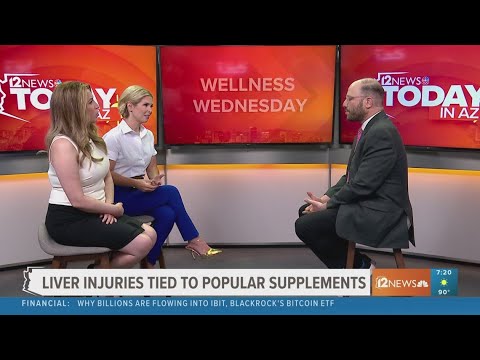
A health expert explains everything you need to know about popular supplements.
Saw that forecast and said I’m coming to Arizona. That sounds nice. Yeah, thanks Crystal. It’s wellness Wednesday we’re diving into health risks on taking supplements. The doctor here is gonna talk to us a little bit about it, uh, but first there’s a rise in the largely unregulated industry of supplements. Recent studies show supplement related liver failure requiring patients to be waitlisted for transplants has increased eightfold, and that is really scary to hear. I feel like I hear about it. A new supplement that’s gonna change my life every single day and it’s all coming from social media. So joining us this morning to kind of break some of those myths is Doctor Moises Neva. I wanna start with what supplements should we be taking, especially women our age, which I know it seems like we’re in 20s it does, but like someone like us, closing in on 40, what do we need to take? So I think first of all, thank you very much for having me. Good morning pleasure, um. You know, the supplement, as you said, the supplement business is a $60 billion a year, um, industry, and it’s not fully regulated by the FDA. And why is that? Well, I think that all of these supplements don’t fall under the category of medications per se, so they don’t have all of the necessary studies ahead of time or up front. And when there are complications there are not the the the regulations that the FDA has set forth to report the complications is not as standardized for the regular medication. I think that’s fascinating because you’re hearing how, — how much it can impact people like that and that it’s not
— regulated. No, it’s not that regulated and, and interestingly enough, if you look at some of the studies um when. You look at the labeling of all of these supplements, um, up to around 50% in some cases up to 80% of the labeling is, is not accurate so whatever they’re actually telling you that are on these supplements is not actually what they have there or it’s kind of compounded with other substances that may be harmful for the patient and uh whoever. Is taking it so just to answer your question, — what should you be taking multivitamins is OK so
— that’s kind of the way that you should be going, yes, so multivitamins are OK and obviously leading a healthy diet, so, um, a lot of fruits, a lot of vegetables, exercise, just common sense. But whenever you get these supplements that are promising earth, wind and fire that they’re gonna change your life forever. Um, you have to be careful and you have to definitely consult with your primary care physician or your specialist if you have underlying conditions that could definitely impact whatever treatment you’re receiving. But it is interesting though because honestly you could just get what you need by what’s simple eating a healthy diet, right, healthy diet is key. Exercise is key and the other thing that that is also kind of a little concerning is that all of these medications or supplements are because they’re unregulated they’re not going through uh the proper channels if you wanna call it you can easily uh access them through the internet or through other so everybody has access to them. And if you’re not well informed you can actually end up getting hurt. Well, so that was gonna be my question. I mean you can find them. You get them all over the ads right on your social media or late at night or you’re watching and so you can just buy them, you know, I don’t need to consult with anyone. I could just get these and start taking them. What are the risks or what would you consider, you know, somebody to do if maybe they think. Supplement, hey, I think that could really help me out. Should you buy it and then take it to your doctor, have them test? How do you even know what you’re putting in? That’s an excellent, excellent point that you bring up that because it’s suspected that up to 60% of Americans are actually using, uh, herbal and dietary supplements, and they’re not disclosing them. They’re they’re used to their physicians so um what I would suggest in this situation is actually, um, talking to your primary care physician, talking to your specialist, and explaining and telling them, OK, I saw this, uh, ad or this product on market online that I’m interested to use for X, Y and Z case and then say if that will interact or interfere with her. Our treatment in any way, — form or fashion so I would consult first before
— acting. And what are the risks if I’m just taking this supplement because if someone told me on social media to take it or if I’m grabbing this at the store because my girlfriend says that this may gives her so much energy, what are the risks associated with that? Excellent. So, um, I’m a liver specialist, so looking at liver related complications, the liver related complications are. Things that could be as simple as just irritation of the liver, OK, um, but as you said, in a small percentage of cases then people can have significant amount of liver inflammation up to the point that you can develop liver failure, um. The easy way to kind of fix this is stop the supplement. OK, if you stop the supplement 9 times out of 10, things will get better on their own. OK, that’s good. Uh, my goodness, but that’s a really scary to think that if you’re taking that you could really cause some major damage to one of your organs. It’s happening it’s. Happening like we just talked about Doctor Moises Neba, thank you so much for breaking this down for us. We appreciate it and hopefully you got some good, uh, information from that on your wellness Wednesday just to be careful with the supplements you see around on social media before you take them consult. — I like that on
— the ending very much and it was a pleasure yeah.