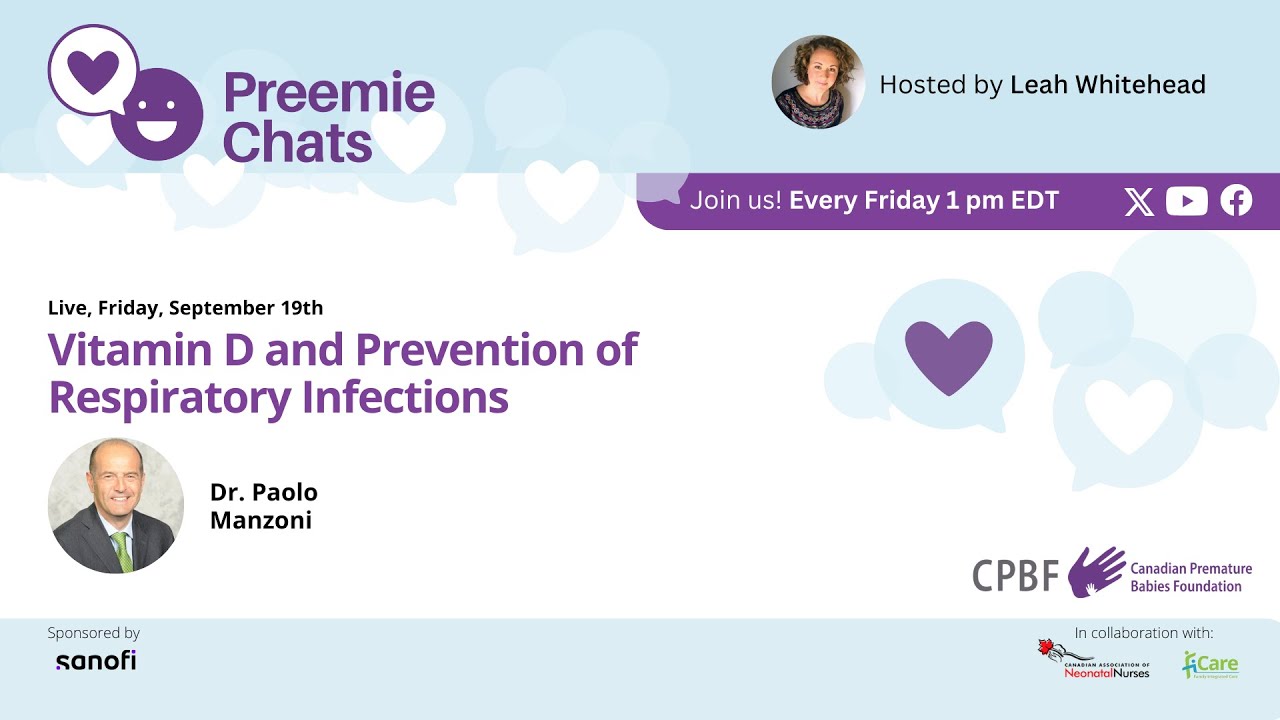
In this talk, Dr Paolo Manzoni will discuss Vitamin D and Prevention of Respiratory Infections.
Vitamin D is a critical nutrient performing several biological functions and delivering many health benefits. Its role is absolutely vital in enabling bone structure and integrity, but also in several other domains such as immunity, control of inflammation, and anti-infective responses.
In particular, Vitamin D serum levels are inversely associated with the risk of developing respiratory disorders in infancy, mainly caused by RSV and other respiratory viruses.
Therefore, correct intakes of vitamin D are needed in neonates and young infants to enable protection from these morbidities, and the same applies to pregnant mothers in order to transfer through placenta correct vitamin D serum values to the fetus before delivery.
🗓️ When: Friday at 1 PM EDT
📍 Where: Facebook | X | YouTube
🎙️ New to streaming or looking to level up? Check out StreamYard and get $10 discount! 😍 https://streamyard.com/pal/d/6676413909827584
Heat. Hey, Heat. [Music] [Music] [Applause] Hello everyone and welcome to Preey Chats, a space where we connect, learn and share stories about the world of prematurity. I’m Leah Whitehead. I’m the proud parent of a preeie and I’m also a former journalist and I’m so honored that you have chosen to join us here today. Preemy Chats is brought to you by the Canadian Premature Babies Foundation, also known as CPBF, a parentled charitable organization dedicated to supporting families, advocating for the needs of premature babies and providing the latest information and resources to help parents and caregivers navigate this journey. So whether you’re a parent, a health care professional, a researcher, or someone interested in understanding more about pre-term birth, you are in the right place. Together, we’re creating a supportive community where stories are shared, questions are answered, new evidence is explored, and no one feels alone. Be sure to visit our website. It’s on the screen, canadianpreies.org. And there you’ll find helpful resources, our latest projects, and most importantly, a community of people who want to see our little babies thrive. If you’re watching live today, I’d invite you to please join the conversation. Share your questions and comments in the chat and we’ll try to address them during our program today. And if you’re watching a recorded session, you can still connect with us through our website. It’s through meaningful discussions like the one we’re about to have where we advance practice and grow together. So, let us know where you’re watching from. We’d love to hear from you. I see Sandy, you’re already saying hello and letting us know that you’re you’re tuning in. So, it invite other people to do the same. It’s always interesting to see where people are joining us from. Now, the topic we’re exploring today is one of the reasons why I love hosting preeie chats. Every time I learn something new, and I hope you will, too. As parents, we deserve the bigger picture when it comes to treatments or medications for our little ones. And I have always been the parent who asks a lot of questions. So, I was honestly shocked to learn this. When we left the NICU, like many families, we were sent home with vitamin D drops to give to our preeie for her first year. And most of us already know vitamin D is important. It helps build strong bones and supports so many essential functions like immunity, reducing inflammation, and even fighting infections. But what I didn’t realize is just how critical vitamin D is when it comes to respiratory health. Research shows that vitamin D levels are inversely linked to the risk of respiratory disorders in infancy, especially those caused by RSV and other viruses. So, in other words, keeping vitamin D levels where they should be, offers a layer of protection for our babies. And here’s something else. It’s not only important for preeies and young infants, but also for those who are pregnant. When a mother’s vitamin D levels are healthy, she passes those benefits on to her baby through the placenta, giving her little one a stronger start even before birth. To help us to help guide us in our conversation today, we are joined by Dr. Paulo Manzone. Dr. Dr. Manzone is a neonatlogist and pediatrician serving as the head of the Italian Society of Neonatal Infectious Diseases and a founding board member of the Resvet Excellence Research Network on RSV and that was established in 2014. He spent over two decades as part of the neonatlogy and NICU team at St. in a hospital in Torino before becoming head of the maternal infant medicine department at the University of Torino Hospital Dal and Fairmy in Bella. He also holds a position as associate professor of pediatrics and neonatlogy at the University of Torino’s school of medicine and I’m so happy he’s joining us here today to share his wisdom. Welcome Paulo. Thank you very much Leah. Um my pleasure to be here and to join you for the second time. Last year I came here and I gave another talk and it was a wonderful experience and so I’m proud and honored to be here once more to highlight these very interesting points that Julia summarized amazingly well because probably you said it all and I have no more room to explain further but I will try to cover some minimal areas that you couldn’t include in a summary. Uh let’s go straight to the point vitamin D and respiratory morbidity and I underline the word and because that means that vitamin D is associated inversely or in other forms with respiratory mobility in infants. Next one please. Next one. Okay. I have no disclosures about this lecture. Next one. And this is the outline. I will cover briefly what’s vitamin D is in terms of structure, intakes, actions and benefits. And then I’ll go straight through the point of this lecture. respiratory diseases and association with vitamin D. Which are the links is if any and how can we and this is the point of practical guidance um use this information to better address our cares and our preventative strategies to pregnant mothers and to neonates and young infants. Next one. So let’s go straight to vitamin D next. Next, vitamin D. It is a lipos soluble hormone. Uh hormones are substances as you probably know that are secreted by the uh by the body internally and are delivered internally to one or more organs uh other organs to to deploy a specific effect. And vitamin D as a reservoir in the skin. In the skin, vitamin D is diluted in the fatty layer of the skin in the surface in a form that is called vitamin D ago D2. And this D2 form of vitamin D is a precursor. In uh in chemistry we call it provitamin. That means that in this in this form vitamin D is not yet active but needs activation. And how can we get activation? Probably you know it very well through the sunlight. Sun beams activate vitamin D2 into vitamin D3 so-called choleiciferol. And this form the D3 form becomes ready for uh being transported into the whole human body and being ultimately ready for intestinal absorption if we get an oral intake. So you understand clearly uh clearly right from this slide that we do need the sunlight in order to have active vitamin D. Next one. In fact, the sources of vitamin D are mainly related to sunlight exposure through the UV rays because more than 80% of the vitamin D that every human being is using comes from there. uh if we want to um let’s say to improve a little bit our vitamin D uh content our vitamin D stoages we can ingest vitamin D um and count on the intestine absorption through uh meals or nutrients that are rich in vitamin vitin D uh oily fish number one um dairies but most of all supplements and fortified milk cereals or bread however the intestine absorption accounts for no more than 20%. So it’s not that easy to overcome and to restore a poor exposure to sunlight if we are not very very actively focused on providing the correct intakes through oral ingestion. Next one. And uh geographically we have areas and sorry for this new you guys in Canada belong to an area that in this view is neglected. uh we have very many geographic areas at the extreme of the two uh hemispheres where the exposure to sun rays is poor I would like to say is inherently poor because the latitude uh implies that the rays do not arrive with correct potency and aren’t able to transform vitamin D2 2 into D3 in all molecules. Uh in contrast in um in countries uh from both side of the of equator and up to the Mediterranean side or the subsaharan continent or Central America or far east, the sun exposure might be good. But however there are other ways to uh decrease the sun exposure despite the geographical location is suitable. And these other ways are pollution number one and um cultural habits to wear long dresses and to um to wear dresses and clothes who do not expose the skin like in Arabian countries. As a whole, you can see from this geographical map that the problem of vitamin D uh deficiency may affect every human being located in every geographical area both for either for poor geographical sun exposure or for cultural or uh environmental habits or conditions. that prevent correct exposure to the sun. Next one. But uh which actions does vitamin D exert? Uh the roles of vitamin D are very many and you know very well that calcium and phosphorosomeasis ultimately uh activity on the bones is the number one action of vitamin D. thus preventing ricketetts osteomalia and osteoporosis especially in elderly but as just as Leah was alluding to there are several other actions of vitamin D it’s a hormone and it’s very active in regulating the im immune system in promoting innate and adaptive immunity in um delivering good cognitive health and well-being and in contrasting infections especially in the respiratory domain. Next one. Vitamin deficiency is diagnosed by measuring the levels of the iso the active isopform in in the blood. And unfortunately vitamin D deficiency during childhood is very frequent. You see here and this is partly in Italian but it’s very easy to understand that levels below below 10 nanog per milliliters uh levels who are that are indeed very very low are very frequent also in Italy and this graphic comes from Italian children despite geographical correct location. And if we want to um to give a figures up to 50% of children might be in uh slight or uh huge uh deficiency of vitamin D uh according to these uh studies. Next one. Obviously, skin exposure, skin sun exposure accounts uh heavily for the deficiency and this is true also in geographical good location during winter season. You see here that during fall and winter and early spring, the levels of vitamin D aren’t correct in in those babies and those individuals believing in northern or southern hemispheres. and uh and therefore at the very least during winter time a deficiency of vitamin D might occur also in areas where the sun exposure is correct. Next one. Um I don’t I don’t want you to uh remember very uh accurately this table, but in uh in a routine daily practice, we usually define deficiency levels of vitamin D that are less than 25 nanom per liter. And when we detect these lab these levels, the action is to replace vitamin D uh rapidly and usually with even loading doses followed by maintainance. However, a big proportion of children is falling within the range of insufficiency that is 25 to 50. And in these levels, in these when these levels occur, these children’s these children are given maintenance doses or loading doses if they are affected by additional mobilities affecting mainly the bone system. Um when the levels exceed 50, we define the vitamin D as repletion and the baby as not having any need for replacement or for continue dosing. Uh however please remember that uh just like every lipos soluble hormone vitamin D may might be even toxic if levels exceed 150 nanomles. This is a very rare, a very unusual and uncommon feature. But however, we do always need to manage this possible problem and to handle with care administration of vitamin D especially when we think to give low doses. Please go on the next one. So after having highlighted what vitamin D is and which are definitions of deficiency and insufficiency let’s go to see whether there is a link between vitamin D respiratory disease the next one and indeed the links are there because vitamin D has a lot of extracellular actions with as just as I was telling you at the beginning of this talk imunomodulatory actions interference, positive interference on the development of autoimmune diseases, promotion of innate immunity and actions also in the inflammation chain. Next one. um especially I want to uh spend a little minute on the actions on immune system and on inflammation. Vitamin D has indeed these effects and these effects can be measured when we go and detect an increased occurrence of respiratory threat infections in individuals affected by vitamin D deprivation. particularly in developing countries where several papers have shown this feature. But we do have also an increased risk of wheezing in infant less than three years old and an increased risk of viral coin infections in those children who are recurrent wheezers. Let’s go through some of these papers and studies in order to understand more in more deeply this point. Next one please. Vitamin D has effects on the immune system and this is implying that vitamin D can modify and imprint uh the development of monocytes and macrofase can enhance maturation of the dendritic cells can affect on the memory T cells in both ways and can also activate the proliferation of B cells. So a wide range of actions ultimately uh conveying and increase the ability to defend from infections especially for the child. Next one. But also on inflammation we have a demonstration that uh inflammation especially in lung epithelial cells can be decreased by having good levels of vitamin D and this is due mainly to an interference of vitamin D against the TNF alpha the tumor necroy factor alpha a key player in the inflammation cascade. Next one. With this in mind, let’s go next one to see which are the proofs. And I was telling you that wheezing and wheezers can be somewhat associated with vitamin D deficiency. And indeed, this study in Finland in the Jackie by Dr. Jati already 15 years ago they could see that when vitamin D levels were lower than 50 nanog per milliliter an increased risk of viral infections mainly by RSV and rhino virus was occurring in children were hospitalized for wheingly and uh And more curiously, vitamin D deficiency can be a cause or can be associated at the very least with an increased risk of respiratory infections in neon. seems the levels in the cord blood. Several studies and this is one of the very first uh published in pediatrics have measured the level of vitamin D in the cord blood soon after birth or I would say immediately after birth. And when these levels are falling within 25 nanom per liter uh meaning that there is a deficiency well these baby have an evolution. These babies have an evolution that is very typical. They go very frequently towards respiratory infections and towards wheezing and viral infection during wheezing. So the point is already there since birth. Next one. And and this is another uh graphic from this study assessing that this risk may be prolonged up to five years of age if having uh low cord blood levels is not corrected during the first months and years of life. Next one. Also in bronchulitis there’s a relationship with vitamin deficiency. Children with acute bronchulitis have more frequently low levels of vitamin D. And this is a case series from Israel published in BMC pediatrics where out of 80 babies with bronchilitis matched with a control group the vitamin D levels in the bronchilitis group were as a mean 28 that means on the border of deficiency whereas the control group had 50. So this is a clear difference uh vouching for a role of vitamin D not only in providing a higher likelihood of being hospitalized for bronchulitis. Next one but also a higher severity of bronchulitis once this baby is hospitalized. And this is again another very interesting picture of this population of babies hospitalized with bronchilitis where we see very clearly that the severe course of bronchulitis is occurring always in babies with deficiency of vitamin D and the moderate feature is occurring again in babies with a high proportion of vitamin V deficiency. So vitamin D deficiency is is impacting very much on bronchulitis both in terms of frequency and in terms of severity. Next one. Thanks. But more um I would say more uh specifically RSV can be a key player in this context. You know very well that bronchulitis and we come back to the previous two slides is mainly caused by RSV. So the suspicion that RSV and vitamin D may be linked is very high and we have several hints bouching for this suspicion from in vitro study from genetic polymorphisms that have been detected and most of all from once more the measurements of vitamin D in the core blood and the followup of these babies born during in different months of the year with different levels of vitamin D in their core blood. X1. One of the most important studies assessing these relationships have been conducted has been conducted in the Netherlands some 10 years ago and was published by pediatrics. This is the group of Louis bond the chair of the resinet network which I belong to. In this uh Dutch study, a prospective birth cohort was followed up with 156 neonates and they were followed up during their first year of life with measuring the core blood vitamin D concentrations at birth and later on with reporting from the parents about RSV symptoms occurring in the first year of age and detection of RSV during uh episodes with the symptoms of respiratory disorders. Next one please. Okay, we have a number of very interesting findings coming from this study. First of all, the levels of cord blood vitamin D were clearly associated and you see this graphic with a red arrow with the months of birth. Meaning that babies born during winter had higher level of vitamin D simply because their mothers have been exposed potentially more exposed to sunlight during the summer months when they were pregnant. Conversely, babies born during summer months were having more frequently low concentrations of vitamin D in the cord blood. Next one. And this exposure during pregnancy was clearly translating on the levels of vitamin D in the core blood in that the frequency of deficiency of vitamin D less than 25 was higher in babies born during uh summer than during winter. Natur. So we might think that mother nature is providing a natural support for those babies being born during winter time because their mothers should have been exposed to sunlight and therefore delivering more vitamin D when the delivery occurs. Next one. And curiously enough, this curve of vitamin D levels as you see in the right according to different birth months with a peak during winter months is fully overlapping with the peak of circulation of RSV during winter months. You see they both are clearly the same. So the nature the natural model of protection against RSV at least of a very basic protection against RSV is um giving value to these natural model of having high vitamin D core blood levels during months where RSV exposure could be the highest and therefore Four, this is a first call to action because we should uh advise pregnant mothers expected to deliver during the fall and winter to get exposure to the sun during summertime when they are four, five, six months pregnant old and to receive supplements if this exposure is not enough. next one. But the final confirmation of what I’m saying is that when following up these babies for the first year of life, it was absolutely more frequent having a respiratory lower respiratory thread infection by RSV in those children being born with low levels of vitamin D compared with those who had good levels. And therefore having less than 50 nanom per liter was already confiring a four far four fourfold higher risk of having a respiratory RSV infection than having levels beyond 15 animal per. Next one. In conclusion, the deficiency of vitamin D was very frequent in Dutch newborns in this study and the concentration of vitamin D in the cold blood were associated clearly with the susceptibility to develop an RSVRI during the first year of age. And therefore since vitamin D status depends on the maternal statues particularly during pregnancy we need to provide a vitamin D supplements during pregnancies in order to increase the core blood vitamin D concentration and we need to reinforce the message and to promote the awareness about what vitamin D can give to each single offspring uh after delivery in order to have a mothers during pregnancy very well concerned and very well um engaged with prophylaxis with vitamin next one. And if we don’t have a good levels in the cord blood, can we correct this mismatch? Yes, we can. We can by giving supplementation of vitamin D since birth and full adherance to the recommendations and guidelines that are very strict and very mandatories. Effect of vitamin D supplementation can be seen after few months of supplementation. And here we have the results of a BMJ study where six months of vitamin D supplementation were able to convert um 80% of the babies belonging to the vitamin D deficiency group in babies uh having an adequate level. Next one. So I’m coming to the end and I would like to close this lecture with some call to actions that that are made the main messages that you can bring home. So the status of vitamin D needs to be assessed in all pregnant women. So OBGYNS, midwives and pregnant mothers need to be fully aware about that. Supplements in pregnancy are critical and are required to avoid vitamin D deficiency in the offsprings besides exposure to the sunlight whenever possible by pregnant mothers. Vitamin D after delivery needs to be supplemented in all infants. The risk of uh overdosing is really negligible. At the very least, it’s not there when we are sticking to the correct dosing recommendations. Whenever vitamin D deficiency occurs, respiratory morbidity in infants increases and RSV is one of the main actors if not the main one in this context. Therefore, and this the my last message, prevention of RSV bronchulitis relies very much also on vitamin D correct intakes and possibly on supplementation of vitamin D in pregnancy and in infants. next one and having said that I thank you for your attention and I’m very happy to promote here and invite you here to the next ICCN international conference on clinical neatlogy that will be performed in Torino Italy on next September 2026 in collaboration with resinet the network of uh experts on RSV which I belong to. Thank you very much and I’m happy to get questions if you have any. Thank you very much for your presentation. I was taking lots of notes. I have lots of questions. Some of them you did answer in your presentation. So that was great. Um, and we did have some questions come in from Sandy who’s watching, and she wondered, you talked about the importance of doing blood tests um, to kind of monitor the vitamin D levels. I think to avoid toxicity was the the uh, purpose there. And so, she was asking how often uh, should you do the blood test to know the vitamin D values? Well, I I I I would be very easy about that. Vitamin D blood test may may be done only once in order to to have a picture of your statues and then move from there. The risk of having over uh dosages as I was telling earlier on is really really negligible. So uh unless you get uh five shots of millions and millions of international unit of vitamin D this is almost impossible but it’s very important to have a picture of the baseline statues and uh very often this picture is is giving us bad surprises because we are not we are not aware of being deficient. then we might be in in Sandy also had a question about the pregnant woman intake vitamin D time and so should they be starting in early pregnancy and I think you mentioned sunbathing can help uh provide additional vitamin D. Yeah, sure. So uh I recommend giving vitamin D during the whole pregnancy. um once more with the correct dosing and dosing regimens and these dosing regimens are absolutely fine and absolutely safe. Um, obviously if you have the chance to to get some sun by using short sleeves, uh, skirts and not having a hats or love big big hats, that’s that’s an additional advantage if you are if you if you can have it because you are living in a geographical suitable area. I had a question uh just about so again the timing um we did vitamin D drops for our preeie when we uh I think it was partway during our stay in NICU if I remember correctly but I’m going back 12 years now and then uh when we were home until she was one and I’m just wondering if that kind of practice like should that go longer than a year or are you finding that that tends to be the sweet spot for our infants? No, I I tell you it’s a it’s important to to prolong this practice at least till school age for many reasons especially if you live in urban areas. Um well I live in northern Italy. Northern Italy is okay. We have a sun exposure during during summer, but then we have a long winters with pollution, with fog, with heavy clothing and um and therefore uh vitamin D is critical also beyond the first year of age is very critical at the very least up to the school age because during the first five to six years children are very prone to respiratory infections and therefore or we do need that in and additionally uh we recommend strongly a vitamin D supplementation when the pubal burst it’s occurring so during the puberty and early adolescence and both for uh reinforcings reinforcing the bone bone system and also because in adolescence immunity may be waning a little bit and an additional protection can be it’s funny you always hear vitamin C talk with the immunity and have your oranges and your juice and but um it sounds like vitamin D is a good to bolster for that as well and something that maybe isn’t as commonly um shared or talked about you know um you got you you touched a very nice point vitamin C is mainly an anti-inflammatory nutrient. So, it’s able to decrease inflammation, but it’s not able that much to pro because it’s an antioxidant. Uh, as vitamin C is ascorbic acid and ascorbic acid is an antioxidant. By decreasing oxidation, uh, at the end of the day, you decrease inflammation. So you get relieved from your symptoms earlier. In turn, vitamin D is an hormone is an hormone delivering actions on several organs including the immune system. So it’s something it’s really something more besides being something different. I’m wondering about long-term effects as well because um especially for preey parents, you know, a lot of us have babies who then receive the diagnosis of chronic lung disease um and go on to be asthmatics. And so, is this something that would affect long-term health? Um and is it something that could help with something like asthma as well? Yeah. So the studies that I provided, I took a a sample, a very limited sample of the studies, but there are many more. Uh those studies um vouch for an association between low levels of vitamin D and wheezing, recurrent wheezing, asthmatic episodes complicated by viral infections and so on. So a a comprehensive picture of increased mobility in the respiratory domain in the first at the very least in the first six years of age. And obviously if you have a baseline condition that is already hampering you um it’s the role of vitamin D might be even more meaningful because this could help preventing a little but not negligible portion of worsening related to your baseline condition. So uh as a matter of fact um at least in Italy we all all neonatlogist involved in followup of pre-term neonates after discharge from the niku uh used to have a very high attention towards vitamin delivery and intakes and number one is vitamin D H and you’re saying that all in would be on vitamin D, not just preeis. Is that right? Yeah, absolutely. Absolutely. Um as I was saying a little earlier, uh preeis uh are how to say are more uh penalized. they have a a a baseline condition that it’s already critical compared to regularly born infants, but both of them can receive benefits from vitamin D. And you talked about the cord blood as well, which is very interesting because again, it’s one of those things that um when you’re taking, you know, your prenatal vitamins, you often don’t think that it will affect respiratory um systems down the road for your baby. And so I’m just wondering um with that core blood you had said that hello I lost Yeah. Hello. Hello. Yes, I’m here. Can you see me? Okay, I can see you. You got freezed. It looks like we may have lost Paulo. he is in Italy and so I thought it was running a little too smoothly um to be having this discussion with someone overseas but uh we will we will wrap up our conversation there for the day. Um thank you for joining us for this edition of preeie chats. I could have asked so many more questions because it is such an interesting topic and one that I think we need to um be talking about and having these kind of conversations. A special thank you to Seni for their support of educational programs such as this one. And if you missed part of today’s episode or you want to revisit it, you can find this episode and all past episodes on our YouTube channel and website again, canadian preeis.org. There it is on our screen. And while you’re there, explore the many resources and support options that we offer to families on their journey. As a charitable organization, CPBF relies on the generous support of people like you. Your donations allow us to continue empowering families of premature babies every step of the way. Together, we can create a brighter future for all preeies and their families. And of course, speaking of brighter future, I know that you’ve heard about this. We are going to make a big splash this year leading up to World Prematurity Day. We have our gala happening November 6th in Toronto. If you’re able to be there, be there. Uh you won’t want to miss it. We are going to have some very special guests. Um some meaningful moments together, a silent auction that we have all kinds of uh items that will be exciting to bid on. And so don’t miss it. And you know, even if you think there’s no way I can make that work, consider donating a ticket to one of our families who would like to attend because it really will be a special evening to come together and shine hope for premature babies all across our country. Thank you for being a part of this community. We will see you next Friday at 1:00 p.m.