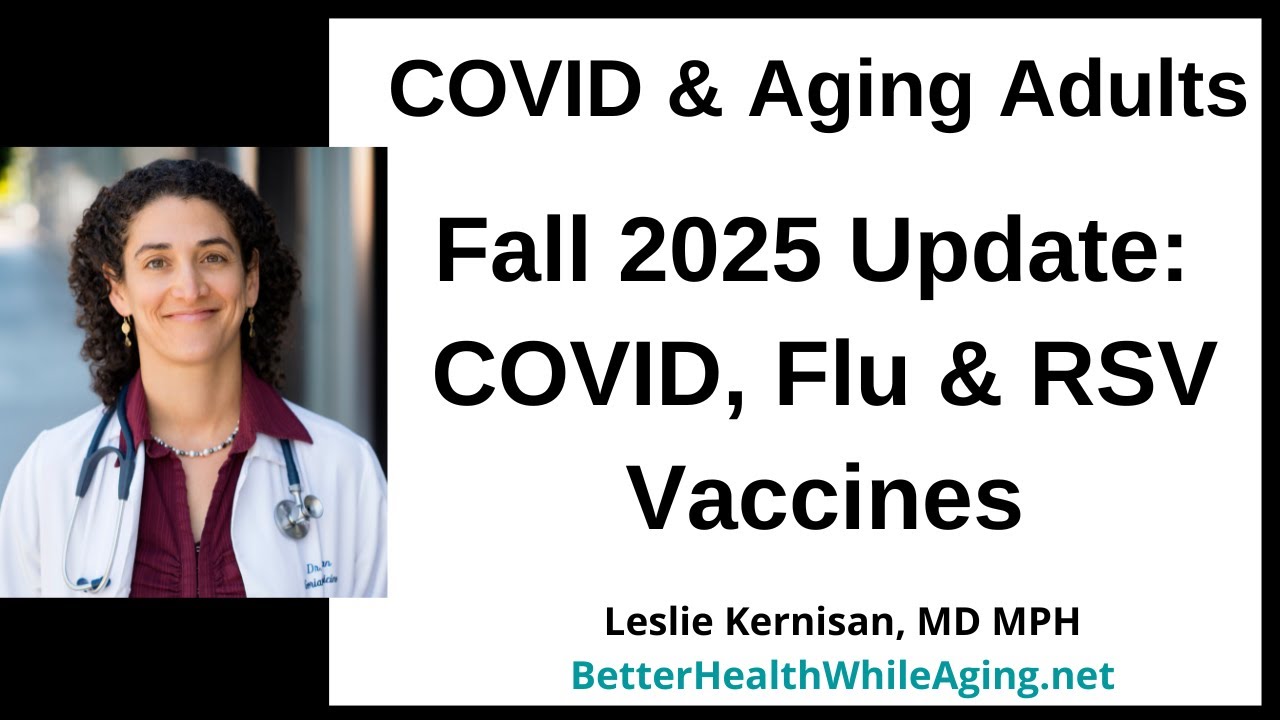
Geriatrician Leslie Kernisan, MD MPH, shares what’s new for the 2025–26 fall vaccine season, especially for adults over 60. She reviews the current COVID situation, the updated vaccine options (including Moderna’s mNexspike), and the latest CDC guidelines. Plus, key reminders on this year’s flu and RSV shots and practical tips for staying healthier this winter.
#covidvaccine #covidupdates #betterhealthwhileaging #flu #rsv #olderadults #geriatrician #immunization
Chapters:
00:00 Fall vaccines for older adults
01:05 COVID so far in 2025
06:20 Why fall vaccines matter
11:18 COVID vaccines for 2025–26
15:11 Moderna mNEXSPIKE and other options
23:37 Flu vaccines for 2025–26
25:16 What to know about RSV vaccines
26:32 How to reduce your chances of getting sick
29:47 Recap
For related links and resources:
168 – COVID & Fall Vaccines 2025: What Older Adults Should Know
Note:
For the masks Dr. K has recommended in the past, you can get the 3M V-flex here https://amzn.to/3OxrsRY, and the Powecom KN95 here https://amzn.to/3W9frXf
These are Amazon affiliate links, so any purchases will help support Better Health While Aging, thank you!
WATCH NEXT:
Can Exercise Reverse Aging? How to Exercise to Age Well
Protein, Metabolism & Aging: Nutrition Tips for Longevity
Disclaimer: The material on the Better Health While Aging Youtube channel, including any exchanges in the comments section, is for informational and educational purposes only. Any comments Dr. Kernisan may make regarding an individual’s story or comments should not be construed as establishing a physician-patient relationship between Dr. Kernisan and a caregiver, or care recipient. None of Dr. Kernisan’s website, social media, comments, or group information should be considered a substitute for individualized medical assessment, diagnosis, or treatment. Please see the full disclaimer for more information: https://betterhealthwhileaging.net/disclaimer/
Well, hello there, everyone. I’m Dr. Leslie Kernisan, board certified geriatrician and founder of the website betterhealthwhileaging.net and this is the Better Health While Aging video podcast, where we discuss common health problems that affect people over age 60 and the best ways to prevent and manage those problems. In today’s episode, I’m going to talk about fall vaccines in aging, specifically Covid and also flu and rsv. Some of you have actually been asking me to cover this. So specifically today I want to talk about the current state of COVID and kind of what’s happened over the past year, and then what to know about the fall COVID vaccine, especially if you are an older adult or are involved in the care of an older adult. And then I’ll also just briefly talk about the flu vaccine and also the RSV vaccine as well. So what do we have so far for Covid in 2025? So this year we actually had less Covid. I mean, I think every year, the past few years we’ve had less Covid, but this year it was substantially less. There was a COVID wave around the holidays again last December, January, followed by another smaller wave in the late summer. But they’re definitely smaller in terms of hospitalizations and deaths than we had seen in previous years. And in fact, last winter, the flu was much worse than Covid was. And so let me see if I can show you this. Let’s see if I can switch my screen. So we have had changes at the cdc, but there still is some reporting. And so this is a graph that shows you the deaths really since the beginning. And so what you can see is our first two winters with COVID we had really big waves in the wintertime, a much smaller one in 2023, even smaller in 2024, and then really quite small in the winter of 2025, you know, even smaller than the, the previous wave of the summer. So this is, you know, this is overall good news. Now it is still older adults who are by far most likely to die. Here you can switch the graph so that it shows by age. This dark purple line is over 75 years old. You can see that the bulk of the deaths still occur in people who are over age 75, including last winter. All right, let me now switch back. Okay. And so what we’re seeing is that if you actually look at wastewater levels during those surges, they actually still go up quite high. There are just fewer hospitalizations and deaths. And I think this speaks to the fact that first of all, we lost A lot of frail and vulnerable people over the previous years before, but also people, lots of people now are still getting Covid about once a year. However, since they’ve already had Covid a few times before, many people have also chosen to be vaccinated. There’s a fair amount of immunity. And so I still go to some events where they ask people to take Covid tests before coming. And when that happens, there are a certain number of people who feel totally fine who will test positive for Covid. There are other people who barely have sniffles who will test positive for Covid. So I think the moral of the story is there’s still probably a fair amount of COVID that goes around when it is going around in your community. It’s just much less likely to send people to the hospital or die. But again, the ones who overwhelmingly are most likely to be hospitalized are older adults. Otherwise, the changes in 2025, the biggest changes really have happened at the level of administration, public health and what the CDC is studying and reporting. And to be honest, I have a master’s in public health and within the public health community, it generally has not felt good. There have been significant cuts and reorganizations to all federal agencies, but the CDC has been hit pretty significantly, as I’m sure you know. Robert F. Kennedy Jr. Is now head of Health and Human Services and he has a history of being skeptical of vaccines for sure. The CDC leadership has been in disarray. You know, at the time that I’m recording, recording this in early October, they. They don’t have a permanent director. There’s somebody in the acting director role. Somebody was appointed in the summer, but then was dismissed. And then vaccines are generally reviewed by. I mean, first they’re approved by the fda, but then they get approved by a special committee at the CDC called ACIP Advisory Committee on Immunization Practices, which histor. The people on the committee have been really sort of well established experts in vaccines and immunology. And that whole group was replaced in June by RFK by people who, honestly, there has been controversy around their qualifications and actions. So this is just to say this is a challenging and honestly, it feels like an unstable time for public health and vaccine policy. And there has been decreased reporting as well as. And that’s even before the government shutdown which started at the beginning of this month. And at the time I’m recording, this is still ongoing. So despite that, we are still going to have vaccines for the fall. They’re just. Some of the availability and recommendations have shifted a bit and I Will talk about that. But first, you know, why do we even have a fall vaccine season? So it used to be because there is more flu in the winter. Flu is very seasonal and every year causes tens of thousands of deaths. In a bad year, significantly more will also cause lots of hospitalizations and lots of illnesses. In fact, last year was quite a bad flu year. Let me show you where you can see that. I will be sharing links to these pages in the replay notes. So the CDC has changed the data that they share related to Covid, but they still have these respiratory viral illness pages, which are nice because they combine Covid, the flu and rsv. And so what you can see is last winter, and this was the first time since COVID came on the scene that this happened, there were way more hospitalizations for flu than for Covid. And there were significantly more deaths actually in the wintertime. So Covid. Covid seems to have had, in the United States, roughly two peaks every year. One in the wintertime after, usually after the winter holidays, and then another one sometime in the summer. This year we had it kind of late in the summer. It was really end of August, September, that it happened. But flu activity goes up every winter. And that is really the genesis of the fall vaccine season. Used to be flu. Now we have flu, but also Covid and then also rsv. So this is respiratory sensational virus. I’ve talked about it in previous videos. I have a page about it on better health while aging. This is a virus that, when I went to medical school, they talked about how it was really dangerous, dangerous for infants and very young children. But they also realize that it affects quite a number of adults. For many adults, it’s just like a bad cold. But especially when it comes to older adults, it can make them quite sick and can hospitalize them as well. And as of the last few years, we do have a vaccine available for older adults. So the CDC does report on all three of these. And there are. There are two. There’s actually a different page, which, if you’re curious, can be a good way to see what’s going on. They have a respiratory virus activity level page. Now, this isn’t currently getting updated because of the government shutdown, but so this was last reported on Friday, September 26. Usually, I think they try to update it every Friday and they show these maps with the kind of, you know, levels of illness, wastewater levels for the different viruses. So you can see here that we actually had high and very high levels in some parts of the country still at the end of September, this seems to still be coming down. We’re on the downslope from our summer. They also report on emergency department visits for respiratory illnesses. That’s also a helpful measure of just how much of it is going around. You can see right here our September bump for Covid, which was really kind of comparable to the winter bump that we had, you know, in terms of magnitude. So this is another place where you can take a look throughout the winter to sort of see, are things revving up? Should I be a little bit more careful or not? Because as I will explain today, and as I usually say, you know, vaccines are a great idea, and if you really want to avoid getting sick, it’s also good to take a few other precautions as well. So the fall vaccines. This fall vaccines are currently available for Covid, for flu and for rsv. And the main benefit for most people is going to be that it reduces your chance of being hospitalized. This winter also does reduce the chance of death. Now, if you’re a healthy, younger person, say, like me, your chance already of being hospitalized or of dying from any of these viruses is so low that even if it gets reduced by vaccination, in absolute terms, it’s not a lot of reduction. But especially as people get into their 70s and 80s, this does make a meaningful difference. But also, even if it’s not, you’re not at high risk of being hospitalized or dying. You know, say, someone like me. Being vaccinated also reduces your chances of feeling miserably sick, of having to take time off work, of having to take time, you know, being careful with your family. And I think that’s a valuable benefit as well. But again, the older or frailer or more chronic illnesses you are, or if you are immune compromised for some reason, the more likely you are to benefit meaningfully from vaccination. So what do we have available for 2025, 2026? So things have been changed up, probably because some people who are somewhat skeptical of vaccines got put in leadership positions at the fda, the cdc, Health and Human Services. So the FDA actually went and did some unusual things this summer. They changed the license for the COVID vaccines and said, well, it’s approved for 65 plus. But then if you’re age 6 months to 64 years, you’re supposed to have at least one condition putting you at high risk. Now, the list of conditions that puts you at high risk is actually quite long. You know, one might even say generous. It includes not only conditions such as diabetes or cancer, but even being overweight qualifies as A high risk condition, mental health conditions qualify. Pregnancy is also considered a high risk condition. So what this means is that if you are under age 65, it’s really not hard to qualify for getting the vaccine on label. And then the CDC in September had a meeting to make review information, make their recommendations about the COVID vaccine, and they ended up saying that they recommend vaccination for everyone, but that it should be done under something called shared clinical decision making. This is not what they used to say, but now this is what they’re. They’re. They’re saying. So what does this mean? Shared clinical decision making is this sort of idea that instead of having a blanket statement of yes, we recommend this for everyone unless there are compelling reasons to not do it, or no, we don’t recommend it for anyone unless there are compelling reasons to do it. They say, well, you should have a conversation with your clinician, meaning your, your doctor, or it could be a nurse practitioner, physician’s assistant, a pharmacist in many states, and you should kind of get informed about the pros and cons and then make a decision together. So that’s supposed to be the idea. There was concern earlier this summer were insurers going to continue to cover Covid vaccines, because often they make their insurance decisions based in part on what is recommended by the cdc. The good news is that my understanding is that they have all said they will continue to cover it as usual. However, in some states, a prescription may be required. And if you want to find out if that’s required in your state, you can Google find out. Is a prescription required for COVID vaccine in my state? Or your local epidemiologist is a great online resource that I will link to, and they have some resources there to help people sort out whether their state has this requirement or not. Otherwise, what are the actual vaccines that we have available? What’s interesting is that this year the FDA actually approved a new vaccine for adults, Moderna, which already previously, as you may remember, we had two MRNA vaccines for Covid for adults, one made by Moderna and one made by Pfizer. Then there’s also the novavax adjuvanted COVID vaccine, which doesn’t have MRNA technology, instead uses something else to kind of rev up the immune system. So this summer, the FDA approved a newer Moderna COVID vaccine, which is called Next Spike. So the original is called spikevax and the new one is called Next Spike. And they presented data on it to the CDC actually in April. And what their data showed was that this vaccine is designed to be more effective in older adults, and their data found that it was actually a little more effective in older adults. Now, what’s the difference between the original Moderna COVID vaccine and the new one? The new one is more targeted. It creates a response from the immune system that is more targeted to a specific part of the COVID virus. This means that, first of all, it can be effective with a smaller dose. The dose is 10 micrograms instead of 50. In the study, they found that people had less pain and swelling at their arm from this, although they had equal numbers of having a fever or systemic side effects afterwards. And then they found that it elicited a more robust immune response, especially in older adults, and that immune response lasted for longer. This is data presented by Moderna. So if we were to do it again, potentially by, you know, ideally by researchers who didn’t have any financial interest in the outcomes, would we find the same effects? Hopefully. But that is the new vaccine that is available. And then all three of the MRNA vaccines were updated for a newer variant of the COVID virus. This is still a subvariant of Omicron that we’ve had going on these past few years. The novavax one, as far as I know, was not updated, but is still believed to be effective because of the currently circulating COVID variants have not evolved that much. They’re not that different from the ones that we had around a year ago. So some people have asked me, well, now that there’s this new vaccine, which one should I get? We don’t have real world data on how well the new vaccine works. Probably it works fine and it might even work better. So I would say you can get either, you can go with the, the 50 microgram spikebacks, newly updated, especially if that has worked well for you before, or you can try the new one. If Pfizer is what’s available for you, getting that is better than getting nothing, especially if you’re an older adult. And then Novavax tends to be popular, especially with people who tend to get flu symptoms or feel sick or have had a reaction to MRNA vaccines, that would be the reason to get that one. And I should add that if you have had Covid recently, especially in the last three to four months, it’s not clear that you get any benefit out of being vaccinated again right now. So keep that in mind as well. So if you had Covid during sort of this latest summer bump that we had, right, that was largely in September, not that long ago, you could certainly postpone getting vaccinated. And then you may be wondering, well, how well do the COVID vaccines work? The CDC did present information on this. So right now what they are monitoring is especially they are making estimates of how effective it is against getting sick enough to be seen in the emergency department or urgent care and against hospitalizations. There’s not really that much data on how much. It just reduces catching COVID in the first time. And last year, what they found was that in older adults, and they did present data in older adults, and I’ll post a link to that in the replay notes, if you want to see, was 30% effective against being seen, roughly about 30% against being seen in the emergency department, urgent care, and depending on how long ago you’d been vaccinated, 30 to 50% against hospitalization. So you know it is doing something. And again, the older frailer you are, the more likely you are to benefit. They also had another study that showed that there was reduced household transmission of COVID when people were vaccinated. Now, of course, people who are vaccinated may also be more likely to take other precautions in the house when somebody has Covid. But, you know, reducing household transmission is valuable. I can tell you that in my own household, when one person has Covid, we’ve been able to keep other people in the house from getting it. We use a combination of, you know, air filters, extra opened windows, masks, especially on the person who has Covid or other people if they’re near. And that has worked out for us. So in general, when it comes to Covid vaccination, they, you know, are they going to keep you from actually catching COVID They probably do reduce your risk of actually catching COVID especially in the first few months, but just by a bit. You can still be vaccinated. And especially if you get enough exposure, you can still get Covid and the effect does wane. So I, I think especially if you’re going to visit people who are older and frail during the holidays, it’s worth getting vaccinated to kind of reduce the, the chance that you’ll have. And also, even if you catch COVID if you’re less sick with it, you’ll be emitting fewer particles and less likely to get vulnerable people around you sick. But really, probably the biggest benefit of these vaccines is that they reduce hospitalizations, especially within the first six months after you’ve had it. After that, it wanes a bit. And that is why we recommend yearly, why it’s recommended to have yearly vaccination against Covid for older adults, more benefit for people who are older, frail, or higher risk, especially people in nursing homes or in residential facilities. So I would say don’t count on an annual COVID vaccine to keep you from getting Covid or passing it on, but it’s especially there to reduce hospitalizations or even death in people who are older and at risk, especially if they have not had Covid in the last six months. So personally, I still strongly recommend the vaccine, unless you’re one of those people who’s had bad reactions to it. You know, that’s. It’s only a small number of people who have. I mean, some people definitely feel sick when they get the vaccine, but, you know, true adverse reactions happen, but are quite rare for. So unless that’s happened to you, for the vast majority of people who are age 65 plus, the likely benefit really outweighs the risk. And the older you are, the more important it is. And it’s especially I especially recommended. So again, people who are older, the older you are, the more I recommend it. And then if you have risk factors, especially heart or lung disease, Covid does seem to be similar. So the flu, meaning if you already have heart failure or copd, it can tip you into exacerbations. I think it’s also worth getting if you have cancer, if you’re immunocompromised, and then if you’re somebody who’s in close, who comes in close contact with people who are quite old, frail or at risk. If you, if you work in a residential facility for older adults, or if you are caring for somebody who is in their 80s or 90s or often visiting with them, I think it’s worth considering vaccination in that case as well. But again,
if you’ve recently had Covid, you can generally wait four to six months before being vaccinated again. CDC’s line is it’s okay to wait three months and then when to get it now is fine. Getting vaccinated in late October, early November might provide a little more protection for the winter holidays, especially since the summer peak this year was late. My guess is that the winter wave, you know, is not going to start early. It’s more likely to start later, probably around New Year’s. But we, we will see. So that’s what I know about COVID vaccines. So what about the flu? Flu was really bad last year. It was actually the worst flu season in over 10 years and it caused more hospitalizations and deaths than Covid. That’s just the way it went. So getting a Flu vaccine every year, because the flu does mutate, every year does reduce your chances of getting sick from the flu, your chances of getting hospitalized or dying, especially again if you are older, frailer or at risk, and your chances of transmitting flu to a vulnerable older person. The information for this year is the same as I’ve presented in previous years and I have an article on better health while aging if you want to learn more about this. But basically, basically because as people get older, their immune systems need more stimulus to respond to a vaccine. And so studies have shown that aging immune systems benefit from stronger vaccines. And those. Right now there are three that are specifically recommended for older adults. Those are Fluzone, high dose Fluod, which contains an adjuvant, and then Flubok because it’s a recombinant type of flu vaccine. And that has shown to sort of be more effective in stimulating the immune system than other types of flu vaccine. So if you’re going to get vaccinated for the flu, I recommend one of those three. And flu is probably going to start picking up soon. So, you know, now is a pretty good time. You can get your flu vaccine at the same time as your COVID vaccine and then RSV vaccines. So these only became available in the last few years. As of last year, there are three vaccines that are available for older adults. They also have something now for infants or potentially pregnant women that’s different. But for older adults, these are your three options. And the important thing to know is that this is not a yearly vaccine. Right now. You only need to get it once. So if you’ve had it in the last few years, you do not need to repeat it. However, if you have not yet had it or never gotten it, I want to encourage you to consider it. Having RSV is often a miserable experience for older adults. I know older people who’ve had it the past few years and why put yourself through that can even be risky if you’re much older or frailer. The CDC did not change its recommendation this year, as far as I know, last year their recommendation, so that still stands, is for everyone age 75 + and then for ages 60 to 74 if you are high risk. If you’re not sure if you’re high risk, I suggest asking your healthcare provider so otherwise to reduce your chance of getting sick this winter. Staying up to date on relevant vaccines does help. It helps protect you. It helps protect people around you. So flu and Covid are currently annual vaccines. People who are quite frail, quite high risk have been allowed to get a second Covid vaccination in the spring. We’ll see if that’s again encouraged allowed, you know, next year, depending on how, how things go. And I think it’s reasonable because so much of the protection wanes after six months. So especially if you’re particularly older or frailer or at high risk, that can be a good idea. RSV right now, just once. So if you haven’t had it before, get it. And then I’m not going to talk about it in depth right now. But there’s also pneumococcal vaccination that helps protect people from getting very sick from pneumonia and other forms of Pneumococcus is a certain kind of staph bacteria that can make people quite sick. And vaccination helps. So if you’ve never had that, that’s good to consider. I’ll have a link to where you can learn more about that kind of vaccination in the replay notes as well. And then I think it’s a good idea to sort of keep an eye on whether there’s a lot of flu or Covid or RSV going on around you. And if there is, use other precautions. You can check the respiratory illness data channel to follow virus levels for Covid flu and rsv. And then Covid and flu are mostly airborne, so especially when wastewater levels go up, I recommend you test if you have any symptoms and then isolate or mask if you’re positive until rapid tests have been negative. And then consider taking your steps to reduce your exposure to what others are inhaling, especially if they’re coughing or otherwise feeling sick. So you want to ventilate indoor spaces. Consider wearing a good mask in a crowded indoor area. A good mask in my mind is a KN95 or an N95. A surgical cloth thing really doesn’t provide a lot of protection if the weather permits it. Socializing outside. Take special care around nursing homes where people tend to be very frail or people who, you know, are older or immune compromised or dealing with significant health conditions. In short, Covid did cause fewer hospitalizations and deaths in 2025 than in previous years, but it still remains a condition that can be a very significant illness, especially for people who are frail, very old, or have significant chronic diseases. So in this way it’s become similar to the flu and every now and then can really knock out somebody who’s relatively healthy before as well. We’re still learning. I think they’re still kind of trying to study now. What can be the other systemic effects given that that most people walking around have already been exposed to Covid several times either through having Covid or vaccination. So I think it’s reasonable to think of COVID as similar to the flu right now. And they’re both conditions that can be very serious, especially in people who are older and frailer. And then RSV causes fewer illnesses but is still significant and worth vaccinating for at least once. So I hope you’ll consider Covid and flu vaccination this fall. It’s especially important if you are over age 65 and you can defer it for a few months after having Covid. I will add also that in many European countries they are still recommending and strongly encouraging Covid vaccination for their older adult population. And then, you know, so many of those countries do not particularly recommend it for adults who are younger unless they have risk factors. So that’s kind of what it looks like in other countries where the vaccine question is maybe less politicized than here. And so I think that’s useful to keep in mind as well. So with that, thank you very much for watching this Covid and fall vaccine updates. So be well and take care. It.