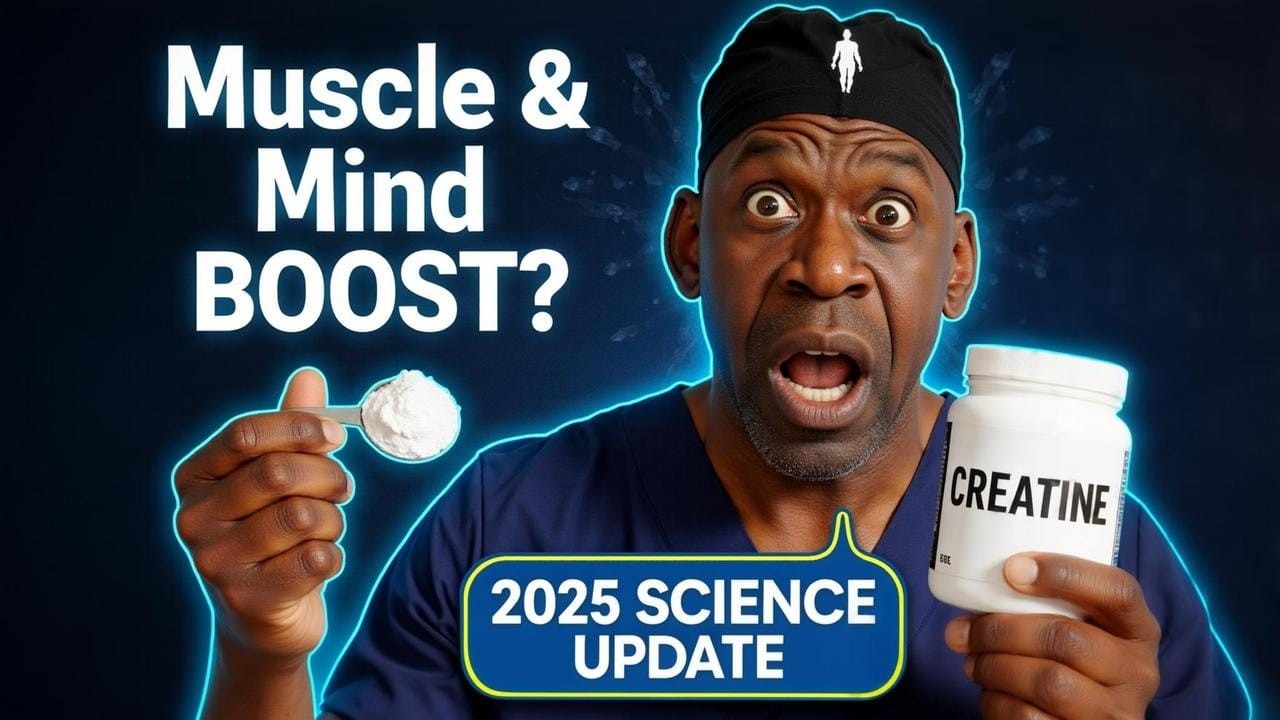
Curious about creatine? In this video, Dr. Chris Raynor and a panel of experts break down the science, benefits, and practical tips about this long-standing supplement including:
-How creatine powers your muscles AND your brain
-The real reason creatine causes water retention (and why it matters)
-Surprising benefits for cognition, brain fog, and recovery after injury
-Special considerations for women, older adults, and plant-based eaters
-Safe dosing, debunking common myths, and how to maximize results
👉🏿Watch to learn why creatine is more than just a gym bro staple—and whether you should add it to your daily routine.
#drchrisraynor #surgeonexplains #internarmy
The Creative Team:
@roarytime
@deejdesign6677
@quintessaevangeline.
If you are interested in learning how to train for health and mobility in a sustainable manner that promotes longevity, consider joining our classes at my online gym @Humantwopointzeroinc : https://www.youtube.com/channel/UC4W6-KO_dKxoCM-R_30zZdw/join
Shop my merch here: https://dr-chris-raynor-not-your-shop.fourthwall.com/products/team-8billion-snapback
If you have any comments, suggestions, questions you would like answered, or ideas for future videos, let us know in the comments below.
Check out my PODCAST: https://www.youtube.com/channel/UCs4_o9G2wSPMt7XcEXIYHmw
If you enjoyed this video, let me know by liking, commenting, and sharing this video with your friends/family. Support the cause and join the #InternArmy https://www.youtube.com/channel/UCJNgMVaiBmD2W701dALL9Iw/join
Don’t forget to TURN YOUR YOUR POST NOTIFICATIONS to be updated when we post new content.
What’s New On Dr. Chris Raynor:
DR. CHRIS SOCIALS:
TWITTER: @stablekneez
INSTAGRAM: @stablekneez
TIKTOK: @dr.chrisraynor
FACEBOOK: https://www.facebook.com/stablekneez/
For business inquiries:
Dr ChrisRaynor@gmail.com
All other inquiries:
darentsrus@gmail.com
These are affiliate links. I make money if you use them:
Music from Epidemic Sound: https://www.epidemicsound.com/referral/b164r1/
TubeBuddy to prepare my videos: https://www.tubebuddy.com/drchrisusestubebuddy
I also use Pikzels for thumbnails: https://pikzels.com?via=g9nqg2
My shirt: https://go.magik.ly/ml/29g9j/
My pants: https://go.magik.ly/ml/29g9k/
My fav shoes: https://go.magik.ly/ml/29g9l/
“Copyright Disclaimer Under Section 107 of the Copyright Act 1976, allowance is made for “fair use” for purposes such as criticism, comment, news reporting, teaching, scholarship, and research. Fair use is a use permitted by copyright statute that might otherwise be infringing. Non-profit, educational or personal use tips the balance in favor of fair use.”
First thing you want to do is you want to add a scoop of creatine. Now what I like to do next is hide in a whole banana. Dip the banana in some creatine. Then we add a scoop of creatine. You trying to get huge? Add some more creatine. And then some creatine. And then and only then we have some creatine. Okay. PSA to everyone. This white powder is your friend. There are dozens of questionable sports performance, athletic performance products come out every year. Most of them are all marketing. No substance. Creatine has been used by athletes for a very long time. This white powder ruled the weight room of the ‘9s. It was the ultimate gym bro supplement. But now you’re just as likely to find it mixed into a 40some professional’s coffee on their way to the office. So why has creatine broken out of the fitness industry and entered the mainstream? We think creatine muscles and indeed it brings water into the muscles and make you stronger. Most of the data, clinical data on creatine are to enhance forebrain function. Oh my gosh. Creatine. Creatine has got to be the best thing that you can be taking for cell energy metabolism, for the the energy of your brain. Wait, energy for the brain. Yeah, that’s right. It’s not just about gains anymore. People are taking it for focus, mood, and to fight brain fog. I know a lot of people who, you know, every time they take creatine, they notice an immediate sort of boost in some kind of cognitive function. and it’s even finding a surprising new role in women’s healthcare. So, with all these new potential benefits beyond the weight room, we have to re-evaluate this old school supplement. It’s accessible. It’s cheap. But with all its new hype, is it actually worth it? You know, when I see people talk about like some of these other supplements and they’re not even taking creatine monohydrate, I’m like, you’re stepping over dollars to pick up pennies. This is just the lowest hanging fruit. It’s having a total glow up. And in this video, we’re breaking down the science that’s bringing it to the forefront. Now, why you guys weren’t looking in a little bit of extra creatine? If you’re a returning viewer, do me a solid and give the video a like and let me know if you are team creatine or not. If you’re new to the channel, welcome. Watch the video first and if so inclined, join our army of intelligent interns learning about supplements and healthcare at the end. Let’s get to a million together and have everyone arrive there a smarter person. Have you seen the studies on creatine? First off, let’s get something straight. Creatine is a natural compound. Our bodies and other animals actually make it. To quote biomedical scientist Dr. Rhonda Patrick, creatine is something that our liver makes a little bit. I think like one maybe 1 to two grams a day. It’s also something that’s found in dietary sources, particularly animal products. So, it’s high in like meat, poultry, fish, dairy, not so much in vegetables. In terms of the creatine we can get through our food, it’s primarily found in beef actually. And just like these animals, the creatine we produce internally has one main job, managing your cellular energy currency called ATP. As fellow orthopedic surgeon Dr. Brad Weining explains, the way that our body moves around energy to do stuff, and that includes to think, to process food, to get rid of waste, but also for your muscles to contract. For all my biochemical enthusiasts, here are some experts breaking down how ATP actually drives energy production at a microscopic level. The nature of the ATP molecule. So, it’s adenazine triphosphate. So, adenazine is actually a molecule called adanine connected to a sugar called ribos. And it has a little tail of three phosphates. And because of this little tail of phosphate, it actually makes it inherently a little bit unstable. That third phosphate can be cleaved. And when it’s cleaved, it releases energy. In order to drive muscular contraction, your ATP donates a phosphate and that liberation of that phosphate to form ADP and a free phosphate is energetically favorable and helps drive these muscular contractions. As PhD powerlifter Lane Norton details, ATP drives muscular contraction, giving you the power to move and subsequently it’s depleting itself. You’re getting tired. But that’s where our endogenous creatine comes in. Creatine enhances brain energy stores by increasing the amount of phosphate available for ATP synthesis, benefiting both muscles and neurons. Creatin can act or phosphor creatine can act as a high energy phosphate in order to reform uh ATP and allow you to perform better. Since everything in our biology is there for a reason. This highlights the brilliant reason this creatine system evolved in the first place. The need for speed. You actually need that energy before you realize you need it. Right? everything that we see and do has essentially already happened because of the time lag that it takes for us to actually interpret the those actions. So that energy is needed immediately and it could be that because of the lag in the system you know upregulating uh energy production that’s where creating becomes important in in in a network as you activate it. Exactly. This internal system is for instant energy on demand. There’s a tiny delay between your brain perceiving a threat, like a lion charging, and your body reacting. But you can’t wait for your metabolism to catch up. You need power now. That’s where creatine comes in. It fuels the phosphogen system, your body’s near instant power switch, the go time energy pathway. So for very energetically expensive uh processes where you you can’t get enough energy through that longer process that glycolysis and aerobic metabolism then the buffer comes from the fossil creatine system. Basically it’s a natural battery buffer for instant energy. And when it seems like oh wow we have this extra tank readily available. Keep this in mind. Not a lot of energy per molecule of creatine. So it gets used up and turned and burned quickly. But the upside is it gives you that energy really fast. So yeah, you don’t get a long boost, maybe 30 seconds, but it’s incredibly fast. Hence why. And so the more of it you have stored, the the quicker you can sort of make that energy. If you have a surplus of creatine readily available, the more times you can recharge your ATP. Think of each creatine molecule like a quarter. A single quarter doesn’t get you much. It’s just one quick burst of energy. But if you have a whole jar of quarters, you can keep feeding the machine over and over, letting you sustain that high power output for those crucial extra seconds. By now, you can probably see why this is a fitness staple. In the gym, that instant energy buffer is the difference between hitting a wall and breaking through it. It’s also really good for that explosive power type of exercise again because you’re getting that quick mobilization of producing energy. In other words, you can do one to two more reps per set. And that leads to obviously if you’re increasing your workload, you’re going to have increased muscle mass and muscle strength because you’re increasing your workload. It doesn’t work like protein in the sense that you can increase muscle mass because it’s anabolic. You need to put the work in. So creatine by itself isn’t going to make your muscles grow, but it is going to make you work harder. It’s going to be easier for you to work harder. And so you end up increasing your exercise volume, which then has adaptations on your muscle. Right? That’s an important point to understand. It’s not a direct growth signal, but it is a performance-enhancer. You can push harder, and that effort is what forces your body to adapt and get stronger. It’s like having a reserve tank for the final sprint, but you still need to sprint, though. Still, for many who start taking creatine, you do look bigger in the mirror after just a few weeks. And while I don’t want to burst your bubble, not all of that is new muscle. People usually retain between 1 and 3 lbs of water when they complete a loading cycle or a 3we cycle of creatine. We’ll talk about the doses afterwards. The water weight is definitely real, but here’s the intriguing plot twist from a conversation between longevity expert Peter and Lane Norton. That water might not just be cosmetic bloat. And what if it is actually part of what makes you grow? It’s also a really powerful osmolite. And so it pulls water into muscle tissue, which in and of itself may actually be anabolic. Just a muscle cell being more hydrated, there’s some evidence that that can actually improve the it’s more anabolic environment. But regardless of the mechanism, we do know that when you take creatin, you see improvements in lean mass. And some people will say, well, that’s just water. Well, but that’s what muscle mostly is, isn’t it? But muscle is 70% water. So there’s also sort of a you you could also kind of make up at least conceptually a framework that says a more hydrated cell more able to carry out its function. It sort of seems logical to me that it’s going to be better at clearing metabolic waste and recruiting fuel. As AIA notes this hydration directly supports hypertrophy by improving nutrient and oxygen delivery to the muscle cells which facilitates repair and growth. So when people dismiss the gains as just water, they’re missing the point. That water is inside the muscle creating the environment where growth is easier. So there’s a lot of potential benefit as you can see in the athletic community. I mean, it’s one of the most researched supplements for a reason. But actually, a huge portion of the most fascinating research is in an area that might surprise you. Scientists have been demonstrating for over a decade now that creatine can significantly enhance cognition. The evidence to date is compelling, leading scientists to explore creatine’s potential therapeutic use in neurodeenerative diseases like Parkinson’s, Huntington’s, and even Alzheimer’s. The same creatine that’s stored in your muscles is also stored in your brain tissue. As Andrew Huberman points out, it’s concentrated in a crucial area is actually quite prominently stored in the forebrain. the area or the real estate of of your brain just behind the forehead which is involved in planning and action and understanding context. So it’s very important for cognition. It’s important for personality too. Very important things to be able to do. This area is basically command center initiating all physical movement and even when the body is still the brain is always on. So creatine acts as a backup battery for these constantly active neurons. Your brain when we say it’s energetically demanding it’s because it’s going through a ton of metabolism. We have this connotation that muscle and metabolism but the brain is metabolism as well. Your basil metabolic rate, the amount of energy you burn throughout the day, your fast or slow metabolism, all these things are it’s in your brain. If you think your muscles are an energy hog, your brain is the biggest energy hog in your entire body. So what happens when we give it a bigger battery pack, a little extra creatine as it were? The benefits are most obvious when your brain is running on empty. Think of it less like a smart pill and more like a resilient supplement for an energetically stressed out brain. And what’s the ultimate brain stressor? Sleep deprivation. God, I don’t know where I read this, but that higher doses of creatine, maybe like 25 g, 20, 25 g, could combat sleep loss or some of the effects of sleep loss. One study showed that a single high dose could help blunt the effects of being awake for over 21 hours straight. Not only negate the negative effects of sleep deprivation on their cognition, but it also improved their cognition beyond what their baseline normal cognition is when they were sleeping. It’s interesting that the results showed creatine could boost cognition beyond a normal baseline. But here’s a critical nuance. I’m not sure the study tells us about the quality of sleep. And as we know, it’s not just quantity, it’s quality that allows for true restoration. Plus, even though the subjects were told to quit caffeine for 48 hours before the test, if you’re a regular coffee drinker, 48 hours off is when withdrawal hits hardest. Headaches, fatigue, brain fog. So, they’re measured baseline during sleep and sleep loss may not reflect their true potential. And for many people in the real world, the same goes. Their long-term baseline is one of chronic low-grade sleep debt and caffeine dependence. It’s likely their brain is always operating in a slightly energy compromised state. But considering that is normal, creatine seems to help. Creatine can acutely uh provide a buffer that allows you to maintain function in the face of um sort of increasing metabolic pressure to to sleep. As Galpin explains, it acts as a cushion that wards off tiredness. This is why some compare the feeling to caffeine, but without the jitters, and that’s likely because, well, the mechanisms are totally different. Caffeine blocks adenosine, the sleep signal molecule, tricking your brain. Fatigue is still there, but essentially numbed out. Creatine doesn’t block the signal. It gives your brain more fuel to power through it. It’s the difference between shutting off a low fuel warning light versus actually putting more gas in the tank. But this extends beyond sleep. It can improve processing speed and working memory under pressure. You know, when you got a lot on your plate. Neuroscientist Dr. Louisa Nola cuts to the chase. The goal is this neuro protection. We want to protect our brain. Protect it from something that might occur. Whether that is getting hit in the head or just protecting it from our life. Like let’s admit it’s 2024. Every single day we have to wake up. It’s like the Hunger Games. Like we are getting so many things thrown at us. Notifications, stressful events. Our brain is under attack. We’re dealing with constant life stress. It’s an overstimulating, mentally draining world. But the research gets even more concrete when we look at its therapeutic potential for recovery after a traumatic brain injury like an actual physical hit to the head. It’s a neutropic. It postconussion, postsurgery, postpartum depression, headache that has been shown to significantly reduce the intensity andor frequency of headaches. So, how does this actually work? How does a simple supplement help with something as serious, say, as a concussion? Neurons, nerve cells rely very heavily on the regulation of calcium in order to generate those action potentials to communicate with one another. Calcium becomes disregulated after traumatic brain injury in a number of different ways. In particular, in ways that impact the energy production systems of cells. After a hit to the head, the brain isn’t just injured. It’s now facing a severe energy crisis on top of everything else. It’s complex biochemistry, but think of the calcium chaos like a systemwide short circuit. The neurons are desperate to communicate, but they’re just too exhausted. And you can feel that that physical tension, that frustrated, pounding feeling of a headache is illustrative of that system breaking down. Creatine doesn’t fix the calcium problem directly. Instead, it sidesteps it like a backup generator. It can’t repair the down lines, but it kicks in to provide emergency power to the command center, keeping the most essential systems online and preventing a total blackout. And we’re seeing results that support this idea. Dr. Huberman references a pilot study where they found a dramatic decrease in the frequency of headaches for people taking creatine after a traumatic brain injury. If you look at the controls and you see that they’re basically getting headache at a frequency of 90% or more after TBI, the reduction in headache frequency is down to about 10 or 12% in the people taking creatine. Dizziness and fatigue, acute and chronic, saw major drops, too. These are exciting results because there are actually very few effective medical treatments for TBI. It suggests that simply supporting the brain’s basic energy needs can have a profound impact on recovery and quality of life. And this principle of brain energy support is exactly what makes it so promising for one of the most overlooked areas, women’s health. Because creatine was stereotyped as a gym bro supplement for so long, we completely missed its potential for women, especially those going through perry menopause and menopause. Well, until now. More women are advocating for it than ever before. The third thing that I really wanted to measure on this challenge was how it impacted my brain health. And this is kind of where I was quite blown away. This principle finds a direct application here. The hormonal fluctuations of pmenopause can trigger a real energy crisis in the brain leading to that infamous brain fog. For many women, creatine is helping to provide the mental clarity that their hormones are stealing. But the benefits aren’t just mental. There’s a powerful physical effect, too. We’re also seeing post-menopausal women who were on the track to becoming osteoporotic actually reversing that because they’re able to work out more. We increase bone density. We increase muscle mass because muscle is an endocrine organ. You have better brain health. So, it’s all intertwined. This is a huge deal. It’s not just about looking stronger. And to be clear, as Dr. Dr. Nicola points out, “Relax, ladies. You’re not suddenly going to get jacked AF from creatine.” But here’s the bigger picture. Muscle is your body’s largest endocrine organ. The more muscle you have, the better your metabolism runs. The more effectively you control your blood sugar, and the more signaling molecules you release that directly support bone strength and density. So, by helping women maintain muscle, creatine isn’t just about lifting more weight in the gym. It’s building a foundation for metabolic health, skeletal health, and long-term resilience. That makes it a true gamecher for healthy aging. I took creatine for 28 days straight, and I tested my strength on day zero and on day 29, and you will not believe these results. All right, so this is all fascinating, but let’s get practical. Who will actually benefit the most from this? And how do you even take it? Well, based on that evidence, the prime candidates are pretty clear. vegetarians and vegans because you get almost none of it from your diet. Meat is probably one of your primary sources. Definitely. Sorry. Sorry. Plant-based eaters. Also, older adults since natural production declines with age. Then anyone under high stress or sleep deprivation. So, students, new parents, shift workers. It is not by any means a wonder drug. The effects are often subtle and supportive. But if you fall into these categories, here’s the simple guide. Get creatine monohydrate powder. It’s the gold standard. And you don’t want to buy creatine already in a pre-made drink, correct? Because it’s impacting the degradation Yes. of the creatine. And listen, bro, you want to stick with the pure powder. Pre-made concoctions and even the popular gummies aren’t as reliable. Just mix a scoop into your morning coffee or water. It’s that simple. Next, the dose. For general muscle benefits, five grams a day is the standard dose to saturate your muscles. Keep in mind that the benefits of creatin are an accumulation. So, you’ve really got to saturate the muscle cell. That’s that’s that’s the key. Saturation means you’re filling up your muscles creatine stores until they’re completely full. And this takes about a month. After that, maintenance is easy. You might not feel anything dramatic at first, but once saturated, you should notice it as a consistent, reliable level of energy and resilience. Creatine is not so much about feeling a peak as it is about eliminating the valleys. Your muscle is a very very greedy when it comes to creatine. So that five grams that you’re taking, I used to take five grams a day. So the five grams a day is what’s been shown in countless studies and that’s probably why you take it. I took it because it was countless studies showing five grams a day was like the the dose. All these brain benefits now coming out seem to be at higher doses. And a final point, you don’t need to cycle it. There’s no reason to start heavy and then take breaks. you can just take a consistent daily dose. While some athletes load with high doses for a week to saturate their muscles faster, for the average person just looking for the benefits, a steady 5 g daily dose is all you need. It used to be like I think people kind of just equated supplements with steroids and so like well you’re supposed to cycle steroids so we should cycle supplements. Creatin is not hormonal. It’s not the same bof feedback loop. I would say there’s probably no reason to cycle it. Now, let’s quickly address safety and side effects because this is where a lot of unnecessary fear comes from. It’s the most widely studied supplement on the market. So, it is the safest. The bottom line is it’s incredibly safe, but let’s be specific. The most common side effect is minor GI upset like bloating or nausea. This usually only happens if you take a huge dose all at once, which is why we recommend sticking to 5 g servings instead of loading with 20 g. The trade-off with this is a lot of people will get pretty bad GI irritation with loading creatin. Uh in terms of like uh GI bloating, uh nausea, you might also gain some weight, maybe a couple of pounds, typically water. And as we’ve discussed, that’s water inside your muscles. Nothing to be worried about. Now, let’s debunk two big myths. First, kidney damage. This is a huge misconception. When you’re taking creatine, your blood levels of creatinine go up. Creatinine is a marker for kidney function, but in this case, it’s a false red flag. We’ve abandoned looking at uh looking at serum, you know, uh creatinin for renal function. This is a test. If you talk to a nefologist would say it’s not the most reliable way to measure kidney function because it doesn’t take into account your amount of lean body mass. So it’s not that your kidneys are stressed. You’ve just given your body more of the raw material creatine. So it produces more of the waste product creatinine. In healthy people it does not cause kidney damage. Second hair loss. There is no solid evidence to support this. It’s largely an internet rumor. Losing hair from using creatine. Every time this topic comes up, I just have to roll my eyes because this myth is a product of one inaccurate study. So overall, it gets a solid green light from experts. It’s also one of the supplements that we feel the most confident telling patients this is a supplement worth taking. It’s clearly passed test number one, which is it’s safe, and it passes test number two, which is it’s got efficacy. So, I would say as long as intramuscular levels of creatin are not falling, there’s really no benefit to coming off. My advice, as long as you’re using it responsibly, it couldn’t hurt to try. But like anything, don’t expect a cure all. Make sure you’re doing the rest of the things to take care of yourself. I will never tell you a supplement can make up for poor sleep or a bad diet, but this one may help you push past the point of exhaustion for just a bit longer. Now, I want to hear from all of you. Are you a lifelong athlete who uses it? Have you recently started taking it for your brain? Let me know in the comments below. And if you found this deep dive helpful, please share it with someone who might be curious. And be sure to join my intern army and click on your notifications to catch my uploads every Monday morning. And if you dig what I do and you want to support our mission even more, consider becoming a member of my channel. And don’t forget to follow my gym, Human 2.0 Fitness, for free right here on YouTube, where we post content that helps you move better and prevent injury. or its sister channel, Human at Home, where we show you how to be healthy in the space where you live. And remember, although it is by no means a wonder drug, creatine, if used properly, just might be the thing to improve your brain function. Otherwise, as always, that’s been a word from Dr. Chris Rainer, not your everyday ortho, where we see one, do one, teach one. [Music] Heat. [Music] Hey, heat. Hey, heat. [Music]