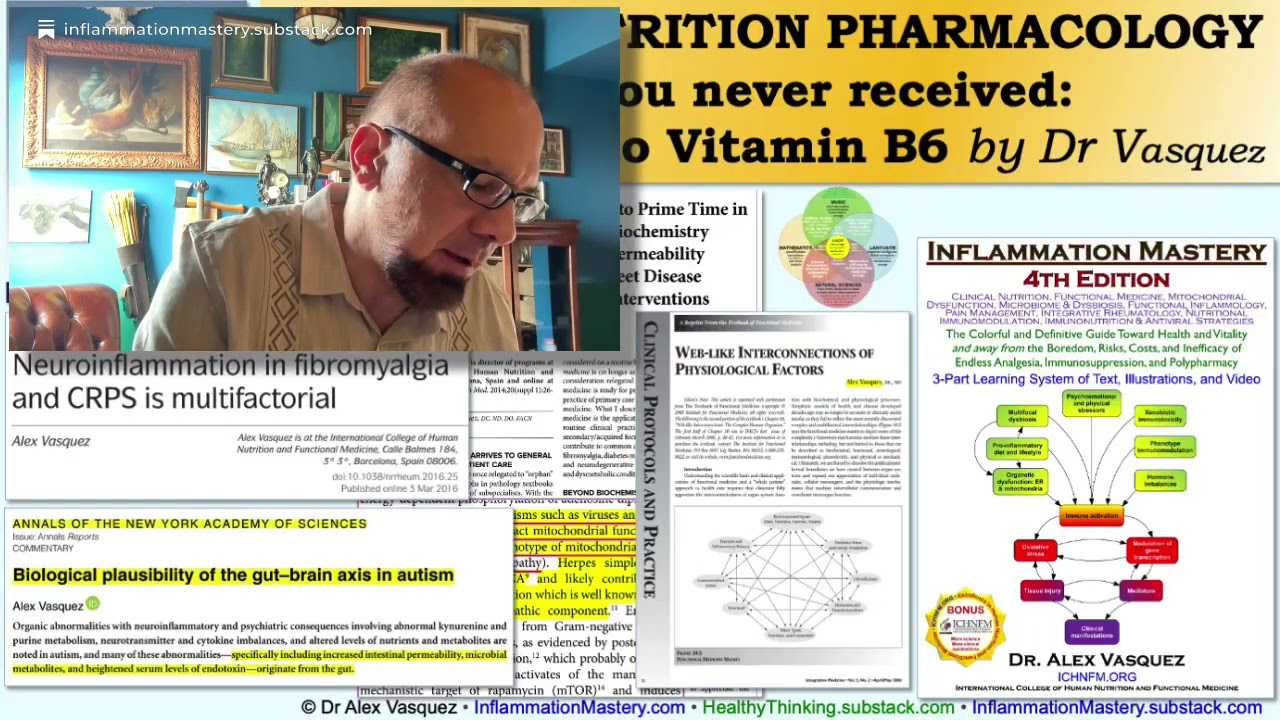
Classes that You Never Received: Introduction to Vitamins, Metabolism, Laboratory Assessment of Nutritional Status, and Therapeutic Interventions by Dr Vasquez
This is a preview. Watch the full video at https://inflammationmastery.substack.com/p/vitamin-b6-pyridoxine-clinical-nutrition
So let me give you a concrete example of um pyroxy and biochemistry and this is I’ve obviously chosen this example because it is the best example and this is a life or death example. So uh you all know about glutamate uh the most abundant excitatory neurotransmitter in the body and of course in the brain. Glutamate let me see if I can draw this out. CO H. Um, let’s see. So, we have a carbon here. We have a hydrogen. CO. No, those are oxygen. Sorry. Um, and then it zigs and zags and zigs and zags. Something like that. I think it zigs. I think that’s what it looks like. And then we have another caroxile group there. I believe I think that’s what glutamate looks like. Well, you all know that glutamate is toxic. That’s pretty much what glutamate looks like. I might be off by one carbon, but I think we’re pretty close. So, glutamate is excitatory and it’s important and we don’t want to totally demonize it, but yeah, it’s toxic. So for glutamate to become less toxic or to be neutralized of its toxicity we have to convert it into something else to neutralize its toxicity by changing its biochemistry and that requires an enzyatic reaction which itself is dependent on B6 which therefore is dependent on magnesium and riboflavin as well. So anything that requires B6 by definition therefore therefore also requires magnesium and riboflavin. So in order to uh eliminate we have a few different ways of eliminating glutamate. We can recycle it. We can pump it in, we can pump it out. We can uh kind of trap it in certain cells to reduce the toxicity on other cells. But we one way to get rid of glutamate is just to convert it into something else. And we can convert glutamate into GABA uh through one enzyatic reaction. So remember what I said just a moment ago. Glutamate is very toxic. So let’s put a plus there. It’s an exytotoxin whereas GABA is inhibitory. So too much glutamate will kill brain cells and eventually kill the entire organism. If this one reaction is defective either genetically or through nutritional deficiencies. If this one reaction is defective, the organism will die typically of progressive neurodeeneration and eventually death and status epilepticus and that whole scene. So I showed you what glutamate looks like. I’m pretty sure that’s it that is accurate. I I might be off by one carbon unit or something like that, but this is pretty pretty darn close, especially for early morning. So, we want to convert um we want to convert that glutamate into GABA. And the structure of GABA is um the same zigzag. I think it’s that. I just don’t know if it’s that or that. Um, and you’ve got another carbon with its two oxygen there. See, as far as I remember, but you’ll notice that we’ve now taken off this uh caroxile group. This is all gone. Maybe I should just erase it. Um, see if this thing lets me do that. No, there we go. Uh so we got rid of this caroxile group through an enzyme called this thing is so impossible sometimes through an enzyme called uh glutamate decaroxilase caroxil ACE. Again, that enzyme requires B6, which therefore means it also requires magnesium and riboflavin. Some people have a defect either in that enzyme or around that enzyme and they don’t do this conversion very well. Uh they don’t convert glutamate, which is neurotoxic, into GABA, which is neuroprotective. What would you expect the clinical manifestation of that to be? Seizures and mental retardation. So, that is a condition now that we’re getting finally into kind of the meat and potatoes of this conversation. That is a condition called I’m going to change colors cuz I don’t really like black so much. Uh, that’s a condition called paradoxine dependent uh epilepsy. Now, that’s a dumb name. It should be called paradoxine responsive. It should be called paradoxian responsive epilepsy because in those usually children although of course it can extend into adulthood. Those patients who have pyoxine responsive uh epilepsy due to a defect in this pathway. uh they respond immediately to vitamin B6. Good morning everybody. Dr. Vasquez here coming to you live with video number three in this new series where I’m talking about clinical nutrition pharmacology or clinical nutrition biochemistry. Uh topic number one was vitamin B1 or thamin. Topic number two was vitamin B2 or riboflavin. And uh topic number three is going to be vitamin B6 or pyrooxine because that’s what I want to talk about. Uh I’ll provide you some quiz questions just like I did yesterday because uh as I’ve said several times as an educator, I mean I’ve been a teacher for 25 years. Uh everybody thinks they’re an expert until they get a quiz from an expert and then they find out, whoa, there’s a a higher level or at least a different level. You can you don’t even have to say it’s a high or low. You can just say, “Wow, I didn’t know that.” And uh I’ll provide you hopefully the opportunity to be surprised. So, let me start writing a few notes now that I’ve given a very brief introduction. So, again, like I said before, uh clinical whoops, started to write my N before my L, and I don’t seem to have a way to get rid of that. All right, maybe I’ll just I can’t get rid of it. Why can’t I reverse that? That’s ridiculous. Well, I’ll just decorate it. I’ll decorate my way around it. Uh, clinical clinical nutrition pharmacology. So uh you know in medical school we take we took a pharmacology class that was just about clinically worthless because it was all equations and mathematics and like a lot of uh courses in medical school it wasn’t designed to teach us anything. It was designed to filter out the bottom 10%. So in our medical school, all of our exams were so mathematically perfect uh because the school was very sophisticated in their way of uh administering these exams. They they knew exactly what questions to ask in order to fail the bottom 10% of the class every time. So every exam cut off the bottom 10%. Another exam cut off the bottom 10%. Or maybe it was like 5%. But um again you know like I wanting to be a good student in order to then be a good teacher when we had the opportunity to take whatever class immunology or pharmarmacology I wanted to learn it you know at the at the highest level possible because I knew I wanted to know it for me and for my patients in clinical practice but eventually I would teach it and write about it and all that kind of stuff. So I always had at least two reasons to learn things not simply oh well I’m going to be a doctor and I need to know this. It’s like, “No, I’m going to be a doctor and I need to know this and I want to teach it eventually.” So, again, in medical school, our pharmarmacology class uh was just it sucked. It was just all equations and math and mostly just trying to filter kids out. Um I’ve taught pharmarmacology and so I’ll apply some of those principles here. Um at least at least one of them. You know, one of the one of the con an important concept in pharmarmacology ultimately is uh analysis of risk benefit ratios and uh risk management in general. So it’s not it’s not specific to pharmarmacology because those courses th those topics could also be discussed in courses on patient management which we by the way never had in medical school. in chiropractic college and maybe in naturopathic medical school. Uh we had classes in patient management. Uh and one of the I mean half of half of any class in patient management is going to be about risk management or maybe a third of it. Um and so when we talk about vitamin B6 as I’m uh slowly getting in getting in through this introduction when we talk about B6 we have to talk about risk management because uh vitamin B6 does have some risks u associated with it even at therapeutic doses and that’s not true of thamin for example. So uh today’s Wednesday on Monday I talked about thamin. Thamin virtually has no risk associated with it. I mean obviously you know if a child or if an adult takes a huge bottle of it yeah maybe they’ll get diarrhea or something just from anosmotic excuse me anosmotic effect but thon is basically risk-f free u same with rioflavin a lot of times when a lot of times the oral administration of nutrients is safe people might get nausea or they might get diarrhea if they take too much but that’s I’ve never heard of that with rioflavin or thyon u the intravenous mis uh administration of some vitamins even though they might be safe orally can cause anaphilaxis and sometimes that’s due to the additives or a bad uh production or something like that. Although um anaphilaxis due to intravenous vitamins has certainly been reported especially with uh cyanocobalamin and uh B12 but anyway generally speaking you know anytime we’re going to utilize some type of therapeutic intervention it’s to change physiology and sometimes we could change physiology too much or the agent whatever it is whether it’s a nutrient or a drug may have a so-called offtarget effect that we have to be aware of. And like I said with B6, you definitely have to be aware of that. Not so much with thin, not so much with riboflavin, but by the time you get to B6, uh you have to be aware that it’s a therapeutic that could have adverse effects. I mean, you would have to have uh you would kind of have in a sense for those adverse effects to be manifest, it would take unusual circumstances. Specifically, you would have to have a bad patient. And what I mean by that is a patient who doesn’t follow instructions or they receive the treatment and they don’t come back for follow-up. But that could be the fault of the doctor if the doctor didn’t say, “Hey, you got to come back in 2 months or 6 months.” So uh bad patients exist and if a doctor uh properly informs the patient and the patient doesn’t follow those rules so to speak or they go off on their own, I mean a lot of patients do that especially these days. you know, they come in for a consult, they pay for a visit, then they don’t follow the instructions, especially with regard to safety and risk because now they’re following some internet guru, uh, and then they come back to the original doctor with a problem, uh, and the doctor says, “Well, yeah, you didn’t come back for 2 years and that’s why you have a problem.” So, I’ve seen patients, uh, it’s horrible, but it does happen. They just kind of go off on their own or or they do half the plan, but they don’t they don’t understand that the whole plan has to work together. or like I had a patient, really sad case because I really cared about these people. Um, but I had a patient, you know, 20 23 years ago, uh, he was a high-risisk patient. I was still somewhat young in practice and uh, he decided to stop his treatment plan because he wanted to go on vacation. Well, that didn’t work out. So, bad things happen. And as we as clinicians, as we gain more experience, and some of that experience is unfortunate, uh, but as we gain more experience, we learn to to be to practice more defensively. And like I’ve said before, I always practice very defensively because for most of my practice or a lot of my practice, even though I’ve practiced in different states with different licenses, uh, a lot of my practice was in Texas after I had graduated from naturopathic medical school. So, I wanted of course to use th that those treatments, but I was practicing in Texas under my chiropractic license. This was before I went to medical school. And so, I had to be very uh careful with what I did and I had to be super safe. And anyway, that’s eventually why I went to medical school cuz I I wanted to have a broader uh lensure within Texas assuming that I was going to stay in Texas. My my plan at that time was to live in Austin. So anyway, uh let’s talk about risk and benefit and how to use vitamin B6. Uh B6 is a co-actor for a lot of different enzymes about 50 different enzymes. So as I explained before, you know, the sum totality of these physiologic reactions and biochemical reactions and enzyatic reactions, that’s what we call metabolism. And uh any given enzyme functioning by itself is going to need uh co-actors. Those are usually minerals or co-enzymes. Those are typically vitamins. So it’s going to need something. As I said before, uh you can think of an enzyme as a globular protein that has to do something. It can function like a pump. So it’s pumping in uh or let’s say pumping in or pumping out sodium, potassium, calcium, maybe even magnesium. But it’s it has to function. It has to move typically. So typically enzymes pump things or bend things or break things or connect things. But they have to do something. They’re actually physically moving the molecules. And typically that requires a co-actor or a co-enzyme or andor requires ATP to move this thing. So if it’s a downhill energetic reaction, then it just takes takes its own process. But if this enzyme is fighting an uphill gradient energetically or osmotically for example, then it’s going to need some energy and that’s that’s ATP. So that’s again an overview of how enzymes function and why they need vitamins and minerals in order to carry out their function. Any given enzyme could be defective. So a patient could have a what we call single nucleotide polymorphism and they can produce an enzyme that has a slightly defective amino acid sequence and it just doesn’t work quite right. Maybe it doesn’t bind its substrate. So let’s say this is an amino uh enzyme that is supposed to convert one amino acid to the other or it’s going to it’s going to elongate a fatty acid or it’s going to do something. But let’s say that this particular patient has a genetic defect and that enzyme just doesn’t work very efficiently. Instead of 100% deficiency, they have a nutritionally deficient diet that brings them down 20% and they’re exposed to glyphosate because all politicians have been bought off by the chemical companies and that impairs their enzyme maybe down to 60% efficiency. And then they’ll say they have a genetic defect on top of that. And so now they’re at 40% deficiency and this enzyme just isn’t doing its job to maintain optimal health. Well, you can clean up the diet, get them on organic foods, and give them nutrients to help this enzyme work a little better. So, maybe now instead of 40% efficiency, maybe now they’re back to 80%. And maybe, you know, as long as they live a healthy lifestyle, maybe that’s sufficient for them. That’s that’s kind of how clinical practice in nutrition kind of works. I mean, clean up the diet, get them off the pesticides, get them on nutritional supplementation. enzymes throughout their whole body start to work better and now they don’t have fatigue, depression, and a bunch of other problems. So, I mean, without intending to do so, I just kind of explained a big part of how functional medicine and clinical nutrition actually works. So let me give you some more uh detailed examples and I’ll I’ll again I want this to be generalizable as it is generalizable to the topic of uh clinical nutrition pharmarmacology but I’m also going to make it specific to vitamin B6. So let me just think of how I want to structure this. So yeah. So anyway, let’s talk about uh pyrooxine. Py oxine also known as vitamin B6. So pyrooxine exists in several different forms within natural foods. When we take it as a supplement most commonly and the cheapest form and probably the most popular form is called pyrooxine hydrochloride that has to get converted in the body into pyrooxal 5 phosphate. That’s the active form pyroxal 5 phosphate. So remember what I said yesterday and that is anytime you hear the word phosphate you need to think of what? Uh anytime you hear the word phosphate, you have to think of magnesium because converting pyrooxine into pyroxal 5 phosphate which is the active form that requires I believe for I believe that the sequence is magnesium first to phosphorolate the molecule and then the second step is an oxidation step that requires riboflavin or vitamin B2. So based on your knowledge of that, you would or could or eventually will reasonably expect that a person could have sufficient B6 and be deficient in magnesium or B2 and not be able to receive the benefit of B6. So let’s say we have a patient who’s magnesium deficient like 40% of the population. Let’s say we have a patient who’s magnesium deficient and we give them B6. Do you think that B6 is going to work if it’s given in the form of pyrooxine hydrochloride? The answer of course is no. If they can’t convert pyrooxine to its active form, which the first step I believe requires magnesium. Doesn’t really matter which step is first or second, but I think that the magnesium step is first. So if they can’t convert pyonoxine hydrochloride into P5P because they don’t have magnesium, you should be able to know two things are going to happen. One that I already said is they’re not going to get the benefit from the B6 because it can’t be converted into its other form. What’s the other thing that’s going to happen? You may or may not be able to intuitit this, but I’ll tell you the answer. The answer is is that pyodoxine hydrochloride is a little bit toxic. Uh and I’ll talk about the location of that toxicity in just a moment. So uh basically uh the biochemical sequence gets bottlenecked or you’ve got a lot of uh paradoxium hydrochloride over here that’s trying to get over here to be its active form in P5P pyroxal 5 phosphate but because of the magnesium bottleneck it can’t get converted. Well, again, that accomplishes two things. One is you don’t get what you want, which is active B6, but you also still end up with too much potentially toxic paradoxium hydrochloride. And that’s how people develop B6 toxicity. Same thing’s true of uh riboflavin, vitamin B2 that I talked about yesterday. If people don’t have enough B2, a little bit more common with women than men for whatever reason, if if a person doesn’t have enough rivoflavin, then the B6 can’t get activated because it can’t get oxidized to its active form. And so again, it’s going to bottleneck at that biochemical reaction. They’re not going to get the full benefit of the B6 because it can’t get converted into P5P. And they’re going to result with too much paradoxium hydrochloride, which is a little bit toxic. So, some patients who have a B6 responsive condition don’t respond to B6 because they’re missing out on either magnesium or B uh B2 riboflavin. And those are both very common nutritional deficiencies. So based on that now you understand why when the medical profession does these clinical studies of nutritional supplementation this is one example of thousands or dozens of examples of why their studies don’t work because they’ll use B6 against whatever and they’ll use rivoflavin against whatever but they don’t understand the basic pharmarmacology of this which is that all nutrients pretty much work together and if you give somebody B6 but they don’t have magnesium and rioflavin the B6 probably isn’t going to work. If you give it as pyrooxine hydrochloride, if you give it as P5P, then it may work a little better in some people. Uh even though that could be argued against because if you give them pre-formed P5P, then the phosphate group still gets ripped off in the gastrointestinal tract, I believe, through the enzyme alkaline phosphotase, but perhaps it’s still a little bit farther down the down the way. So uh nutritional intake of uh B6 like with most nutrients uh vitamins that is is in the 1 or 2 milligram zone so to speak. So it’s minor. So if normal consumption let’s say is 1 or 2 milligs 1 millig. When we talk about using B6 we we’ve got a pretty big range and we need to know how to manage that range. So you could start at 10 milligrams. Uh that would be a reasonable maintenance dose. it could or or it may or may not produce clinical benefits because that’s a pretty low dose. So let me give you a concrete example of um pyrooxy and biochemistry and this is I’ve obviously chosen this example because it is the best example and this is a life or death example. So uh you all know about glutamate uh the most abundant excitatory neurotransmitter in the body and of course in the brain. Glutamate let me see if I can draw this out. CO H. Um let’s see. So we have a carbon here. We have a hydrogen CO. No, those are oxygen. Sorry. Um, and then it zigs and zags and zigs and zags. Something like that. I think it zigs. I think that’s what it looks like. And then we have another caroxile group there, I believe. I think that’s what glutamate looks like. Well, you all know that glutamate is toxic. That’s pretty much what glutamate looks like. I might be off by one carbon, but I think we’re pretty close. So, glutamate is uh excitatory and it’s important and we don’t want to totally demonize it, but yeah, it’s toxic. So, for glutamate to become less toxic or to be neutralized of its toxicity, we have to convert it into something else to neutralize its toxicity by changing its biochemistry. And that requires an enzyatic reaction which itself is dependent on B6 which therefore is dependent on magnesium and riboflavin as well. So anything that requires B6 by definition therefore therefore also requires magnesium and riboflavin. So in order to uh eliminate we have a few different ways of eliminating glutamate. We can recycle it. We can pump it in. We can pump it out. we can uh kind of trap it in certain cells to reduce the toxicity on other cells. But we one way to get rid of glutamate is just to convert it into something else. And we can convert glutamate into GABA uh through one enzyatic reaction. So remember what I said just a moment ago, glutamate is very toxic. So let’s put a plus there. It’s an exytotoxin whereas GABA is inhibitory. So too much glutamate will kill brain cells and eventually kill the entire organism. If this one reaction is defective either genetically or through nutritional deficiencies, if this one reaction is defective, the organism will die typically of progressive neurodeeneration and eventually death and status epilepticus and that whole scene. So, I showed you what glutamate looks like. I’m pretty sure that’s that is accurate. I I might be off by one carbon unit or something like that, but this is pretty pretty darn close, especially for early morning. So, we want to convert um we want to convert that glutamate into GABA. And the structure of GABA is um the same zigzag So, I think it’s that. I just don’t know if it’s that or that. Um, and you’ve got another carbon with its two oxygen there. See, as far as I remember. But you’ll notice that we’ve now taken off this uh caroxile group. This is all gone. Maybe I should just erase it. Um, see if this thing lets me do that. No. There we go. Uh, so we got rid of this caroxile group through an enzyme called This thing is so impossible sometimes through an enzyme called uh glutamate decarboxilase caroxil AC. Again that enzyme requires B6 which therefore means it also requires uh magnesium and rimoplavin. Some people have a defect either in that enzyme or around that enzyme and they don’t do this conversion very well. Uh they don’t convert glutamate which is neurotoxic into GABA which is neuroprotective. What would you expect the clinical manifestation of that to be? Seizures and mental retardation. So, that is a condition now that we’re getting finally into kind of the meat and potatoes of this conversation. That is a condition called I’m going to change colors cuz I don’t really like black so much. Uh that’s a condition called paradoxine dependent uh epilepsy. Now, that’s a dumb name. It should be called paradoxine responsive. It should be called paradoxian responsive epilepsy because in those usually children although of course it can extend into adulthood. Those patients who have pyrooxine responsive uh epilepsy due to a defect in this pathway. uh they respond immediately to vitamin B6, usually within minutes, usually administered introvenously. So, you’ve got a little baby who starts to develop uh seizures. This is one of the rule outs cuz it’s actually not too uncommon. Um and uh some of these patients typically typically these patients respond to B6. Sometimes they need B6 and magnesium because of course magnesium has its own anti-epileptic uh benefits. Sometimes they need magnesium along with the B6 and of course rioflavin or a B complex supplement. What else? Oh u and some of these patients don’t respond even though they have pyrooxine dependent epilepsy. Some of them don’t respond to pyrooxine in the form of pyrooxine hydrochloride but they do respond to pre-formed P5P. And so that’s the treatment. They have to be on this treatment for life. Well, if they have to be on treatment for life at relatively high doses, then we have to go back and talk about toxicity, right? So, remember what I said earlier. I said most B6 is given as pyoxy and hydrochloride, but hydro pyroxy hydrochloride can be a little bit toxic. So, we have to know how to manage that. And I’m going to show you uh I’ll go back to the topic that I started to mention earlier about risk management. We’ll go through an exercise in that. So let’s say that we have a patient who has a paradoxine responsive condition. The uh perfect example of course is paradoxy dependent epilepsy. So let’s say we have to use uh B6. Uh if we use B6, so we’re going to talk about dosages. Now I’m going to obviously we have to talk about dosages because that is the prerequisite to then talking about the probability of toxicity and then based on that probability then we have to talk about the management strategy. So uh let’s say that we have a patient with a pyrooxine responsive condition whatever it is uh and we have to use highdosese B6 with them. So how are we going to do that? What form are we going to use? what’s the dosage and then how do we manage that long term? Those are the questions. So with B6 we like I said before we’ve basically got two options. You can use uh paradoxine hydrochloride which is a little bit toxic. The dose that you would need to know as a clinician is uh for pyrooxine uh dependent epilepsy as the model the dosage is uh 18. Let me make sure I’m saying this right. Yeah. 18 uh mg per kilogram. If you were to use uh P5P, because the phosphate group is a little heavier, you have to use more of the substance to get the equivalent amount of active vitamin. And so you have to use a higher dose. And that dose that dose is 30 milligrams per kilogram. Some patients would need more or some would need less. But this is the average the average effective dose according to some studies. This is a ballpark number. I mean you could go a little higher or a little lower but this is the ballpark. The typical dose for pyrooxyine responsive epilepsy is 18 milligs per kilogram for pyroxy hydrochloride or 30 milligs per kilogram. I have to use more uh just because of the weight issue, the molecular weight, but that’s still a lot of B6. Uh now I’m going to focus probably for the rest of this conversation, I’m going to focus on pyrooxine hydrochloride. So like I said, this is a little bit toxic. Um it’s neurotoxic. So the the irony of pyroxy hydrochloride in high doses is that it can be neuroprotective and neurotoxic at the same time. So, how do you manage that? That’s called being a doctor. You have to learn how to manage risk. And you know, that’s that’s what we do. Uh or at least that’s what we’re supposed to do. So, I guess I’ll mention two things. One is a general comment and then the other is something that one of our uh neurology professors said in medical school specific to epilepsy. Specific to epilepsy. He said you keep this is an exact quote from 20 Let’s see how many years ago, 19 years ago. This is an exact quote from 19 years ago. He was talking about anti-seizure drugs. He said, quote, to our medical school class of 165 uh students, he said, you keep pushing the drug until you get toxicity or e efficacy or both. Sometimes you get a little bit of toxicity with benefit. So that’s called risk management. You got to know how to walk that line. You know, you got to learn how to manage that balance. risk, benefit, toxicity, efficacy. The medical profession as a whole does that very well with drugs. I mean, that’s again, that’s that’s called being a skilled prescriber. You know how to push the limit without crossing the line, so to speak. Oh, but when it comes to using nutrients, they say, “Well, we just don’t know. We don’t know how to do this. We don’t know what the dose is.” I mean, look at what the Endocrine Society said within the last few years. They said, “We don’t know how to test and uh prescribe vitamin D.” So we just we can’t we can’t even issue a guideline on it because we just don’t know how to do it. It’s so selectively stupid. It’s just bewildering. Bewildering how the medical profession and medical education can be so precise with drugs and surgery and managing their own specialties so to speak. can be so precise and then when they talk about uh using cannabis for example for pain management they say we don’t know what the dose is or the the entire endocrine society which has 16,000 members they said well we can’t issue a vitamin D clinical guideline because we don’t know how to test vitamin D and we don’t know how to administer it it’s just so selectively stupid it’s just mind-blowing so anyway u beyond all that propaganda we as clinicians have to apply our knowledge of pharmarmacology and risk management to nutritional therapy. And yeah, sometimes we’re walking that line. So 18 milligrams per kilogram for an adult of my size. I weigh right now I weigh aboutund let’s say I weigh uh 225 lbs. 100 kilos. That’s 1,800 mg. Of course the pen stopped working. Oh, shut up. Stop. No. Cancel. uh that would be 1,800 milligrams per day for somebody my size. Is that a potentially toxic dose of B6? You’re damn right it is. So, you know, typically, uh B6 toxicity. So, now I’m going to talk about B6 toxicity. Like I said, uh B6 can be neuroprotective and neurotoxic at the same time. It’s but you have to know the difference. It’s usually neuroprotective in one location and neurotoxic for another location. So in your clinical exam, you would have to know how to test one versus the other to differentiate are we getting benefit where we want it or andor are we getting damage where we don’t want it. So, you know, this is a perfect example of where using nutrients requires clinical skills as well because, like I said, you’re looking for benefit in one area of the nervous system and you’re looking for toxicity in the other area of the nervous system. So, you have to know how to do your physical exam in order to differentiate one from the other. So, it’s actually a pretty cool clinical topic. So, uh, what we’re aiming for, so let me just say this a slightly different way. Toxicity versus risk. The famous risk benefit ratio. What we want is a benefit in the brain. So, we’re trying to protect the brain. We want brain protection from glutamate. The way that we’re going to achieve that protection from glutamate is to convert glutamate through the enzyme glutamate decarboxilase into GABA which is actually neuroprotective. That’s our strategy. That’s what we want to accomplish. That’s why we’re using up to let’s say 18 milligrams per kilogram of B6. You can look at that uh clinically. Okay, the kid’s not having seizures anymore. I’ve seen that happen uh within days in little pediatric patients who had so-called intractable epilepsy. I remember this one kid I saw little baby he was about 2 years old I guess uh when I was still practicing in Houston, Texas and this kid had intractable epilepsy but of course his neurologists never did anything with his diet or nutrition. By the time the patient uh parents brought this little child into my office uh he had already had a corpus colostomy which means they had cut his brain into two parts. They had divided one hemisphere from the other again without ever using nutritional intervention on this kid. So but he still had seizures. So they they ruined his brain. I mean they damaged his brain to stop the seizures but he was still having seizures. So, the parents brought this kid to me and uh this is this is the the line of thought that I did. Clean up his diet, nutritional supplements, and a little a little bit extra B6. And the kid stopped having seizures. I remember the mom wrote me an email. I could probably find the email. Um but she wrote me saying that uh or maybe she said this in the office but she told me that uh immediately upon upon starting the nutritional interventions the kid started doing better. He started speaking more or you know babbling more cuz like I said I think he was only like 2 years old or so. Um and that she said he was making gains every day based on changing this pathway with B6. really incredible case, but they had already, you know, cut the corpus colosum and that’s obviously never going to regrow. So, it’s just tragic. Uh, so again, what we’re looking for is brain protection from glutamate by stimulating or at least supporting the enzyme glutamate decarboxilase, which like I showed you before strips off this caroxile group from glutamate, and that’s what makes it GABA. And that’s what we want. And so you would monitor a clinical response like I was just saying in that example clinical response. You could also in this case in this example of uh paradoxing responsive epilepsy. You could also uh look at the uh electron and sephilogram to look for electrical activity. And you could also in some patients you can do before and after serum or plasma glutamate. So that would be your monitoring strategy. So that’s that’s the good side. That’s what you want. You want to see clinical response, EEG normalization, and a reduction commonly but not always. If it was high, then you want to see a reduction in their serum or plasma glutamate because that’s a surrogate marker for what’s going on in the CSF or the cerebral spinal fluid. Now, let’s talk about toxicity and how to manage that. The toxicity of this same B6 u occurs in a different location. So, we’re looking for this kind of global CNS benefit. Yes, that’s true. We want to see the three benefits that I mentioned before, but the toxicity of B6 occurs at a different location within the anatomy of this of the central nervous system. And arguably, it’s not even the central nervous system. So, the toxicity of B6 is manifested as, and I’m going to put this in quotes, it’s it manifests as a peripheral neuropathy. Well, B6 deficiency can also cause peripheral neuropathy. So, this is again where you have to be you have to use good clinical judgment. B6 deficiency can cause peripheral neuropathy. But B6 toxicity can also create a peripheral neuropathy. except that when we when we typically think of neuropathy, we’re thinking of the nerve tract itself. So, you know, like this would be my media nerve or my radial nerve or my ular nerve. When we when we talk about neuropathy, we usually think of like damage to the myelin sheath or whatever of that nerve. But that’s not uh how B6 neuropathy, so-called neuropathy occurs. It looks like a neuropathy but it’s actually uh localized to the dorsal root gangling. So it’s really yeah it’s a neuropathy but it’s really a gangleionopathy and yeah it looks like anopathy. So people come in and they’ve got like a little bit of uh numbness or tingling in their hands or feet and that’s why you have to do a physical exam. So you do your usual uh central nervous system physical exam. Uh in this case you’re checking in on your patient’s clinical status. Maybe you’re looking at some other markers that I already mentioned. But your physical exam would be specific to looking for signs of you know like hyper reflexia. you’re looking for kind of hypertonicity because remember these people are already on their way to having a seizure. So they’re going to be a little bit hypertonic. So that’s what you would look for in your physical exam. If they then start to develop this so-called peripheral neuropathy or ganglenopathy at the dorsal root ganglen, they’re going to have sensory deficits. So, you’re going to test them for light touch, uh, two-point discrimination, dorsal columns, even though you’re not really looking for that. You’re just looking for, you know, balance and prop reception, things like that. Even though you’re going to do your kind of dorsal column test, even though you’re going to apply it to the dorsal reangling, but at some point if they are truly B6 toxic uh in this clinical setting, you would expect them to go from hyper reflexia to hypo reflexia because now they’re not getting the sensory input to activate their uh reflex. So that’s what you’re that’s that would be that’s called being a good clinician. You know, you have to differentiate where the lesion is. You have to understand if your treatment is even responsible for this. Maybe it’s another problem or maybe they have a B12 deficiency on top of their B6 deficiency, especially if they’re, you know, diabetic, especially if they’re taking metformin. So, you know, not everything in the world is B6. It could be uh diabetic neuropathy. could be a B12 neuropathy in a diabetic patient that gets mislabeled as diabetic neuropathy, but in fact, it’s actually a B12 deficiency causing the neuropathy triggered by metformin because metformin causes B12 malabsorption. I mean, it could be a situation like that. And then again, that’s called being a good doctor and you have to be able to figure that stuff out. So, uh, let me get back to kind of a basic review before I close this out. Uh what does what does B6 do? It does the same thing that most B vitamins do and that is it’s a co-actor for enzymes. Whether it’s 300 enzymes or or 50 or 60 enzymes, it doesn’t really matter. You need those enzymes to work well. Otherwise, you or your patient or whoever is going to have some type of problem. Any defect in any enzyme could be life-threatening. And this is a good example. If glutamate decaroxilase is not working, the patient is going to have too much glutamate and not enough GABA and they’re going to have intractable epilepsy and neurodeeneration and they are going to die from that situation event. They’re going to die early from that whether it’s in 2 years or 15 years and or have a progressive uh brain damage. So, one of the treatments that we can use in this conversation is B6. Uh remember what I said, typical uh food intake, what we used to call the RDA, recommended daily allowance, is usually about 1 millig.