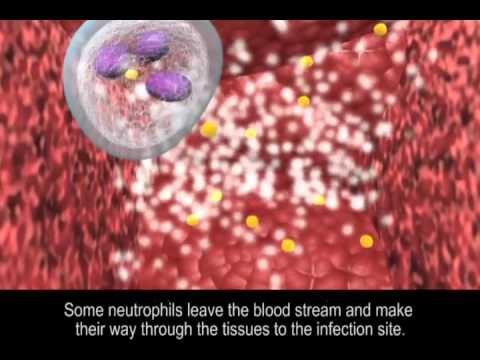
This animation shows how the body naturally responds to and destroys invading bacteria.
[Music] Even the smallest cut in your skin can be the start of an infection from different types of bacteria. Bacteria take advantage of the cut as an entry point. When damaged skin cells come in contact with bacteria, they release chemical signals. These signals trigger inflammation at the wound site. Inflammation is a type of defense against invasion. In the bloodstream, one layer below the damaged skin and bacteria, we see a mixture of red cells, white cells, and platelets. One type of white blood cell is called a neutrfil. Neutrfils are key immune cells that kill harmful bacteria. Neutrfils circulate in the bloodstream looking for signals of infection. When neutrfils sense harm, they gather and prepare to fight. Some neutrfils leave the bloodstream and make their way through the tissues to the infection site. Eventually, neutrfils find the bacteria. On contact, a killing process known as fagocytosis begins. The neutrfil pulls the bacteria into a compartment called a fagosome. Inside the fagosome, the isolated bacteria are surrounded by swirling granules. The granules create a hostile environment by releasing killing elements into the fagosome. Protein complexes generate clouds of deadly agents to help kill the bacteria. Other granules continue to fuse with the fagosome, releasing many other different agents that also contribute to killing the bacteria. In a matter of minutes, the immediate threat to the body has been destroyed, and your immune system has successfully protected you from a cut on the skin. [Music]