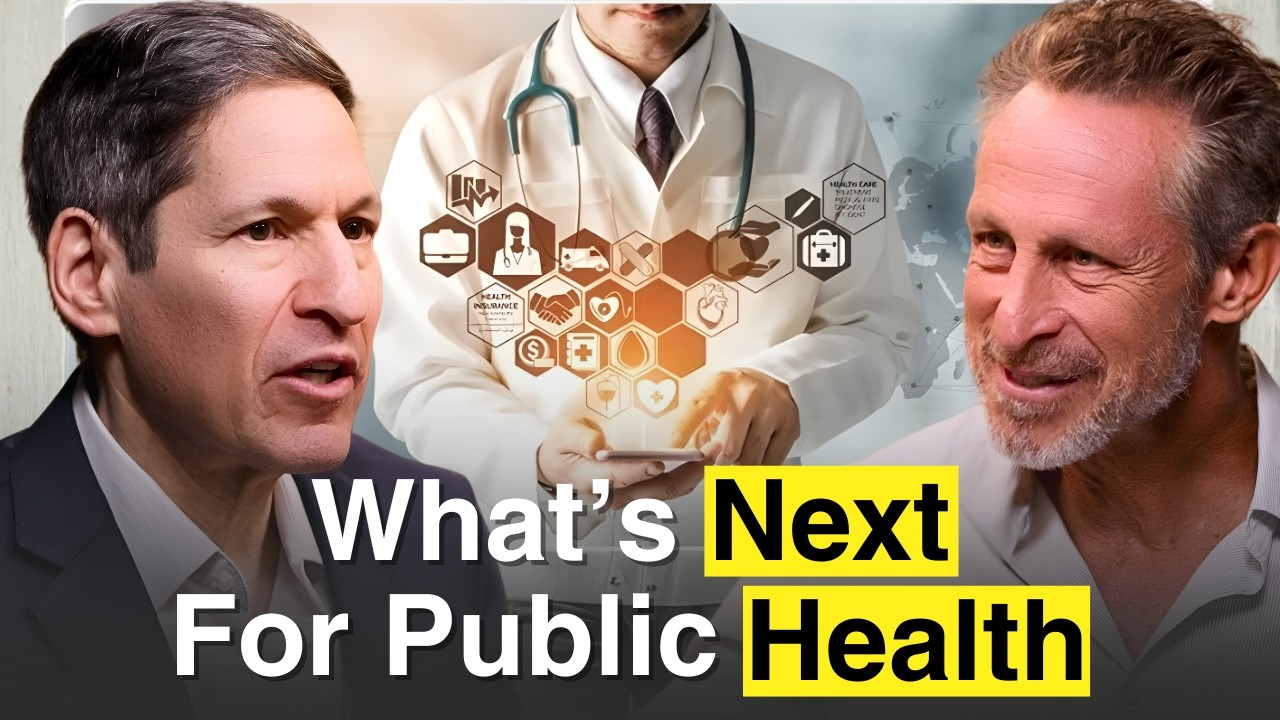
Public trust in health care in the United States is at an all-time low , yet the epidemic of chronic disease is worse than ever. How do we fix this? Dr. Mark Hyman sits down with Dr. Tom Frieden, the former Director of the CDC and NYC Health Commissioner, to discuss what public health gets wrong, how to get it right, and the proven formula to end the chronic disease epidemic in America with health promotion.
Dr. Frieden, who now runs Resolve to Save Lives , shares insights from his new book, “The Formula for Better Health”. He introduces his “See–Believe–Create” framework—a powerful method for connecting public policy with personal action to make prevention the easy choice.
In this conversation, Dr. Hyman and Dr. Frieden unpack:
Rebuilding trust in public health after COVID
What the food industry learned from Big Tobacco’s playbook
How Big Food uses addiction science (like the “bliss point”) to hook you on ultra-processed food
Why sodium (salt) is a bigger killer than sugar and how to fix your sodium-potassium ratio
The “magic wand” policies that work: soda taxes, smoke-free laws, and front-of-pack “black stop sign” warning labels
The future of medicine: Fixing the broken primary care system and why AI will be a “game changer”
Invisible threats: The truth about lead poisoning, PFAS (forever chemicals), and other environmental toxins
Mandates vs. Public Health: What did we learn from masks, lockdowns, and vaccine mandates?
This conversation is a masterclass in “structural violence” and how we can fight back against the systems that drive disease. We already know what works. The challenge is putting it into action. This conversation is about how each of us can help create that change, one small step at a time.
View Show Notes From This Episode
https://drhyman.com/blogs/content/podcast-ep1083
Get Free Weekly Health Tips from Dr. Hyman https://drhyman.com/pages/picks?utm_campaign=shownotes&utm_medium=banner&utm_source=podcast
Sign Up for Dr. Hyman’s Weekly Longevity Journal https://drhyman.com/pages/longevity?utm_campaign=shownotes&utm_medium=banner&utm_source=podcast
Join the 10-Day Detox to Reset Your Health
https://drhyman.com/pages/10-day-detox
Join the Hyman Hive for Expert Support and Real Results
https://drhyman.com/pages/hyman-hive
This episode is brought to you by Seed, BON CHARGE, Function Health, AirDoctor and Pique.
Visit https:/seed.com/hyman and use code 25HYMAN for 25% off your first month of Seed’s DS-01® Daily Synbiotic.
Head to https:/boncharge.com and use code DRMARK for 15% off your order.
Join today at https:/FunctionHealth.com/Mark and use code HYMAN100 to get $100 toward your membership.
Get cleaner air. Right now, you can get up to $300 off at https:/airdoctorpro.com/drhyman.
Receive 20% off FOR LIFE + a free Starter Kit with a rechargeable frother and glass beaker at https:/Piquelife com/Hyman.
#DrMarkHyman #PublicHealth #TomFrieden #CDC #ChronicDisease #HealthPolicy #FoodIndustry #UltraProcessedFood #Sugar #Sodium #Hypertension #SodaTax #HealthTrust #AIinMedicine
(0:00) Introduction to public health challenges and lack of primary care access
(1:05) Subscribe and support message
(1:22) Dr. Tom Friedman’s public health accomplishments and book discussion
(2:32) Soda taxes, structural violence, and chronic disease
(6:04) Regaining public trust in public health post-COVID
(8:08) Public health mandates and communication during COVID-19
(15:22) Vitamin D, public health recommendations, and technical rigor
(18:04) Ultra-processed food and the chronic disease epidemic
(19:57) Strategies for addressing chronic disease and better health formula
(21:58) Tobacco industry tactics and public health strategies
(27:39) Litigation’s role in combating unhealthy industry practices
(30:13) Food addiction, obesity, and global health crisis
(33:36) Public policies to reduce sodium intake and promote high-potassium foods
(39:36) Challenges and industry opposition to public health policies
(48:26) Sponsor: The Hyman Hive membership community
(49:34) The prevention paradox and health behavior economics
(54:08) Advocacy and policy actions for chronic disease prevention
(1:03:55) Comprehensive care for diabetes and environmental toxins
(1:09:53) Lead poisoning, industrial pollution, and health impacts
(1:14:48) Industry influence on public health policy and global challenges
(1:18:06) Belief in change and government role in health research
(1:23:08) Importance of primary health care and nutrients like vitamin B12
(1:28:21) Shortage of primary care physicians and the potential of AI in healthcare
(1:30:42) Financial model changes and the role of telemedicine
(1:33:14) Summary of transforming health in America and personal politics impact
(1:35:07) Litigation as a tool for health progress and closing remarks
We’ve got a a deep hole to dig out of in public health. I realized about a decade ago is there isn’t a good understanding of what public health is, why it’s important, and how it could save a lot of lives, including yours. How do we start to restore public trust in public health? Dr. Tom Frerieden serves as the director of the Center for Disease Control and Prevention of the CDC and the commissioner of the New York City Health Department. He’s a physician who’s advanced training in internal medicine, infectious disease, public health, and epidemiology. And he currently runs Resolve to Save Lives, a nonprofit that addresses the world’s deadliest health threats. 100 million Americans don’t have a primary care doctor. That’s ridiculous. $4 trillion in healthcare, and we can’t give this basic thing to a third of the people in this country. That’s absurd. The scary data is that 14% of adults and 14% of children are biologically addicted to food, which is actually more people than are addicted to alcohol. So this is a big problem cuz people can stop smoking but they can’t stop eating. Where are the big problems and what are the policies that need to happen and what do we do for ourselves when it comes to public health specifically? I think there are three things we’ve got to do. One is Hey, it’s Dr. Heyman. I’m so excited to share this episode with you today. But before we dive in, I want to get your help. Please take a minute to hit that subscribe button. Whether you’re watching here on YouTube or listening on your favorite podcast platform, it truly means the world to me and it helps my team and I bring you this podcast every single week. Plus, I don’t want you to miss a thing. So, thanks so much for being part of this community and I’m glad you’re here. Well, Tom, it’s an honor for me to have you on the podcast because I’ve been a huge fan for actually decades before you were CDC head in in uh 2009 to 2017 when you were the New York Health Commissioner and you were taking arrows in the back for trying to get trans fat out of food supply before the FDA said it was a nonsafe substance to eat or non-grass. We were talking about ways of reducing hypertension through sodium restriction. You were working on trying to limit sizes of sodas and soda taxes. Uh and we’re really, you know, reaching really a lot of resistance and the food industry is so powerful. And we were just chatting about our mutual friend Paul Farmer who really addressed what he called structural violence. you know, we’re trying to do public health. We’re trying to do personal health. You’re trying to be a doctor in in an office seeing patients, but you’re up against this structural system. The social, economic, and political conditions that drive disease, big food, big egg, big pharma, the medical industrial complex, whatever you want to call it, is a real thing. And, you know, we were just chatting about how soda taxes, you know, are can be very helpful, but I was saying how the hunger groups are all funded by big food. And of course, they’re going to be against any restrictions on SNAP for soda or anything else or soda taxes. So, we’re in this situation where, you know, you were one of the first pioneers in public health to start talking about these issues and then doing something about it. And I read this, I don’t know how this actually the math works out, but you’ve helped reduce trans fat consumption for almost 4 billion people, which is about how many people were on the earth when we and I were first born, you know? So, really planetary medicine. Uh, and I’m just uh I’m just so tickled and honored to have you on here to talk about your new book, The Formula for Better Health: How to save millions of lives, including your own. I think the public health, personal health, uh, has has not been properly integrated. I think this is really a huge problem in in medicine where there’s like public health and epidemiologists and people who are trying to do things on a public health level and there’s the doctors in their office doing on a personal health level and there’s not a lot of synergy or communication or thinking about how do we actually solve these problems holistically and you you do that and it’s a lot of what your book’s about. It took 10 years to write which is very impressive. I I’m uh I think to have that much dedication and that much focus to getting it right and to telling a new narrative about how to think differently about public health is really ultimately what this is about. So I’m just thrilled to have you here. Thank you so much, Mark. It’s very nice of you to say and and that the honest truth is I have been lucky. I’ve been lucky because I’ve had great mentors. I’ve been lucky because I happen to have opportunities to do uh jobs where I could make a big difference. And I’ve learned a lot. And what I realized about a decade ago is there isn’t a good understanding of what public health is, why it’s important, and how it could save a lot of lives, including yours. So, I I really struggled to to get clear on both explaining what I knew and learning more because when I got into some of this stuff, I realized, wait, I don’t understand why that happens or what does the latest data show or why don’t we look at it this way. So, I try to sort that out in the book. I think it’s important that we’re having this conversation now because in the earlier part of your career when you were the commissioner of health for New York City and then when you were the CDC director for eight years we were in a period of time where there was still public trust in medicine and public health with the co pandemic for a lot of reasons and various echo chambers and propaganda and you know the whole mismatch of kind of the culture around how to think about what was the truth they’re not the truth and things we learned after they were told that weren’t true and there’s so like there’s a whole there’s a whole feeling now that there’s sort of a mistrust in public health and yet it’s really important and I don’t I don’t you probably as as an know this guy but when I went to the University of Ottawa medical school one of my professors was John last who wrote the textbook on public health dictionary legend and he was one of my early inspirations and I did a public health u expedition in in Nepal when I was in medical school looking at the public health of small rural communities up in the Himalayas. So, I mean, I went there cuz I wanted to go trekking actually, but it was a good I got credits for it, but it was amazing. And how do we start to restore public trust in public health and address some of the big issues now? Because yes, the pandemic was a big deal, but chronic illness kills far more people and it’s almost entirely preventable. And the things that we’re facing now didn’t exist 150 years ago. diabetes, obesity, heart disease. They were like it’s like seeing someone with polio now. Oh my god, there’s this polio rush and see this case. I’ve never seen one or measles, you know, although that’s increasing, but like it’s just it’s it’s these are we’re not necessarily inevitable conditions of being human beings and they’re related to our public health. The reality is is that we haven’t really come to terms as a society with the massive impact of our epidemic of chronic disease. And whether you like it or not or whether you believe it or not, like the at least the whole maha movement has been like, “Hey, we have a problem Houston, you know, like like what are we doing about it?” So I think, you know, to your question, what what can we do to regain trust in public health? I I think it’s a a specific question about a broader one, which is how can we get back to recognizing that even though we may disagree on a lot of things, there there is something that’s the common good. There are win-wins in society, not just win- losses. And there are things that we could do together that will help all of us. But when it comes to public health specifically, I think there are three things we’ve got to do. One is we have to listen better. We have to communicate better. But communication starts with listening. And listening means understanding. Yeah, people are really frustrated. They’re scared. They don’t know who to trust, what to trust. Uh there’s a lot of suspicion. Uh there’s a lot of lack of access to 100 million Americans don’t have a primary care doctor. That’s ridiculous.$4 trillion dollars in healthcare and we can’t give this basic thing to a third of the people in this country. That’s absurd. The second thing I think we have to do is to make small wins, things that make a difference that people can see in their own lives. And the third thing is stay away from mandates. Only require things when it’s absolutely essential. Right? And and I think with those three things we can step by step build back trust but it’s going to take a long time because trust gets broken in an instant and it gets put back slowly. Yes. It’s lost in buckets and it’s gained in trips. Exactly. I just double click on something you said. You said uh you know one of the challenges of public health is these dictims and mandates which were a big part of co um what’s your view on what happened there in terms of the mandates around vaccines around masks around distancing around lockdowns around school closures and all the stuff that we now recognize may have been really bad public health decisions I re I discussed this in some detail in the book actually though it’s not mostly about co the the fact is that take them one by one right so I I Before I was health commissioner, I worked on tuberculosis for more than a decade. First in New York City, where we stopped a big outbreak, the biggest outbreak the US has ever had of multi-drugresistant tuberculosis. Then in India, where I supported the government to implement a program that saved millions of lives. And in tuberculosis in New York City, we had a few patients, small number, one maybe one or two% who just wouldn’t take their medicines. And so we had to mandate them to take their medicines. And if that didn’t work, we locked them up, not in a jail, but in a hospital. We couldn’t force them to take the medicines, but they had to stay until they were cured. So, they eventually took their medicines, and they got cured because they were a harm to themselves or others and others, right? So, your right to swing your fist doesn’t extend to my nose. And your right not to take your anti-tuberculosis medications doesn’t extend to coughing untreatable, multi-drug resistant to my lungs, right on a subway. I think everyone can understand that, get with the program. We did it with full concern for patient rights. We individualized the assessment. We only did it when nothing else would have worked. Uh and it worked. We cured just about everybody uh who had been not cured, some of them for many years. So, if that’s not controversial, why is wearing a mask controversial? And uh let’s just take them the three things that got mandated. masks, closures, and vaccines. Masks, you really have to look at the situation. Let’s suppose you’re walking into a ward of a hospital for kids with leukemia on cancer. You think it’s a requirement, right, to wear a mask. That’s not an unreasonable thing because these kids immune systems are suppressed and they’re going to get sick. If you look at East Asia, people wear masks all the time and their death rate. No, I used to live in China. I was like, why everyone? But it’s because of the pollution. Well, not just it even goes before that. It actually goes back to SARS one in the 90s and to flu where it’s pretty clear that societies that use more masking have less. I said this in 2010 when I was CDC director, nothing to do with CO. CO hadn’t come out yet. That you know, if we had a culture where if you’re not feeling so good, you wear a mask, we’d all be healthier. When it comes to masks, at one extreme, you have the leukemia ward, right? At the other extreme, you have outdoors where it really doesn’t make sense to mandate anyone wear a mask jogging with a mask on. Right. Right. Masks actually were a way at one point to open more of the economy faster, but they got so politicized that it was difficult. I was on a focus group where a guy said, “I have cancer. I’m on treatment, but if anyone wears a mask, I don’t trust anything they say.” I I I happened to be on a flight the day the mask mandate was lifted and the pilot got on the intercom and he said, “Please respect whatever mask decision the people around you have made.” It was a beautiful comment, right? Um look, it’s like wildfires or ozone. We like to know what our risk is. And if it’s a high ozone place and you’re got asthma or COPD, you may want to not go out or you may want to wear a mask. Same thing for CO. If it’s raining CO hard and you’re immunressed or you got a big talk next week you want to give or a meeting or a wedding you want to go to and you don’t want to have CO, maybe you want to wear a mask. Sure. I mean, it’s a nuance for sure decision that is based on your medical history, your conditions, who you are, what you’re around, but as a mandate you think is a bad idea. Closures are much more complicated. closures. Look, when we didn’t have a vaccine and hospitals were slammed and patients were dying and we didn’t have enough space in the morg, actually closures worked to tamp down spread temporarily. They’re not going to we can’t hunker down forever. But that was done wrong in terms of when, where, for how long, what, and involvement of communities in that decision. And finally on vaccines, what really changed was what we understood when the if you remember when the first studies came out, it looked like they prevented spread that they were so good you didn’t get COVID, you didn’t spread it to anyone. That’s a vaccine where there’s a case for a mandate, but then it became clear, no, actually they mostly just protect you. So then it becomes more like a motorcycle helmet mandate. Maybe it makes sense, maybe it doesn’t. Every community could should decide. But clearly mandates were one of the things that uh you know both administrations got wrong. Communication is something that both administrations got wrong. And what’s the communication that was the problem? Well, if you go back to February 2020, CO is just coming out. Nancy Mesier from the CDC says this could be really bad, but we need to be humble. We don’t know. We may not have planned for everything, but disruption to everyday life may be severe. The Trump administration didn’t like that. the CDC wasn’t heard from again for all of 2020. And you didn’t have the the the good public health messaging which was at the start of every sentence. We don’t know everything based on what we know now, this is what we’re going to do. It’s likely going to change. We treated Americans as if they were dumb and and not able to understand nuance or anything like that. And then and then in the Biden administration, frankly, I didn’t agree with having the CDC speak from the White House because that means if you didn’t vote for President Biden, you didn’t believe what the CDC was saying. So, you really need to separate the technical from the political. They need to be aligned, but they need to be separated so you don’t feel that that person with the white coat is doing something that a politician told them to say. So, I I think we’ve got a a deep hole to dig out of in public health in the vaccine. You want to touch on that? cuz I think you know people that was the biggest thing for people was like you know my body I’m you know medical freed the medical freedom movement I’m a sovereign how do you dare you tell me what to stick in my body here I say give people information encourage them to talk to their doctor or clinician uh the data is very clear that the vaccine reduces severe illness boosters reduce severe illness but it’s like the flu vaccine I wasn’t there were some in public health who were like oh my goodness we don’t have enough people vaccinated like I go back long enough so that almost nobody was getting flu flu vaccine every year. Little by little, people got more confidence in it, more faith in it. They saw that it reduced risk. Is it perfect? No. It’s, you know, compared to other vaccines, the flu vaccine is a lousy vaccine. It’s safe, but it’s only 30 to 60% effective. So, it’s not great, but it’s the best protection we have against flu. So, you don’t vitamin D reduces your flu by 75%. We should have a vitamin D mandate. And same thing with COVID. We didn’t have the data was there from Israel and other countries where if your level was over 50, there were no deaths. Tricky tricky tricky tricky topic. Tricky topic. Okay. Well, let’s go. I want to hear Well, here’s here’s I want to step back a little bit because what what I do in the book is I talk about a formula. See, believe create a way of systematically working to protect our own health and the health of our family and our community. And in the C I talk about in one of the aspects of seeing the invisible because that’s the superpower of of public health, seeing the vis the invisible, seeing the pathway to progress. And part of that is really good technical rigor. And I distinguish between things that are essentially certain, things that are probable, things that are possible, and things that are theories. Yeah. Now, the theories may be right, but we may not have the evidence or they may have been disproven. But I think when we give people personal health advice, we should stick with the things that have definite proof and that are a big deal for their own health. And I think there are a limited number of those things and low risk. That’s right. Most of them are pretty easy to do. Vitamin D is like as almost as low risk as you can get. Well, it’s fat soluble. So, you can have too much for sure, but you have to be careful dosing it the right way. And yeah, you can overdose, but like you have to take a lot. I did actually some of the initial studies on vitamin A because there was a measles outbreak in New York City when I was an epidemic intelligence service officer and we had acute and convolescent sera and so I could get the vitamin A levels of all of the patients with measles and I showed that when they were acutely ill they all came down. Vitamin A is acute phase reactant you know that lowers goes way down when you’re sick and have fever and then it comes back up a couple weeks later the studies show that you know some moderate benefit of treatment in in kids under the age of two in the US globally where stewards are much more tenuous there’s a mortality benefit for treating kids with measles with vitamin A but obviously vaccine is the most effective way to prevent it vitamin D is tricky because our our measurement is complicated There are certain things, Mark, I think uh we’re going to learn so much more in the future about lipids, about vitamin D, the way we measure it now, what we measure, what the different types show, they’re they’re really different. I mean, take lipids where I went into it in some detail when I was at CDC. We say LDL bad, HDL good. Not so simple. Not so simple, right? LDL is like hundreds or thousands of different types of molecules. Same with HDL. and some HDLs are unhealthy and some LDLs are healthy. So, we’ll learn more, but we know enough to take certain actions. Now, moving on from the from the swamp of vaccines, I kind of want to I want to zoom out and and talk about what’s happening in America right now because and increasing globally, which is that we have this chronic disease epidemic that you spent a lot of time thinking about that you wrote this book about and this is a global book. It’s not just about America. The formula for better health, how to save millions, I would say billions of lives and including your own. We haven’t really taken a serious look at those interventions that are going to make the biggest difference and there’s now a movement and David Kesser who’s going to come on podcast this afternoon after you, you know, who’s who’s really taking a stand for making ultrarocessed food an issue that we have to face and particularly the refined starches and sugars as as the biggest driver of the chronic disease epidemic. But there’s other things like obviously the sodium potassium ratios and hypertension which is also related to some degree to insulin resistance. Um and and small fact that for those of you who are listening when you eat sugar your insulin level goes up. When your insulin goes up you retain salt or sodium so you retain fluid so you get high blood pressure. This is just a known medical fact. I’m not sure if you’re aware of that but it’s it’s pretty straightforward. So, one of the best ways to lower blood pressure is to not only limit salt, but to limit sugar as a way to actually reduce your your retention of sodium. And I’ve seen this over and over and over again. And it’s probably the quickest, fastest way to lower blood pressure. And and America’s really suffering from this epidemic of metabolic disease, pre-diabetes, diabetes, obesity, and that leads to heart disease, cancer, dementia, and obviously diabetes. So, it’s it’s this is a big problem. and and I’d love you to sort of summarize, you know, the things that you talk about in the book that that I think we should all be aware of as as Americans and as as a global population of, you know, where are the big problems, where should we be pushing, and what are the policies that need to happen, can they happen, and what do we do for ourselves? Well, let’s focus on chronic disease. And the formula for better health is see, believe, create. Three steps. see the invisible. Believe that what seems like it’s going to be there forever can actually be changed and then work systematically to create a healthier future. I love that. See, believe and for each of these there’s a personal steal. Take it any time. There’s a personal part of it and there’s a societal part of it. Can I take two examples and take you through this whole thing? All right. Let’s take this is your show. Tobacco and let’s take sugar. All right. And we think about the societal and the personal. See the invisible. So when I became health commissioner in New York City, we had no data on how many people smoked in New York City. It didn’t exist. So we had to start a survey rigorous systematic standardized survey and came back 22% of adults smoked. Wow. And it hadn’t changed in a decade. So we This was in the8s. This was in um no ‘ 90s um actually 2000 2002 I became city became a uh New York City health commissioner we didn’t know right and public health really is like Cassandra Cassandra was this Greek mythological priestess who could see the future but she was cursed uh nobody believed her predictions so they didn’t change their behavior we can break that Cassandra curse if we see the invisible believe we can change it and create a healthier future. So, we knew that 22% of of New Yorkers smoked. That was 1.2 million people at that point. That meant we knew at least 400,000 New Yorkers were going to die from smoking related causes. About a third of them from cancer, about a third from heart disease, and about a third from lung disease and other things. So, these were 400,000 people about to go over the cliff. And the other thing we could see is what works. What works to stop smoking? Now, when I got to CDC, I found out some of the things the tobacco industry does to keep people smoking. It is amazing. And I describe it in the book. Oh, tell us the secrets. It’s amazing. You know, it started with the CDC tobacco lab ordered what’s called a smoking machine, which actually exists, which the tobacco industry used to say how much healthier their cigarettes were. And so the first clue that there was some bad stuff happening was that the tobacco industry tried to block the sale of the tobacco smoking machine to the CDC. But the company said, “Hey, we want to sell it.” So they sell sold it. First thing they found is that each cigarette had holes in the filter. Now when you smoke a cigarette, you cover those holes. And so when you cover the holes, all the smoke comes right into your lungs. But the smoking machine didn’t cover those holes. So they got all this what’s called sidstream air coming in diluting the cigarette smoke and reducing how much they said. But that was kind of a rigged machine. Rigged machine. But they figured out how to fix that. But that was just the beginning. Then they found that if you look at the amount of nicotine, there’s the most nicotine at the tip of the cigarette. Why? because after you know how chain smokers stub out the cigarette when it’s halfway smoked and that’s because they need to get another hit of nicotine but that was just the beginning then they realized that they were alkalinizing the tobacco because if you alkalinize with ura or other things it’s painful to smoke actually it increase it potentiates absorption so you absorb it faster then they found that they’re adding sugars because that increases binding to the lung receptors and things like menthol not only to make it smoother, but they may increase actually the number of nicotine receptors in the brain. And they they were studying this. So they this isn’t like, oh, oops, we we see this. No, this is all in there. This is all by design. All by design. So with this design, a single smoke, a single puff of a cigarette will deliver more free nicotine or crack nicotine to your brain than an injection, an intravenous injection of nicotine. So you know these are invisible things that are changing how people behave and the more you see them the more you can do something about them. The path to progress is another thing we can see and what the path to progress was tax cigarettes. It’s the single most effective thing you can do to to help people quit smoking. Most people want to quit and price is really important and there’s a actually but a pack used to be like a dollar now it’s $10. Right? So like that’s it’s not like a little tax, it’s a big tax. And the bigger the tax, the bigger the impact. And the impact we saw cuz we had this survey now. We tax cigarettes another buck 42 a pack. In the next year, big reduction in smoking. After 10 years of no reduction, a significant reduction. What’s the next effective thing you can do? Next most effective thing you can do is go smoke free in all your restaurants and bars. We did that. It was a massive political fight. Yeah. In the next year came way down again. And just to give you some kudos, just so you understand, now you can’t smoke on a plane, you can’t smoke in a restaurant, you can’t smoke in a hotel. That was you. Well, some of that was me. It was really advocates doing this all over the country, all over the world. But credit wouldn’t have happened without Mike Bloomberg, to be frank. He went to the mat on this. The next year, I thought, you know, okay, we started that downward trend. It’ll continue. But because we could see the invisible, because we had a tracking system in place, we found out that actually the decrease had stalled. And it was scary. Here it was. You know, I’d come back from India to take this job. I had taken on tobacco was the highest priority and we were failing. So I looked at the data and the next most effective thing you can do is run hard-hitting ads. So all right, I’m not sure that’ll work. It’s expensive. $10 million to do that. Could run a bunch of clinics for that. Hire a bunch of staff. We did it. We had the data. Big further reduction, especially in the groups we targeted most with the ad. Yeah. I mean a limp cigarette in the Marbor man’s mouth really worked you know you know it’s interesting what works is very interesting cuz we studied it we studied it what works is showing disability and disfigurement if you tell people you’re going to die like everyone’s going to die so your black lung Yel Brener and his black lungs in the if you can if you but and and when I was at CDC we did the tips from former smokers campaign and I got to know Terry a wonderful woman from North Carolina she had been a cheerleader in high school. She had worked on a tobacco farm. She had started smoking two packs of cigarettes a day. She was funny. She was vivacious. And she got uh cancer at a young age in her in her 40s. She ended up getting surgery, chemotherapy, um tracheotomy, and she we had these tips from former smokers. And um you know, she was so effective. She helped more smokers quit, saved more lives than most doctors ever will. But on the on the tobacco side, yeah, individuals may blame themselves. Oh, why can’t I quit? But that’s happening because advertising, marketing, not easy, right? But so you did you did you did uh the the restricting where you can smoke and you did taxes and you did hard-hitting ads. Hard-hitting ads. And we did cessation where we helped people quit with nicotine patches. But was that was that what created the most delta? Was it the fact that it wasn’t regulation? It wasn’t legislation. It was litigation that finally brought tobacco to its knees and to a class action shoot. And this was I think under David Kesler actually got the litigation did a lot. So litigation uh revealed the the discovery the discovery the these sleazy tactics of the industry the lies uh and that opened the door and made it easier to do things like tax cigarettes and go smoke free. So there is an interplay between but but but you know and most people listening know that in the 70s a lot of these big tobacco companies saw the decline in smoking and they started buying the food companies RJ Nabiscoco you know uh you know what was it crafts Reynolds Craft or something it was like Philip Morris Craft it was like there were these big tobacco companies started buying these companies and I don’t know whether it’s intentionally or not and Michael Moss talks about his book salt sugar burn fat how the food industry scientists created, you know, uh, tasting labs where they hired craving experts to find the bliss point of food, to create literally heavy users, quote unquote, all their own language, internal language in the industry. And and so it almost seems the same way that they were deliberately designing food to keep us biologically addicted. And and the scary data is that 14% of adults and 14% of children are biologically addicted to food, which is actually more people than are addicted to alcohol. Alcohol is 14% of adults, but not kids. So this is a big problem. And then many other people fall in the like kind of semi-addicted craving, can’t stop eating sugar, carb kind of category because of how it affects the brain. So the the the question I have for you is you you were about to sort of talk about sugar. This is a this is even a bigger problem because people can stop smoking but they can’t stop eating. And and yet 60% of the food we’re eating is ultrarocessed food. Probably 75% of that is sugar and starch and other weird derivatives of sugar and starch that David Kesler points out in his petition to the FDA on defining ultrarocessed food. And how do we navigate that? Because you know, you’ve got, you know, the hunger group saying, “Oh, it’s regressive and dangerous to restrict access to this to the poor. We’re just providing convenience, safe food. We’re going to damage the food supply. You’re going to make people be unable to afford good food. This is this is a huge service to America.” Blah, blah, blah. And there and that it’s, you know, you basically, you know, your fault if you’re overweight. Like everything in moderation. It’s all about calories in, calories out. And not all calories are created equal. They have different effects on your hormones, your brain chemistry, your metabolism. And so, how do we navigate this? Because to me, this is their biggest global crisis right now. And the global burden of disease studies showed clearly that, you know, 195 countries, food was the biggest killer more than smoking, more than more, more than anything else. So, you know, you’ve you’ve tackled these big problems. You’ve been inside government. You you’ve you’ve won some big wins. uh we’re we now have an administration that seems alert to this and people in the administration seem t talking about it. Are they going about it the right way? What do we need to be doing? Because I don’t think this is an individual problem. You know, yes, as as a one-on-one doctor, I can coach my patients and I can help them understand what’s going on and I can put them in a group and have group support and and I can move the needle in a couple of people. But on a public health level, this is just getting worse and worse. So, I think you’re absolutely right. When you and I graduated medical school, there was not a single state with an obesity rate over 20%. Now there’s none one under 30 and most are 40 something. Well, my father was a cardiologist and I shadowed him uh in his practice for a month and he was a wonderful physician and you know there was essentially no obesity. It’s very rare and I’ll talk about that a little bit. But I want to just as we transition from tobacco to nutrition, not only has industry that’s gotten rich off of making people sick, learned from tobacco and applied it to food, but we in society in public health and medicine, as individuals, we need to learn those lessons also. What worked to reduce tobacco? Now, we have to say the tobacco epidemic is not over. It still kills more Americans than any other preventable cause. Half a million a year. There’s still a lot of people smoking. It’s come way down, but the war isn’t over on tobacco. But we’ve learned a lot. But food kills more, right? Well, let’s go into nutrition. I I got asked, actually, it was by one of my kids. I got asked when he was about four or five years old. He said, “Daddy, which is worseer, sugar or salt?” Uh, and you know, it’s a hard question, but after a couple of decades of thinking about it, it’s salt. Salt is worse. Salt kills more people than sugar. Now, they’re both bad. There’s no reason to fight, you know, this that, but but let’s start with salt because this is an area where we can make a really big difference. But half a century of urging people to eat less salt has done nothing. nothing. In fact, globally, cuz it’s in every processed food, you can’t eat anything without it. You go to a restaurant, you buy something in the grocery store, it’s astonishingly high. Astonishingly high. It’s not the salt you add at your dinner table. That’s right. That’s right. It’s the salt added by corporations. And And it’s almost impossible. It’s not impossible, but it’s very very difficult for an individual to reduce their salt level unless they stop eating ultrarocessed food. That will help or don’t eat out at fast food restaurants. But you know how practical are some of the things that were recommending for people like uh Jim Salace said to me when I was health commissioner he said something made big impact. I was trying to increase physical activity and I didn’t know how in the population and he said you’ll never get more than 5% of people going to a gym regularly. I thought oh that’s a really good point. Right. So if we want to affect society as a whole we have to think about scalable interventions. And I talk about how to how to get scale uh in the book. But when when we look globally at policies that have worked to reduce sodium, they’re really only two. Uh one of them is to promote potassium enriched low sodium salts. And this is a great life hack. This is probably uh you know one of the best life hacks you can have. You can just change the brand of salt you use at home and you can reduce your risk of a heart attack, stroke or early death cooked food. That’s only everything that I get is like a factory. Hey, you know, we don’t have to solve all problems to solve some problem. Yeah. So, it’s something right. It’s something you can do. Yeah. In terms of public policy, the policies that we saw coming out of Latin America, Chile, Argentina, Mexico, Colombia, where they put a black stop sign that says too much salt, too much sugar, too much fat. You can debate the fat or too many calories. These make dramatic changes because they improve both the options and the choices. The companies don’t want a black mark on their food. So they reformulate really quick like 30 40 50% of foods after saying we couldn’t possibly reformulate the day after it becomes required. Oh, we reformulated. And the second thing is it changes the choices that people make. And you can tie that policy to things like, hey, if it’s got a mark, you can’t advertise it on TV. You can’t sell it in public places. We’re going to tax it. So the public policy approach like with tobacco taxation smoke-free places the equivalent in food restricting advertising like there’s no tobacco ads in magazines and television right or you know you can’t have tobacco on public property why can you have junk food on public property so I think on sodium it’s really difficult as individuals but for those who are really health conscious you could do things like just for once count the sodium and potassium that you consume in a 24-hour period because the strongest predictor of heart health is consuming more potassium than sodium. We mostly consume about three times more sodium than potassium. But if we cut way back on sod and you get used to it, you know, I’ve cut sodium out of my diet. I eat hardly any salt and and food that comes in the restaurant salty. I can’t eat it. It tastes like brine, you know. I mean, who wants to eat that? Yeah. Like Yeah. You know, it’s interesting you say this, but you know, because I looked at some of the that Leo Cordane and other works on the paleolithic diets and Melvin Connor and and you know, they published in New England Journal. It was really fascinating to read that work. And one of the key highlights of that was that the sodium potassium ratio has flipped since since our hunter gather days 10:1 potassium to sodium and it’s now almost the opposite in terms of 10 to1 sodium to potassium. And and potassium comes from eating vegetables and fruit. And so like you can make a potassium soup. I have like a whole recipe in my book uh called the ultra broth which is essentially is you throw in a lot of root vegetables, throw a lot of onions, you throw like just a bunch of you know veggies in there and you cook it down and drink the broth and it’s just full of potassium. And I think you know that that’s really the other benefit is not just absolutely eating low sodium. It’s actually increasing your potassium intake. You know that’s why fruits and vegetables are part of the DASH diet and all this because they have more potassium and they weren’t. So the the inter salult study that was done by Jerry Stamler and his colleagues and and Jerry and my father did research together on sodium in the 1950s. Oh wow. That’s so he just passed away at 103. He was very active still writing articles at 100. Right. Uh I’m counting on that. I’m counting on that. You and me Tom. Let’s hope. Now uh what they studied in Interalt was 32 communities in 28 countries. And they identified four communities that were basically pre-industrial communities and they had no age related increase in blood pressure. They were 90 over 60 at age 16 and 90 over 60 at age 60. And yeah, there were other things, but the amount of sodium they consumed was about a tenth what we consume. And they didn’t have any symptoms of low sodium. We really have so much sodium in our diets and it’s so unhealthy. the more we can replace it and again it’s going to be the public policies that make a difference telling people to eat healthier you know we have 50 years of failure doing that now there are things that are important one of the things I go into so the public health thing with the salt though like what what are we talking about those labels promote low sodium potassium enriched salt not just at home but but in industrial food and restaurant food as well what we we limit it can you can you regulate to limit it on ultrarocessed food or in restaurants say you can’t have more than 2500 grams of sodium in like you know one tablespoon. What the what the Latin America model is that works very well is if it’s above this level it gets a warning label and then that encourages reformulation. Um you can also set maximums, you can track things, but it’s hard to reduce sodium as individuals and as a society and it means taking on industry like they make money. Look, salt is really cheap and salt in makes cardboard taste good. Yes. Exactly. And if you put it in your chicken, you know, a lot of the chicken you buy in the store Oh my god. is in brine. And guess what that is? That salt and water. And you’re selling it by weight. Yeah. So what am I selling? I’m buying salt water for, you know, a couple bucks a pound. Um Well, that that’s my point about the sugar because when you increase insulin, you increase sodium retention and that causes fluid retention and that increases your blood pressure. Like I’m 65. My blood pressure is 105 or 110 over 70 and I eat tons of salt. Like I don’t eat processed food. I don’t I go out to restaurants sometimes, but like I’m very careful, but you know, I don’t worry about how much salt I add in the food I’m cooking at home, right? It’s just it’s not an issue because the rest of my salt intake is so low. Well, I think for what I find with people that I counsel on nutrition is rather than deny yourself stuff you love, find stuff that’s healthy and eat more of it, right? So like high potassium food, sweet potatoes, salmon, tomatoes, mushrooms. I mean, this is stuff that tastes good. Avocados, bananas, yogurt, pistachios. I like my diet, right? So, so like instead of deny yourself stuff, then find stuff that’s healthy that you like to do. Same for physical activity. Now, you want to talk sugar. Before, before I salt thing is important, and I think it’s going to relate to the sugar conversation, too, because what you’re what you know, people may not really hear that you said is that in South America across the board and most countries there, they’ve had radical sweeping policy changes that have been studied that have profound impact. and you worked with uh Bloomberg and and Johns Hopkins and helping with some of their public health stuff and and they’ve been very involved in these policies in South America and there were a number of things that were collectively done that are incredibly hard to do here and I’d love to hear your opinion about how that would get done. Soda tax of 18% restricting food marketing to kids between 6:00 and 10 p.m. Getting all the crap out of schools having no infant formula advertising. having these warning labels on the front of the packages that have the the stop signs with black this is going to kill you basically. These are all policies that you know work and they’ve been demonstrated work and you know in this country trying to change food labeling, trying to restrict food advertising, trying to do any of these things is is almost impossible because you’ve got the first amendment, you’ve got the industry lobby that’s bigger than almost any other lobby and the food and egg industry lobby. How do you how do you think about this here because because globally it seems like people are catching on especially because those countries are putting the bill ought for the healthcare. Well, my organization resolve to save lives works on nutrition issues around the world. We have supported more than 50 countries to ban artificial trans fat. That will, as you said, protect 4 billion people, prevent 9 million deaths from heart attacks. And the other nutritional measures that will reduce heart attacks are reducing sodium and improving the healthfulness of foods. It always involves taking on industry because there are very powerful economic interests. And I talk about in the book how how you do that, right? You can’t just ring your hands and say, “Oh, we don’t have the political will.” That’s sloppy thinking. Who are the winners? Who are the losers? Who are the deciders? Who are the influencers? Who are the advocates and champions? What are the partnerships? That’s going to work. Look, Coke and Pepsi hate each other, right? But they work together to block tobacco taxes and reform in health policy. So we can work with groups that we may not agree with on everything but we agree with on some things. American Beverage Association, they both belong to that. I used to be called the American Soda Pop Association. It’s terrible. Thinking about, you know, what can be done when at the local level, at the state level, at the national level where there’s a window of opportunity. Um, soda taxes are a really important example. Like soda taxes work. And I use it as a case study in the book because we tried them in New York City and New York State and we got shot down. Um I had written an article in 2009 ounces of prevention posing a penny and ounce tax and you know for a while President Obama thought about it and his budget director thought about it and then the industry came down like a ton of bricks and he never heard about it again. But since that time, the Bloomberg Foundation has supported cities all over the US and countries all over the world to implement soda taxes. We found a beverage association publication that said soda taxes were the biggest threat to their industry that ever occurred. And they are because they really reduce consumption. And one of the aspects of the formula for better health is believing we can make progress. And part of that believing is showing that what is existing now is not normal. Like the amount of soda people consume now is nothing like what people consumed when we grew up. It’s become as cheap or cheaper than water and consumed in huge quantities. When I was at CDC, we used the the the best study there is and hannes to see that’s the national health and nutrition examination survey. It’s done by the government regularly on tens of thousands of people to look at all their health issues and biomarkers and it’s really rigorous. It’s really rigorous and and what that showed was that we actually hadn’t reduced our physical activity that much in the US in the last couple decades. But we’ve increased our calorie consumption by about 300 calories per person per day. And about half of that is from soda. And the other probably have is ultrarocessed food. And you know, we have 500 more calories of food on in the market than we did in the 70s because of the increasing corn production and the way crops uh subsidies and supports changed from the FDR policies under Robots to the policies under Nixon that made it, you know, incentivized to grow as much food as you can and get paid for it even if it goes to waste or it’s, you know, used to make us eat more. So I think you know the the the uh the thing you mentioned for example about the soda tax in New York and I’m sure you’re aware of this but the NAACP and the Hispanic Federation were funded by Coca-Cola and Pepsi to actually I know oppose those taxes. So you’ve got people who are the most affected these these populations that are underserved that are genetically susceptible that are suffering disproportionate rates of diabetes and obesity and kidney failure and the list goes on. They’re the ones who are the victims of this and they’re co-opted. This is the dirty tactics that they use. You mentioned astroturfing. There’s co-opting of of of of professional societies. I mean, the American Heart Association got mad at me because I said, you know, they get $192 million from, you know, industry, which they do. And a big portion of that is from the food industry. And they’re like, oh, well, no, we like trying to defend themsel like, look, you’re taking money from these guys. And and so you’ve got, you know, front groups like the American Council on Science and Health that confuse everybody was saying pesticides, trans fats, and, you know, sugar and high fructose corn syrup are all healthy for you. You know, tobacco is great, right? And you’ve got and you’ve got science being funded by industry at 12 times the rate of as as regulars nutrition science by the government. And so you’ve got all these areas that are that are almost circling the wagons. And it’s not like subtle. Uh you mentioned soda taxes. Yeah, they work. And you’re right, they’re a threat. And that’s why in California when the soda tax craze was going on in Berkeley started and then every little town started doing soda taxes the industry got together and they they basically put a ballot petition which had nothing to do with anything saying if if you want to pass any state or local law you need a twothirds majority which is insane and so that would have frozen the entire government of California and they went to Governor Jerry Brown otherwise known as Governor Moon Beam the most left probably governor in tree and said, “If you don’t put a semi-permanent lock down on any further soda taxes, we’re going to pass this ballot and you’re screwed.” Like, that’s what they’re doing. And how do you fight that? I think we learn from the past. And this is the essence of the formula. See the invisible, including the reasons we don’t change. Why does the Cassandra curse exist? See the path to curse is what? The Cassandra curse. Cassandra could see the future, but she was cursed. No one believed the tragedies that would happen and so they didn’t change their behavior and they didn’t prevent those tragedies. So the Cassandra curse is something that we may know that our smoking is going to kill us but we don’t stop. We may know that eating something unhealthy is going to kill us but we’re going to eat it anyway. Why does that occur? And it has to do with our perceptions. Our perceptions of ourselves, our world, our future. And there are ways to counteract that. But then see what really works. Like there’s a lot of stuff that’s performative like high I’m sorry but high fructose corn syrup versus regular sugar right it’s almost a wash calories I can’t tell you whether one tastes better or not that’s not my area of expertise but nutritionally this is performative nonsense I mean there there are subtle differences in terms of free fructose and its effect on liver disease potential there are some things that are may but like compare that with soda tax or front of pack warnings to empower consumer rumors to know what’s healthy and what’s not at the glance. These are there’s no no comparison. That’s what I said. I got I got interviewed on a show I think News Nation about the the Coke uh switch to sugar. We’re making it more available here. And I’m like, well, to quote Sarah Palin, you put lipstick on a pig, it’s still it’s still a pig. So, you put sugar in a Coke, it’s still well put. Have you ever wished there was a trusted space where you can get real support on your health journey? Where your questions get answered and you don’t feel like you’re doing it all alone? Well, that’s exactly what’s happening inside my brand new membership community, the Heyman Hive. And I couldn’t be more excited about it. Thousands of members are already inside sharing wins and asking meaningful questions, supporting one another like never before. The conversations are powerful, the camaraderie is real, and the community is growing every single day. Inside the hive, you’ll get monthly live sessions with me, office hours with our resident functional nutritionists, sciencebacked protocols, monthly challenges, behindthe-scenes content, and so much more. All designed to help you create healthier habits that actually stick. Whether you’re just getting started or fine-tuning your routine, The Hive meets you where you are and gives you the tools and support to keep going. If you’re ready to take control of your health with a community that truly gets it, join us at drrheimman.com/hive. That’s draheimman.comhivve. To make progress, this is, you know, public health is never easy. One of the I’ll get a little technical here. One of the drivers of the Cassandra, one of the reasons we don’t take action on things that might kill us is a public health concept from Jeffrey Rose called the prevention paradox. And what the prevention paradox says is basically harm or benefit that’s a little bit for a lot of people will cause more good or more harm than harm or benefit to a small number. That’s a very technical way of saying basically things that do a little bit of good for a lot of people will do much more good than things that do a lot of good for a few people. And yet when we pass regulations, laws, due policies or programs, the the losers in that, the tobacco industry, the food industry, that’s a very concentrated loss. That’s a few groups. They’re organized. They’re powerful. The people who benefit don’t know they’re going to benefit. That’s a very diffuse benefit. And so the prevention principle, the the um the prevention paradox tells us that the biggest changes come from the smallest changes. And the there’s a political coralary of that which is that there’s going to be a systematic opposition that’s very powerful to public health action. So how do you get around it? You first analyze who are the winners, who are the losers, and you figure out, okay, who’s going to win from well, insurers would win if we have less obesity. Employers would win if we have less obesity. And and map it out and who’s going to win, would insurers win? Because they make more money by increasing their premiums if they just keep going up and up and up. And they don’t really care because the more sick you are, the more they can raise the premiums, the more money they make and they get a percent that’s fixed. It seems like a rigged game. Well, life insurers do better. Life insurers for sure. And that’s why John Hancock, by the way, is got their vitality program. Why? They’re actually giving function. My com my company’s at preventive health health data platform services of lab testing for proactive preventive care to their members. It’s it’s it’s interesting. There was a long-term partnership between Metife and the New York City Health Department uh to promote health. But you also think about who are the deciders, who are the influencers. And sometimes someone comes in with a commitment to do something and it becomes possible. You think about pragmatism and timing like what can be gotten through when at what level. Maybe we can’t get soda taxes through at the state level, but we can get them through in some cities. Maybe Philadelphia did it and but the first time they tried Ko gave $10 million to the children’s hospital and they and they buckled and they backed down and you know one of the reason one another another driver of the Cassandra I get all like no no I’m it’s fun cuz it allows me to get a little little wonky here but another another driver of the Cassandra curse is uh something called hyperbolic discounting which means we short change the future um and um we will if if something’s going to happen to me tomorrow, I’ll take action to avoid it. If it’s going to happen in a year or 10 years, I’m not going to avoid it. I use this for my scheduling mark. I decide when I get an invitation and uh it’s six months. I used to go to these things, why did I agree to do this? And then I learned I’m not the only one who feels that way. So, here’s here’s the hack. Here’s the hack. I have nothing on my calendar in six months. Sure, why not? Here’s the hack. When I learned about hyperbolic discounting, I said, “All right, I’m going to pretend it’s tomorrow. Would I want to do it tomorrow? If I say no, I don’t accept the invitation. That might be the the biggest benefit I’ve ever get gotten from having someone on my podcast because my wife always talks about future forecasting. I’m like, “What’s my future self going to want on that day?” And I’m like, “Yeah.” And she’s like, “No, you’re not going to want to do that. I promise you.” So, the same is true for health. If we can imagine the future, and the reason I bring it up with Philadelphia is the way to counteract hyperbolic discounting, that shortch changing the future is to give yourself short-term benefits. And what Philadelphia said is, hey, we’re going to use the soda tax to fund prek. Yeah. Childare and and then you have an immediate benefit as well as long-term benefits. So there are ways to counteract the Cassandra CR and you have to look for those moments of opportunity where you can make progress. Advocates can make a huge difference in these things. You know, never doubt that advocates can make a huge difference in whether it’s tobacco or food policy. Well, that’s Margaret me, right? Never doubt that a small group of committed people can change the world. In fact, it’s the only thing that ever has. So, and you’re one of those. Nice to say. But, you know, I I’ve learned from great advocates and I I tell a story in the book about Matt Meyers. He’s a very effective tobacco control advocate. Uh, at one point the state of Vermont was debating whether or not to go smoke free and there was one vote in the assembly that would determine whether they succeeded. And so Matt went to the assemblyman and he said, “Assemblyman, here are two ads. The first one thanks you for protecting Vermont’s children. The second holds you responsible for the cancer and heart disease and suffering and death of Vermont’s children. One of these is definitely running tomorrow.” You get to choose which one by how you vote today. That sounds like the godfather. I made him an offer you can’t refuse, right? I mean, those tactics didn’t work. But, you know, what’s what’s interesting to me is I’ve been and like as you have been, you know, pounding this drum for decades and first went to the White House in 2005 and started to try to advocate in these ways and in 2009 was very involved in trying to change policies around the Affordable Care Act for prevention and health and food medicine. And you know it’s it’s it’s been such a slow process and and for us you know we’ve been doing this a long time but the the there seems like to be this interesting moment now where it’s not like invisible anymore and you talk about making the invisible visible the cultural movement around I think what happened with COVID medical freedom and that translating to make America healthy again right or wrong is is a moment of awakening and and So the question I want to point to you and you you pointed a lot of things that need to be done like sodium potassium ratios, reducing ultrarocessed food, smoking, um you know other simple public health measures. If you were king, if you know right now, President Trump, the Supreme Court, and Congress said you have a magic wand, you what could be realistically done over the next 8 years to dramatically impact this chronic disease epidemic that’s killing most of Americans, that six out of 10 people have a chronic illness, that 93% are metabolically unhealthy, on their way to diabetes, that, you know, cancer rates are going up, autoimmune rates are going up, mental health crisis is increasing. You know, we just we’re just in a spiral, like a death spiral. So, if you were if you were king really and had that magic wand because you you’ve been in doing this for so long. I I would love to hear your insights about how to navigate this because there’s a lot of people in Washington trying to do good, but Bernard Len once said, “The well-meaning are often illdoing.” The well-meaning are often illdoing. So, we don’t want illoing. We want the well-meaning to do good. Right? My father and Bernie Lamb were friends. So, it’s always nice to hear I knew him. I was actually I was actually part of the international physicians for the prevention of nuclear war group back in the 80s when he was within Chazoff won the Nobel Prize with the with the organization. So, I don’t know if I can say I won the Nobel Prize because I was a member, but the organization won the prize. So, and I don’t put it on my resume. I I think you have to start with what are the things that we can do with public policy? what are the things that we can do on the clinical front and what are the things that individuals have to do. So if you really had the levers of power uh you would take strong action on tobacco alcohol because these are proven killers and we have proven means to prevent them that we’re not implementing taxation restrictions on sales and marketing uh some of the um uh liability laws on alcohol. So these are really big and they’re underappreciated as continuing sources of illness and death. On the nutrition front, the two most wellstudied, best proven high impact policies would be tax soda and potentially other sugary foods and implement a kind of front of pack warning system. That’s clear. And you know, it’s interesting. We’ve studied this. Uh there are various systems like Neutrascore, ABC, traffic lights. They don’t work. They don’t work. The only thing that actually substantially reduces consumption is this black stop sign because people spend at most 6 seconds making a decision of what to buy in the supermarket. And it’s just got to say yes or no. I don’t know what a traffic light means. Maybe red is good. I should stop there and like it. Right. You have something called the keep it simple. So my mother said keep it simple stupid. The kiss method. Absolutely. And it’s like, yeah, black warning, stop sign, don’t eat this. Chapter six, simplicity. Simplicity is the ultimate sophistication. Leonardo da Vinci, you have to keep it simple. So on nutrition policy, you would absolutely tax sugar. You’d absolutely put in a front of pack warning. But I I do want to talk about health care cuz sometimes I think and do just go before we jump on that. So, front of package labeling is now under review at the FDA. And the Biden administration put forth a rule which I thought was kind of lame that basically put a front of package label for sodium, saturated fat, and sugar and basically rated them high, medium, low. I don’t think that was very helpful and very confusing. And you know, nutrition fact labels are just you need a PhD to understand them anyway. No, I mean they would advance from nothing but it was they’re not really what we should have. Is there a pathway to do that legally that we have with our current laws around free freedom of speech and you know they have Supreme Court and all the ways all the ways that the industry is going to fight back. It’s going to be tough. It’s David and Goliath here. Where’s the where’s the stone in the It’s going to be tough. It’s touch and go of whether you could get through the Supreme Court a mandate to put even factual stuff on the front of pack. So, you’d rather say too much salt or excess sodium, excess sugar, but because high, medium, low will confuse people. Like maybe high is good, right? Oh, good. We we we studied this when it came to calorie labeling on menu boards. A lot of college kids like, “Oh, more calories. I want that.” Yeah. Exactly. Right. What’s politically and legally possible in this country is is a challenge. Uh because this idea that corporations are people and they have free speech rights and you can’t make them say things that they don’t want to say even if it’s the truth. That’s that’s challenged. So repeal Citizens United is is what we got to do. Well, I don’t I don’t get into politics. I’m a doctor. But but I do want to talk about health care because I think sometimes what I hear coming out of some of the folks is it’s either or. And we can walk and chew gum at the same time, right? We can prevent a lot of disease and treat as well. And we can walk and chew gum. We can prevent illness and disease and also treat. And I think it’s it’s a false dichotomy to say, “Oh, we’re overmedicalizing.” I do agree that there are some things like ADD meds where there’s too much use. But there’s underuse of medicines for conditions that are asymptomatic like high blood pressure, high blood pressure, high lipids, hepatitis C infection, you know, things that you don’t feel, things that are invisible that might kill you. And uh when it comes to blood pressure, the data is really strong. Lower is better down to 120 over 80. Reduce your risk of dementia. Not only heart attack, stroke, early death, kidney failure, but also your cognitive function. I mean even lower like I mean he was where’s the lower limit like 115 115 the elegant studies that uh that the group in Oxford has done all around the world starting at 115 over 75 your risk of a heart attack stroke or death doubles with every 20 point increase it’s a continuum and I think people don’t realize that it’s not like 140 over 90 and it was like oh 120 over 80 but no it’s like 110 over probably 115 over 70 something. So if you were going to remake our health context and health system, you’d not only do the prevention stuff, you’d give people a primary care doctor, you’d change the way we fund health care, so it’s more like Kaiser Permanente, where the payer and the provider have the same interest of keeping you healthy. Right now, they have different interests. You know, most doctors in America, they want their patients to have their blood pressure controlled, but we don’t even get that right half the time because it doesn’t pay. And if you don’t control the blood pressure, heart attack and stroke, that pays now. No doctor wants their patient to have a heart attack or stroke. Not one. But that’s the way our system is structured. So that’s what happened. Were you New York commissioner when they did the whole diabetes initiative and they they basically identified there were 800,000 diabetics in New York and they put in a whole nutrition curriculum and they got people free nutrition consults and lifestyle change programs and it was dramatically effective. But the program had to be shut down because the hospitals were freaking out cuz they were getting $200 for nutrition consult and not $6,000 for toe amputation. And this was a whole series in the New York Times that sort of outlined this. It was it was maybe it wasn’t during your tenure, but I was like, “Oh, I had a much less successful diabetes effort.” I I oversaw the public hospitals and focused on diabetes as the chair of quality assurance there. I we made HBA1C mandatorily reportable. We tracked all A1C’s over nine. We reached out to all doctors and all patients with A1C’s over nine and we made zero progress. And what I learned about diabetes after years of failure was diabetes is not a sugar disease. As you know perfectly well. It’s a metabolic disease. And if you got diabetes, the thing that’s going to kill you first is your blood pressure. The thing that is easiest to correct is your lipids. And the thing that’s going to do you the least good and be hardest to control is your sugar. Doesn’t mean we shouldn’t try. Uh but if you think of comprehensive care of someone with diabetes, get their blood pressure down below 130, maybe even lower. Get them on statins, maybe other lipid lowering drugs. Increase physical activity because physical activity is the closest thing to a wonder drug. Uh and then do your best to control their sugar because that will make a difference. But the health gain of sugar control in a person with diabetes is way less than the health gain of blood pressure control or lipid control. Don’t get me wrong, I want to do everything to have the sugar control. It’s interesting you’re saying that because I’m trying to remember the name of the study, but there was a series of studies that were published maybe a decade or so ago where they looked at really aggressive interventions, lowering blood sugar, lowering blood pressure, lowering lipids, and the more aggressive they were, the worse the outcomes were. But that was the sugar driving. It wasn’t just the accord study. It was it was the sugar was driving that and this is the challenge. Now we have some better meds because they weren’t my theory was that they weren’t actually dealing with the fundamental metabolic disease and that they were just masking the symptoms and that underneath it inflammation was still raging. And yes, you can get lipids to come down and you can get blood pressure to come down, but if you’ve got this visceral fat that’s spewing out cytoines and inflammation, you know, you’re still going to get there’s probably there’s probably some truth to that. But it’s also the case that just leave the sugar aside, the benefit from uh blood pressure control and lipid control and now the SGLT2 inhibitors, the Flozins are is really big. There’s a big mortality benefit and morbidity benefit from that. Uh sugar is much more complicated. the the um you know once you get past metformin uh what else you do to reduce sugar you know the SGLT2s do a little bit of sugar reduction not a whole lot um but I I really think we we get diabetes wrong it is not a sugar disease and we need to treat the whole patient and that means you know another part of the book is burden times amenability right how big is the problem and how amenable it is the highest burden is your blood pressure And the most amendable is your lipids. So get those two things in really good control. And then absolutely I I talk in the book about the six keys to healthier living. And it’s blood pressure, lipids, physical activity, getting enough sleep, avoiding toxins, and of course healthy nutrition. Those are those are fundamental. And there, you know, they’re things that some we have control over. But you know you talk about air pollution and lead in the book and you know we’re increasingly seeing you know the harms of particulate air pollution from industry that is affecting us across the spectrum of disease from heart disease to cancer to metabolic health and we’re also seeing despite the fact that we removed lead from paint and from gasoline which was great that there’s still a huge lead burden. And I see this clinically in my practice like I have a patient I’m treating now who I mean my often an affluent clientele and they are drinking out of crystal glasses and crystal wine glasses and I once went into this shop in town to buy some wine glasses and they was like well there’s a $5 ones and there’s a $50 ones. I’m like why is this $50? They said oh it’s ryel crystal. I’m like what does that mean? He says well it has lead in it makes the wine taste better. And I’m like, what? And so all these people eating off these fancy glazed plates and crystal this. And it’s it’s stunning how what a burden there is. There are a lot of toxins in the world. My group, Resolve to Save Lives, is uh beginning work to address the global problem of lead poisoning. And it’s massive. Uh it’s not subtle. It is massive. And it’s still in cosmetics. It’s instution. It’s in all sorts of stuff. And we think that uh result to save lives can support governments to implement programs that will prevent literally millions of deaths and lots of people from being terribly lead poisoned. You know, just to talk about lead for a minute cuz it’s in the book. Alice Hamilton was the first female professor at Harvard University. She created the field of occupational health in the US, worker health, and she was really, really effective at working with factories and getting the lead out so workers wouldn’t get poisoned. And in 1924, there was uh an industrial accident in New Jersey. And more than 40 workers were uh made severely ill or killed by a lead poisoning incident, an acute poisoning incident. And then there were hearings about is it a good idea or not to put lead in gasoline and Alice Hamilton Alice Hamilton said I am not one of those who believe that this leaded gasoline can ever be made safe. Sure you can control the factory but how are you going to control the whole community and country? And just imagine this was a Cassandra warning and Cassandra 1925 exactly 100 years ago. And you know Cassandra could see the future but she was cursed. Nobody listened to her. So just imagine just put yourself for a minute close your eyes put yourself in a world where in 1925 we had listened. We had said to industry no you can’t do that. Generations of Americans would have grown up with less heart attacks, less high blood pressure, less violence, smarter, making more, more creative, more harmonious, lower health care costs, less ADHD. In the lead-free America that listened to Alice Hamilton, it’s a more harmonious, productive, creative society. In our world, we have massive amounts of avoidable suffering, illness, disability, and death. The when we were growing up, the average level of lead was 15. I know in people’s blood. In people’s blood. So, everybody just cuz now I know what that means. 40 used to be the cutoff. Then it was 20. Now it’s 10. And there’s papers that show that even down three and a half. Down to three. Even down to one, you’re seeing clinical effects on cognitive function in kids. Even down to one. This is exactly and 39% of Americans have a level of over two. This is exactly what the prevention paradox shows that these few people who had really high levels like we had a terrible incident in Nigeria with seizures. 400 kids died from acute lead poisoning. That’s dramatic. But the bigger harm is lots of people having a low level of toxicity. But and it’s going to take public action to get rid of that. And and at Resolve to save lives, we’re we’re really engaged in trying to do this globally because you can talk about it, but we like to support societies to do something about it. Yeah. I mean, this issue of toxins is again one of those invisible threats, right? And it’s it’s also again a big industrial issue because we live in an industrialized world and we can’t switch that off because we’re all benefiting from it and and yet it’s impacting our health. So from a public health perspective, you know, you’ve now, you know, you’ve got on the one hand Bobby Kennedy talking about I mean, he was an environmental lawyer. He’s the one who got the Hudson River cleaned up from the PCBs that G dumped in there and got them to pay over a billion dollars and, you know, reparations to fix it. You know, he’s been fighting these fights for a long time on the environmental front, but you know, now he’s on the focus on the food and health issues, but the EPA doesn’t want to hear about the environmental issues. They don’t want to hear about glyphosate. They don’t want to hear about atrizine. I mean, Senator Grassley and a whole cohort of senators and congressmen wrote a letter to the Maha Commission saying, “Hey guys, pesticides are safe.” Like, don’t make a big deal about this. It’s all hippie propaganda. Like, forget about it. Focus on other stuff. And and I know in the back rooms, it was a big battle. It was a huge battle. You know, Lee Zeldon and, you know, uh the USA Secretary, Brooke Rollins, and Bobby Kennedy, it was it was a it was a fist fight. And so this is all industry and you know we’ve got we’ve got to face that. And as a society, how do we get Americans to wake up and say no more? Like just enough is enough. See, believe, create. See, believe, create. See the harms that these toxins are causing. See the reason we’re not taking action. See the pathway to progress to getting rid of them. Believe we can make a difference. We got lead out of paint. We got lead out of gasoline. We got a lot of toxins out of our environment. It’s not that we haven’t made any progress. Well, now we’re increasing. We have new ones. You know, we have nanop particles which are really scary. Microplastics, microplastics, endocrine disruptors, the microbiome, probably the greatest unknown in our society. It’s like what is actually inside of us, right? And how do we change that and improve it other than some simple things like more fiber? but and then create a healthier future by analyzing who wins, who loses, figuring out those windows of opportunity where you can make progress on a specific issue. I’m really discouraged that the current administration rolled back the PAS law, right? Half of our water has PAS. Those are forever chemicals. Forever and everywhere, right? They’re forever and everywhere. Um, you know, we really can make a lot of progress. They’re things that seem like they’re inevitable, but they’re not. We’ve made progress before. Smallox is gone, right? Typhoid is gone. And I think if we take the right actions, heart attacks and strokes can be gone as well. But nobody’s making millions of dollars from typhoid or smallox, right? People are making trillions of dollars from the food industry. It’s the single biggest industry on the planet. Employs more people than anybody else on the planet. Everybody eats. It’s like 15 16 trillion dollars. It’s a massive I I made that point. I got into trouble making that point. I’m like, you know, so when I became health commissioner in New York City, I’d been working on tuberculosis for a decade and I said, for the last decade, my enemy has been a micro miccoacterium tuberculosis. Now it’s a really low life form, the tobacco executive. And I got a letter from Philip Morris, I still have it, that says this is a form of hate speech. Yeah. Because no human being should be described as less than human. And you know, I had to admit they were right. So ever since then, I don’t use that phrase. I just say that they’re mass society mass mass murderers. That’s good. They haven’t written again. That’s good. That’s good. I I got a letter from the corn refiners uh of America berating me for actually talking about high fructose corn syrup. It was really interesting and it was really hysterical because then the sugar association called me up and said, “Hey, would you testify on our behalf?” Because, you know, I’m like, “No, get up. We’ll pay you half a million dollars.” No. Go away. Literally. Literally. I’m like, when I was CDC director, we got a directive from Congress to study the marketing of unhealthy food to children along with three other agencies. And then the food industry spent, according to reports, at least $175 million lobbying Congress. And we got another letter from Congress saying, “You will not write that report.” Yeah. It’s it’s crazy. So, Congress told the CDC not to write a scientific report because of hundred plus million dollars that the industry spent to they, you know, they couched it in other language, but that’s essentially what it was. We had one year where the budget bill had in it a writer that said the CDC can’t recommend that people consume less sodium. And you have to study it, but the group that studies it can’t be anyone who knows anything about sodium. You can’t make this stuff up. Well, what you just said is really important because, you know, the the continuous trope of industry is, you know, we don’t know. There’s not enough science. We need more science. We need to study this. We can’t make any decisions. Just like the tobacco industry. That’s exactly That’s right. That’s why that’s why I’m bringing it up. So, what do you say to that? There are certain things that we’re certain of and for those we need to take action and I agree there are others that we’re not so sure. But PAS isn’t good for you, right? Sugar isn’t good for you. I wanted to say to I want to say to Senator Grassley, here’s a glass of atrizine. Just enjoy, you know, here’s a glass you can you can have a combo package with the glyphosate and the atrizine. You enjoy those Senator Grassly. I’m like I mean I get he’s from Iowa and he’s got to protect the farmers, but the farmers are also not happy. The farmers are, you know, struggling. They’re more suicid than farmers than any other subopul in America. They’re they’re making incredibly small amounts of money or losing money. they’re they’re not actually healthy because they’re affected by all the chemicals they’re using and their diseases and Parkinson’s is the number one, you know, uh group that has Parkinson’s disease and and they want to change. They want to do different practices, but they’re stuck. If you think this is Sorry, I get all I get all hyped up. Well, I’ll tell you if you think this is bad in the US, we work globally. Oh, it’s terrible. Yeah. What the industry does globally is even worse. Made in America. We’re going to ship it overseas. Well, they pay off the government very openly. They buy out the news media and put stuff in as if it’s news articles. They pay farmers to grow stuff so that there will be a lobby against reducing tobacco or alcohol or or sugar consumption, even if they’re not going to buy that. They have contract farmers who are not making any money from that and are getting really sick from tobacco and other products. But you know I remain optimistic because ultimately one of the things we can see one of the things that we can reveal is what industry is really doing what the profit motive is doing. And and you see some um you know accusations about different groups. What’s really happening is, yeah, there’s a lot of money behind pushing stuff that’s very unhealthy. Tobacco, alcohol, unsafe food, unsafe chemicals in our environment, and people want to be healthy. And I don’t think that’s a Democratic or Republican issue. I don’t think it’s a right or left issue. It’s about health or sickness. It’s about fact or fiction. It’s so important. I mean, we have a lot of work to do a lot of work to do. And I think, you know, your message in your book, The Formula for Better Health, which definitely should be on everybody’s reading list, and you can get a copy now wherever it’s out, is, you know, we can’t ignore this anymore. And and it’s it’s gotten to a point where, you know, we we have to take this on as a society, just as we took on slavery, as we took I mean, we think about slavery. Maybe it’s a bad analogy, but you know, the entire economy was based on slavery and then it stopped and then there different forms of sort of quasi slavery. They persisted afterwards, but it was basically stopped and America went on and industry recalibrated and we figured it out, you know. And I feel like it’s kind of that moment where we’re being enslaved by the food system that is producing foods that are killing us on mass. And and it’s almost an invisible problem. One of the aspects of the formula is to strengthen our belief in the possibility of change. And I think one way we do that is by recognizing the progress that we’ve made in the past, whether it’s progress in tobacco or progress in other areas getting some toxins out of our environment. I think sometimes uh public health folks and and and others are really reluctant to recognize past progress because they think it’s a way of saying mission accomplished, foot off the accelerator, everything’s fine. No, I think it should give you more impetus, more energy to do more. Another way to strengthen belief is to make small steps. What concerns me about some of the stuff going on today is that a lot of the diagnosis is pretty good. Yeah, we have a big problem with nutrition. We have a big problem with obesity, but the prescription is tell people to eat healthy or, you know, switch to regular sugar instead of high or even the food additives. You know, it’s good to get them out, but this is not going to move the needle. The things that will move the needle are the policy levers, whether it’s on soda tax or clear warning labels or pro low sodium activities or getting unhealthy food off public property including food government and schools and other areas. So I think making steady progress is really important so we don’t just throw up our hands and say oh there’s nothing we can do about it. There is something we can do about it. I mean I I think one of the greatest things that could happen and I love your opinion on this is you know we spend the government itself is the single biggest funer of of healthcare and through all the different programs the department of defense the VA Medicare Medicare I mean it’s health service you go across everything they’re they’re funding 40% of the population’s healthcare in some way or another and they’re paying almost $2 trillion of the almost $5 trillion healthcare bill every year if we took 1 billion of that trillion and we did rigorous research church showing the harms of ultrarocessed food, the harms of sugar and starch in a way that that could change minds and change, you know, make the evidence so clear. Kind of like with tobacco. I feel like that could start to to kind of be a force that could start to shift the policies because right now it’s like, oh, there’s lack of evidence. I mean, even the the dietary guidelines committee when they looked at ultrarocessed food data, they were like, well, you can’t really say it affects weight. There’s one study here, one study there, not enough evidence, blah blah blah. And the ev what I always say, and I stole this from somebody, I forget who, is the absence of evidence is not the evidence of absence. And and I think this is where we can lean in as a government to start to fund at a at a scale that we’re funding a lot of other things that are way downstream from these problems. So I would say two things about that. First is there are certain things that we do know already, right? We know that we should be consuming less sodium, less sugar, and we know some of the ways we could implement programs that would make that happen. More fiber, more fruit and vegetables. We don’t need a new study to show us that. The second thing is if you’re thinking about the US healthcare system, I really think we should focus on primary health care. A 100 million Americans don’t have primary health care. And it’s really important whether it’s to interpret the evidence for you or to give you good care or to make sure you get the care you need. Um there’s a lot of good care that Americans don’t get and it’s not driven by pharma. You know, just to be clear, neither I nor my group have ever taken money from pharma, nor will we ever. But and the medicines we recommend are all generic, lowcost, but there’s just no excuse for this country having a less than 50% blood pressure control rate. And that’s to 140, let alone 130 or even lower. And that’s a lot of suffering. More than a half a million deaths a year in this country. About 40% of them people under the age of 70 because their blood pressures aren’t controlled. We need to do much better at what we know how to do. And yeah, let’s learn more about other things as well. It’s personal for me too. My grandma had high blood pressure and she had a stroke. You know, I feel like with this with this there’s a huge inflection point now in health and America globally um kind of the the cats out of the bag. The invisible has become visible and I think there’s political will to change things here and around the world. I see it increasingly happen. You know, you and I are about the same age and it’s been slow but it’s sort of like happen slow then all at once. It feels like that moment. I don’t know if it’ll be a passing moment, but it it feels like it’s really important. And I think your work and the formula for better health and the the framework of how to save millions of lives and your own, including your own, is really important. And and there’s some simple things that you talk about in your book that are foundational that we say over and over, but that are real. One of the things I thought was interesting that you brought up in your book that we didn’t talk about was um B12 as a intervention. Not lowering salt, not lowering sugar. it’s something you add. And also, I was surprised to see that you wrote about it in a way that said even if your levels are quote normal, there may be a benefit to increasing the amount. So, can you just talk a little bit about that because I think that was a that was a little bit of an aha for me. Yeah, there are some lab tests that are not perfect. We still have a lot to learn about lipids, vitamin D, and B12. Even the very sophisticated lab tests for it can miss uh subtle deficiency. You mean methylonic acid? Yes. Yes. Which is a big word, but it’s sort of a way of looking at a metabolite of B12. And if B12 is adequate, it’s lower, and if it’s not adequate, it’s higher. I think of two, you know, ways, two vectors, if you will. How certain are we about something? How big is the benefit and how hard is it to do? So, when it comes to vitamin D B12, to take that as an example, I’m not sure that taking vitamin B12 will help, but it’s not going to hurt. Uh, it costs, you know, pennies a pill and it might help and it might even help a lot. And you really have no way to know if you’re deficient. Help what? It might help reduce dementia because B12 issues may may as well just like uh you know potassium also low potassium is associated with fatigue. So you get enough potassium you’re you may feel more energetic. You’ll certainly live longer but you may feel more energetic for those years as well. There’s this misconception that healthy stuff makes you feel bad that you have to deny yourself pleasures. It’s just the opposite. I’m a henist. Trust me I like all the pleasures. So B12 is an example of something I take it every day. uh because it might help. Can’t hurt relatively reasonable, straightforward. I have to say um you know, one of the brands I was using, I got back from a long trip. I traveled around the world a lot and it smelled off. It’s like, whoa, that’s a bad form of quality control. So, I don’t use that brand anymore. But remember, Congress has prevented the FDA from regulating uh additives and vitamins, and that’s a real problem. So we have no way of knowing which company is more reliable. Yeah, I know it’s true. And by the way, a lot of people will take B12 and then the doctor will check their 11. They see they’re really high and they’ll go, “Oh, you’re toxic from B12.” Like it’s a water- soluble vitamin and you’re if you take it without folate or folic acid or folate, you can get problems. You can Yeah, you can mask an but it’s basically folate is another you know, it’s not just about diet. when the CDC discovered that folate deficiency causes birth defects, really severe neural tube birth defects, and got a mandate for some of our flower to be fortified, that prevents about a thousand severe birth defects a year, saves hundreds of millions of dollars, and you don’t have to change. No, that’s the that’s the sweet spot of public health. Oh my god. But um Tom, I I I 100% agree with you and I had a conversation with someone in government recently which was like, you know, we want to really reduce the amount of refined flour in the dietary guidelines. It has to be something that we can’t just say eat half of your grains as whole grains. Like having half of your grain intake as ultrarocessed, highly pulverized, high glycemic, metabolically chaotic white flour is not a good idea. And they’re like, well, there’s like all these unintended consequences because people get their folic acid in flour. And I’m like that that yeah, yes, we we we impoverished our food, so we had to enrich it. But let’s figure out a different solution because like saying we can’t say to reduce our flour intake because there’s vitamins in it that were put in after the fact doesn’t make sense. And here’s a really important point and and it’s something that that happened on my watch that wasn’t right. Right. So don’t try voluntary measures with the food industry. They don’t work. No, of course not. So we’re going to lower our calorie. We we worked with the corn masa flour producers and for whatever reason it was a voluntary action. No difference. There’s a large part of the population consumes corn masa flour. Hispanics, they continue to have folate deficiency. They continue to have birth defects from it. That needs to be mandatory. So if you want to make a change, force it to happen. Yeah. 100%. You’re talking about primary care and I’m a family doctor. I’m a primary care doctor. I trained in Santa Rosa Hospital. There were only family doctors, did community medicine, worked in a small town in Idaho with 3,500 people, family doctor. There was one drunk surgeon, a few family doctors, did everything. I get primary care. I worked, you know, inner city hospitals. I understand it. And and what’s true is that yes, people need access to good quality primary care, but we’re going to beund I think 32,000 physicians short by 2030 in America. And that’s concerning. And globally, it’s even more a shortage of physicians, nurses, healthcare providers. And we’re we’re at this interesting moment in in this sort of intersection between technology, AI, and medicine and healthcare where it seems as though early the early indicators are that actually AI can do as good or better a job in assessing and treating people than actual primary care doctors or even specialists for that matter. So it it can never be done independent of healthcare. I don’t think it’s not just like you throw AI in medicine and then forget about it. But but I I do think that there’s this moment where we can start to reimagine how we deliver care at scale. I mean tele medicine should be uh approved. I don’t know why we we rolled it back after co it’s only because the boards of registration of medicine want to make money in each state. There’s no reason that your body changes from moving from like Arizona to Colorado or New York to New Jersey. It’s like unlike the law which changes your body doesn’t change. and and and second like we we could deploy at scale a tech solution that is has embedded within protections but still guides people for a lot of the issues that they have and and provides almost better quality answers and I know I’m you know I’m a 40 year how many years ago like a 40 something three year I don’t know I’m not good at math but a lot of years of not being a doctor and and you know I feel like I’m well trained and well experienced and there’s still so much I don’t know and so when I see a patient And now I’m like I just I’m see I can remember D and I kind of look it up and I’m like wow I just got so much smarter about how to take care of this patient and it’s really it’s not making decision for me but it’s actually like like a it’s like a it’s like a rocket booster on my medical practice. I think there are three things we have to do to really transform health care to make it work for people. One is change the financial model so that primary care pays. Right now, a primary care doctor who does wonderful work for 20 years will make less than half what a surgeon who graduated yesterday makes. 100%. That’s ridiculous. It’s crazy. That’s ridiculous. And so we need to change so that primary care pays and it pays to keep you healthy. That’s what works at Kaiser Permanente. If they keep you healthy, they make more money. In the rest of the health care system, if you have a heart attack or stroke, they make more money. We have to change that. The second thing is teams nurses. You’re kind of talking about either accountable care organizations, singlepayer system. Singlepayer is a non-starter in this country, but some way of making everyone value. You know, a lot of stuff that says it’s value based isn’t value based. It’s changing the incentives. Another approach is what’s called total cost of care, which says if you drive down the costs, you’re going to share in some of those shared savings model. Yeah. So that’s that’s a but you have to guard against cheating. It’s complicated stuff. So fix the financial model is one. Second is teams, nurses, nurse practitioners, social workers, outreach workers, really important and that includes tele medicine. Farmer a million community health workers do a lot to help our country. It includes tele medicine. I think very little good came out of co but tele medicine really did make a leap forward and we need to use it because it gives people access. And you know, one other team member is AI. AI is I got to say it blows me away. It is awesome. There are topics that I know cold and it knows them better. 100%. I’m like, wow, I thought I was pretty good at that. I don’t like that. And it’s, you know, the the open evidence is really impressive. I use it every single day. And uh you know the only problem is if it’s a you know I’m checking on somebody who’s being treated by another doctor and it knows better. It’s very awkward to say you know actually your dose is wrong of that. So I I do think that this will make it possible to give better care to more people for less money but we still need to fix the finances and to have a whole team to do it because the nurse is going to be better at talking to the patients. The nurse practitioner is going to go to places the doctor’s not going to go to. You do need some hands-on care. But I do think AI is not just awesomely good. It gets better every day in a way that’s just astonishing. I love this conversation. I could go on for hours. I just want to sort of sum up what you’re saying, which is the core of your message, which is that changing health in America and globally really is comprised of three things. One is addressing the public health crisis, addressing the care model, and empowering the individual. Yes. And and I would also say the individual can also work to change the policy because they’re the ones who were members were listening to. The reason RFK got confirmed was because Senator Cassidy had 200,000 phone calls to his office because people spoke up. So people have more power than they think with their voice and their vote and they can vote with their fork and their voice and their every way that you can vote is important and I think that’s kind of in a message that’s empowering. I think we can we can kind of agree on that. You know it’s actually how I what I discuss at the toward the end of the book about personal politics. If you just take the the four or five healthiest habits, less than 5% of Americans have them. Less than 5% of our kids are going to have them. And it’s not just about willpower. We can encourage you to be healthier and eat healthier, but it’s in your self-interest to get policies changed. Whether it’s at a community, walkable streets and bicycle paths, they work. Whether it’s at the state level trying to get tobacco and alcohol and soda taxes through, whether it’s at the national level to regulate some of the things that really would make a difference and get menthol out of cigarettes. The personal has a lot to do with not just what you can do in your own life, but what you can do in your community so that you, your family, and all of us can live a longer, healthier life. I think it might be one more piece to your your puzzle. It’s like a three-legged stool. we can make it four-legged is litigation cuz that’s worked. It worked for GA in the Hudson River. It worked for It’s worked for glyphosate. It’s worked for uh tobacco. I think you know it’s one of the tools. It’s one of the tools that we can use that to to push for progress. Um there are other tools as well. building coalitions, building movements, communicating effectively, showing where there’s progress and using that progress to encourage other groups to make similar progress, documenting harms that are happening. Um, we have to keep in mind that there really is a common good, that it’s not all win-lose. There are some win-win things. If we improve health for everyone, we’ll have a more productive society. If other countries are less likely to have disease outbreaks, we’ll have more customers, we’ll have cheaper goods, we’ll have better ability to thrive. Yeah, health is a good it’s a good metric for the world at so many levels. So Tom, thank you for your life’s work. Um, for being an inspiration to me early on as I look to how do we get out of this mess that I’m seeing in my clinic cuz I realized I couldn’t cure diabetes in my clinic and for staying at it and and with your resolve to save lives for continuing, you know, people can support it. It’s a nonprofit. I think your work is really important and everybody should get your book, The Formula for Better Health: How to Save Millions of Lives, Including Your Own. Uh, thank you so much for coming to Austin and being on the podcast and giving me the chance to meet one of my heroes. So, thank you. So nice of you, Mark. It’s great conversation. I’ve learned from it. And just to be clear, I don’t make a penny from the book. Any proceeds will go to groups we work with around the world to advance health problems. Okay. So, everybody buy 10 books then. Thank you so much. If you loved that last video, you’re going to love the next one. Check it out here.