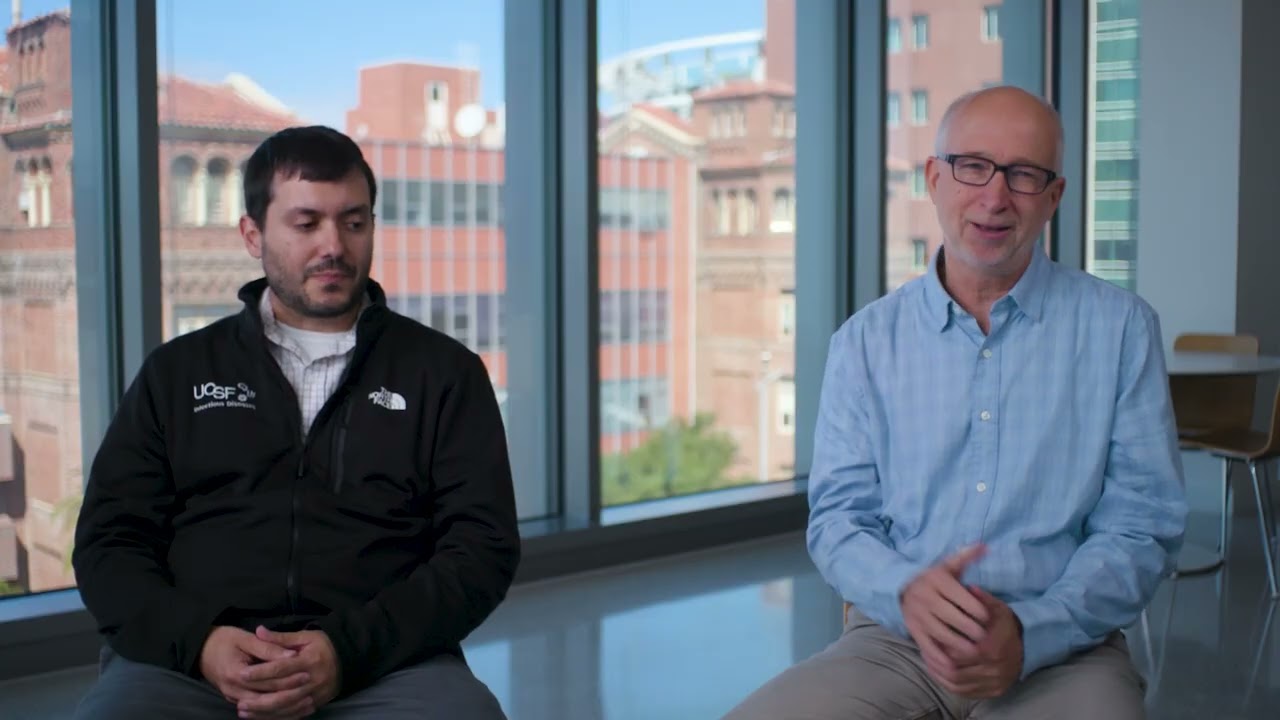
[Music] In March of 2020, uh, we got the notification that there was basically the first case of community spread of COVID in San Francisco and everything shut down. We got together and thought about how we could pivot our HIV research program, which had been highly successful over the preceding two decades, to understand the long-term consequences of CO. This was before people were talking about on social media before that was in the New York Times and you had all these people coming in with these unusual stories totally independent of each other. Some of the most striking cases of that are young men or women who now require assistive devices to get around. Within weeks we launched our link research program to understand the long-term consequences of this infection. uh we began to see people uh who were experiencing longco and we realized that this was going to be a big problem that we really needed to understand. We’ve enrolled I don’t 2,000 people, collected 100,000 samples of blood. We’ve distributed 30,000 samples to people. We’ve built up collaborations in multiple continents. We have at least 40 or 50 ongoing collaborations. In terms of productivity, we’ve launched four or five different clinical trials here. What we’ve really been finding is that SARS KV2 is able to persist for a long period of time in various tissues across the body. For example, we see viral persistence in tissues such as the gut, the bone marrow, the brain, uh, and other deeper tissues that are actually very difficult to sample. We’ve also been finding that there is profound changes in immune responses and inflammation in these tissues as well. So we’ve also instigated a program to look at PET imaging. So this is non-invasive imaging where we can look at TE- cell activation across the body. We’ve also been developing studies to look directly at the virus. And what we’ve been finding is that there is also residual TE-C cell activation across much of the body following SARS KV2 infection. It causes chronic inflammation. That inflammation makes the immune system not work well. And to get rid of HIV, we need to go after the virus. We need to go after the inflammation. We need to make the immune system work better. And so, as a consequence, over the last 20 years, we have built up all these collaborations with industry uh funders and other academic groups trying to target those pathways. And those are the exact same pathways that we’re now targeting longco. So again, it’s the synergy between the work we’re doing in HIV, which we’ve been doing for 30 years, and now in long co. And I have I have a feeling that curing HIV and curing long CO is going to involve interventions or or targeting pathways in which there’s going to end up being a lot of overlap. What’s next is that we really want to continue pushing the envelope in terms of both diagnostics and therapeutics. uh we need to move beyond single therapy treatments for long COVID and begin to piece together combinations targeting the different biological mechanisms of long CO kind of hit this disease from um multiple angles to try to get people feeling better. Those types of studies really push the envelope. They’re the types of studies that are higher risk and potentially much higher reward. You also need the capacity to do it quickly, to be nimble, and you also very importantly need to be able to build up an infrastructure that allows for collaboration. Having a group like Poly Bio that brings people together, brings people to the table, creates collaborations that may otherwise not naturally come into being is really special. everybody who’s part of it. We all have a sense that we’re working together to try to get the answers that we need for this condition. Now, in 2025, it’s really remarkable the progress that we’ve been able to make in just 5 years. And I think that groups like Poly Bio and the Longco Research Consortium that we’re a part of um are really going to be at the center of figuring it out. [Music]
Related Posts