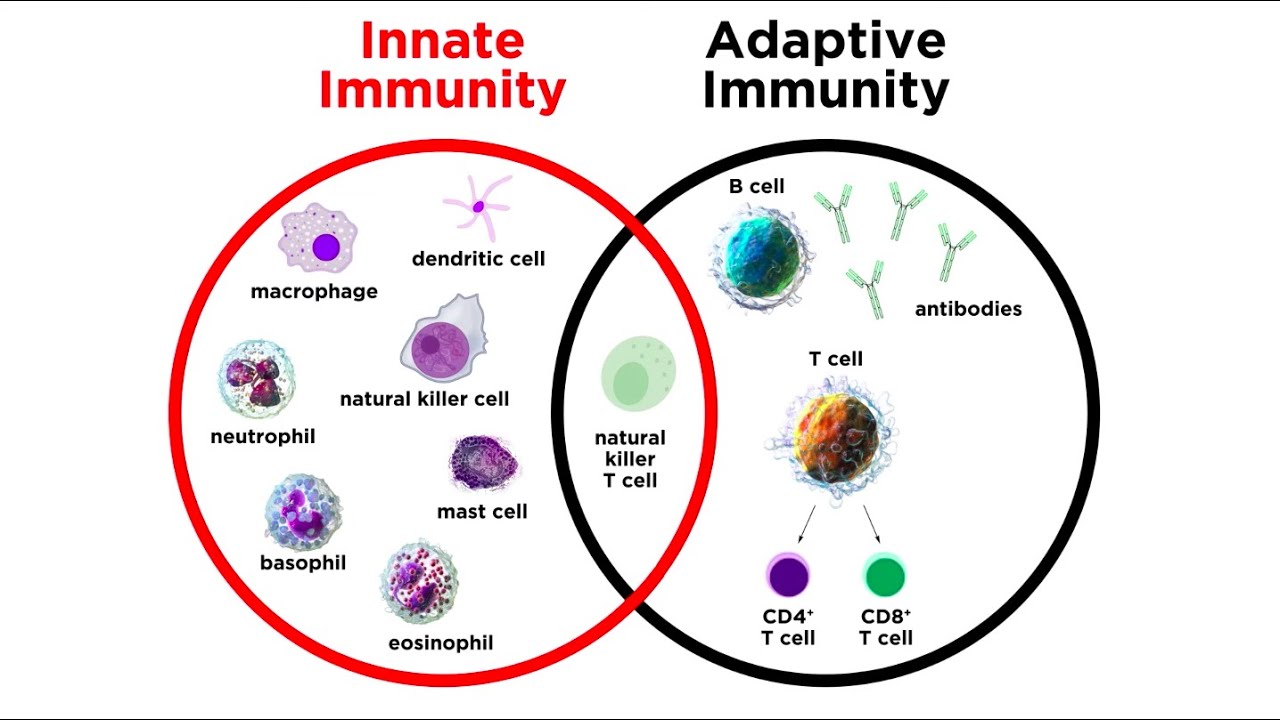
By now we’ve introduced a number of elements of the immune system. Now it’s time to start learning how these work together to recognize and eliminate pathogens. Let’s start by taking a deep dive into the innate immune response. This includes barrier defense, the complement system, the inflammatory response, and innate immune cells. What are all of these components? What do they do? Let’s introduce them now so that we can investigate them over the next several tutorials!
Script by Stephanie Melchor
Select images provided by BioRender.com
Watch the whole Immunology playlist: http://bit.ly/ProfDaveImmuno
General Chemistry Tutorials: http://bit.ly/ProfDaveGenChem
Organic Chemistry Tutorials: http://bit.ly/ProfDaveOrgChem
Biochemistry Tutorials: http://bit.ly/ProfDaveBiochem
Biology/Genetics Tutorials: http://bit.ly/ProfDaveBio
Anatomy & Physiology Tutorials: http://bit.ly/ProfDaveAnatPhys
Biopsychology Tutorials: http://bit.ly/ProfDaveBiopsych
Microbiology/Infectious Diseases Tutorials: http://bit.ly/ProfDaveMicrobio
History of Drugs Videos: http://bit.ly/ProfDaveHistoryDrugs
EMAIL► ProfessorDaveExplains@gmail.com
PATREON► http://patreon.com/ProfessorDaveExplains
Check out “Is This Wi-Fi Organic?”, my book on disarming pseudoscience!
Amazon: https://amzn.to/2HtNpVH
Bookshop: https://bit.ly/39cKADM
Barnes and Noble: https://bit.ly/3pUjmrn
Book Depository: http://bit.ly/3aOVDlT
At this point in the series, we’ve
introduced aspects of the immune system at the molecular, cellular, and organismal
levels. So now it’s time to start learning about how all these different components work
together to recognize and eliminate pathogens. Let’s start out by introducing the innate
immune system, so that we can get an overview of some of the things we will discuss in
greater detail over the next few tutorials. The innate immune system is an
evolutionarily ancient defense system, with elements conserved across plants,
invertebrates, and even single-celled organisms. It is called the innate immune system because it
consists of immune mechanisms that are hard-wired to quickly recognize and neutralize a broad range
of threats, regardless of previous exposure. It differs from the adaptive immune system, which
relies on highly antigen-specific defenses that take some time to launch, and which are
strengthened by repeated exposure to the antigen. So what are some of the most important
features of the innate immune system that we will be investigating? The first is
barrier defense. We will learn about some of the many strategies our bodies have evolved
to keep pathogens out of various surfaces. Barrier defense goes way beyond just structural
barriers, however. There are also some incredible chemical and biological defenses that occur at
barrier surfaces, and many of these defenses are coordinated by the cells lining the skin,
airway, and gut. These cells are right at the interface between what is outside versus
inside the body, and they represent the first line of defense that a pathogen has
to overcome in order to infect a host. If a pathogen is able to slip through
physical and chemical barriers, one of the first internal immune defenses
it will meet is the complement system. The complement system involves a series of
cleavable proteins that circulate through the bloodstream, and this is activated when
proteins recognize microbial surfaces, bind antigen-antibody complexes, or experience
low-level spontaneous cleavage. Activation of the complement system initiates a chain
reaction of proteins cleaving other proteins, and the byproducts of these reactions have a
broad range of effects, including recruiting phagocytes, coating pathogens to mark them for
phagocytosis in a process called opsonization, and even forming pores on microbial surfaces to
directly kill pathogens. We’ll talk much more about this process a bit later in the series.
Once the initial signs of barrier breach and infection begin to manifest, the affected
area enters a state of inflammation. We will learn how to recognize the four signs of inflammation,
which include heat, redness, swelling, and pain, as we will gain an understanding of what is
transpiring on the cellular and molecular level when this happens. Although inflammation
gets a bad rap sometimes, we’ll learn how important and effective this process is for
quickly containing and neutralizing a threat. We’ve introduced innate immune cells and
pattern recognition receptors already, but as we move forward we will devote more time to
understanding these powerful mechanisms of immune defense as well. Many immunology courses can be
rather focused on the adaptive immune system, and will thereby avoid going into detail
regarding aspects of innate immunity, as some consider it to be less sophisticated or
less interesting than the adaptive immune system. Again, this is perhaps due to the fact that
innate immunity is highly conserved across so many species, while adaptive immunity is
found exclusively in vertebrates, thereby representing evolutionary progress. But there is
so much to learn about innate immunity as well, as this system is truly complex, elegant,
and incredibly important. So let’s get a closer look at all these components
of the innate immune system now.