
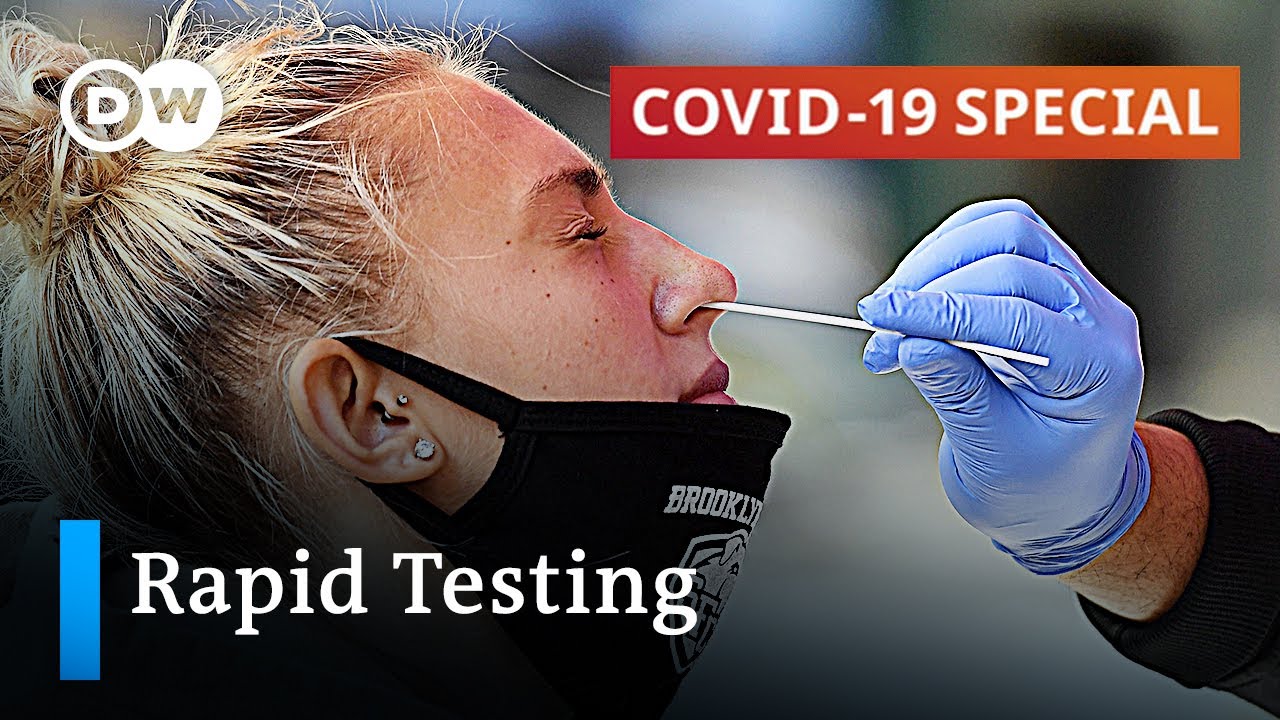
A strong testing regime plays a key role in slowing the spread of COVID-19. But getting tested can be a major challenge. Several nations are developing rapid tests, that turn out results within minutes. In Germany the new antigen test is on the market now – it is not an antibody test or a regular lab test – it checks for the virus in people’s saliva and promises a result within 15 minutes, without a laboratory or doctor involved. But experts are concerned about their accuracy. How user friendly is the test and is it reliable?
Subscribe: https://www.youtube.com/user/deutschewelleenglish?sub_confirmation=1
For more news go to: http://www.dw.com/en/
Follow DW on social media:
►Facebook: https://www.facebook.com/deutschewellenews/
►Twitter: https://twitter.com/dwnews
►Instagram: https://www.instagram.com/dwnews
Für Videos in deutscher Sprache besuchen Sie: https://www.youtube.com/channel/deutschewelle
#Coronavirus #AntigenTest #RapidTesting
a strong testing regime plays a key role in slowing the spread of covet 19 but getting tested can be a major challenge and then waiting for the results the sample has to get to the lab and back that can take up to four days that is much too long to stop a pandemic several nations are developing rapid tests that turn out results within minutes but experts are concerned about their accuracy [Music] well no one wants to be ushered into a false sense of security thinking they haven’t got the coronavirus but are spreading it and it’s a pain to think you do have it when you don’t and go to all the trouble of total quarantine that’s why these new rapid tests could be a blessing but could they also be a curse as a journalist i meet quite a lot of people and some of them may be corona positive so today i want to try out the new antigen test hi there if you would again i would like to buy an antigen i’m afraid i can’t sell you the test as things stand it can only be given out to medical staff so you don’t qualify you can’t test yourself you’ll simply have to go to the doctors after this initial setback i find a doctor who’s willing to let me do the test myself not the standard procedure yet this is the packet containing the antigen quick test i only got it a week ago so i had to read the instructions too there’s also a small sterile swab here if you can’t put your tongue down far enough you can use a stick to help not that easy but for me definitely doable have you done both sides yes left and right afterwards the swab goes into a liquid which is then dripped onto the test one line means negative two means positive it’s pretty clear the test is showing a negative result everyone should have a test like this at home it will be great for a mom for example whose child wakes up feeling sniffly but she isn’t sure and is wondering whether she can take the child to school and go to work herself if patients had access to a simple test they could do at home that would ease the pressure on doctors and laboratories and it would help a lot of people to decide what to do but critics say the test is not sufficiently reliable here’s how laboratory and antigen tests compare when a person gets infected with covet 19 the virus load in the body starts off low increasing rapidly in the first days and then decreasing as time passes a regular lab test can detect the virus early on with very little virus load the antigen test can only detect the virus later when the load is higher so does that mean i could actually still be positive despite having a negative result i asked a lab expert if the viral load in the throat is not high enough to be detectable by the test that might result in a false negative and it’s the same if the swab is not done properly the antigen test is a cheap and fast way of testing a lot of people but the test is less sensitive than others and can’t completely rule out an infection antigen tests can’t replace lab tests but they can be a great help in the fight against covet 19. martin burke has been helping develop an antigen-based test at the university of illinois he says it allows for fast and frequent testing on a large scale and is safe first of all how does it work thanks yes to clarify the test that we’re currently using is a pcr-based test a saliva test at the university of illinois that was developed to skip rna isolation so it’s fast and scalable results are within hours and i think it’s important to point out this is different than the antigen test we’re working on antigen tests here we have not rolled those out yet in the laboratory um is it also completely different to an antibody test which would only tell you if you’ve had an infection not if you’re actually infectious correct our test is looking for the virus in your saliva so we look for three genes from the virus it’s a quick direct from saliva to pcr assay so it allows us to detect whether the to tell you the number of copies per milliliter of the virus in your saliva what makes it safe so the key is that the level detection is very low so we pick up 500 to a thousand copies per mill we’ve been now testing about 50 000 people uh twice per week over the course of the last several months more than half a million tests have been performed and what we see is that people go from negative negative negative and then when they flip positive we can see it at very low viral votes so we think we can catch people before they infect others so it sounds extremely accurate or precise how accurate would you say it is yeah it’s very accurate we’re looking at three genes at the same time and for the positive test we go ahead and repeat them very quickly just to make sure so we believe we have a very high level of accuracy both for positives and negatives which is critical when applying on scale with 50 000 people we can’t have a lot of false positives or false negatives otherwise it’s very difficult to make the system work exactly because false negatives are what will implode any testing system and and we’ve already seen examples in countries where they’ve stocked up on these rapid test sets but they’ve been antibody based tests and that’s basically backfired on them well i think what we need to learn to do is figure out how to use each type of test in the right setting right so this is a very challenging problem and we have to figure out the best way to use different tests in different situations to maximize protection against spread in a community we think now that we have a system working with the saliva based test comparing that test directly to these new antigen tests head to head would be a really good way to find out whether they could provide the same level of protection of the test that we’re using martin i guess the the question everyone’s going to be asking themselves is is this going to be a game changer i hope so and i think we need to figure out how to use the antigen tests so that we are not giving ourselves a false sense of security i think we have to understand the limitations every test has limitations and we just need to i think better understand when is the right time to use which test and to understand the limitations so that we don’t give ourselves a false sense of confidence the one thing i would just say no matter what test we’re using we have to wear masks and social distance no test will allow us to stop doing that and that’s really important and the limitations in this case that you need actual trained personnel to conduct these tests these aren’t tests that one could do just at home correct our test is done in a laboratory now the saliva collection is done in tents you just walk through in five minutes and dribble saliva into a tube but then the rest of it is done absolutely in a laboratory setting um you mentioned this won’t be the only solution in fighting off the coronavirus is it going to take other types of tests and other approaches to see that we do battle this battle off this or fight off this pandemic absolutely i think we need all hands on deck and we need to continue to innovate and find new ways to detect the virus obviously we need a safe and very effective vaccine we continue to need better and better treatments to make sure that people who get sick don’t actually die or have long-term sequelae in the hospital and we all need to continue to do our part obviously it’s an extraordinary challenging time we need to hang in there and continue to be safe and make smart choices about how we socialize and wear masks and social distance it works and we need to keep those vigilant in place and before i let you go what sort of time scale are you or timeline are you looking at because we are now heading into winter in the northern hemisphere it’s going to be a very challenging time i expect absolutely so we are in this for the long haul at the university of illinois as i mentioned uh we’ve now performed half a million tests the last several months our daily positivity rate is 0.24 percent and but we are not letting our guard down so we figure we’re in this probably for a couple years and i think we all need to just kind of adapt to the new normal where we do very safe thoughtful things to help us get back to thriving as a as a society and as our economies need to you know thrive as well so it’s just really important that we of course think holistically that’s my most important message it’s got to be a holistic approach i think in order for this to work excellent martin burke thanks for joining us today thanks for having me on derek williams turn to take the reins now the science correspondent has been busy looking into your questions about the pandemic what’s dangerous is the pneumonia why not find a cure or treatment for the pneumonia instead of the virus pneumonia is a blanket term that’s generally defined as a more or less serious inflammation of tissue in in your air passages and or your lungs it can be caused by a number of different pathogens both both viral and bacterial the pneumonia that covet 19 can cause is generally initiated by the virus and can’t be treated for example uh with antibiotics which only kill bacteria when they’re infected with saurus cove 2 the cells in the small sacks in your lungs where gas exchange occurs what are called um the alveoli begin to die and clog the lungs up and and that can eventually lead to what’s called acute respiratory distress syndrome as the pneumonia progresses the situation can be exacerbated by the immune system causing massive inflammation which is which is supposed to help get the infection under control but which can actually make things worse so so treating or curing coronavirus pneumonia means either addressing the problem at its root which is the sars co2 infection itself or somehow toning down the body’s immune response to it when it goes over the top [Music] and now to the latest data from over 200 countries which show new cases doubling in 26 nations and increasing in another 83 countries they’ve stayed at the same level in 10 countries 71 nations have seen their new positive covert 19 cases fall another 11 halving and eight countries have reported no new cases for four weeks in a row here’s the bar graph showing the statistics of the last weeks the fight against corona is over when that whole chart turns blue that’s going to take a while