Paid sick leave keeps everyone healthier. During a pandemic, it’s a necessity.
Become a Video Lab member! http://bit.ly/video-lab
In most developed countries, workers have the right to a certain number of paid sick days. It’s a policy that isn’t rooted in just generosity — during pandemics like the novel coronavirus, it can literally save lives.
When workers have to choose between earning a living and staying home sick, it incentivizes them to come to work when they’re ill, and potentially infect their colleagues and anyone else they come into contact with. That’s why public health officials are concerned that millions of American workers don’t have access to paid sick days. And a disproportionate share of those workers are concentrated in occupations like food service and hospitality, where there’s potential to infect the hundreds of customers many of them interact with every day.
Correction: At 1:18, islands in Canada, Denmark, Japan, Italy, and Australia are missing highlights.
Previous headline: One policy that changes the coronavirus math
Further reading:
The Italian Ministry of Health
https://www.thelocal.it/20200309/map-which-parts-of-italy-are-affected-by-coronavirus-outbreak
World Health Organization
https://en.wikipedia.org/wiki/2019%E2%80%9320_coronavirus_pandemic#/media/File:2020_coronavirus_cases_outside_China.svg
Center for Economic and Policy Research
https://media.milanote.com/p/files/1Jcvmg1vhFTY82/Rt8/CEPR%20-%20paid%20sick%20leave%20in%2022%20countries%20%282020%20update%29.pdf
Pew Research Center
https://www.pewresearch.org/fact-tank/2020/03/12/as-coronavirus-spreads-which-u-s-workers-have-paid-sick-leave-and-which-dont/
Centers for Disease Control and Prevention
https://www.cdc.gov/coronavirus/2019-ncov/prepare/prevention.html
A Better Balance
Milwaukee Journal Sentinel
http://archive.jsonline.com/news/statepolitics/33874059.html
Wisconsin State Legislature
https://docs.legis.wisconsin.gov/2011/proposals/sb23
PR Watch
https://www.prwatch.org/files/ALEC%20Labor%20Business%20Reg%20Subcttee%20Annual%20Mtg%202011.pdf#8
Economic Policy Institute
https://www.epi.org/preemption-map/
House Democrats (via CNN)
https://www.cnn.com/2020/03/12/politics/coronavirus-house-economic-bill/index.html
US House of Representatives
https://docs.house.gov/billsthisweek/20200309/BILLS-116hr6201-SUS.pdf
The New York Times
https://www.nytimes.com/2020/03/14/opinion/sunday/coronavirus-paid-sick-leave.html?action=click&module=Opinion&pgtype=Homepage
Vox.com is a news website that helps you cut through the noise and understand what’s really driving the events in the headlines. Check out http://www.vox.com.
Watch our full video catalog: http://goo.gl/IZONyE
Follow Vox on Facebook: http://goo.gl/U2g06o
Or Twitter: http://goo.gl/XFrZ5H
St. Mark’s Square. Venice, Italy. It’s one of the most-visited tourist destinations
in the world. Most years in mid-March, it’s
crowded with people hanging out in cafes, checking out the cathedral, and riding gondolas. But in March of 2020,
St. Marks’ Square was practically empty. More and more people in
northern Italy had tested positive for the highly-contagious Coronavirus. To slow down
the spread of the virus, The Prime Minister told everyone to stay at home: “The future of Italy is in our hands” And they listened. A big part of the reason
they could do that, is because of a national policy in Italy: everyone there is guaranteed
paid sick days, no matter their job. The same is true in the UK, and Germany, and Spain, and Japan, and Ireland, and Austria, and Australia, and Norway and France, and, well, basically
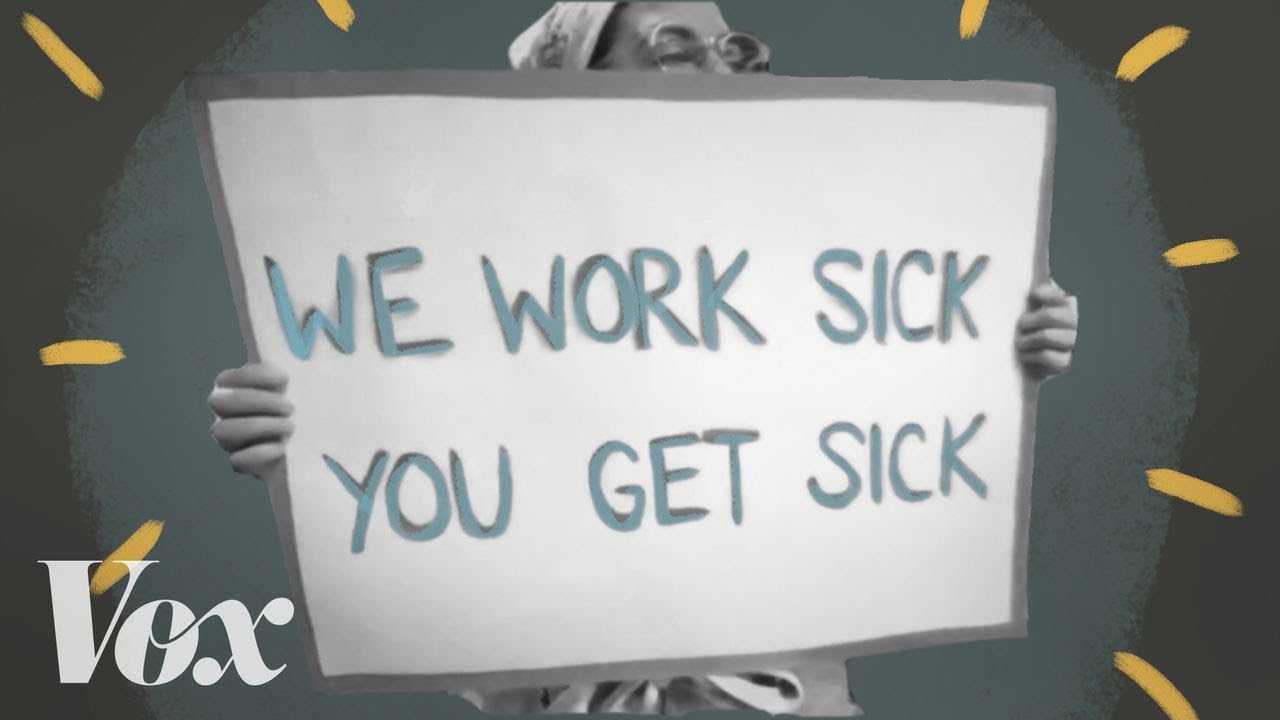
all wealthy countries. But in the US, a huge number of workers face a very different reality. These restaurant workers in New Orleans are demanding emergency sick pay during the coronavirus
pandemic. Unlike in all these countries, there is no national law in the US guaranteeing
workers the right to paid sick days. Instead, whether you have that right depends on where
you live, and who you work for. It’s a system that leaves tens of millions of the lowest-paid Americans vulnerable. And it’s about to be tested by the biggest global pandemic in a hundred years. If you look at how other countries handle
paid sick leave, some of them, like Italy and Japan, pay workers directly out of a social
security fund. Others, like Germany, New Zealand, and Australia have laws that require employers
to foot the bill. In Ireland and Spain, it’s a combination of both. But they all do it
for the same reason: because it helps contain the spread of disease and can save lives. When workers have to choose between making money, and staying home when they’re sick, the incentivize is for them to come to work. Which can get their customers and coworkers sick. That’s an especially big problem in a pandemic like coronavirus, when hospitals might already be at capacity, which would mean some people can’t
get medical attention, which would mean more people die. That’s why the website of the CDC, America’s main public health agency, is unambiguous
about what you should do if you’re sick right now: stay home. But if staying home means not
being able to pay your rent, it might not be that simple. I’m a production assistant. I’m a music educator. I work in Houston, Texas as a stagehand. I’m a line opener at a bakery by day, a
bartender by night, and neither job offers paid sick days. I don’t get sick days because
I’m not staffed. I’m hired, like, day to day. So, I’m a contract worker, so that means we’re ineligible for
benefits or paid sick leave at all. If for any reason I have
to call in sick, the company calls the next person on the list and I do not get paid. It basically means I start playing tetris with my living expenses – pull money away from one bill
to squeeze it into another. So it makes things complicated and a bit scary. In recent years, service industry workers
have pushed for new paid sick leave laws in cities and states across the country. And
in a handful of places, they’ve succeeded. But service workers are a huge part of every
state’s economy. So why haven’t they been more successful in getting paid sick days
in more places? Part of the reason why starts here – in Milwaukee, Wisconsin. In 2008, voters
there passed a paid-sick-leave referendum by a huge margin. But three years later, Wisconsin
Governor Scott Walker signed a bill that said no city in Wisconsin could require employers
to provide employees with leave of any kind. Milwaukee’s paid sick leave law was toast.
Then, later that same year, an executive from the company YUM! Brands — which owns KFC,
Taco Bell and Pizza Hut — went to a meeting of the American Legislative Exchange Council
– a group that writes legislation for Republican state lawmakers all over the country, so they
don’t have to write it themselves – and handed out copies of that Wisconsin bill.
In the decade since, Republican-conrolled state legislatures in 16 other states have passed nearly identical laws. Including Louisiana, home of those New Orleans protesters. But now that there’s a pandemic, the US
really needs sick workers everywhere to stay home. That’s partly why on March 18, 2020, President Trump signed a coronavirus relief bill that Vice President Mike Pence described to the
American people this way: “If you’re sick, stay home. You’re not going to miss a paycheck.” The problem is that’s not true. The Democrats original bill gave everyone access to paid sick days, but to get Republicans on board they made some concessions. The bill does contain a line that
says, “an employee shall be entitled to paid sick time.” during public health emergencies.
The problem is, that rule only applies to companies with between 50 and 500 employees. And companies that size only employ about 20% of American workers. So even with this new
bill, millions of workers at big national chains like McDonalds, Walmart, Kroger, and
Pizza Hut still don’t have paid sick days. There are lots of American workers that do
have paid sick leave. Many also have the privilege of working from home during the crisis. But coronavirus
doesn’t distinguish between people who have that privilege and those who don’t. That means the status quo puts all Americans at risk. Because we’re only as safe as our
least-protected neighbors.