It’s a good time to be a Wings fan, which hasn’t always been the case. Time was, mention even a sneaking admiration for Paul McCartney’s first post-Beatles band, and the kindest response you would get would be sympathy. More likely, though, you’d be barraged with 100 Reasons Why Wings Are Sh*t, with numbers 1-99 being “they’re not the Beatles,” and No. 100 being “Linda can’t sing.”
Well, the first one is true, and thank heavens for that. No silly Ringo singalongs, no “I’m here too” George contributions, no jaundiced John diatribes. And the second one was just silly, because as early as Ram, which of course was credited to Paul and Linda, her harmonies are simply breathtaking. So there.
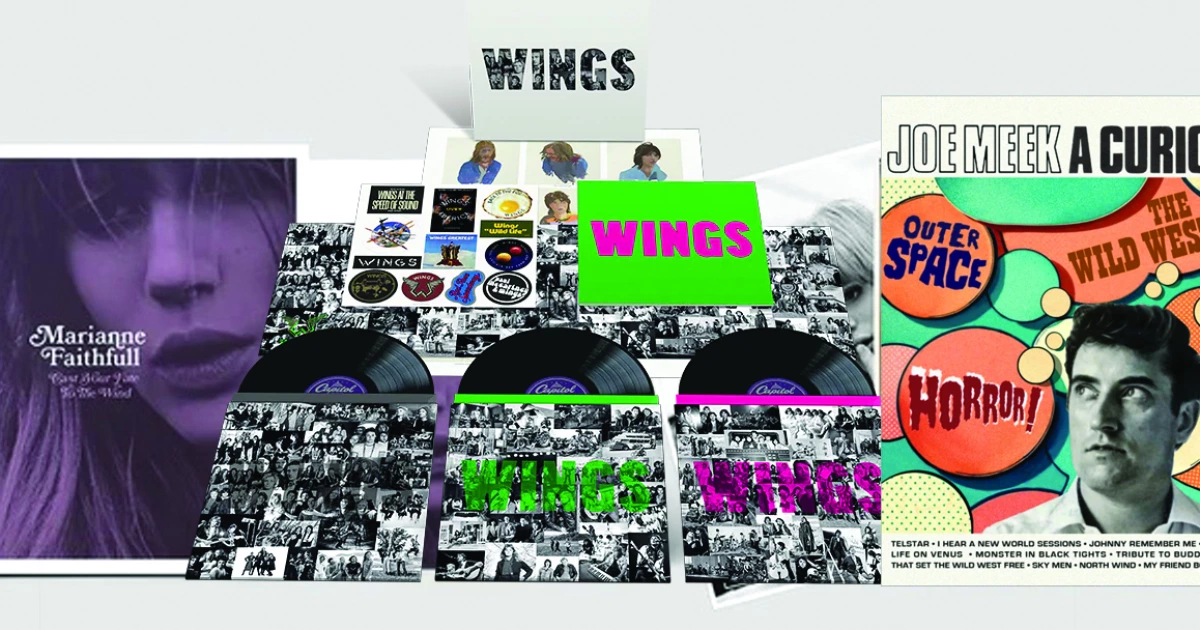
But time has passed, grudges have been forgotten, and Wings suddenly stand revealed as … well, can you name one single band that kept up such a solid run of killer 45s for more or less their entire career? Certainly, between “C Moon” (1973) and “Old Siam Sir” (1979), Wings barely put a foot wrong, and if you pick up the just-released 3-LP Wings box (Capitol Records), you’ll agree, because almost all of them are here.

Yes, there’s a few 45 rpm omissions – the live “Maybe I’m Amazed” really should have replaced one of the six (!!!) cuts from Band On The Run (Spin Cycle’s vote would go to “Mamunia”), and tracing back a little, “Mary Had A Little Lamb” really isn’t as malodorous as the nay-sayers proclaimed, and “Give Ireland Back To The Irish” is a snazzy rocker, even if its lyrics are now as dated as … I dunno, the whole of the latest John Lennon box?
What really makes Wings stand out, however, is sitting down to listen to it while browsing McCartney’s book, Wings – The Story of a Band on the Run (Liveright Publishing), an oral history that is un-put-downable as it is immense — 550 hardbound pages of memories, timelines, concert dates and discography.
Nothing escapes McCartney (and, presumably, editor Ted Widmer)’s attention. Opening the book at random, Spin Cycle found itself sucked into a page or so about “Walking In The Park With Eloise” — a Macca spin-off that really should be better known than its non-charting obscurity allows. Turning to another page, we find his thoughts on his incarceration in a Japanese cell.
No silly Ringo singalongs, no “I’m here too” George contributions, no jaundiced John diatribes.
He discusses drugs and recalls the sheer hostility that Linda encountered both as a musician and as a part of his life. The frustration of Wings’s ever-changing lineup, but the loyalty of Denny Laine, is a constant undercurrent, while the addition of a veritable army of other people’s perspectives is also a lot of fun.
It’s also gratifying to see McCartney state that the Jimmy McCulloch/Joe English lineup was “the best version of Wings,” with the albums Venus and Mars and Wings Over America certainly backing up that claim. It’s just a shame they then went and made Wings At The Speed of Sound… then and now one of the most disappointing of all McCartney’s albums, band or solo.
And talking of disappointment, his description of the magisterial “Junior’s Farm” as “a little bit of a stopgap … it didn’t feel like it was going to end up on the next album” sends one running to side two of Wings, and playing it again, loud. Spin Cycle rates “Junior’s Farm” among Macca’s greatest singles of all, with its B-side, “Sally G,” high up there as well. How that missed the box set is a mystery that will never have a satisfactory answer.
Writes our hero. “Once we’d done that, and then the band was starting to morph and people were leaving, it inevitably became more boring. Been there, done that.” Plus, that last album, Back to the Egg, really was another stinker. Bar, of course, “Old Siam Sir,” a hit single in the U.K., but relegated to the B-side of the vastly inferior “Arrow Through Me” in America. “Getting Closer” wasn’t bad, either.
McCartney, incidentally, compares Back To The Egg to side one of Revolver. Get your head around that!
A fabulous book, then; and, in its own way, one of the best on the entire Beatles bookshelf. No, it’s not as in-depth as Allan Kozinn and Adrian Sinclair’s ongoing The McCartney Legacy series, the first two volumes of which align perfectly with the Wings story. But then you wouldn’t want it to be. The Legacy tells the story of the band in the studio. Wings – The Story of a Band on the Run is indeed the story of a band, on the run or otherwise.
And the box set soundtracks it exquisitely.

While Marianne Faithfull’s death at the end of January this year prompted a vast outpouring of affection for her life and work, it was significant that the bulk of it focused on her post Broken English releases -— that is the long and indeed remarkable sequence of albums that followed her so-called “comeback” in 1979.
Little attention was paid to what she was actually coming back from, beyond the usual quotes from erstwhile manager Andrew Loog Oldham, and the same old stories about her first hit, “As Tears Go By,” in 1964.
In places, one cannot really fault the omission. An ill-fated dalliance with country music in the mid-1970s spawned two albums, which even fans tend to overlook, Dreamin’ My Dreams and Faithless; and the decade as a whole is generally summed up by her theater work and (here come the clicks) drugs.
But Spin Cycle saw her play the London Music Machine in 1978, where a startling, savage show included a cover of the Velvet Underground’s “Sweet Jane,” the brutal “She’s Got A Problem” and the delightfully titled “Bullshit,” and it was already clear that the country phase was far behind her.
And if you spin back to the beginning of the decade, the dark, covers-heavy clutch of sessions that were rejected by Bell Records clung together so well that many discographies blithely consider them an actual 1971 release, as opposed to a lathe cut that languished forgotten for 15 years, before finally squeaking out on a 1985 compilation, absurdly paired with great swathes of Faithless.
Now, we can reach back even further, to the four albums Faithfull recorded during her first flood of fame, newly reissued alongside a collection of non-LP singles and rarities. And it becomes apparent that, even as a teenager, Faithfull possessed a resolve, not to mention a talent, that already pointed towards the albums that are now so revered by rock critic-dom.
Although this is their first time on vinyl since their original release, Marianne Faithfull, Come My Way (both 1965), North Country Maid (1966) and Loveinamist (1967) have all seen reissues in the past, most notably across 2007’s Japanese The Decca Years 1965-1967 CD box set. Many (but not all) of the cuts included on the new two-disc Cast Your Fate to the Wind: The Singles, B-Sides & Rarities compilation were also included therein as bonus tracks. (Albeit with little regard for continuity or chronology.)
The albums themselves fascinate. While Marianne Faithfull and Loveinamist were designed and marketed as pop albums, the other pair were singularly folk-oriented, with Come My Way focusing on the American tradition, and North Country Maid on the English. And that latter pair are peerless, and it is not only Spin Cycle that thinks so.
Famously, it was Faithfull who insisted that both Marianne Faithfull and Come My Way be released on the same day. What nobody expected was for the folk album to prove the biggest seller, despite including no hits at all (the pop set featured two, “As Tears Go By” and “Come and Stay With Me”). In fact, Come My Way remains the highest U.K. charting album of her entire career, peaking at No. 12. Even Broken English faltered just inside the Top 60!
Spin Cycle’s own experience with the albums mirrors this — long-cherished copies of the two folk albums were in need of vinyl replacements long before these reissues were schemed; the poppy pair really don’t get pulled off the shelf too often.
It is glorious to see all four back on the shelves, though, if only to remind people that even Faithfull’s final album, She Walks In Beauty, was in many ways a glance back at her earliest days, drawing upon her love of poetry for the first time since Come My Way offered musical settings to Lewis Carroll and William Shakespeare.
With all this in mind, the Cast Your Fate to the Wind vinyl set is a necessary round-up of the material that didn’t make the albums, largely singles but also a handful of unreleased cuts. In terms of continuity, it’s fairly scattershot, but it does the job. Nevertheless, there is still sufficient material out there for at least one further box set (primarily the mono versions of all four LPs, most recently available only on a second Japanese issue).
For now, though, these reissues should finally elevate Faithfull’s 1960s to at least the same plateau as the remainder of her catalog — because that’s where they deserve to be.
Sticking with the ’60s, and music that is finally receiving the recognition it should have always been given, the latest installment in Cherry Red’s exhumation of Joe Meek’s so-called Tea Chest Tapes might well be the most remarkable yet.
The tea chests were always a thing of legend … nobody knew what was in them, some people doubted they would ever be opened, a few didn’t believe they even existed. And two years on from their so-long-awaited public unveiling, it must be said that they have lived up to almost every expectation that the faithful nurtured.
Almost. It is true that the oft-rumored existence of hitherto unknown Bowie, Bolan, Rod Stewart and even Beatles recordings has yet to be proven either way, although the general consensus seems to be that, if they did exist, we’d have heard them by now. This is … what, the eighth set of tea chest treasures to have graced our ears, and the proto-superstars resolutely remain out of sight.
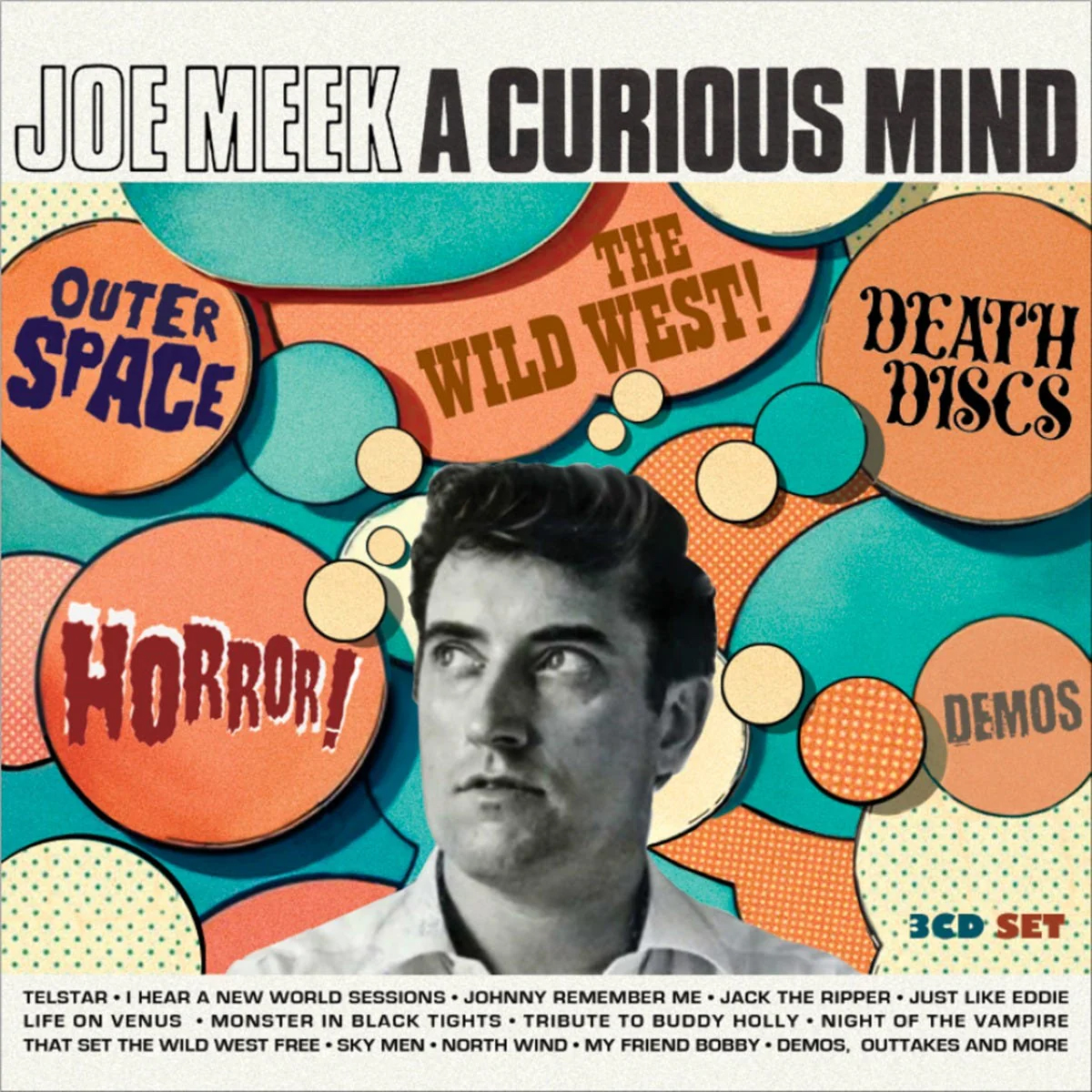
But three CDs of A Curious Mind: Outer Space! Horror! Death Discs! The Wild West! Demos! might well be more valuable, an 82-track exploration of Meek’s own pop cultural touchstones … that is, science fiction, the supernatural, the wild west and death songs. Valuable, because it was within these realms that the very heart of Meek’s latter-day legend beat, in his ceaseless drive to create and conjure sounds that replicated the personal interests that went into the songs.
Ghostly chorales, creaking coffins, screaming victims, bleeping spacecraft, wild electronics, howling beasts, astral winds and deep space emptiness … the three discs here each pursue a relevant concept, be it “Beyond the Stars” (disc one) “Beyond the Grave” and “Out West” (disc two) or “I Hear a New World,” with the latter offering up the deepest dive yet into the 1960 album of the same name via newly discovered versions and outtakes, plus a first ever airing for the stereo masters of an early compilation/demo of the album.
All told, 23 of the box’s 57 unreleased tracks are located on that particular disc; the remainder, then, are spread across discs one and two, where they rub shoulders with a further 25 established Meek hits and classics, and highlights from other releases in this series.
That these latter include some of the most exhilarating exhumations from the tea chests (so far) goes without saying, while the former wrap up deathless smashes from the Tornados (alternate mixes and edits of “Telstar” and “Globetrotter”); John Leyton (the so-called “died” version of “Johnny Remember Me”); Heinz and Mike Berry (tributes, respectively, to Buddy Holly and Eddie Cochran); the Outlaws; and, best of all, Screaming Lord Sutch.
“Jack The Ripper,” “She’s Fallen In Love With a Monster Man” and “Till the Following Night” are all present, alongside unreleased versions of both Sutch and Meek’s own demo version of “Monster In Black Tights,” aka a glorious rewrite of “Venus In Blue Jeans.” Plus, for 34 seconds of genuine insanity, Meek and Sutch working on some screaming.
It’s moments like that, these behind-the-scenes scraps, fragments of demos and general off-cuts, that in many ways have proven the tea chests’ greatest gift to longtime Meek collectors, and this set is no exception. A brief snatch of Meek’s co-writer Geoff Goddard messing around with “Somebody’s Knocking On My Coffin” is a delight despite its brevity (38 seconds); Meek’s own Buddy Holly-inflected “Have You Ever Tried Living On the Moon,” and the instrumental “DX Experiment #2” likewise.
In fact, even among the familiar tracks, the sheer magnitude of Meek’s imagination is laid bare for all to marvel at — and there’s still a bunch more tea chests waiting to give up their secrets.
—