Download free rotation guides: https://info.sketchy.com/guide/all-clerkships?utm_medium=organic_social&utm_source=youtube&
Download free patient presentation guides: https://info.sketchy.com/guide/all-patient-presentations?utm_medium=organic_social&utm_source=youtube&
Save 25% off Sketchy for Black Friday with code BF25 to watch this lesson and more from our Microbiology Course https://www.sketchy.com/explore/medical?utm_medium=organic_social&utm_source=youtube&utm_term=MDP_MICRO-Full-Lesson-Coron&
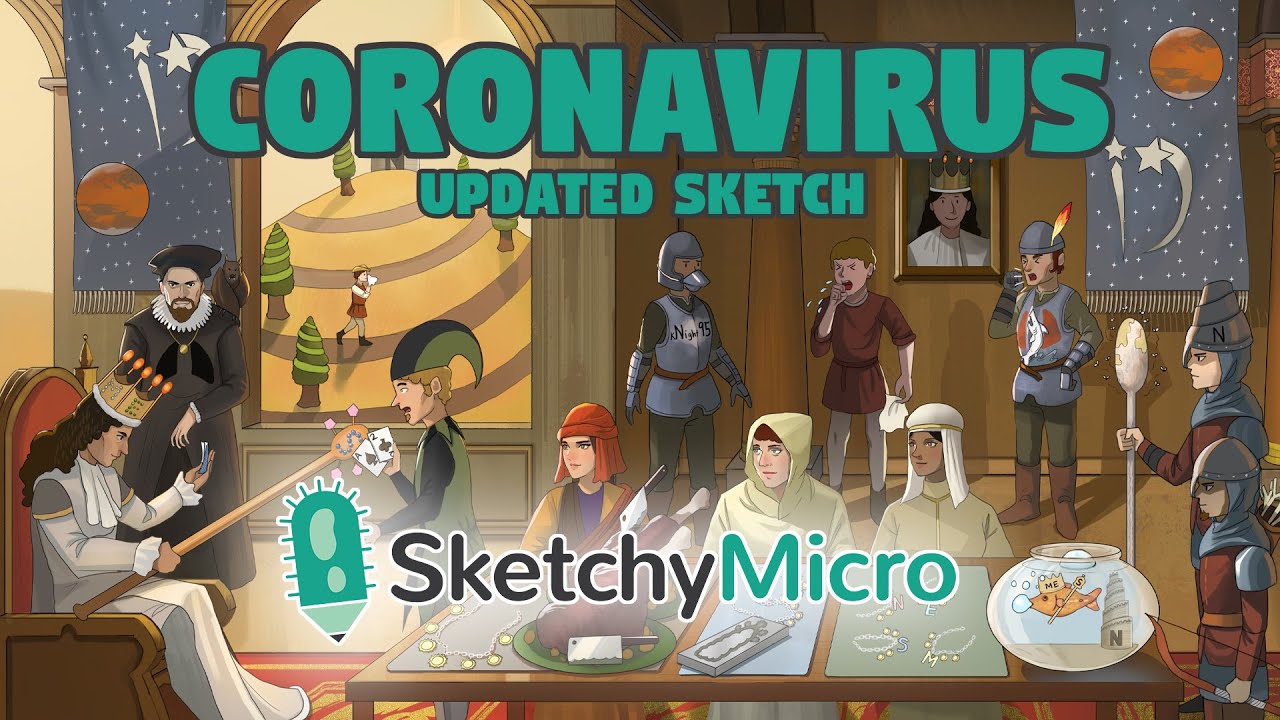
Coronavirus dominated 2020. Once upon a time we said this was a low-yield topic. Sadly, this is no longer true. This week, we updated Sketchy Micro with a brand new Coronavirus sketch.
Sketchy Micro is part of Sketchy Medical, which features this sketch, includes 800+ lessons covering high-yield topics for your preclinical and clinical years in one combined program which also preps you for USMLE Step 1, Step 2, wards and shelf exams.
We cover Microbiology, Pharmacology, Pathophysiology, Biochemistry, Ob/Gyn, Surgery and more!
From the tale of the golden staff of Aureus to the heist at Park & Sons bank… Adventure awaits!
—
Sketchy is the #1 visual learning platform brought to you from the creators of SketchyMicro and SketchyPharm. We turn what you need to know for your course prep and exams and into engaging, artful stories that you’ll remember forever. Rooted in an ancient memorization technique called the ‘method of loci,’ The Sketchy Method is proven to accelerate learning, increase retention, and improve test scores. (Trust us, we’re doctors.) Our comprehensive one-of-a-kind curriculum covers everything you need to know to conquer any subject—and have fun while doing it.
Sketchy has programs to help your study and improve your scores for USMLE, MCAT, PANCE, NP boards, & NAPLEX!
Follow us:
https://www.instagram.com/sketchylearning
https://www.instagram.com/sketchymcat
https://www.tiktok.com/@UC1BRRTxAdlQCy2Tq8YfHX0w
https://discord.gg/sketchylearning
https://www.facebook.com/sketchylearning
Tweets by SketchyLearning
[Music] [Music] welcome to our corona beardy sketch we will of course cover the newest member of this family the virus that causes coven 19 as well as its cousins the causative agents of sars and mirth we’ll also throw in a few mentions about the four less pathogenic and less well-known human coronaviruses welcome to the corona kingdom a land of everlasting summer verdant forests and beautiful sunrises nah just kidding it’s a socially distant serfdom but let’s take a tour of the castle anyway masks on corona is latin for crown and that’s because of the crown-like spikes on its surface these spikes also known as peplomeres are pretty important so we’ll be coming back to those peppy peepers in a bit first some basic specs coronaviruses are single-stranded positive sense rna viruses we’ve set the scene in warm orangey hues which should tip you off that we’re talking about an rna virus and rising above the horizon you’ll see a positive sense sun the positive sense part means that the genome can also serve as messenger rna we’ll come back to the implications of this in our discussion of the life cycle there are seven coronaviruses known to infect humans but prior to the beginning of the 21st century there are only four all low pathogenicity viruses that cause the common cold that’s why this commenter out here with the case of the sniffles looks pretty unthreatening unthreatening just wait till i drop the magna carta on this middle ages milk sup these viruses are considered endemic in humans and see no animals in sight these viruses continue to circulate worldwide but they’re not even famous enough to get pronounceable names the three newer coronaviruses are of course quite a different story they’re all zoonotic viruses that have crossed the species barrier to cause deadly respiratory illness on pandemic levels all three viruses likely originate in bats aka the primary host or natural reservoir the intermediate host varies palm civets in the case of the original sarskovi and dromedary camels in the case of merscovy sarsko v2 the 19 virus may have had an intermediate host or may have been directly transmitted from bats we’ll depict the three highly pathogenic coronaviruses on this banner above starting with these sar stars that’s because this whole mess started with stars kovi which by the way stands for severe acute respiratory syndrome coronavirus the og sars kobe emerged in 2002 and causes you guessed it sars next came mars covi or middle east respiratory syndrome coronavirus in 2012 which causes a murse not a very creative move by the international disease naming committee but what else anyway astrology teaches us that you’re most likely to contract this disease while under the bale flu influence of the red planet mars and of course the newest addition to the family is sars cov2 the virus that causes coronavirus disease 19 better known as covid19 the virus was named sars kobe 2 because it’s genetically similar to the original sars virus we’ve added these two shooting stars in the shape of a 19 to remind you of stars cov2 and covid19 now that you’re familiar with the corona royal family let’s move on to structure most coronaviruses have four structural proteins that form the virion what’s a virion you ask it’s the fully formed virus particle typically seen outside the host cell and capable of infecting new cells at the core you’ve got the rna genome bound to multiple subunits of nucleocapsid or n-protein together they form a nucleocapsid with the helical shape we’ve sketched an orange helical tower with an n door to remind you of this and we even made the hills and trees spirally so you extra won’t forget that these little squirmy devils have a helical nucleocapsid the nucleocapsid is surrounded by a viral envelope just like this king is enveloped by a luxurious robe so yes coronaviruses are enveloped meaning they have a lipid bilayer studded with proteins the coronavirus envelope typically contains three different proteins all of which are in the possession of the king his crown is embellished with the letters m-e like a real king like a king with self-respect and possibly narcissistic personality disorder and his scepter has a beautiful s on it for scepter i guess take a look at the sugary shapes on the surface of the king scepter the protruding portion of the s protein is heavily glycosylated it’s these large widely spaced glycosylated knobs or spikes or peplomirs that give coronaviruses their crown-like appearance but these spikes are far from just decorative they’re responsible for entry into host cells including receptor binding and membrane fusion which we’ll talk about in just a sec so far we’ve been talking about coronaviruses in general but let’s shift our focus to take a look at the life cycle of sars kobe 2 specifically pay attention future noble laureates any of the stages of the life cycle are potential therapeutic targets the receptor for sars cov2 is angiotensin converting enzyme 2 or ace2 hence the ac2 hand held by the king’s opponent ace2 is expressed on a number of different cell types most notably type ii alveolar cells in the lungs and no suit looks more like those bubbly alveoli than clubs hence the two of clubs the original sarskovi uses the same receptor in contrast mers covi uses a different receptor dipeptidyl peptidase iv or dpp4 let’s take a look at how source cov2 gains entry into the host cell it all starts with the spike protein which is the part of the coronavirus that actually binds ace2 on the target cell after binding the spike protein undergoes a conformational change allowing it to facilitate viral entry through the fusion of viral and host membranes once a virus has gained entry into a host cell the series of events appears to be very similar across the different coronaviruses the virus uncoats as it enters the cytoplasm of note the virus will stay here in the cytoplasm for its entire replication cycle this is true for most rna viruses there’s no need for dna intermediates and no need to enter the nucleus you can think of this table as the cytoplasm of the host cell we’ll be depicting the rest of the sars cov2 virus lifecycle here with gifts set out for the king by the three wise women of the kingdom once the virus has entered the cell the first order of business is protein production the immediate production of proteins is possible because of the positive sense rna genome which we’ll represent with orange sun necklaces since it’s structured like messenger rna it can be directly translated by host cell ribosomes that’s exactly what happens here a key gene called the replicase gene is translated into two long polyproteins represented by two giant proteinaceous mutton shops and take a look at these protein cutting meat cleavers that came with the mutton chops a recurring symbol for proteases after translation the viral proteases actually cleave themselves from the long polypeptide chain which is called autoproteolysis freedom once free these proteases process the remaining polypeptide chain releasing a whole bunch more proteins many of these proteins perform crucial roles in replication and transcription and associate with one another to form the aptly named replication transcription complex the key member of this complex is the so-called rna-dependent rna polymerase or rdrp which the virus uses to make more copies of the genome from its own rna the rdrp uses the positive sense genome to make a negative sense copy which is then used as a template for more positive sense rna no dna intermediate needed just like the virus this wise woman is using positive sense necklaces to make negative sense molds which she can then use to make more positive sense necklaces the full positive sense genomic rna is also used to produce shorter rna segments that ultimately lead to synthesis of viral proteins which is how the s m e and n proteins we talked about at the beginning ultimately get made these newly synthesized structural proteins are the building blocks for the next generation of viruses let’s take a closer look at the assembly process the s m and e proteins just like your typical membrane protein are translated at the endoplasmic reticulum where they’re folded and packaged into vesicles for transport from there they’re shipped off to the golgi represented by our recurring golgi goldfish meanwhile in the cytoplasm the n proteins associate with freshly transcribed positive sense genomic rna forming the helical nucleocapsid this is where coronaviruses get weird the nucleocapsid of your average envelope virus usually waits for the membrane proteins to make it all the way to the cell membrane before joining up and budding from the cell surface the coronavirus is a little different because it buds from the golgi instead of the cell membrane it still has to actually get out of the cell to do its dastardly deeds but technically it’s a fully functional virus once it’s budded from the golgi the finnish virions are then transported through a series of membranous vesicles to the cell membrane where they’re released via exocytosis all right now that you’re familiar with the coronavirus life cycle let’s move on to transmission and clinical manifestations coronavirus may be transmitted by aerosols or droplets though the jury is still out on which is the most important method of transmission so for now just remember this sickly dude coughing a whole bunch of gross droplets all over this poor knight 95 who’s fortunately wearing a specialized piece of armor to block aerosol transmission as we’ve mentioned the four less pathogenic coronaviruses cause mild upper respiratory illness basically the common cold hence this commoner with a tissue commoner you take that back you boiled newt forsooth so yes the case of the sniffles you had a while back that could have been a coronavirus or any of the other viruses that caused the common cold the more pathogenic coronaviruses can all cause severe potentially deadly pneumonia which is why our friend with the dirty lung spots is standing next to another stars and mars tapestry let’s talk a little bit more about covet 19 specifically this disease has an impressive range of severity some people are even asymptomatic that’s why the king in this painting is happy and asymptomatic among people with symptoms the majority are relatively mild including fever cough and in some cases upper respiratory symptoms though some patients report gi symptoms and even changes in their sense of taste iguazia and smell anosmia a smaller percentage develops severe life-threatening pneumonia hence the dirty lung spots on this chest plate in addition to fever and cough these patients also tend to have dyspnea severe cases may be complicated by ards and consequently a need for mechanical ventilation the development of ards may be related to cytokine storm in which the immune system essentially overreacts to the viral infection by releasing excessive cytokines which can damage tissues and the bad news doesn’t stop there that immune overdrive can cause all kinds of other problems like mi pe or stroke the diagnosis of copin 19 is typically made by detecting the genetic material of sars kobe 2 with a nucleic acid test or nat depicted by our recurring swarm of gnats the most commonly used nat is rt-pcr also known as reverse transcription polymerase chain reaction this test is usually performed on a sample from the respiratory tract typically a nasopharyngeal or nasal swab yeah this spear is ineffective for spearing but it’s great for sample collection these same types of swabs can also be used for a second type of diagnostic test antigen testing this involves detecting a part of the virus itself for example the nucleocapsid protein another important type of test is serology which specifically looks for the presence of antibodies in the serum so we’ve included another guard with a quiver of antibody arrows most of these serologic tests measure igg but some measure igm since antibodies take time to develop the main role of these tests is not to diagnose active infection instead they’re used to determine if a person has a history of infection though we don’t yet know how long these antibodies stick around currently management of covid19 is largely supportive but of course a number of therapeutic agents are being tested in clinical trials around the world and a number of vaccines are in development hopefully we’ll have an update to this section of the video soon and we’ll talk about how sars kobe 2 is preventable with a common vaccine common again we talked about this you pussilanimous poltroon forsooth [Music] you