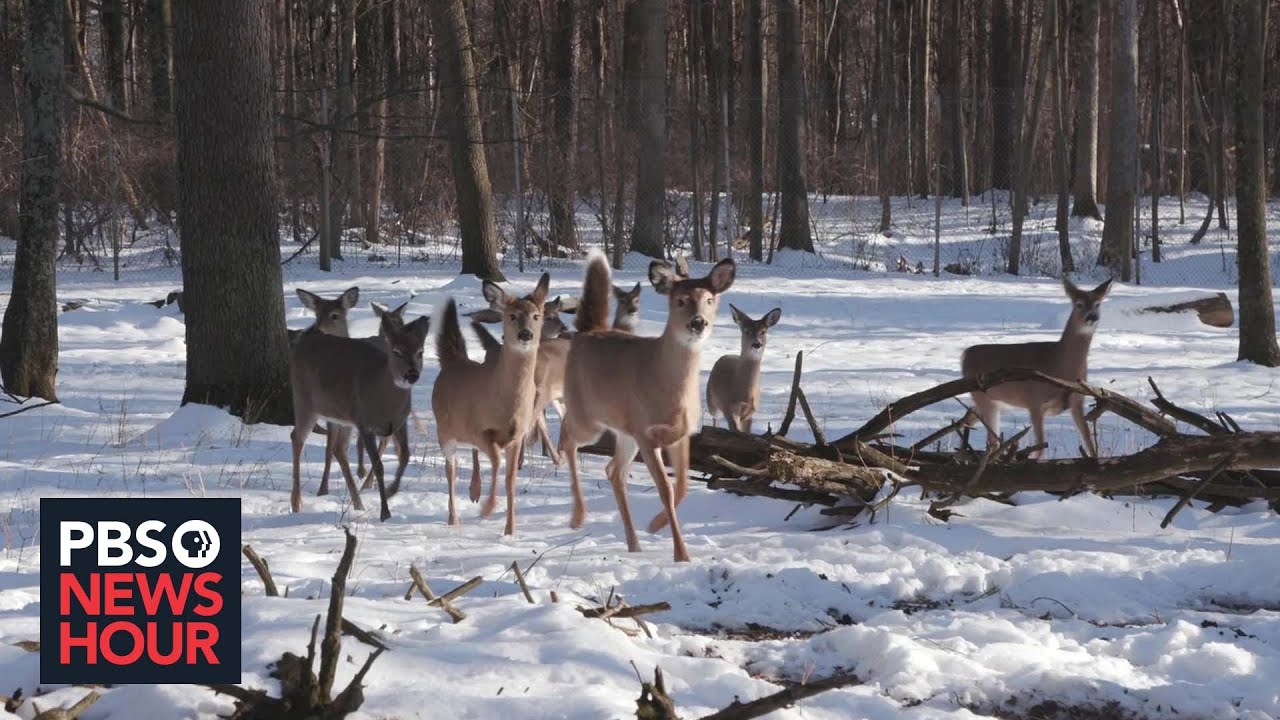
Scientists have recently discovered what they are calling a silent outbreak of coronavirus among white-tailed deer. William Brangham reports about how one of the most ubiquitous species in North America contracted COVID, and what that means for the future of the pandemic.
Stream your PBS favorites with the PBS app: https://to.pbs.org/2Jb8twG
Find more from PBS NewsHour at https://www.pbs.org/newshour
Subscribe to our YouTube channel: https://bit.ly/2HfsCD6
Follow us:
Facebook: http://www.pbs.org/newshour
Twitter: http://www.twitter.com/newshour
Instagram: http://www.instagram.com/newshour
Subscribe:
PBS NewsHour podcasts: https://www.pbs.org/newshour/podcasts
Newsletters: https://www.pbs.org/newshour/subscribe
JUDY WOODRUFF: Scientists have recently
discovered what they are calling a silent outbreak of coronavirus among white-tailed deer. William Brangham is back now with this report
about how one of the most ubiquitous species in North America got COVID and what that
means for the future of the pandemic. And a warning: Viewers may find some of
the images in this report distressing. WILLIAM BRANGHAM: They are an elegant
sight dancing through the trees. There are an estimated 25 million
white-tailed deer in the U.S., and now scientists have learned some have
shockingly high rates of COVID infections. SURESH KUCHIPUDI, Virologist,
Penn State University: The level of infectivity we found in
these animals was truly stunning. VIVEK KAPUR, Infectious Disease Specialist, Penn
State University: Gobsmacked is the word I used. WILLIAM BRANGHAM: That’s
the technical term for it? (LAUGHTER) VIVEK KAPUR: That’s the technical term, is
gobsmacked. It was quite, quite striking. So, these are the Penn State Deer
facilities, the facilities… WILLIAM BRANGHAM: Oh, I see where
it gets its name, all the deer. Stunning, gobsmacked, striking, not
the usual vocabulary for scientists. So, on a cold Pennsylvania day, I went out with
veterinary virologists Suresh Kuchipudi and Vivek Kapur to see some deer up close. This is an
enclosed facility at Penn State University. And the scientists said it’s
fine for us to be near them. And some of the deer, like tiny Peanut, who was
raised in captivity and bottle-fed by humans, wanted to be near us. It was in Kapur and
Kuchipudi’s labs here at Penn State that they made this remarkable discovery
about widespread infections in deer. And it raises concerns about whether
humans can fully control this coronavirus. SURESH KUCHIPUDI: This is the first time a widespread natural infection of a wild
animal species has been demonstrated, which really changes the way we ought to
understand this pandemic and the virus. WILLIAM BRANGHAM: It began with these
deer lymph nodes from Iowa collected when deer were killed by hunters or cars
at various times during the pandemic. Researchers in Iowa weren’t looking for
COVID. They were tracking what’s known as chronic wasting disease. but Kapur and
Kuchipudi took the samples and tested them to see if deer had gotten COVID, and when. VIVEK KAPUR: September, the first positive
there. October, another one shows up. November. WILLIAM BRANGHAM: Wow. VIVEK KAPUR: And, December, all that positive. WILLIAM BRANGHAM: Wow. VIVEK KAPUR: You Zoom out into the state, the
whole state. You can see this event in different parts. With these samples, about 30 percent
of them overall were positive at this stage. SURESH KUCHIPUDI: If you look at the spread
of these red dots on the map, these are all individual clusters, which also points to the fact
that there are multiple spillover events happened. WILLIAM BRANGHAM: Spillover, meaning
the virus that was circulating in humans spills over into the wild animal population. VIVEK KAPUR: So, out of just under 2,000
samples collected, 1,200 were positive. It’s just completely amazing. If this were
happening in humans, you would just give up, yes. (CROSSTALK) VIVEK KAPUR: It’s just incredible to see
that to see how quickly this occurred. WILLIAM BRANGHAM: And, of course,
because there’s no interventions, they’re not — they don’t know to
distance or mask or no vaccines. And… There’s no evidence infected deer
showed any symptoms of COVID-19. The virus seems not to affect them. The Iowa
samples showed they got the same variants we got. And by tracking the timing of the
infections, and using genomic sequencing, the researchers are certain humans gave
the virus to the deer, not the reverse. But how? With the exception of Peanut here, who does
seem very eager to interact with humans, most humans don’t have interactions like this with
the deer. So, how is it possible that that we gave the virus to them? SURESH KUCHIPUDI: It doesn’t necessarily require
a direct interaction between a human and the deer. A kid throwing half-eaten apple or leftover food
or somebody’s feeding deer in their backyard, all it takes is just one or two
deer to pick up the infection. They can transmit the virus among themselves very
effectively. And once one animal gets infected, the virus spreads among them very, very quickly. VIVEK KAPUR: If you look back there,
you can simply see them interacting… WILLIAM BRANGHAM: Right. They’re all… VIVEK KAPUR: … quite a
lot. They’re all huddled up. WILLIAM BRANGHAM: They’re
all very packed together. VIVEK KAPUR: Yes. They’re all huddled up. And then, if you have ever walked in a forest and
seen deer, it’s — and they’re blowing, you just see plumes of their breath come out. And given
what we know about the amount of virus that these deer had, it’s very easy to see why they were so
susceptible and it spread explosively in herds. WILLIAM BRANGHAM: Given what your findings in
Iowa indicate, should we just make the assumption that deer, white-tailed deer all over
North America, are carrying the virus? VIVEK KAPUR: I think it’s safe to
assume that that would be the case. WILLIAM BRANGHAM: These human-to-animal
leaps by the coronavirus aren’t unheard of. While this research is the first
known case in a wild population, there are examples with more domesticated animals.
In the Netherlands, scientists discovered that, when pet owners got COVID, their dogs and cats
had a one-in-five chance of getting it too. In Hong Kong, a pet store hamster got the virus, and officials then killed 2,000
others to stop any further spread. All this leads to a potentially more
troubling issue. If humans can mutate the virus and pass different variants to deer,
could deer do the same in reverse, meaning, could they create new variants
and pass those back to us? It’s not impossible. In 2020, in Denmark,
officials killed the country’s entire population of farmed mink after a mutated
COVID strain jumped from mink back to humans. But Kapur and Kuchipudi say, thus far, there’s
no evidence that’s happening with deer. SURESH KUCHIPUDI: This is still
primarily a pandemic of a virus that is spreading in human beings
across the world. And, so far, all the animal infections have been
opportunistic spillover from human beings. VIVEK KAPUR: My personal feeling is, actually, deer are more likely to get the infection
from humans than give it to humans. And so I think we also have to be respectful
that, when we are going out, we’re likely to be transmitting just as easily to deer, animals
we love, than getting the infection back. WILLIAM BRANGHAM: We’re the problem
here, for the most part, not them. VIVEK KAPUR: We’re the initial
problem. And we want to make sure that they don’t become a
problem for us in the future. WILLIAM BRANGHAM: These scientists say that,
given how widespread deer and this virus are in North America today, much more research
needs to be done about this potential threat. For the “PBS NewsHour,” I’m William
Brangham in State College, Pennsylvania.