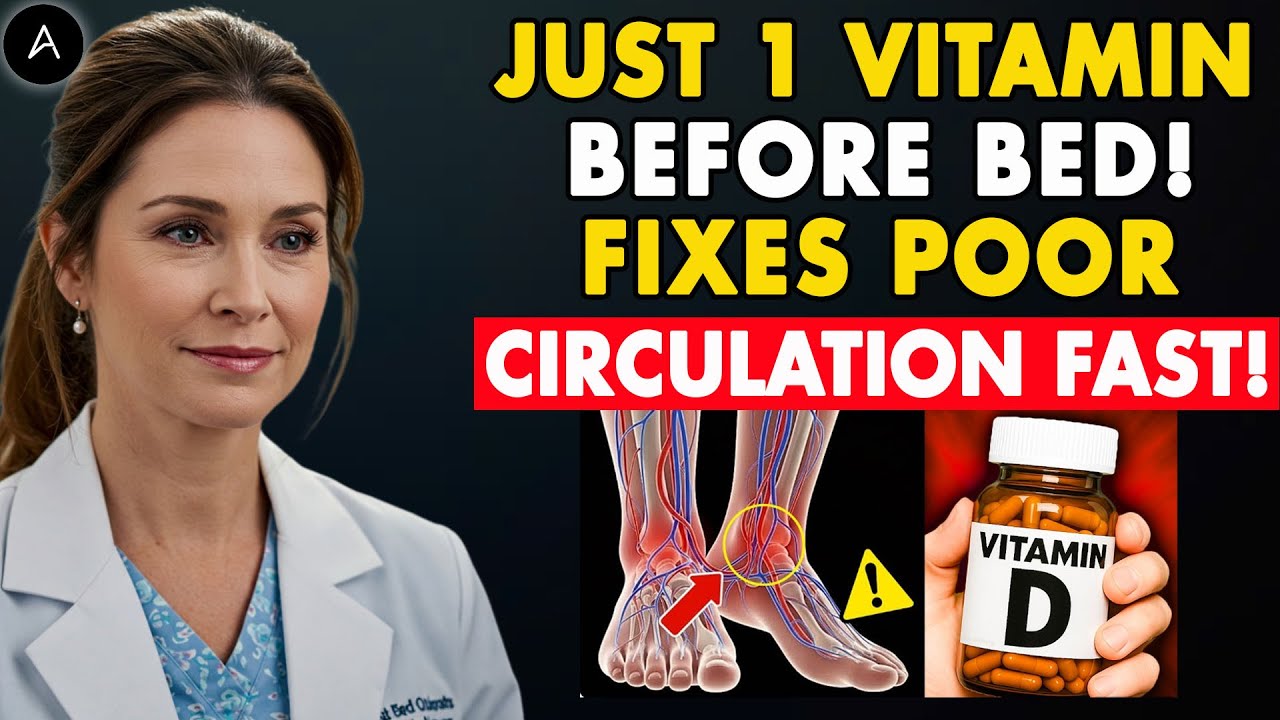
Improving blood flow in the legs is essential for balance, mobility, and confidence after age 60. This video reveals the five key vitamins—B3, D3, E, C, and K2—that support stronger circulation, warmer feet, and healthier arteries. Learn how these nutrients help increase nitric oxide, reduce stiffness, and protect vessel walls from damage. Many age-related leg issues such as coldness, heaviness, and tingling are not inevitable—they are signs of deficiency. Discover how restoring these vitamins can enhance strength, stability, and quality of life. Dedicated to empowering Senior Health, protecting independence, and inspiring better movement for everyone focused on Senior Health and long-term Senior Health success.
#seniorhealthtips
#seniorhealth
#seniorwellness
#elderlyhealth
#seniorhealthsecrets
#seniorhealthcare
#seniorhealthpodcast
► Playlists: Senior Health Tips
• https://www.youtube.com/watch?v=f3FZo_2-bIs&list=PLB9WE_Kb4TT0-JcBADLBPlxppoQ3HGBsl&index=1
► As a BRAIN Doctor, I’m SHOCKED: THIS Morning Habit Triple Your Stroke Risk After 60 | Senior Health
• https://www.youtube.com/watch?v=eWPBg_dHzD8
► As a BRAIN Doctor, I’m SHOCKED: THIS Vegetable Raises Stroke Risk Overnight
• https://www.youtube.com/watch?v=f3FZo_2-bIs
► Seniors, 4 WORST Shower Habits You Should Avoid — and 4 Better Ones to Try Instead
• https://www.youtube.com/watch?v=d0qBXOML678
► Seniors, 4 WORST Vitamins You Should NEVER Take and 4 You MUST Take Daily
• https://www.youtube.com/watch?v=kHhUcnPMkHo
#seniorhealthtips #seniorhealth #drthomasseniorhealthtips #drthomas
► Dr. Thomas is your trusted guide for Senior Health Tips and well-being. We share practical advice, expert insights, and uplifting stories to support aging with confidence, strength, and wisdom. From everyday wellness routines to professional Senior Health guidance, and through our engaging health podcast, we help you live smarter, healthier, and more empowered each day.
▬▬▬▬▬▬▬▬▬▬▬▬▬▬▬▬▬▬▬▬▬▬▬▬▬▬▬
👍 If you found this video helpful, please like ❤️, share your thoughts 💬 in the comments, and subscribe 🔔 to stay updated with more expert tips and wisdom for seniors! ✨
All research and content are carefully created by us.
► Thank you for watching. We put a lot of effort into bringing you this content, and we hope it inspires and benefits you.
© This material is copyrighted (audio and video). Any use without permission may be subject to copyright law.
Did you know that after the age of 60, a single missing vitamin can silently weaken the blood flow in your legs and triple your risk of falling without you feeling a single warning sign? I’m Thomas, and what I’m about to reveal may challenge everything you’ve been told about aging, circulation, and what truly controls the strength and warmth in your lower legs. Most seniors believe slow blood flow is simply a part of getting older. But that’s not the whole story. In reality, your body’s ability to move blood to your feet depends on key vitamins that quietly decline with age, some by more than 50%. When those levels drop, your arteries stiffen, your muscles starve for oxygen, and your nerves begin to misfire. That’s when the coldness starts, the heaviness, the tingling. the unsteady steps. But here’s the shocking part. Restoring just a few of these vitamins can help your blood vessels reopen, soften, and respond again, often faster than you’d expect. And today, I’m going to show you the five essential vitamins that can support warmer feet, stronger legs, and better circulation, starting far sooner than you think. Before we dive in, if you haven’t subscribed yet, I recommend you hit that button and turn on the bell so you never miss another health tip made just for you. If you enjoy this video, type one in the comments. If not, type zero to let me know how I can make better content for you. One, vitamin B3 niacin. Let me begin with a simple truth. Many people don’t hear often enough. After 60, your blood vessels don’t behave the way they used to. That steady warmth in your feet, the easy strength in your calves, the confidence in each step. Many seniors slowly lose these things, not because they did anything wrong, but because time quietly reshapes the body’s inner machinery. And that’s where vitamin B3, known as niacin, becomes far more important than most doctors ever mention. Let me explain what’s happening inside your legs right now. As you age, the tiny muscles lining your blood vessels, the ones responsible for opening and closing the flow of blood, start to stiffen. They don’t respond as quickly. They don’t widen the way they once did when your legs needed more oxygen. This stiffness is one of the hidden reasons behind cold feet, nighttime cramping, and that slow, heavy feeling when you stand up or walk across a room. Here is the part no one talks about. Your body also produces less nitric oxide, the natural chemical that tells your arteries, “Relax, open, let the blood through.” Niacin plays a key role in this. Not by magic, by biology. When you take niacin, something remarkable happens. It helps your vessels release compounds that encourage gentle vasoddilation. Think of it as persuading tense arteries to loosen their grip. Your bloodstream moves more freely. Oxygen reaches the muscles that have been starving quietly. Waste products clear faster. Warmth returns. Sensation improves. For some seniors, the difference is subtle at first. Toes that aren’t quite as cold, legs that don’t feel as heavy. For others, the change is more noticeable. Longer walks, fewer nighttime spasms, a sense that the legs are waking up again. But here is the real reason nascin matters so deeply after 60. It supports blood flow while also improving cholesterol patterns which directly affects circulation in your legs. Plaque buildup in the arteries of the calves called peripheral artery disease is extremely common in older adults. Many don’t realize it until the symptoms become severe. Niacin helps reduce LDL, supports HDL, and assists the body in repairing the delicate lining of the vessels. And yes, it may cause that warm flushing feeling across the face or neck. It surprises people the first time, but that temporary flush is simply a sign that blood vessels are responding, opening, relaxing, allowing more flow than they have in years. Still, like everything in later life, niacin must be used wisely. High doses are not recommended without medical guidance. People with liver issues or those taking cholesterol medication should check with their physician. The goal is not extreme dosing. It’s gentle, steady support. The kind that honors the body rather than overwhelming it. Imagine just for a moment what it would feel like if the blood in your legs moved the way it’s meant to. If warmth returned. If walking felt lighter. If the fear of falling eased because your muscles were finally getting the oxygen they’ve been deprived of. That’s the promise of niacin when used correctly. Not a miracle, but a meaningful shift. And if vitamin B3 can do this, what comes next on this list will surprise you even more. If you’re still watching and finding these insights helpful, please comment number one below to let me know you’re with me. Now, let’s move on to point number two. Two, vitamin D3. Let me tell you something most people don’t realize until much later in life. The way your legs feel, their strength, their warmth, their steadiness is deeply connected to a vitamin many older adults are quietly missing. You may think of vitamin D3 as the bone vitamin, something doctors mention in passing, usually during winter checkups, but after 60, D3 becomes far more than that. It becomes a foundation for the way blood moves through your legs, how your muscles respond, and even how stable you feel when you stand up from a chair. Now, let me paint a picture of what happens inside the aging body. As the years pass, the skin becomes less efficient at converting sunlight into vitamin D3. Even if you live in Arizona or Florida, even if you spend time outdoors, your body simply does not produce the same amount it once did. And this decline has consequences. Subtle but powerful. Low D3 doesn’t just weaken bones, it stiffens blood vessels, especially the arteries that carry blood toward the feet. It increases inflammation in the lining of the vessels and it affects the signals that help your muscles contract smoothly. When vitamin D3 levels fall below a healthy range, circulation in the legs become sluggish. Muscles fatigue more quickly. Steps feel heavier. Some people describe it as if their legs are older than the rest of their body. Others notice that walking up a small hill leaves them breathless even when their heart is healthy. Here’s the part that often surprises seniors. Research shows that low vitamin D is linked to reduced nitric oxide availability, the very molecule your arteries depend on to stay flexible. Without enough D3, your vessels lose that easy natural ability to widen when your legs need more oxygen. This is why some older adults experience cold feet, aching calves, or that dull pressure that comes out of nowhere when they’re simply standing in the kitchen. It’s not just age. It’s not just how things are now. It’s a biological signal, a sign that the body is missing something essential. And when D3 levels are restored, something begins to change. Older adults often report that their legs feel stronger, steadier, more reliable. They find it easier to walk the length of the grocery store. They feel more balanced on the stairs. Even nighttime leg discomfort improves when the muscles finally receive the support they’ve been lacking. But vitamin D3’s most overlooked gift is this. It strengthens the muscles responsible for posture and balance. The very muscles that protect seniors from dangerous falls. In fact, low D3 is one of the most common deficiencies found in older adults who struggle with mobility or repeated tripping. And here in America, particularly in the northern states, Minnesota, Wisconsin, Michigan, New York, D3 deficiency is practically a silent epidemic among seniors. Indoor living, winter seasons, and natural aging form a combination that leaves millions unknowingly depleted. The solution isn’t complicated. A modest daily dose of D3 taken consistently can restore levels over time. It doesn’t act like a stimulant or a quick fix, but it rebuilds the body’s foundation quietly, steadily, reliably. Imagine feeling a little stronger each week. Imagine walking without the same fatigue. Imagine your legs responding with confidence when you need them most. That’s the promise of vitamin D3. when your body has been running low for years. And if that surprises you, wait until you discover the vitamin that supports blood flow by protecting your arteries from the inside out. Three, vitamin E. There’s something quietly unsettling that happens to many older adults, but almost nobody talks about it. You may feel it more often at night. That faint tingling in your toes, the subtle coolness creeping into your feet, or the sense that your legs take longer to wake up when you stand. These sensations seem small at first, easy to ignore, but with time, they become whispers of something deeper happening within your circulation. And this is where vitamin E becomes far more important than most people realize. Let me show you what’s going on beneath the surface. As the body ages, blood becomes slightly more prone to clumping. The vessels themselves lose some elasticity. Tiny capillaries, the small, delicate branches that deliver oxygen to your lower legs, don’t open as widely or as quickly as they should. And because of this, your muscles and nerves receive less nourishment. Waste products linger longer than they ought to. The result, cold feet, slow healing, cramping, a heaviness that makes walking feel like more of a chore than it once did. Vitamin E steps directly into this problem, not with force, but with a quiet biological wisdom. Vitamin E works as a powerful antioxidant, protecting the fragile lining of your arteries from the oxidative stress that builds with age. But that’s not all. It gently helps reduce the stickiness of blood platelets, the small cells that can form tiny clots in narrow vessels. Nothing dramatic, nothing dangerous when used correctly. Just a subtle easing of tension in the bloodstream. A smoother flow, a calmer pathway. Imagine your arteries not as rigid pipes, but as living tubes that respond to every heartbeat. Vitamin E helps them stay flexible, resilient, and less prone to the tiny blockages that cause numbness or color changes in the lower legs. For seniors who have lived with decades of stress, inflammation, or medical conditions like diabetes, this support is even more valuable. Over time, oxidative damage accumulates. Free radicals attack the vessel walls. Vitamin E doesn’t reverse decades in a day, but it protects what’s still strong and strengthens what’s beginning to weaken. And here’s what many older adults notice when they begin restoring healthy vitamin E levels. The legs feel warmer. The skin tone improves. The muscles seem to cooperate more willingly during daily movement. Even walking becomes less taxing because the tissues finally receive the oxygen they’ve been quietly craving. But as with everything, wisdom is essential. High doses beyond what the body needs can interfere with blood thinning medications. That’s why moderation matters because vitamin E is most powerful when it supports the natural rhythm of your circulation, not when it overwhelms it. Still, its role in vascular health is undeniable. It protects. It softens. It nourishes. It helps your blood do what it was always meant to do. Travel freely to the parts of your body that must stay strong if you want to remain independent. Picture your feet warm again. Picture steadier steps. Picture the confidence of knowing your circulation is receiving the kind of gentle, intelligent support that respects your age while strengthening your resilience. That’s the gift of vitamin E when it’s used with intention. And if this vitamin can ease the very flow of blood itself, wait until you see the one that strengthens the structural framework of your arteries from the inside out. If you’re still watching and finding these insights valuable, please comment number one below to let me know you’re here. Now, let’s keep going with point number four. Four, vitamin C. There is a quiet, often overlooked truth about aging. Sometimes the smallest deficiency can create the biggest ripple in how your legs feel each day. You may have blamed the coldness in your feet on the weather or the aching in your calves on just getting older. But what if part of the problem traces back to a vitamin most people associate only with cold seasons and immune support? Vitamin C is more than an immune booster. For seniors, especially those past 60, it becomes an essential guardian of the very pathways that keep your legs alive and strong. Let me take you inside your circulatory system for a moment. Your blood vessels are not rigid tubes. They are living breathing structures made of collagen, the same protein that supports your skin, joints, and connective tissues. As you age, your body becomes less efficient at producing and repairing collagen. The vessel walls become less flexible, more fragile, and slower to respond when your legs demand more oxygen. This is where vitamin C steps in with remarkable purpose. Vitamin C is the nutrient your body relies on to rebuild and reinforce collagen. When collagen weakens, vessels stiffen. When vessels stiffen, blood flow slows. And when blood flow slows, the lower legs suffer first because the distance is farthest and the vessels there are thinner, more vulnerable, and more easily compromised. Imagine a worn out garden hose. No matter how strong the water pressure is, the hose will not deliver what it should unless its structure is solid. That is exactly what happens inside the aging leg. Without enough vitamin C, the hose itself begins to falter. But there’s something even more important, something many seniors never hear from their doctors. Vitamin C directly supports the body’s ability to produce nitric oxide, the molecule responsible for relaxing your arteries and helping blood flow smoothly. When nitric oxide levels fall, which they do naturally after 60, the legs begin to feel colder, tighter, heavier. Vitamin C helps restore this balance by protecting nitric oxide from breaking down too quickly and by supporting the cells that produce it. That’s why seniors with good vitamin C levels often have warmer feet, fewer nighttime cramps, quicker healing of small cuts, and improved stamina during walks. These are not coincidences. They are physiological changes. But perhaps the most touching part of vitamin C’s role is this. It helps older adults maintain the integrity of the very structures that keep them independent. The calves that support them while climbing stairs. The ankles that stabilize them on uneven ground. The feet that carry them through grocery aisles, family gatherings, and morning walks. For many older Americans, especially those who grew up in decades where diets were simple, convenient, and often lacking in fresh produce, vitamin C deficiency is more common than expected. Even mild deficiency can weaken vessel walls enough to affect circulation. And unlike other nutrients, vitamin C does its work quietly. No dramatic rush, no sudden jolt, just steady rebuilding, thread by thread, vessel by vessel. Picture your arteries becoming more flexible again. Picture the legs feeling less tight when you stand. Picture the confidence that comes when your lower limbs are supported from the inside out. That is what vitamin C offers when it becomes a daily habit rather than an afterthought. And if a simple vitamin can reinforce the very structure of your blood vessels, wait until you discover the one that guides calcium away from your arteries and keeps them open where it matters most. Five. vitamin K to MK7. There is a turning point in life, usually sometime after 60, when you begin to notice that the legs you once trusted without a second thought now require a little more attention. Maybe your calves feel tight in the morning. Maybe your feet take longer to warm up. Maybe walking across a parking lot isn’t quite as effortless as it once was. It’s easy to write these changes off as uh I mean just age but there is something deeper happening inside your arteries something many older adults are never told about and that’s where vitamin K2 especially the MK7 form becomes quietly profoundly important let me show you why as the years pass calcium doesn’t always go where it should instead of staying in your bones where it belongs some of it begins to drift into the walls of your arteries. This is not a dramatic process. It builds slowly, silently, layer by layer, until the vessels in your legs lose the flexibility they once had. Arteries that were once soft and responsive become stiff. Stiff arteries don’t widen easily. And when they don’t widen, blood can’t reach your feet as freely. This is one of the hidden reasons seniors experience coldness, numbness, slower healing, and reduced walking endurance. The problem isn’t just blood flow. It’s the loss of elasticity in the very tubes that carry that blood. Vitamin K2 is the nutrient your body uses to direct calcium to the right place. Not the arteries, not the vessel walls, the bones. K2 activates proteins that literally escort calcium out of the bloodstream and back into your skeletal system, restoring strength to your bones while easing the burden on your arteries. In doing so, K2 helps maintain softer, more flexible vessels, the kind that can deliver warm, oxygenrich blood to your legs with far less resistance. For older adults, this becomes a quiet form of protection. With healthier arteries, blood can travel farther. With better circulation, your toes stay warmer. Your calves fatigue less quickly. Your balance improves because your muscles receive the oxygen they need to respond on time. But here’s what makes K2 truly remarkable. Its effects are not instant, but they are transformative over time. While other vitamins offer short-term boosts, K2 works at the structural level, reshaping the internal environment that supports circulation itself. And this matters deeply for seniors in the United States, especially those managing diabetes, high blood pressure, or years of cholesterol buildup. These conditions accelerate arterial stiffening, making K2’s role even more vital. Most Americans do not get enough of this vitamin. It is rarely found in modern diets. It is almost never emphasized in routine healthcare discussions. Yet, it stands at the crossroads of bone health, vascular health, and long-term mobility, three pillars of independence in later life. When K2 is restored, older adults often describe a subtle but meaningful change. legs that feel more alive, less tightness when standing, a greater ease during daily walks, and a quiet assurance that their circulation is finally being supported at its roots. Imagine arteries that bend instead of resist. Imagine blood flowing freely without fighting against hardened walls. Imagine the legs carrying you with confidence because their internal pathways have been renewed from the inside out. That is the quiet promise of vitamin K2. And when you combine all five of these vitamins, each supporting circulation from a different angle, the results may surprise you more than you expect. Bringing it all together, restoring the lifeline in your legs. When you step back and look at all five vitamins together, B3, D3, E, C, and K2, a clear truth emerges. Your legs are not failing you. They are asking for the raw materials they’ve been missing. Circulation does not decline overnight. It weakens quietly year by year as vessels stiffen, as nitric oxide production falls, as calcium settles where it shouldn’t, and as tiny deficiencies build into larger imbalances. What feels like aging is often a chain reaction, one that can be softened, slowed, and in many cases meaningfully improved when the body receives the nutrients it requires to function the way it was designed to. Each vitamin plays a different role, but they work toward the same goal. Vitamin B3 encourages your vessels to open and welcome blood through. Vitamin D3 strengthens your muscles and reduces the stiffness in your arteries. Vitamin E keeps your blood flowing smoothly and protects delicate vessel walls. Vitamin C rebuilds the very fabric of your arteries, making them more resilient. Vitamin K too guides calcium away from your vessels and back into your bones. Together, they support a system that carries your strength, your balance, and your independence. Imagine the difference this can make in your daily life. Warmer feet in the morning, more energy in your steps, greater confidence walking through a grocery store, fewer moments of hesitation when rising from a chair, and a sense that your legs are becoming partners again, not obstacles. This is what happens when circulation is nourished, protected, and supported from every direction. And now that you understand the power behind these essential nutrients, there’s one more lesson waiting, something even deeper about how to rebuild leg health from the ground up. These lessons are meant to inspire you to live fully and authentically. Now, I’d love to hear from you. Take a moment to reflect and share one thing you’ve learned and plan to apply in your own life. Let’s support each other on this journey toward embracing these truths. If you enjoyed this video, please leave a comment with one. If not, feel free to comment with zero. Your feedback means a lot to us. Don’t forget to like, share, and subscribe to our YouTube channel for more content like this. Thank you for watching, and here’s to living life on your own terms.