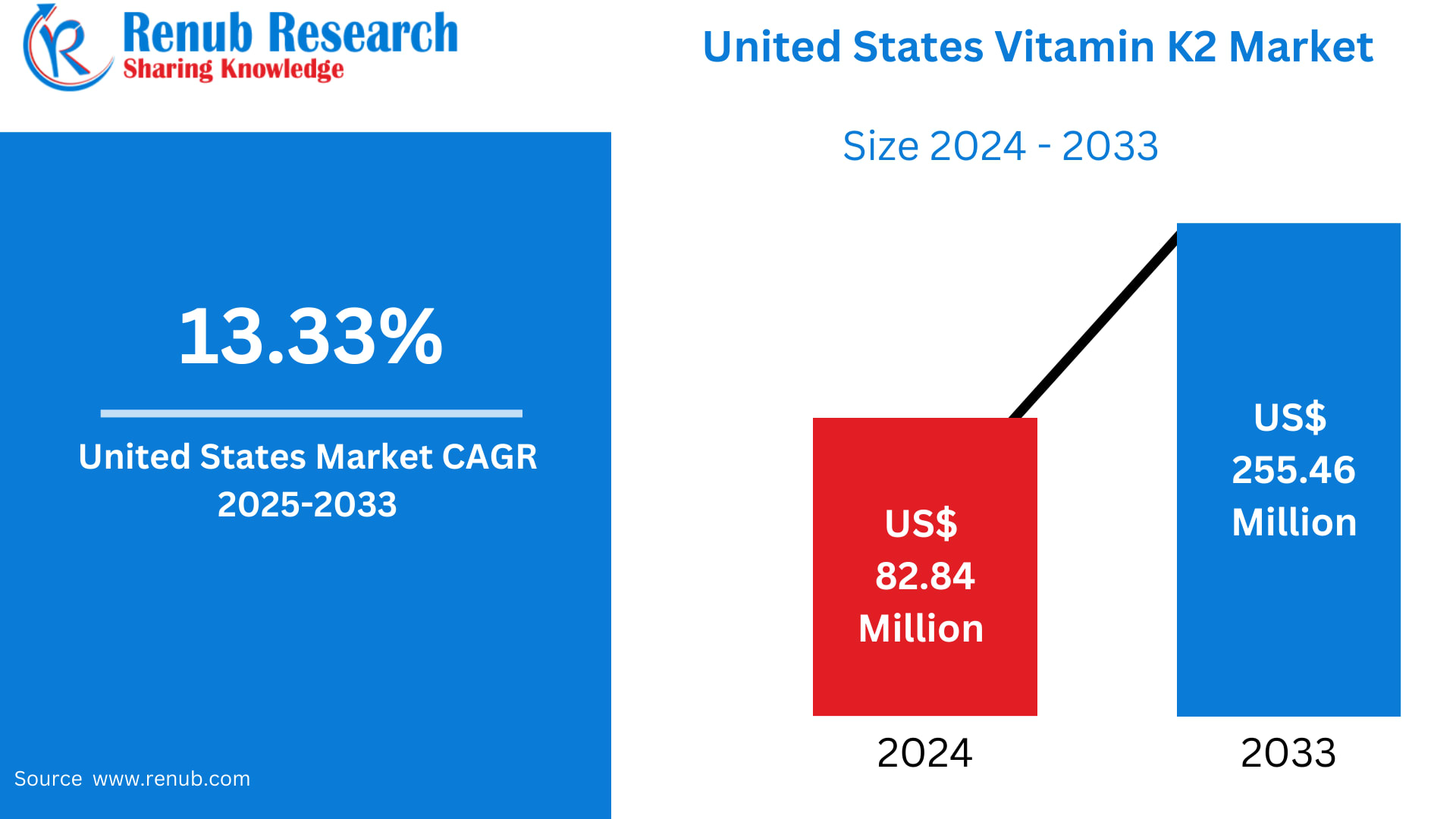
The United States Vitamin K2 Market is positioned for a dramatic expansion over the next decade. According to Renub Research, the market will surge from US$ 82.84 million in 2024 to US$ 255.46 million by 2033, growing at a strong CAGR of 13.33% (2025–2033). This powerful trajectory reflects a combination of rising consumer health awareness, the shifting landscape of preventive healthcare, the aging U.S. population, and the massive growth of the nation’s dietary supplement and functional food industries.
While Vitamin K1 has long been recognized for its role in blood coagulation, Vitamin K2 (menaquinone) has recently taken center stage due to its superior benefits for calcium metabolism, bone mineralization, and cardiovascular protection. With Americans increasingly focused on long-term wellness, heart health, mobility, and quality of life, Vitamin K2 has quickly evolved from a niche nutrient to a mainstream health essential.
Understanding the U.S. Vitamin K2 Market: What Makes It so Important?
Vitamin K2 is a fat-soluble vitamin naturally found in fermented foods (like natto), cheese, eggs, and some meats. It belongs to a family of menaquinones—most notably MK-4 and MK-7—which play a critical role in regulating where calcium goes in the body.
The Science Behind the Surge
Vitamin K2 activates specific proteins that ensure:
Calcium reaches bones and teeth
Calcium does not accumulate in soft tissues and arteries
Arterial calcification risk is reduced
Bone density and strength are enhanced
This dual action makes Vitamin K2 essential in:
Preventing osteoporosis, especially in older adults
Reducing cardiovascular disease risk
Supporting long-term mobility and wellness
New studies continue to underline K2’s potential in preventing chronic illnesses such as atherosclerosis, osteoporosis, and even some forms of metabolic disorders. As a result, U.S. consumers, physicians, and nutritionists are increasingly incorporating Vitamin K2 into daily health regimens.
Growth Drivers Fueling the U.S. Vitamin K2 Market
1. Rising Awareness of Bone & Cardiovascular Health
Heart disease remains the leading cause of death in the United States. With February recognized nationally as Heart Month, public education campaigns have increased awareness about cardiovascular risks.
Vitamin K2’s unique ability to direct calcium into the bones and away from arteries has become a major selling point. As osteoporosis and CVD cases rise, more Americans are purchasing supplements that offer proven long-term benefits.
Healthcare professionals—particularly cardiologists and endocrinologists—are now recommending Vitamin K2 alongside Vitamin D3 and calcium supplements, creating a major boost for market demand.
2. A Rapidly Aging U.S. Population
The U.S. Census Bureau predicts that one in every five Americans will be 65+ by 2030. Claritas Pop-Facts 2024 reports:
U.S. population in 2025: 337.6 million
Expected to surpass 345.7 million by 2030, up 2.4%
Older adults face higher risks of:
Bone fractures
Osteoporosis
Cardiovascular calcification
Thus, preventive healthcare is becoming a lifestyle, not a trend. Seniors are increasingly gravitating toward evidence-backed supplements like Vitamin K2, especially MK-7, due to its higher bioavailability and longer half-life.
Manufacturers are responding with consumer-friendly formats:
Gummies
Effervescent drinks
Liquid drops
Softgels
Fortified food products
This aligns with the broader shift toward proactive, longevity-focused healthcare.
3. Explosion of Functional Foods & Nutraceuticals
The U.S. nutraceuticals industry is growing at record pace, with consumers preferring foods that offer added health benefits. Vitamin K2 is now being integrated into:
Dairy products
Yogurts
Nutrition bars
Breakfast cereals
Beverages
Plant-based foods
A major breakthrough came in July 2024, when Kappa Bioscience launched K2VITAL MCT Organic, the first USDA-certified organic all-trans MK-7 for U.S. markets. This development has opened the doors for a new generation of organic Vitamin K2 supplements and fortified foods.
The clean-label movement—emphasizing natural, minimally processed ingredients—has propelled demand for natural K2 sourced from fermented soybeans (natto) and bacterial fermentation.
Key Market Challenges
Despite strong growth, the U.S. Vitamin K2 market faces several bottlenecks:
1. High Production Costs & Raw Material Shortages
Producing Vitamin K2—especially MK-7—involves:
Complex fermentation processes
Expensive purification methods
Limited availability of specialized bacterial strains
These factors result in higher retail prices compared to popular vitamins like C, D, or B-complex, making K2 less accessible for price-sensitive consumers.
2. Low Consumer Awareness
Even though scientific studies strongly support Vitamin K2’s benefits, public awareness lags behind.
Most consumers still confuse:
Vitamin K1 (for blood clotting)
Vitamin K2 (for heart & bone health)
This knowledge gap slows supplement adoption.
3. Regulatory Restrictions on Health Claims
In the U.S., supplement manufacturers must comply with strict FDA and FTC guidelines.
Claims related to:
Cardiovascular health
Arterial calcification
Disease prevention
…require careful wording, making marketing and product labeling more complicated.
These regulatory boundaries create challenges for brands looking to educate consumers aggressively.
Market Overview by Key Segments
United States Vitamin MK2 Market
Though less researched than MK-7, MK-4 remains popular for bone health benefits. It is increasingly included in:
Specialized bone health formulas
Combination supplements
Clinical nutrition products
Demand is rising in niche consumer groups looking for faster absorption and short-term action.
Vitamin K2 Powder & Crystalline Market
These formats are preferred by:
Nutraceutical manufacturers
Functional food brands
Supplement formulators
Benefits include:
High stability
Easy blending
Long shelf life
Powder form is particularly favored for beverage blends, tablets, and high-dose capsules.
Natural Vitamin K2 Market
Driven by clean-label preferences, natural K2 from fermented sources is gaining traction among:
Vegans
Organic consumers
The premium supplement segment
Manufacturers are investing heavily in natural fermentation processes to meet the rising demand.
Vitamin K2 Health Supplements Market
Supplements constitute the largest share of the U.S. Vitamin K2 market. Popular forms include:
Capsules
Tablets
Softgels
Gummies
The supplement category benefits from:
Physician endorsements
E-commerce expansion
Consumer familiarity and convenience
Offline Distribution Market
Despite the growth of online retail, the offline channel remains dominant, with major sales through:
Drugstore chains
Supermarkets
Specialty health stores
Nutrition retailers
Consumers often rely on in-person advice, brand trust, and professional recommendations when purchasing supplements.
Regional Market Highlights
Washington
Health-conscious consumers and a strong nutraceutical industry ecosystem make Washington a rapidly expanding Vitamin K2 market. Urban and suburban populations are actively investing in preventive health supplements.
California
California represents one of the strongest state markets due to:
A large wellness-driven population
Major nutraceutical headquarters
Strong adoption of functional foods and clean-label supplements
Its cultural emphasis on holistic health fuels innovation and product launches.
New York
New York’s booming Vitamin K2 market is driven by:
High consumer awareness
Strong healthcare sector influence
High retail availability in pharmacies and health stores
Vitamin K2 has become a mainstream nutrient for bone and heart health among New Yorkers prioritizing preventive wellness.
Market Segmentations Overview
Product:
MK-7
MK-4
Dosage Form:
Powder & Crystalline
Capsules & Tablets
Oils & Liquid
Source:
Natural
Synthetic
Application:
Health Supplements
Functional Foods & Beverages
Distribution Channel:
Offline
Online
Top States Covered:
California, Texas, New York, Florida, Illinois, Pennsylvania, Ohio, Georgia, New Jersey, Washington, North Carolina, Massachusetts, Virginia, Michigan, Maryland, Colorado, Tennessee, Indiana, Arizona, Minnesota, Wisconsin, Missouri, Connecticut, South Carolina, Oregon, Louisiana, Alabama, Kentucky, and the Rest of the U.S.
Major Companies Operating in the U.S. Vitamin K2 Market
Each company can be analyzed across five viewpoints: Overview, Key Person, Recent Developments, SWOT Analysis, and Revenue Analysis.
Key Players
NOW Foods
Life Extension
Nestlé
Bronson
NatureWise
Solaray
Natural Factors
Source Naturals
These companies are expanding portfolios with high-bioavailability MK-7 formulations, organic ingredients, and innovative delivery formats.
Final Thoughts: The Future of Vitamin K2 in the United States
The U.S. Vitamin K2 market is moving from niche supplement to mainstream wellness essential, driven by growing awareness of its critical role in:
Bone health
Cardiovascular protection
Longevity
Preventive wellness
With Renub Research projecting the market to reach US$ 255.46 million by 2033, the decade ahead promises rapid innovation, new functional food launches, expanding retail distribution, and greater adoption among seniors and health-focused consumers.
As more Americans prioritize healthy aging, heart health, and nutrient-based preventive care, Vitamin K2 is set to become one of the most important nutraceuticals shaping the future of U.S. healthcare.