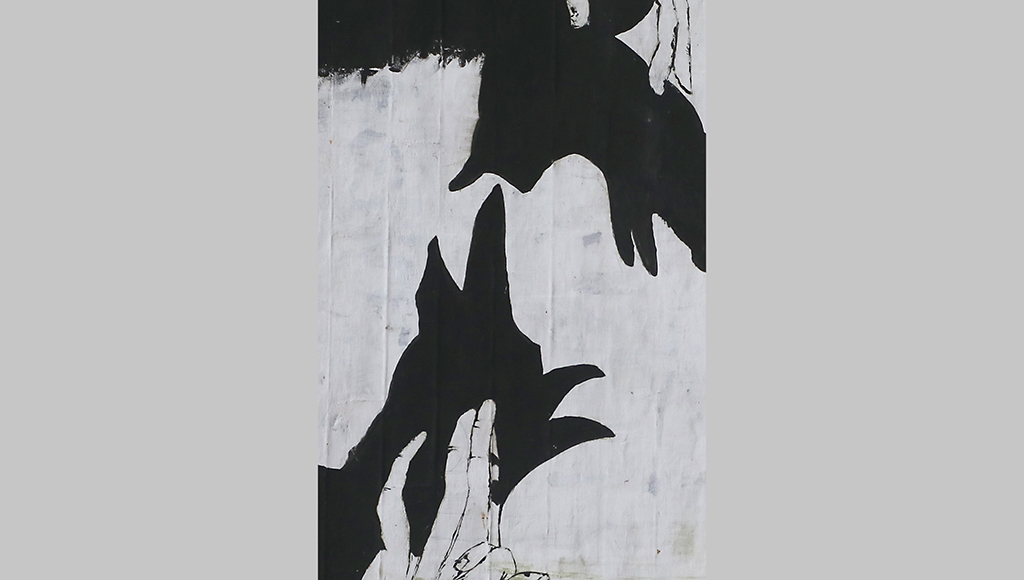
A graffito on a wall in Dhaka. | Sony Ramani
CIVIL-MILITARY relations theory was never meant to live a quiet life in lecture halls. It was meant for moments like this — when uniforms are folded away, medals polished and the state’s unresolved contradictions begin to walk openly into politics.
In Bangladesh today, a visible cohort of retired military officers — some decorated, some institutionally prominent — are entering electoral politics under Jamaat-led or hard-right banners. This is not a coincidence. Nor is it merely ambition cloaked in democratic language. It is a pattern. And patterns, especially among men trained to think institutionally, rarely emerge without design.
Let us dispense with the easy fiction first: this is not about rights. Retired officers have every legal entitlement to contest elections. The more uncomfortable question is why a particular ideological shelter repeatedly attracts a particular professional class — one that has long benefited from closed hierarchies, internal patronage and inherited access to power. Why does the road from the barracks, for some, lead so reliably towards the religious right?
As someone shaped by military service, I know that retirement does not simply end a career. It dismantles an entire architecture of identity. Rank disappears. Deference evaporates. The institution that once absorbed individual error, softened professional failure and quietly redistributed responsibility through its own internal networks steps back. What remains is exposure.
For decades, many officers rose not only through merit, but through proximity — batch loyalty, regimental favouritism, family lineage and the unspoken economy of patronage that all armies pretend not to have. Nepotism in uniform is rarely loud; it is procedural. It hides in postings, in course nominations, in premature absolutions after professional misjudgement. While serving, the institution protects its own. After retirement, that protection vanishes.
Samuel Huntington and Morris Janowitz warned us — long before our politics became this transactional — that when military professionalism is allowed to merge with personal networks of privilege, it does not dissolve upon retirement. It seeks continuity. It searches for new patrons.
For some retired officers, Jamaat-led or hard-right formations provide precisely that continuity. These spaces do not ask inconvenient questions about operational lapses, command failures or compromised loyalties. They do not reopen files or interrogate legacies. Instead, they offer moral overcompensation — piety as purification, ideology as erasure. Faith becomes not a belief system, but a solvent.
This is often framed as a quest for moral clarity in a corrupt political landscape. But that explanation is too generous. What we are witnessing is not mass ideological conversion, but strategic migration — away from pluralist politics that demand accountability, and towards ideological ecosystems that reward loyalty over scrutiny.
This is not an indictment. It is an autopsy.
In any serious analysis of power, we must distinguish between what people say and the functional role their actions perform. The visible drift of a section of Bangladesh’s retired officer class towards the religious right functions less as a moral awakening and more as an insurance policy — a shield against reputational reckoning, institutional audit and historical memory.
When former custodians of the state begin seeking refuge in movements that reject constitutional pluralism, the problem is not faith. It is fear. Fear of daylight. Fear of civilian scrutiny. Fear that without the uniform, the old protections no longer apply.
History is unkind to such arrangements. It always has been. When soldiers begin looking for absolution outside the constitution, it is rarely religion that has failed them. It is the institution that raised them — and the state that never demanded a full accounting.
The logic of convenience
ONE does not enter a disciplined, cadre-based organisation like Jamaat out of a sudden affection for theology. For a retired officer — particularly one who has navigated the grey zones of politicised service — the religious right offers something far more practical than belief. It offers insurance.
Civilian politics in Bangladesh is volatile, personalised and often vengeful. Files reopen. Narratives shift. Yesterday’s patriot becomes today’s liability. In this landscape, right-wing religious organisations function as closed systems — internally coherent, tightly disciplined and unusually protective of their own. They provide organisational depth, loyal cadres and a form of collective shielding that centrist or transactional parties simply cannot guarantee. Here, ‘convenience’ is not comfort. It is sanctuary.
The afterlife of authority
MILITARY service grants a rare commodity: embedded authority. Rank is visible. Obedience is institutionalised. Purpose is affirmed externally. Even dissent has a syntax.
Retirement dismantles this world overnight.
One day, you are addressed by rank. The next, by name — if at all. The uniform that once acted as both shield and signal is folded away. The phone grows quiet. The institution that once absorbed individual error and redistributed responsibility now offers polite distance. For officers who entered young and left late, this rupture is not merely professional. It is existential.
This is the first vulnerability.
Familiar orders in unfamiliar clothes
RIGHT-WING religious politics — particularly Jamaat’s organisational culture — offers something unsettlingly familiar to men recently unmoored from command: clear hierarchies, moral absolutism, disciplined in-group identity, a narrative of siege and betrayal and the promise of restored dignity.
This resemblance is not accidental. Jamaat’s internal discipline mirrors military order. Its rhetoric substitutes operational clarity with moral certainty. Its worldview divides society into loyalists and threats. For someone dislocated from structured authority, this can feel less like a choice and more like a return.
Wounded institutions, wounded men
TO UNDERSTAND this migration, we must confront an uncomfortable truth: Bangladesh has not reformed its institutions so much as humiliated them — through politicisation, suspicion and selective memory. The armed forces have been praised when useful, distrusted when autonomous and silenced when inconvenient.
Retired officers often carry a double wound: the erosion of institutional dignity during service and the erasure of relevance after it. Resentment accumulates quietly. It does not dissolve at retirement.
Religious right-wing forces are adept at weaponising this grievance. They speak the language of betrayed guardianship. They flatter the idea that the nation has strayed from ‘order,’ ‘values,’ and ‘discipline’ — concepts that resonate deeply with those formed inside uniformed life. This is not radicalisation. It is seduction through recognition.
From constitutional loyalty to moral certainty
THE Bangladeshi military oath is to the constitution, not to ideology. That distinction matters — while one is in uniform.
After retirement, constitutional loyalty offers no community, no platform, no applause. Moral certainty does.
Right-wing politics simplifies complexity. It replaces policy debate with virtue. It turns disagreement into deviance. For men trained to resolve ambiguity through command, this clarity can be intoxicating. It answers the questions retirement leaves unresolved: Was my service meaningful? Did the nation deserve my restraint? Why does indiscipline flourish while discipline is ignored?
The answer offered is simple and seductive: the nation has been corrupted. Restoration, not reform, is required.
Huntington’s unfinished business
SAMUEL Huntington warned that healthy civil-military relations depend on objective control: a politically neutral professional military, subordinated to civilian authority, rewarded with autonomy in its domain.
Bangladesh practised something else — subjective control — where loyalty, proximity and political reading often mattered more than professional detachment. Officers learned, implicitly, that advancement could hinge on alignment rather than excellence. Politics seeped into the institution long before retirement.
So when officers later surface on Jamaat or hard-right tickets, this is misread as ideological conversion. It is more accurately continuity — politicisation by other means.
Janowitz and the failed transition
MORRIS Janowitz imagined the modern officer as a constabulary professional — socialised into restraint, pluralism, and permanent negotiation with civilian society. That model requires social integration, tolerance of ambiguity and acceptance of political diversity.
Bangladesh’s political culture rewarded none of these consistently. It oscillated between adulation and suspicion, offering neither stable respect nor clear boundaries. Many officers retired without ever completing the transition from guardian of order to participant in society.
When that transition fails, the vacuum is filled by movements that promise clarity, hierarchy, enemies and purpose. Religious right-wing politics provides this efficiently.
What appears as belief is often structure. What looks like conviction is frequently continuity. And what is framed as faith is, in many cases, fear — of exposure, of irrelevance, of life without institutional shelter.
Strategic essentialism: the intellectual mask
THE most common justification offered by retired officers aligning with hard-right forces is what might be called strategic essentialism. This is the language of temporary convergence, of tactical compromise in service of a supposedly higher national purpose. Officers claim they are merely ‘using’ these forces — to restore order, to counter a perceived greater enemy, to stabilise a drifting polity.
This is intellectual theatre.
In practice, strategic essentialism functions as a moral sedative. By framing the alliance as provisional and instrumental, the officer avoids confronting its ethical contradiction: that he is lending professional legitimacy to movements that openly reject the constitutional framework he once swore to defend. The claim of temporariness suspends moral reckoning. It does not resolve it.
The transactional guard
WHAT appears as ideological alignment is more accurately understood as a transaction. The retired officer brings symbolic capital: the prestige of uniformed service, the aura of discipline, the technical authority of command. In return, the movement provides protection — from scrutiny, from isolation, from the disorder of democratic accountability.
This is not conversion; it is exchange.
The officer believes he is borrowing power without consequence. History suggests otherwise. Power drawn from absolutist movements is never neutral. It reshapes the borrower long before it is returned — if it is returned at all.
Laundering the past: the shield of the cadre
PERHAPS the most consequential function of this drift lies in the management of past actions. Service in a politicised military inevitably involves compromises — decisions taken under pressure that may not withstand scrutiny in a genuinely independent civilian order.
By entering the fold of the religious right, these actions are re-narrated. Professional misjudgements, ethical lapses or politicised conduct are reframed as persecution by ‘secular,’ ‘liberal’ or ‘anti-faith’ forces. Accountability is displaced by grievance. Law is replaced by loyalty.
The right-wing alliance thus operates as an immunity machine. It offers a new moral identity to cleanse old stains, group solidarity to convert individual cases into collective victimhood, and narrative control to replace a service record with a story of betrayed guardianship.
Washing hands after the fact
A RELATED pattern deserves scrutiny: officers accused of politicising the military while in uniform later presenting themselves as neutral statesmen after retirement.
Attempts by figures such as Lt General Suhawardy to re-enter politics through alliance tickets — often framed as manoeuvres in the ‘national interest’ — raise questions not of legality, but of accountability. You cannot actively shape political alignments while in uniform and later claim moral distance from politics once retired. That is not neutrality. It is institutional laundering.
Huntington warned that once political calculation is internalised within the military profession, professionalism erodes from within. Retirement does not automatically reverse that erosion.
Ego, recognition and politics of resentment
SOME trajectories are less strategic and more personal — and therefore more revealing.
Decorated freedom fighters and gallantry award recipients, Colonel Oli being the most prominent example, have often defined their politics not through coherent programmes but through enduring antagonism towards the political centre, particularly the BNP. This opposition reads less like ideological divergence and more like unresolved conflict over recognition.
Democracy is indifferent to medals. Ballots do not salute past heroism. For some veterans, this egalitarian cruelty is intolerable.
Right-wing movements are adept at converting personal grievance into moral crusade. Opposition becomes virtue. Marginalisation becomes righteousness. What cannot be secured electorally is reclaimed symbolically.
Why not the centre?
A HARDER question follows naturally: why do these officers not gravitate towards centrist formations?
The answer lies in temperament rather than policy. Centrist politics is untidy. It demands negotiation, tolerance of dissent, acceptance of moral imperfection and comfort with ambiguity. It offers no fixed hierarchy, no permanent enemy, no final truth.
For officers trained in decisive frameworks, this feels like drift.
Moreover, the BNP’s historical relationship with the military — alternating between reliance and distance — offers no emotional reassurance. Jamaat does not interrogate the officer’s past. It sanctifies it. The centre negotiates. The right anoints.
Youth, money, and the NCP interlude
THE emergence of the NCP adds a further transactional layer. For segments of its leadership, alliances with Jamaat appear less ideological than logistical — aimed at securing funding, organisational depth and symbolic discipline.
Mid-ranking retired officers become useful intermediaries. They bring structure and operational credibility. Jamaat provides machinery and money. The NCP supplies youthful optics. This is not coalition-building. It is mutual instrumentalisation.
Janowitz would recognise this as a failure of democratic socialisation — where neither civilian actors nor retired officers fully internalise pluralist norms.
Masculinity, order and control
THERE is also an unspoken gendered dimension. Military institutions cultivate a specific masculinity — hierarchical, protective and command-oriented. Retirement destabilises this identity. Pluralist politics offers little refuge for it.
Right-wing religious movements repackage masculinity as moral guardianship. Women’s autonomy, minority rights, and dissenting youth are reframed as chaos rather than democratic expression. For some retired officers, this restores a sense of command over a society that no longer salutes.
RAOWA and the weight of symbols
THIS drift becomes institutionally sensitive when it intersects with veterans’ bodies. RAOWA is not an ordinary association; it is a symbolic extension of the officer corps into civilian life.
When its incumbent chairman contests parliamentary elections on a Jamaat ticket, the act cannot be read as purely personal. It sends clear signals — that alignment with Islamist right-wing forces is compatible with military identity, that constitutional pluralism is negotiable after retirement and that the boundary between professional service and ideological politics was always thin.
This is not unprecedented. Figures such as General Ibrahim participated in deeply controversial electoral exercises in the past, each time defended as personal choice, each time imposing collective institutional cost.
The fear beneath it all
AT ITS core, this phenomenon is driven not by ideology but by fear — fear of irrelevance, of exposure, of narrative collapse.
Religious right-wing politics offers a story in which these losses are not personal failures but symptoms of national decay and moral betrayal. It is a comforting story. It is also a dangerous one.
History — from Egypt to Pakistan to Iran — shows that alliances justified as temporary rarely remain so. Absolutist movements do not stay junior partners. They absorb, moralise and dominate.
The officer who believes he is using Jamaat is not managing risk. He is normalising it.
Uniforms, even when retired, cast long shadows.
Conclusion: the harder loyalty
NATIONS do not usually collapse with a bang. They erode — quietly, politely, wrapped in language that sounds reasonable. The most dangerous moments are not when uniforms seize power, but when they seek comfort; not when authority announces itself, but when it looks for shelter.
The temptation facing retired officers today is not political participation. It is moral escape. The pull of absolutist politics offers something democracy never promises: certainty without accountability, belonging without doubt, virtue without introspection. It replaces the discomfort of equality with the familiarity of hierarchy. It restores the feeling of command in a world that now insists on negotiation.
But the republic cannot be defended by those who refuse to live inside its uncertainty.
A democracy does not ask its former guardians to be heroic again. It asks something harder: to relinquish moral privilege, to endure anonymity, to accept that past service does not purchase future exemption. This is not humiliation. It is citizenship.
The constitution was never meant to be a temporary companion, discarded when it becomes inconvenient. It was meant to outlast uniforms, governments and even gratitude. To remain loyal to it after retirement — without applause, without protection, without ideological shelter — is the final test of professionalism.
History is crowded with men who believed they were rescuing their nations by simplifying them. It remembers them not as saviours, but as accelerants.
Bangladesh does not need restoration myths or borrowed certainties. It needs institutional humility — the courage to remain unfinished, to argue without annihilating, to disagree without declaring enemies. It needs retired officers who understand that restraint is not weakness and doubt is not decay.
The uniform does not expire. But neither does responsibility.
If memory is to remain a compass rather than a weapon, those who once carried the state on their shoulders must now learn to walk beside it — unadorned, unshielded, equal among equals.
That, in the end, is the hardest service of all.
Abdul Monaiem Kudrot Ullah, a retired captain of the Bangladesh navy, is an informed voice on institutional reform, geo-strategy, strategic governance and supply chain management.