Hans Dorsinville is a prominent former CCO, Creative Consultant & Brand Architect in the fashion and beauty industry, most recently serving as Senior Vice President, Global Creative for Balmain Beauty. With more than 32 years of experience, he’s built a reputation for bold conceptual thinking, visual storytelling, and brand strategy. He began his career in 1993 as a junior designer in Donna Karan’s in-house creative team, eventually rising to the role of EVP and leading multi-channel campaigns for its fashion and licensing lines. Later, founding Laird + Partners and serving as executive vice president and senior group creative director for more than a decade. In 2017, Dorsinville became Chief Creative Officer at Select World, before contributing his talents to Gotham, partnering with brands across beauty and fashion. Beyond his professional roles, Hans is deeply committed to diversity and inclusion. In 2018, he founded the Creative Coalition for Diversity to help expand opportunities for creatives of color in the industry. His work often weaves together artistry and advocacy, reflecting his belief that visibility and equity must go hand in hand.
hube: Could you share your professional journey in a more personal way? Were there moments of profound transformation, encounters, or turning points that not only drew you into the beauty world but also shaped how you see it today?
Hans Dorsinville: My earliest memories of beauty come from the 1980s, growing up in Montreal. I was captivated by a series of Revlon ads photographed by Richard Avedon – The Most Unforgettable Women in the World Wear Revlon. I’d tear them from magazines and pin them to my (analogue) cork wall. One image especially stood out: three Black models – Beverly Johnson, Louise Vent and Iman. As a young boy of colour, it was powerful to see Black beauty celebrated in a way that wasn’t common at the time.
In my home, Black beauty was deeply honoured. I was surrounded by African and Haitian art, sculptures, drawings depicting Black women. My father, Haitian, came from a lineage steeped in African culture – his father was the Chairman of the UN missions to several African nations and an avid photographer who documented the beauty he saw everywhere he went. I’d watch his Super 8 films and flip through his photographs during visits to my grandparents’ home, absorbing everything Black and beautiful.
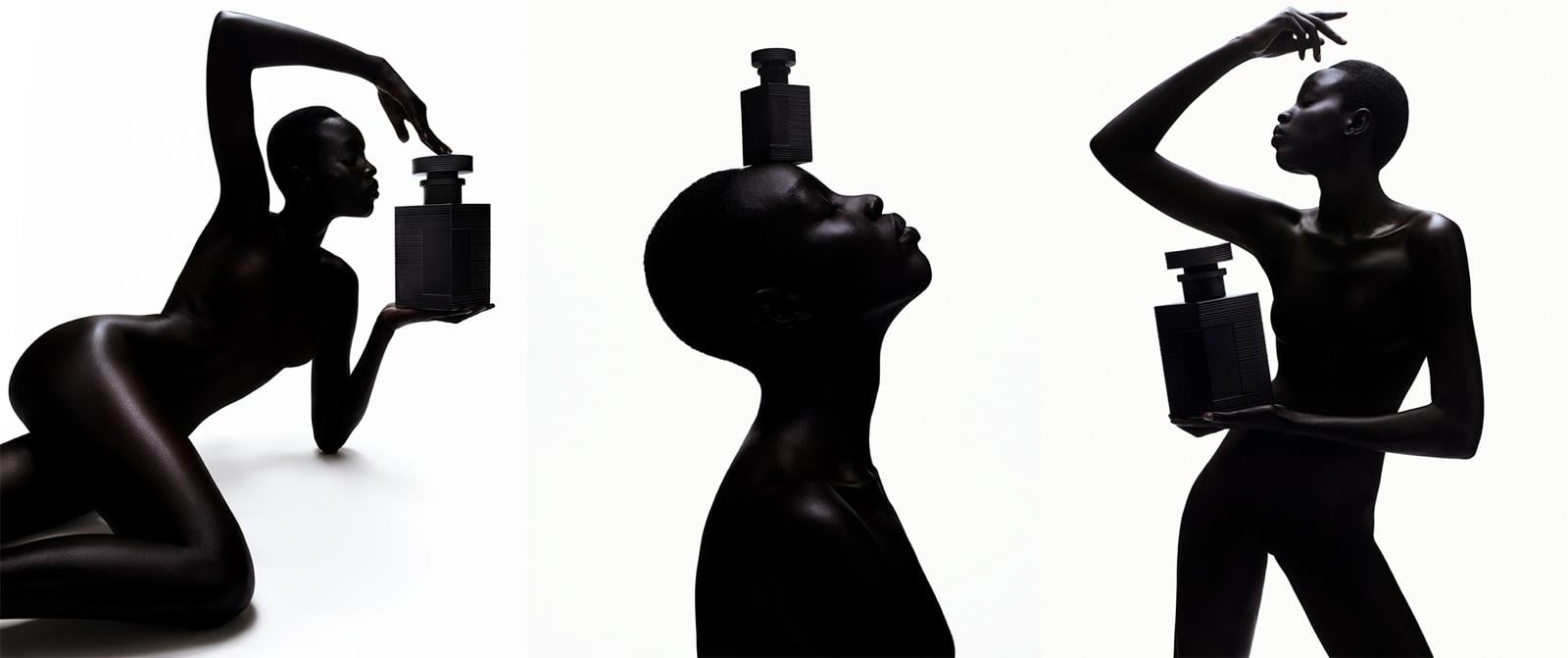
My mother, a French-Canadian Caucasian woman, was an avid user of fragrance. Some of her favourites were Nina Ricci’s L’Air du Temps and Pierre Balmain’s Vent Vert (this became a full-circle moment when I got the job at Balmain). I had been seduced by Lalique’s beautiful and whimsical two doves on the cap of the Ricci perfume. In a way, this was the beginning of my love of fragrance bottles. In my career I got to design several bottles. From her, I learned the emotional power of scent and how it imprints itself in memory.
These early experiences laid the foundation for my connection to beauty – visual, cultural and sensory – even before I recognised it as a path. Years later, while studying at Parsons Paris, I created a fragrance concept for a project. I called it Ivresse. That was my first conscious step into beauty.
After graduating in 1993, I joined Donna Karan’s in-house creative team, where I was immersed in fashion, fragrance and beauty imagery. Peter Arnell’s work – timeless black-and-white visuals filled with sensual storytelling – left a deep impression. One photo in particular, inspired by Jacques-Louis David’s 1793 painting The Death of Marat, showed an anonymous woman draped over a tub. It was both memorable and beautiful. This was the beginning of a long series of beauty and fragrance projects for Donna Karan, DKNY, Coty, Maybelline and, most recently, Balmain Beauty.
h: When Balmain approached you with the role of Senior Vice President of Balmain Beauty, what resonated most deeply with you–was it the heritage of the house, the challenge of reimagining beauty, or something more personal?
HD: I was actually approached by Guillaume Jesel, President and CEO of Tom Ford and Luxury Business Development at Estée Lauder, the licensor of Balmain beauty. The idea of building a beauty brand with such a strong legacy coupled with Olivier Rousteing’s commitment to inclusivity and representation was very appealing.. He spoke of addressing ‘all the beauties of the world, no exceptions’. This was a premise that resonated with me.