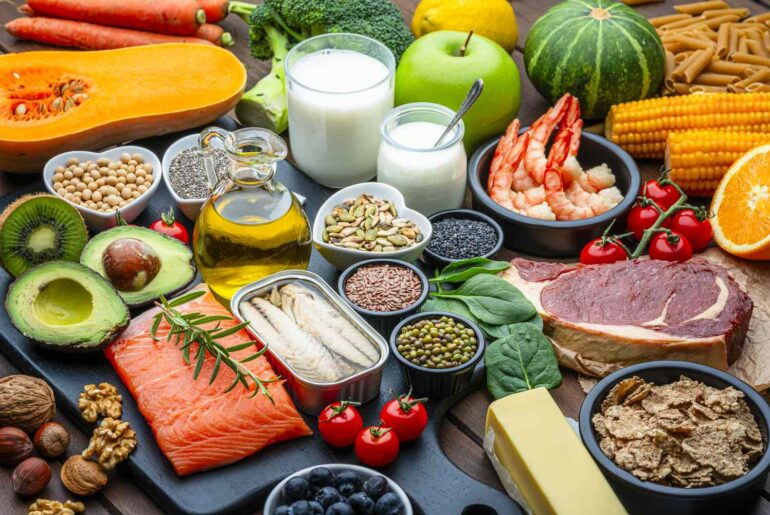
For years, the federal government advised Americans to limit red meat and foods high in saturated fats.
However, new federal dietary guidelines elevate protein, dairy and healthy fats to the top of a redesigned food pyramid — a shift that has drawn mixed reactions from nutrition experts.
The new food pyramid continues to emphasize fruits and vegetables and avoiding added sugar, but it also encourages Americans to cook with butter or beef tallow and increase their protein intake. The recommendations are now for adults to consume 1.2 to 1.6 grams of protein per kilogram of body weight, up from the previous guideline of 0.8 grams. Protein is recommended from both animal sources, such as red meat, and plant-based options.
Experts said the new guidelines’ emphasis on avoiding processed foods and added sugar are sound. But some worry that encouraging more fats will conflict with existing guidelines on limiting fat to 10% of one’s daily calories — and that some Americans may not need additional protein.
“These guidelines represent a significant shift, but they raise as many questions as they answer,” said Darin Detwiler, a food policy expert and assistant teaching professor at Northeastern University. “My concern is not the emphasis on ‘real food’ (over ultra-processed options). It’s how the scientific evidence and public health context were interpreted.”
“The message is simple: eat real food,” says the letter from U.S Department of Agriculture Secretary Brooke L. Rollins and U.S. Department of Health and Human Services Secretary Robert F. Kennedy Jr. “To Make America Healthy Again, we must return to the basics. American households must prioritize diets built on whole, nutrient-dense foods — protein, dairy, vegetables, fruits, healthy fats and whole grains. Paired with a dramatic reduction in highly processed foods laden with refined carbohydrates, added sugars, excess sodium, unhealthy fats, and chemical additives, this approach can change the health trajectory for so many Americans.”
They also continue to encourage Americans to avoid added sugar and processed food, saying that the United States “is in a health emergency” due to chronic disease from poor diet.
The new 10-page document is a dramatic reduction from the length of the previous guidelines, something that Jing-Ke Weng, a plant biochemist and professor of chemistry & chemical biology and bioengineering at Northeastern, said is an improvement.
“It’s a simplified version of things,” Weng said. “It has basically encouraged people to not have highly processed foods and reduce added sugar. There is some controversy to it — it’s encouraging saturated fats like tallow or butter — but it’s still under the cap of less than 10 percent of recommended consumption of daily calorie intake.”
Detwiler added that the continued focus on reducing added sugars and processed foods is also a positive. However, he expressed concerns about the updated protein guidelines, which he said may unnecessarily encourage people to consume food that is expensive and high in saturated fat.
“My understanding is that most Americans already meet basic protein needs,” Detwiler said. “There is limited evidence that higher protein improves health for the general population. For people who are strength training or trying to preserve muscle in older age, higher protein can be useful. But this should not be the default for everyone without nuance.”
Similarly, Detwiler said the guidance on encouraging the consumption of red meat and full-fat dairy, along with cooking with beef tallow and butter, is contradictory, given the suggested cap on saturated fats.
Research also shows saturated fats are linked to higher LDL cholesterol, which is a casual factor for cardiovascular disease, said Detwiler. This is not factored into the guidelines that he said could cause more long-term health consequences.
“Encouraging red meat and full-fat dairy without clear guidance on portion size or population risk profiles is not supported by the bulk of cardiovascular research,” he said. “Mixed messaging on saturated fat can lead consumers to misinterpret what constitutes a heart-healthy diet. In public health nutrition, clear evidence, consistency, and practical guidance matter.”
The new guidelines also note that people should eat what’s right for them, depending on factors like age and physical activity level.
Janice Maras, registered dietitian, director in the Dietary Assessment Center and associate teaching professor of public health and health sciences at Northeastern, emphasized this as well, saying people should focus more on getting vegetables, whole grains and adequate proteins while minimizing ultra-processed foods.
“My approach to dietary guidance emphasizes quality, variety, and personalization rather than focusing on a single graphic,” she said. “Protein and dairy are important but needs vary across life stages and individual health contexts — more is not always better. Protein should come from a variety of sources, including both animal and plant foods, and dairy choices can reasonably differ depending on age and growth or maintenance needs. Helping people understand food quality and read labels is more important than emphasizing one specific pyramid.”