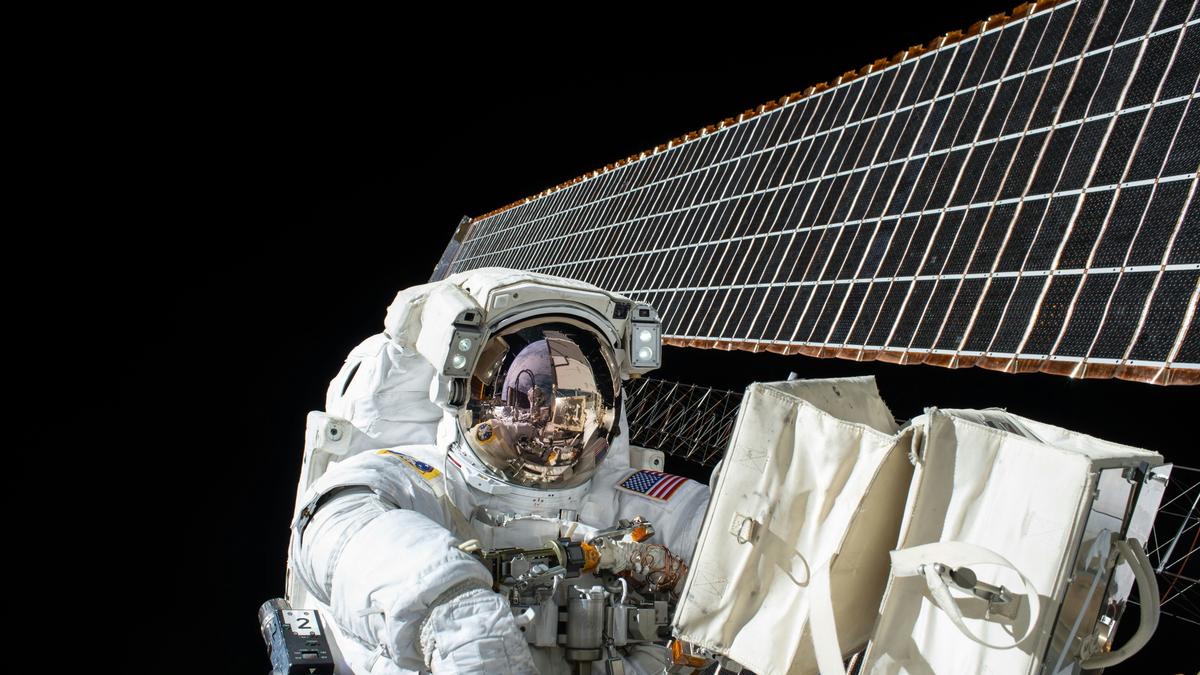

A new study has found that genes related to heart function, the nervous system, and the senses of vision and smell became overactive during spaceflight. Representative image of a NASA astronaut working outside the International Space Station.
| Photo Credit: NASA
As humans prepare for longer missions to the moon and eventually Mars, scientists need to understand exactly how spaceflight affects the human body. They already know the microgravity and radiation in space affect astronauts’ health.
To this end, a study published on January 2 in Science by researchers from Saudi Arabia examined human immune cells (THP-1 monocytes) that had been sent to the International Space Station. They found that the space environment significantly altered the cells’ gene expression, the instructions that tell cells how to behave.
Specifically, genes related to heart function, the nervous system, and the senses of vision and smell became overactive, which could explain astronaut health issues like heart risks and sleep trouble. On the other hand genes that repaired DNA and helped cells divide worked less effectively, signalling long-term risks.
The brain is a particularly important area of concern. Previous research has shown that without gravity, the brain tends to shift position inside the skull. However, these studies only looked at the average movement of the whole brain. Another study published on January 12 in Proceedings of the National Academy of Sciences by researchers from Germany and the US has examined changes in specific regions.
The researchers analysed MRI scans from 26 astronauts before and after missions and compared them to a control group of 24 participants in a head-down tilt bed rest study. Here, people lie in bed with their heads slightly lower than their feet for 60 days to mimic the effects of weightlessness.
This way, the study found that during spaceflight, different parts of the brain (reversibly) move and deform in different ways. Those that handle movement and sensation shifted the most. In astronauts who spent a year in space, the supplementary motor cortex moved 2.52 mm up. The researchers also found that the more the posterior insula shifted, the worse the astronauts performed on balance tests when they returned, although the ‘why’ remains unclear.
The scientists also identified the limited sample size, inability to capture changes within specific brain regions, crew members being tested at different times post-mission, and the incomplete ability of the tilt test to mimic the effects of gravity on the brain as limitations of their effort.
Nonetheless, “Our approach provides state-of-the-art regional brain deformation and position shift maps induced by varying duration exposures to microgravity,” the team wrote in its paper.
Published – January 14, 2026 08:00 am IST