Fitness Equipment Market
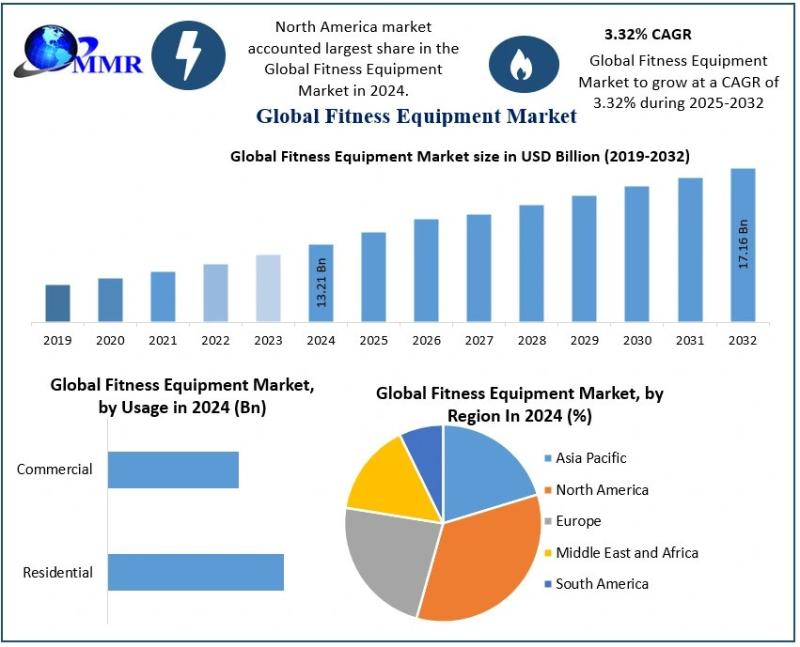
Fitness Equipment Market size was valued at USD 13.21 Billion in 2024 and the total Fitness Equipment revenue is expected to grow at a CAGR of 3.32% from 2025 to 2032, reaching nearly USD 17.16 Billion.
The global fitness equipment market is currently navigating a dynamic hybrid phase, driven by a permanent structural shift in how consumers approach physical well-being. While the commercial sector-comprising health clubs, gyms, and hotels-is experiencing a strong post-pandemic recovery, the “home gym” segment has matured from a temporary trend into a sustained revenue pillar. Consumers are increasingly demanding professional-grade versatility within the confines of residential spaces, prompting manufacturers to engineer equipment that balances robust durability with compact, aesthetically pleasing designs. This evolution is further supported by the rising popularity of functional training, which has expanded the market inventory beyond traditional heavy machinery to include versatile tools like kettlebells, resistance bands, and suspension trainers, catering to a demographic focused on mobility and holistic health rather than just muscle mass.
On the technological front, the market is undergoing a radical digitalization where hardware is becoming secondary to the software experience it delivers. The modern fitness consumer expects a “connected ecosystem,” leading to a surge in smart equipment embedded with IoT (Internet of Things) sensors and AI-driven coaching interfaces. These innovations allow for real-time performance analytics, virtual community competition, and immersive workout environments, effectively blurring the lines between physical exertion and digital entertainment. Furthermore, a growing undercurrent of sustainability is beginning to reshape manufacturing standards; leading brands are increasingly exploring eco-friendly materials and self-powered machines that generate electricity, positioning environmental responsibility as a key differentiator in a crowded and highly competitive landscape.
Get a sample of the report @ https://www.maximizemarketresearch.com/request-sample/29892/
Fitness Equipment Market analysis:
The primary objective of this report is to conduct a comprehensive structural analysis of the global Fitness Equipment Market, accurately quantifying the post-pandemic valuation and projecting revenue trajectories through 2032. The research aims to dissect the bifurcated growth dynamics between the commercial segment-driven by the revitalization of health clubs and hospitality wellness-and the rapidly maturing home fitness sector, specifically evaluating the demand elasticity for smart, connected devices versus traditional weight management hardware. A critical focus is placed on mapping the competitive landscape by identifying strategic consolidations, assessing the impact of supply chain volatility on manufacturing costs, and benchmarking the R&D investments of key industry leaders. Furthermore, the study intends to scrutinize regional growth pockets, particularly the rising adoption in Asia-Pacific markets, while analyzing how sustainability mandates and the integration of AI-driven virtual coaching are redefining consumer purchasing behaviors and long-term brand loyalty.
Fitness Equipment Market Major companies profiled in the market report include:
1.ICON Health & Fitness, Inc.
2. Brunswick Corporation
3. Johnson Health Tech Co. Ltd.
4. TechnogymS.p.A.
5. Amer Sports Corporation
6. Nautilus, Inc.
7. Core Health and Fitness, LLC
8. TRUE Fitness Technology, Inc.
9. Impulse (Qingdao) Health Tech Co. Ltd.
10. Torque Fitness, LLC.
11. Star Trac Health and Fitness Inc.
12. Body-Solid Inc.
13. Yowza fitness
14. Precor Incorporated
15. Paramount Fitness Corp.
16 NordikTrack Inc.
17. Cybex International Inc.
18. Body by Jake Global LLC
19. Nautilus Inc.
20. Fitness EM
21. Motus
22. Technogym
23. Seca GmbH
24. Omron Healthcare, Inc.
Fitness Equipment Market Research objectives:
The central objective of this research is to execute a rigorous evaluation of the global Fitness Equipment Market, providing a detailed quantification of market size and a strategic forecast of revenue potential through 2032. The study aims to deconstruct the evolving “hybrid fitness” economy, analyzing the cross-channel dynamics between the recovering commercial sector (gyms, health clubs) and the technologically advancing home fitness segment. A primary focus is placed on benchmarking the impact of digital transformation, specifically investigating how the integration of IoT sensors, AI-driven personalization, and immersive virtual environments is redefining hardware value propositions and pricing power. Furthermore, this report seeks to map the competitive landscape by scrutinizing the consolidation strategies of major OEMs, evaluating the resilience of global supply chains against raw material volatility, and identifying high-growth opportunities within emerging markets where urbanization and rising disposable incomes are driving preventative healthcare adoption.
Get access to the full description of the report @ https://www.maximizemarketresearch.com/market-report/global-fitness-equipment-market/29892/
Key Objectives of the Fitness Equipment Market Report:
The primary goal of this research is to move beyond static market sizing to provide a dynamic analysis of the “connected fitness” ecosystem, specifically evaluating the transition from one-time hardware sales to recurring subscription-based revenue models. The study aims to rigorously assess the long-term viability of this “hardware-as-a-service” shift, quantifying how proprietary software ecosystems are influencing brand loyalty and creating high barriers to entry for new competitors. A critical objective is to analyze the convergence of fitness equipment with the broader healthcare sector, investigating the emerging potential for medical reimbursement of smart rehabilitation devices and the integration of these tools into corporate preventative health insurance plans. Furthermore, the report seeks to identify “white space” opportunities within the supply chain, particularly looking at the diversification of manufacturing hubs outside of East Asia to mitigate geopolitical risks, while simultaneously forecasting the impact of next-generation immersive technologies (VR/AR) on the obsolescence cycles of traditional cardiovascular machinery.
Explore More Related Report @
ERP Software Market https://www.maximizemarketresearch.com/market-report/global-erp-software-market/61246/
Sports Technology Market https://www.maximizemarketresearch.com/market-report/global-sports-technology-market/29807/
Virtual Office Market https://www.maximizemarketresearch.com/market-report/global-virtual-office-market/113811/
Independent Software Vendors (ISVs) Market https://www.maximizemarketresearch.com/market-report/independent-software-vendors-isvs-market/147006/
India Industrial IoT Market https://www.maximizemarketresearch.com/market-report/india-industrial-iot-market/20804/
Thank you for reading the report. The report can be customized as per the requirements of the clients. For further information or query about customization, please reach out to us, and we will offer you the report best suited for your needs.
Contact Maximize Market Research:
3rd Floor, Navale IT Park, Phase 2
Pune Bangalore Highway, Narhe,
Pune, Maharashtra 411041, India
sales@maximizemarketresearch.com
+91 96071 95908, +91 9607365656
Maximize Market Research is a multifaceted market research and consulting company with professionals from several industries. Some of the industries we cover include medical devices, pharmaceutical manufacturers, science and engineering, electronic components, industrial equipment, technology and communication, cars and automobiles, chemical products and substances, general merchandise, beverages, personal care, and automated systems. To mention a few, we provide market-verified industry estimations, technical trend analysis, crucial market research, strategic advice, competition analysis, production and demand analysis, and client impact studies.
This release was published on openPR.